
Contents
- Noise When Turning Steering Wheel While Stationary: Causes, Diagnosis, and Fixes
- Why Does the Steering Wheel Make Noise When the Car Is Stationary?
- Different Steering Noises and What They Usually Mean
- Noise Type vs Likely Cause vs Seriousness
- Most Common Causes of Noise When Turning While Parked
- Low Power Steering Fluid
- Power Steering Fluid Leak
- Air in the System or Contaminated Fluid
- Failing Power Steering Pump
- Loose or Worn Serpentine Belt
- Steering Rack or Gearbox Issues
- Worn Tie Rod Ends
- Ball Joints (Dry or Worn)
- Control Arm Bushings
- Jounce Bushing (Less Common)
- Steering Column Bearing
- Clogged Power Steering Reservoir
- Hydraulic vs Electric Power Steering: Does the Cause Change?
- Symptoms That Mean the Problem Is Getting Worse
- Is It Safe to Drive With Steering Noise?
- How to Diagnose the Noise at Home
- Fixes Based on the Cause
- Repair Costs You Can Expect
- How to Prevent Steering Noise in the Future
- Faqs
Noise When Turning Steering Wheel While Stationary: Causes, Diagnosis, and Fixes
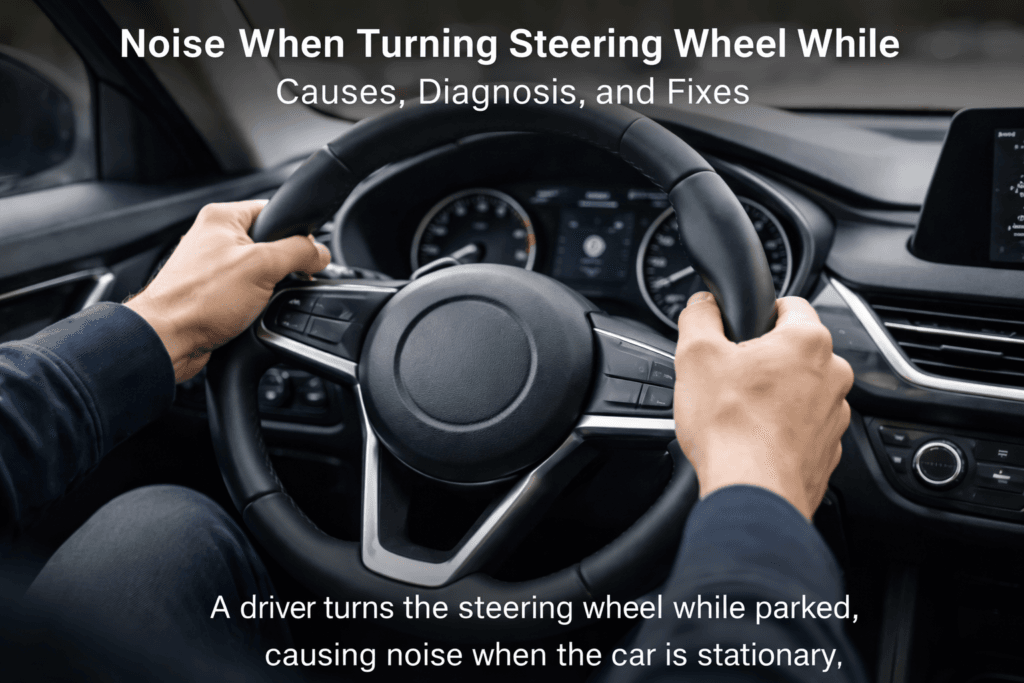
If your steering wheel starts making noise while you are turning it and the car is just sitting there… most of the time, it comes down to power steering fluid. Either it is low, leaking somewhere quietly, or just old enough to stop doing its job properly.
That said, it is not always that simple. Sometimes the pump is getting weak, sometimes suspension parts like tie rods or bushings are worn out, or maybe the belt is slipping a bit. And yeah, in some cases, the steering rack itself starts acting up.
You can drive short distances if everything still feels normal. But honestly, if the steering begins to feel heavy or the noise gets louder over time… that is your sign. Do not ignore it.
Why Does the Steering Wheel Make Noise When the Car Is Stationary?
This confuses a lot of people. It feels strange, right?
You turn the wheel while parked → noise.
You move the car a little → silence.
So what changed?
Well… when the car is not moving, the tires are basically stuck to the ground. No rolling, no easing into the turn. Just resistance. A lot of it. That means the steering system has to work harder than usual.
And when extra load kicks in, weak components start showing their true condition.
- A pump that was barely okay suddenly sounds tired
- Fluid that should be smooth starts acting rough
- Bushings that were slightly worn begin to complain
Once the car moves, resistance drops. Everything feels easier again. But—and this is important—the problem did not disappear. It just went quiet for a bit.
Different Steering Noises and What They Usually Mean
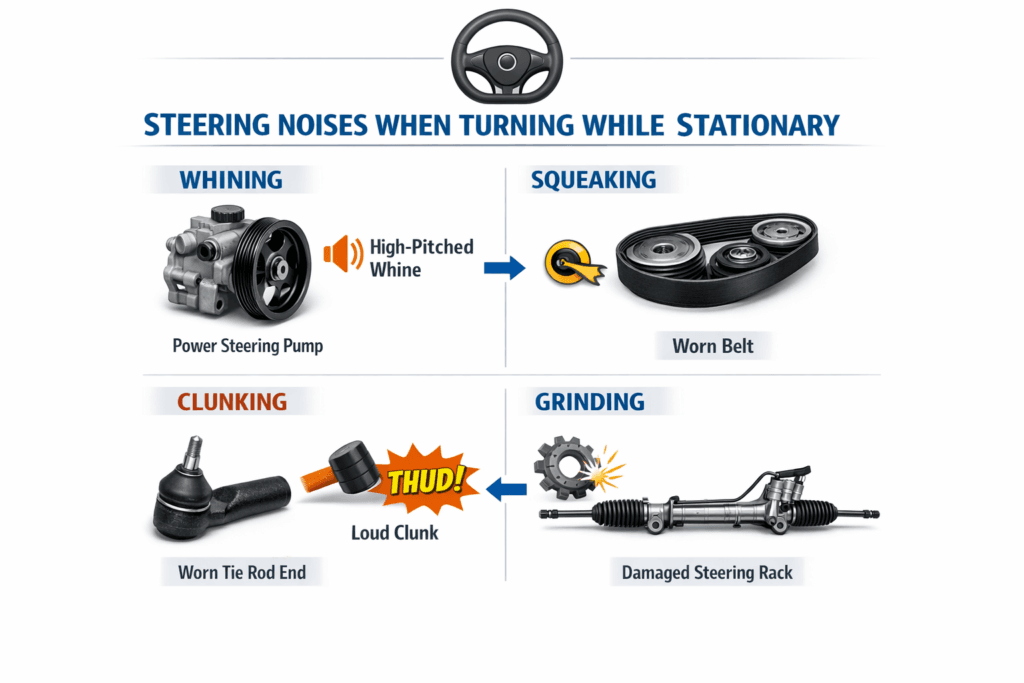
Each type of steering noise gives a clue about what is wrong inside the system.Not all noises are equal. Some are mild warnings. Others… well, they are more like early alarms.
Whining Noise
That high-pitched sound. Almost like something is under stress.
Most likely causes:
- Low power steering fluid
- Air trapped inside the system
- A pump that is slowly giving up
What is really happening here? The pump cannot maintain proper pressure, so it starts making that whining sound when you turn.
You might also notice the steering feeling a bit heavier. And yeah, the noise usually gets worse the more you turn.
Not something to delay for too long.Some sounds may also be confused with noise when braking at low speed.
Squeaking or Squealing Noise
This one sounds… rubbery. Like something slipping.
Could be:
- Loose or worn serpentine belt
- Dry bushings
- Early-stage fluid issue
Basically, friction is not being handled properly. Either the belt is slipping or components are not lubricated enough.
You might hear it more when starting the car. Sometimes it fades after driving a bit. Still, ignoring it is how small problems become annoying ones.
Clunking or Knocking Noise
This one feels different. Heavier. You might even feel it through the steering wheel.
Common causes:
- Worn tie rod ends
- Loose steering components
- Suspension wear
What is going on? Something is moving that should not be moving.
Loose parts shift under load and create that clunk sound. If you are hearing this, it is not early-stage anymore.
In some cases, this overlaps with situations where the steering wheel shakes when turning.
Grinding or Rubbing Noise
Yeah… this one is not pleasant.
Rough. Uncomfortable. You feel it and hear it.
Usually linked to:
- Contaminated power steering fluid
- Steering rack damage
- Steering column bearing wear
- Even plastic parts rubbing inside
This is internal friction. Something is wearing down where it should not.
If you hear grinding, do not “wait and see.” Seriously.
Noise Type vs Likely Cause vs Seriousness
| Noise Type | Likely Causes | Seriousness |
|---|---|---|
| Whining | Low fluid, air in system, failing pump | Medium → High |
| Squeaking / Squealing | Belt wear, dry bushings, low fluid | Low → Medium |
| Clunking / Knocking | Tie rods, suspension wear, loose parts | High |
| Grinding / Rubbing | Rack damage, contaminated fluid, bearings | High |
Most Common Causes of Noise When Turning While Parked
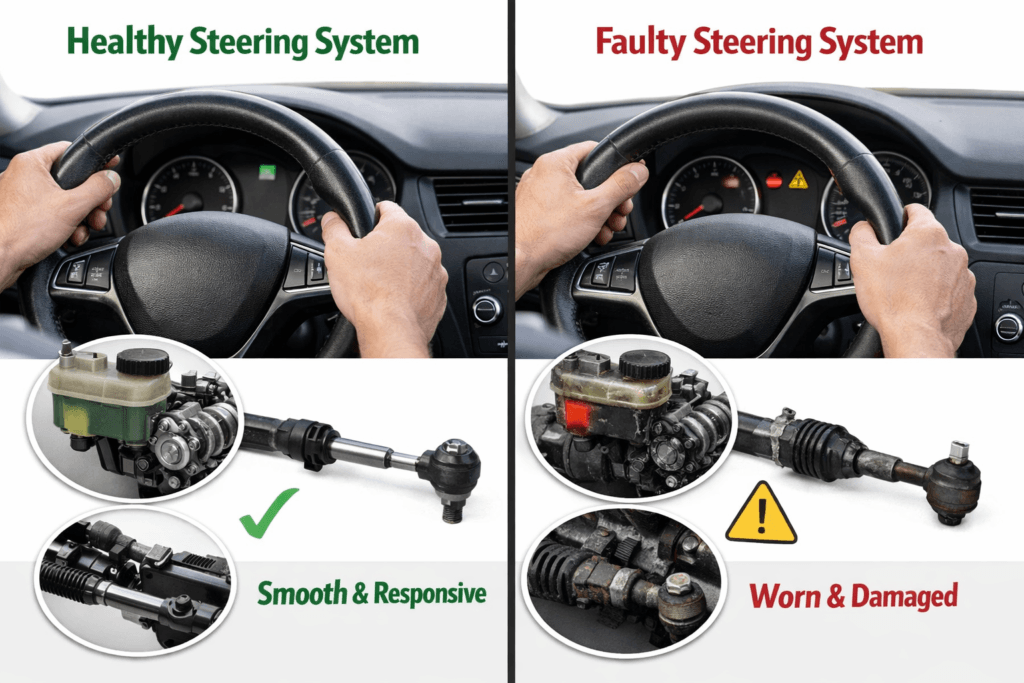
Alright, now we get into the actual parts. The real reasons behind the sound.
Low Power Steering Fluid
This is the big one.
When fluid drops, pressure drops. The system struggles. Noise starts.
You will usually hear whining or groaning. Steering might feel heavier too.
Not the worst problem—but definitely not something to ignore for weeks.
Power Steering Fluid Leak
If fluid keeps disappearing… it is leaking. Somewhere.
Could be hoses, seals, pump, even the rack. Sometimes you see it on the ground. Sometimes you do not.
The system loses pressure and pulls in air. That is where noise begins.
Air in the System or Contaminated Fluid
Air bubbles mess with flow. Dirty fluid loses lubrication.
You might hear whining or even rough grinding. Fluid might look dark or foamy and smell burnt.
It is not catastrophic immediately—but it will get worse if left alone.
Failing Power Steering Pump
The pump does most of the work. When it starts wearing out, it struggles under load.
Noise gets louder. Steering feels inconsistent.
At this point… yeah, replacement is usually the fix.
Loose or Worn Serpentine Belt
If the belt slips, the pump cannot work properly.
That is where the squealing comes from. Especially during startup.
Sometimes it is just loose. Sometimes it is worn out.
Steering Rack or Gearbox Issues
This is where things get expensive.
Inside the rack, components wear out over time. That creates friction and play.
You may hear grinding or knocking. Steering might feel off. Not smooth.
Worn Tie Rod Ends
Tie rods connect your steering to the wheels.
When they wear out, things start moving loosely. That creates clunking sounds.
You might also notice uneven tire wear or steering play.
Ball Joints (Dry or Worn)
Ball joints need lubrication to move smoothly.
When that lubrication is gone, friction increases. Noise follows.
Usually creaking or clunking. Sometimes both.
Control Arm Bushings
These absorb movement.
When they wear out, extra movement starts happening. That leads to vibration and noise.
Jounce Bushing (Less Common)
Small part. Easy to miss.
When dry, it can create light squeaking during slow turns.
Steering Column Bearing
Located inside the steering column.
When worn, it creates rubbing or grinding near the wheel area itself. Feels close. Hard to ignore.
Clogged Power Steering Reservoir
Not very common, but it happens.
Fluid flow gets restricted. Pressure builds unevenly. Noise follows.
Hydraulic vs Electric Power Steering: Does the Cause Change?
Short answer… yes.
Hydraulic systems rely on fluid, pump, belt. So most noise comes from those.
Electric Power Steering (EPS) is different. No fluid doing the work.
So if noise appears in EPS systems, it is usually:
- Motor-related
- Steering gear issue
- Bearing wear
- Suspension components
Important difference. A lot of newer cars will not even have fluid problems.
Symptoms That Mean the Problem Is Getting Worse
Some signs you should not brush off:
- Steering feels heavier
- Wheel does not return smoothly
- Vibration while turning
- Fluid looks dark or burnt
- Visible leaks
- Noise getting louder
If multiple signs show up together… yeah, the problem is progressing.
Vibration during turning can also be linked to steering wheel shaking while driving.
Is It Safe to Drive With Steering Noise?
When It May Be Less Urgent
- Light squeak only
- No change in steering feel
- No visible leaks
- Noise stable
You can drive short distances. But still… check it soon.
When It Is Risky
- Steering feels heavier
- Noise getting louder
- Happens more often
Driving becomes less predictable.
When to Stop Driving Immediately
- Grinding or loud clunking
- Steering becomes hard
- Visible leak
- Loss of control or vibration
At that point… do not push it. Not worth it.
How to Diagnose the Noise at Home
You do not always need a mechanic right away. Start simple.
Step 1: Identify the Sound
Whine. Squeal. Clunk. Grind. Each tells a different story.
Step 2: Check When It Happens
Only parked? Or also moving?
Step 3: Check Direction
Left turn. Right turn. Same or different?
Step 4: Cold vs Warm
Worse when cold? Likely fluid issue.
Worse when hot? Could be wear.
Step 5: Steering Angle
Only at full lock? Or even small turns?
Step 6: Engine On vs Off
Engine on → hydraulic system likely
Engine off → mechanical components
Step 7: Inspect Fluid
Look at level, color, bubbles, smell.
Step 8: Look for Leaks
Check under the car, hoses, pump area.
Step 9: Inspect Belt
Cracks. Looseness. Shine.
Step 10: Check Suspension
Tie rods, ball joints, bushings, struts.
If something moves more than it should… there is your clue.
Fixes Based on the Cause
- Top off or replace fluid
- Fix leaks first
- Bleed air from system
- Replace pump
- Replace worn belt
- Replace tie rods
- Repair steering rack
- Replace bushings or joints
Fix the cause. Not just the symptom.
Repair Costs You Can Expect
Cheap Fixes
- Fluid service: $20 – $150
- Belt replacement: $50 – $200
Moderate Repairs
- Tie rod: $200 – $400
- Ball joint: $250 – $500
- Bushings: $150 – $400
Expensive Repairs
- Pump: $700 – $900
- Steering rack: $2000 – $2500
Prices vary. Car model, labor, damage… sab depend karta hai.
How to Prevent Steering Noise in the Future
- Check fluid regularly
- Fix leaks early
- Avoid full lock holding
- Maintain tire pressure
- Inspect belts
- Do not ignore small sounds
Small noises rarely stay small.
Faqs
Why does my steering wheel make noise only when parked?
Because the system is under maximum load, weak components show their problems.
Can low tire pressure cause noise?
Yes. More resistance means more strain.
Can I keep driving if it feels normal?
Short term, maybe. But early check saves money.
Does electric steering make same noise?
No. EPS issues are usually motor or mechanical.
Why worse in hot or cold?
Fluid and materials react to temperature changes.
Is clicking always tie rod?
Not always. Could be joints, bushings or column parts.