
Contents
- Oil in Coolant Reservoir: Causes, Symptoms, Diagnosis, and Fixes
- Quick Answer
- Why Oil in Coolant Is Not a Small Thing
- What Oil in Coolant Reservoir Actually Looks Like
- Symptoms That Usually Come Along With It
- Main Causes (And What Actually Happens)
- Head Gasket vs Oil Cooler vs Transmission Cooler(table)
- Quick Comparison (Simplified)
- Oil in Coolant But Oil Looks Clean
- No Overheating Yet… So Safe?
- Driving With Oil in Coolant? Not a Great Idea
- How Proper Diagnosis Works
- Real-Life Situations That Help
- Fixing the Problem
- Cost Reality (Rough Idea)
- Stop-Leak Solutions?
- Preventing It
- Final Thought
Oil in Coolant Reservoir: Causes, Symptoms, Diagnosis, and Fixes
It is a weird feeling. You pop the hood, take a quick look at the coolant reservoir, and something just feels… off. Maybe the color looks wrong. Maybe there is a greasy layer floating on top. And suddenly your brain jumps to worst-case scenarios. Honestly, that reaction is not wrong.
Oil and coolant are not supposed to meet. Ever. They live separate lives inside the engine, doing completely different jobs. When they start mixing, it usually means something somewhere inside has gone bad. Could be a blown head gasket. Could be an oil cooler acting up. Or, in those unlucky situations, something more serious like a cracked head or even the engine block itself.
Now, some people convince themselves it is just old coolant sitting there, maybe a bit dirty. That happens, sure. But not often enough to bet on it. If the coolant looks milky, brownish, sludgy, or has that thin oily shine on top, there is usually more going on beneath the surface. And leaving it like that? Yeah… that tends to snowball into overheating, poor lubrication, clogged passages, rough engine behavior, and a repair bill that no one enjoys seeing.You should know about why car overheats at idle and how to fix it.
Quick Answer
If you notice oil in the coolant reservoir, the usual suspects are:
- blown head gasket
- faulty oil cooler
- cracked cylinder head
- cracked engine block
- transmission cooler leak inside the radiator
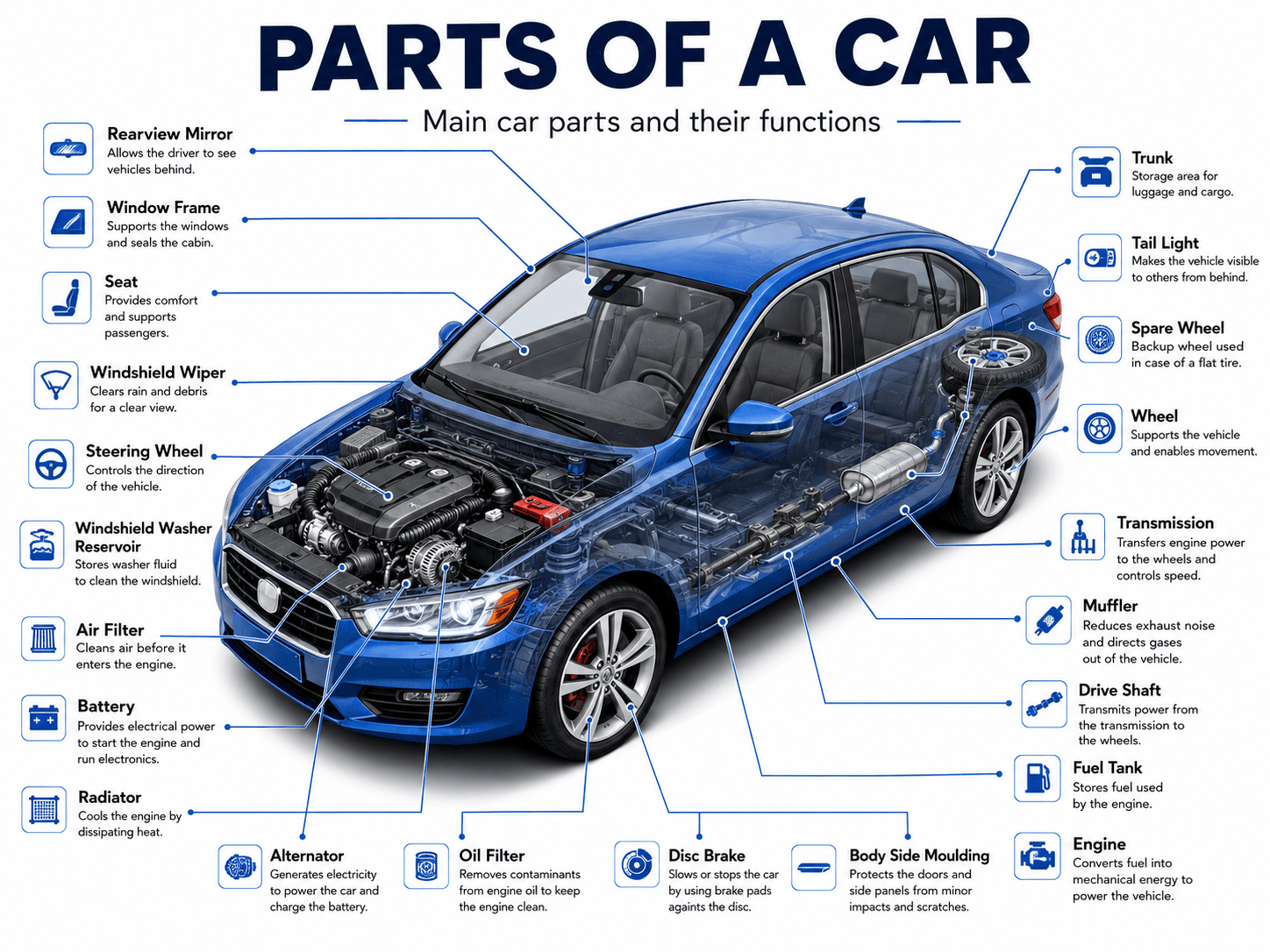
And no, it is not something to ignore. Oil mixing with coolant almost always points to an internal issue that needs proper checking before you keep driving like nothing happened.Some times the bubble appear in coolant and people get panicked bout if it is safe or not to drive.
Why Oil in Coolant Is Not a Small Thing
Think of it this way.
Engine oil is there to keep metal parts sliding smoothly, reducing wear and heat from friction. Coolant, on the other hand, manages temperature so the engine does not cook itself alive. Two completely different roles.
So when they mix, both systems kind of fail at the same time. Not instantly, but gradually… then suddenly.
Coolant stops transferring heat properly. Oil loses some of its protective quality. Sticky residue starts building up in places where it should not. Hoses, passages, even the radiator can get affected. And if coolant sneaks into the oil system too, then internal wear begins quietly, almost invisibly.
It is like the engine is fighting two problems instead of one. Not ideal.
What Oil in Coolant Reservoir Actually Looks Like
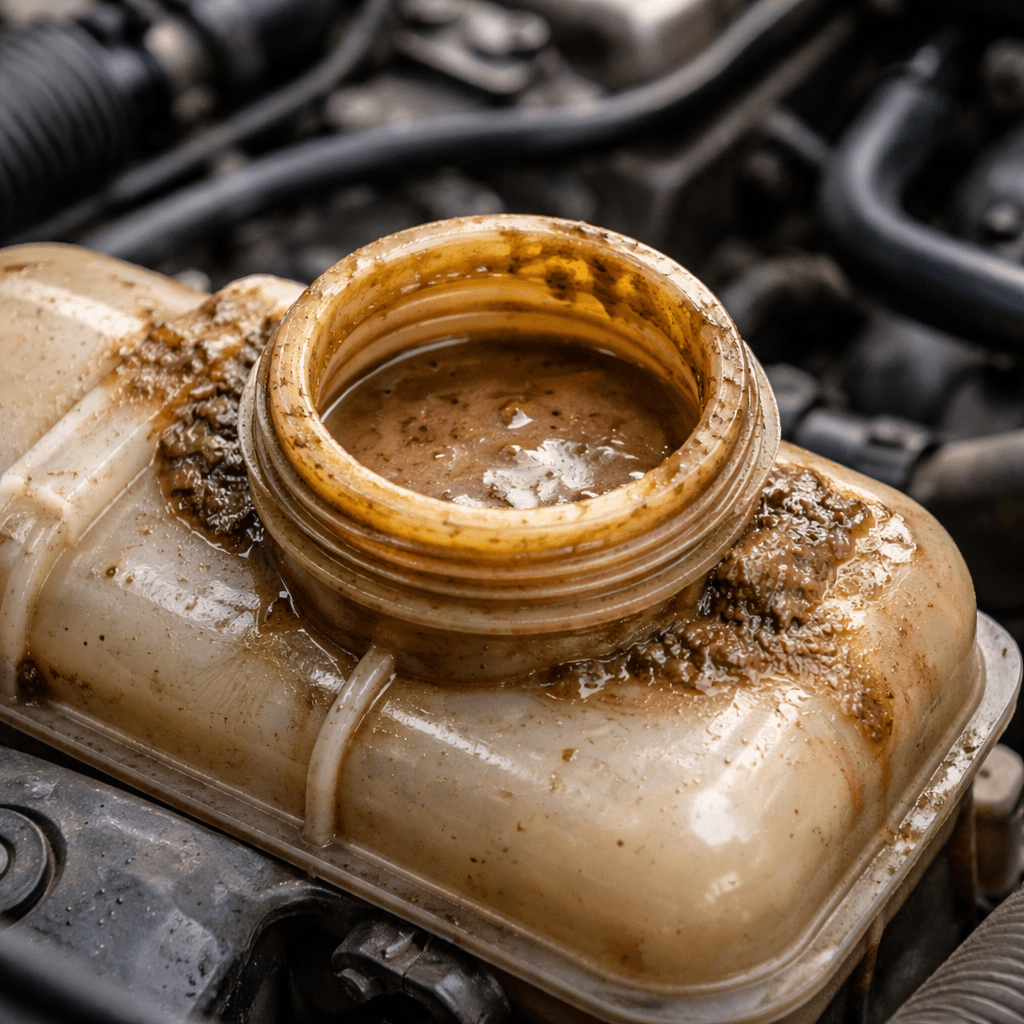
People expect something obvious. A thick black oil layer floating cleanly on top. Reality is rarely that neat.
More often, you will see:
- a brown or milky sludge — kind of like badly mixed coffee
- a thin oily film with a rainbow effect
- coolant that looks muddy or heavier than usual
- sticky residue around the reservoir cap
- sometimes a pinkish or reddish tint (that is usually transmission fluid, by the way)
And here is something that throws people off — sometimes only the reservoir looks dirty while the rest of the system still seems okay. That can trick you into waiting. Not the best idea, honestly.
Symptoms That Usually Come Along With It
The reservoir is just the clue. The engine usually drops more hints.
Brown Sludge or Milky Coolant
That is often the first thing you notice. It does not look clean anymore. Something is clearly mixed in.
Engine Overheating
When coolant gets contaminated, it does not cool as well. Simple as that.
White Smoke From Exhaust
If coolant starts burning inside the engine, you will see white smoke, sometimes with a slightly sweet smell.
Rough Idle or Misfire
Combustion gets messy. The engine feels uneven, maybe shaky.
Coolant Disappearing
No puddle under the car, but coolant keeps dropping. That usually means internal leak.
Milky Oil on Dipstick
If coolant enters oil, the dipstick can look like a milkshake. Not a good sign.
Oil Level Rising
Strange one, but it happens. Coolant entering oil can push the level up.
Main Causes (And What Actually Happens)
Blown Head Gasket
This is the usual suspect. The head gasket keeps oil, coolant, and combustion gases separated. When it fails, everything starts crossing paths.
You might see overheating, white smoke, rough running — all mixed together.
And here is the thing most articles skip: it usually fails because something else was ignored. Overheating, poor maintenance, warped surfaces. It rarely just happens out of nowhere.
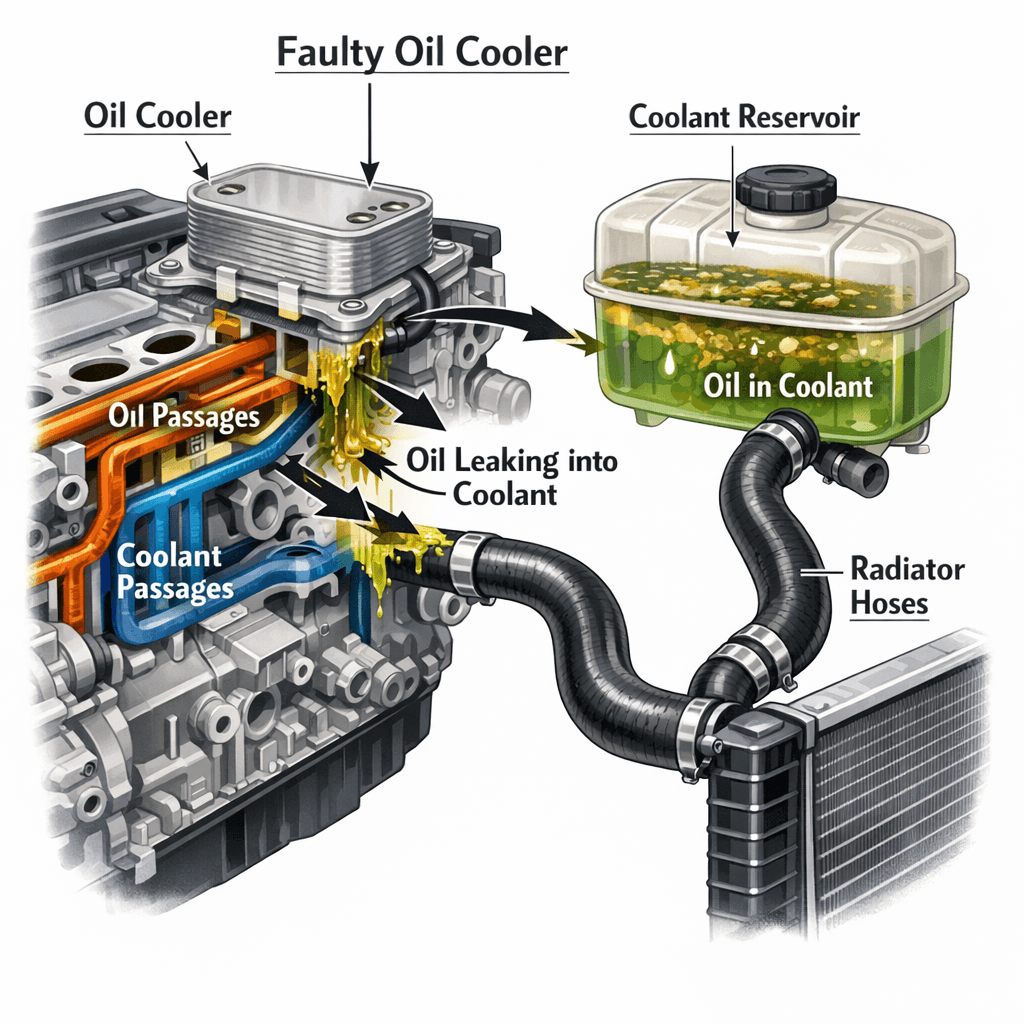
Faulty Oil Cooler
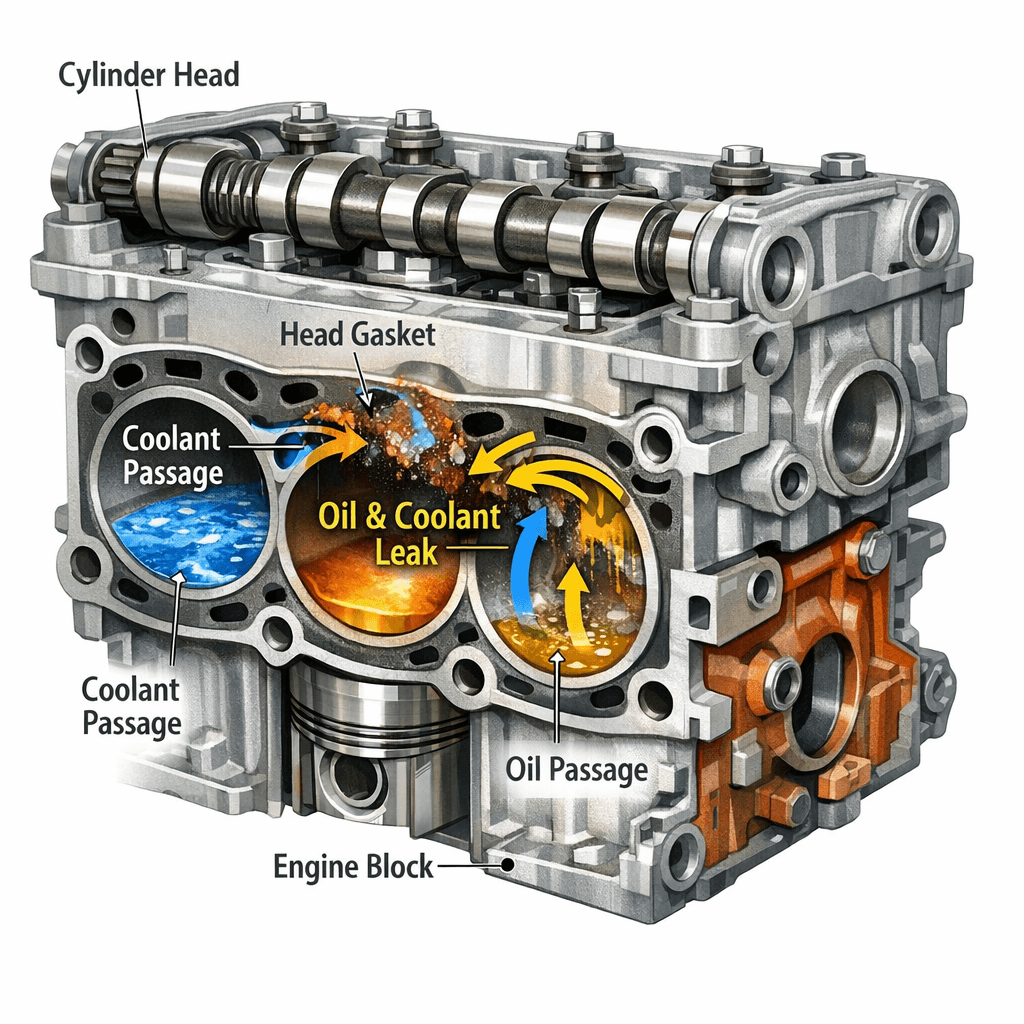
This one catches people off guard.
In some engines, oil and coolant pass close to each other inside an oil cooler. If that unit cracks internally, oil gets pushed into coolant because of pressure differences.
No smoke. Engine may feel fine. Just contamination.
And yeah, people often replace the head gasket for this… and then realize later it was never the problem.
Transmission Cooler Leak
A bit sneaky, this one.
Many cars have the transmission cooler inside the radiator. If it leaks, transmission fluid mixes with coolant.
It looks oily, but technically it is not engine oil.
Usually you will see:
- pink or reddish fluid
- maybe shifting issues
- engine behaving mostly normal
Misdiagnose this, and you waste both time and money.
Cracked Cylinder Head
Overheating can crack the cylinder head. Symptoms feel almost identical to a bad head gasket.
Which makes diagnosis… tricky. You really need proper testing here.
Cracked Engine Block
Worst case. Not common, but it happens.
Usually after severe overheating or freezing conditions. And honestly, when this happens, repairs can get very expensive very quickly. Sometimes replacing the engine just makes more sense.
Failed Seals or Gaskets
Some engines have specific weak points — seals, housings, or gasket areas where oil and coolant run close.
When those fail, fluids start mixing without the usual dramatic symptoms.
Head Gasket vs Oil Cooler vs Transmission Cooler(table)
| Symptom | Likely Cause | Reason |
|---|---|---|
| White smoke + overheating | Blown head gasket | Coolant combustion is going into chamber |
| Oily coolant but engine normal | Oil cooler failure | Internal leak without combustion issue |
| Pink/red fluid in coolant | Transmission cooler leak | ATF contamination |
| Milky oil + coolant loss | Head gasket / cracked head | Two-way mixing |
| No overheating, only contamination | Oil cooler / early leak | Pressure difference |
Quick Comparison (Simplified)
White smoke + overheating → likely head gasket
Oily coolant but engine feels okay → oil cooler
Pink fluid in coolant → transmission cooler
Milky oil + coolant loss → internal leak
No overheating yet → early-stage issue
Oil in Coolant But Oil Looks Clean
This confuses people.
If coolant looks bad but oil still looks fine, it often means:
- oil cooler problem
- early head gasket issue
- transmission cooler leak
Just because oil looks normal does not mean everything is okay.
No Overheating Yet… So Safe?
Short answer: no.
Sometimes contamination starts before temperature problems show up. Waiting for overheating is basically waiting for things to get worse.
Driving With Oil in Coolant? Not a Great Idea
Could you drive a little? Maybe. In real life, people do.
Should you keep driving normally? No.
Because:
- cooling efficiency drops
- engine can overheat
- sludge builds up
- damage spreads
And then you are not fixing a small issue anymore.
How Proper Diagnosis Works
This is where guessing gets expensive.
Start simple:
Check reservoir
Check dipstick
Look at exhaust
Then move to proper tests:
- pressure test
- compression test
- block test
- oil cooler inspection
- transmission cooler check
Each step tells part of the story.
Real-Life Situations That Help
Reservoir dirty, oil clean → likely oil cooler
Smoke + overheating → head gasket
Pink coolant + shifting issue → transmission cooler
Milky oil + rough engine → serious internal problem
Patterns matter.
Fixing the Problem
First step? Identify the cause. No guessing.
Then repair:
- head gasket replacement
- oil cooler replacement
- radiator replacement
- cylinder head repair
- engine replacement (worst case)
After that, full system flush. And not a lazy one. Oil sticks everywhere.
Cost Reality (Rough Idea)
Oil cooler → relatively cheaper
Radiator / cooler → moderate
Head gasket → expensive
Cylinder head → very expensive
Engine replacement → yeah… painful
Prices vary, but the pattern stays the same.
Stop-Leak Solutions?
People try them. Understandable.
But honestly, they are temporary at best. Sometimes they mask small leaks, but they do not fix real internal failures. Usually just delay the inevitable.
Preventing It
You cannot prevent everything, but you can reduce risk:
Fix overheating early
Use correct coolant
Do not ignore warning signs
Check fluids regularly
Stop driving when something feels off
Most major failures start small. Then get ignored.
Final Thought
Oil in the coolant reservoir is not just a cosmetic issue. It is usually the engine telling you something is wrong internally.
Could be minor. Could be serious.
But the smart move is always the same:
check it, confirm it, fix it.
Because waiting rarely makes it better.Although you must need to be aware of parts of car.