
Contents
- Blown Head Gasket Symptoms: 9 Warning Signs Before It Ruins Your Engine
- Quick Answer:
- Why a Blown Head Gasket Is Such a Serious Problem
- 9 Blown Head Gasket Symptoms You Should Never Ignore
- 1. Engine Overheating Again and Again
- 2. Thick White Smoke from the Exhaust
- 3. Coolant Disappearing with No Visible Leak
- 4. Milky Oil or Creamy Sludge Under the Oil Cap
- 5. Bubbling in the Radiator or Coolant Reservoir
- 6. Rough Idle and Misfire
- 7. Loss of Power
- 8. Check Engine Light
- 9. External Oil or Coolant Leak Near the Head
- Early vs Late Blown Head Gasket Symptoms
- Most Dangerous Blown Head Gasket Symptoms
- Blown Head Gasket vs Other Problems
- How to Confirm a Blown Head Gasket
- Real Mechanic Approach: Where to Start First
- Can You Drive with a Blown Head Gasket?
- Repair Cost of a Blown Head Gasket
- What Causes a Head Gasket to Blow?
- What To Do Right Now If You Suspect a Blown Head Gasket
- FAQs
- Final Thoughts
Blown Head Gasket Symptoms: 9 Warning Signs Before It Ruins Your Engine
Quick Answer:
The most common blown head gasket symptoms are engine overheating, thick white smoke from the exhaust, coolant loss with no visible leak, milky oil, rough running, misfires, bubbling in the coolant reservoir, loss of power, and a check engine light.
If your car is showing two or more of these signs at the same time, there is a strong chance the head gasket is failing. And once that starts, the problem usually does not stay small for long.
Why a Blown Head Gasket Is Such a Serious Problem
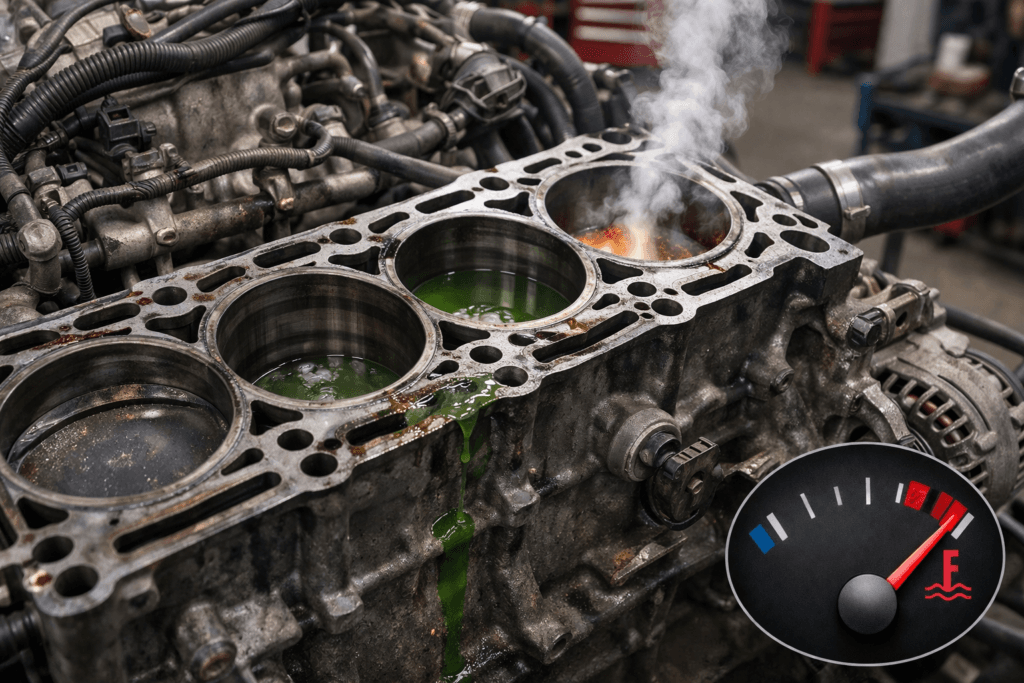
A head gasket sits between the engine block and the cylinder head. It has one of the most important sealing jobs in the engine. It keeps combustion pressure, coolant, and engine oil in their proper paths.
When that seal fails, everything starts going wrong at once.
Coolant can leak into the cylinders. Oil and coolant can mix. Compression can escape. The engine can run rough, overheat, lose power, and in more serious cases, suffer heavy internal damage.
That is what makes this issue so expensive. At first, it may look like a simple coolant problem. Some drivers only notice a small drop in coolant level or a little bit of white smoke. But if the problem keeps building, the engine can overheat badly enough to warp the cylinder head or damage other internal parts.
That is why a blown head gasket should never be treated like a minor issue.
9 Blown Head Gasket Symptoms You Should Never Ignore
1. Engine Overheating Again and Again
One of the biggest warning signs is repeated overheating.
If the temperature gauge keeps rising, or the car overheats even after adding coolant, something serious may be happening, often linked to deeper issues like engine overheating causes.
A bad head gasket can let combustion gases enter the cooling system or allow coolant to leak internally. Once that happens, the cooling system cannot control engine temperature properly.
Some cars overheat only when driving hard. Others overheat at idle. In both cases, if the overheating keeps coming back, do not brush it off.
2. Thick White Smoke from the Exhaust
Another classic symptom is thick white smoke coming out of the exhaust.
This usually happens when coolant leaks into the combustion chamber and burns with the air-fuel mixture. The result is a heavy white cloud from the tailpipe.
It is important not to confuse this with normal vapor. On cold mornings, a little white mist is completely normal and usually disappears as the engine warms up. The real warning sign is continuous white smoke that does not go away after warm-up.
If that smoke also has a slightly sweet smell, the suspicion gets even stronger.
3. Coolant Disappearing with No Visible Leak
If your coolant level keeps dropping but there is no obvious leak under the car, do not assume everything is fine.
This is one of the most common blown head gasket symptoms and is often related to problems like coolant disappearing no leak, where coolant is lost internally.
In many cases, the coolant is not leaking outside the engine. It is leaking inside.
That coolant may be entering the cylinders and burning off, or it may be mixing with oil depending on where the gasket has failed.
A lot of drivers keep topping up coolant again and again without realizing the problem is internal. That delay is what often turns a repairable issue into a much bigger bill.
4. Milky Oil or Creamy Sludge Under the Oil Cap
When coolant mixes with engine oil, the oil can turn milky, creamy, or sludgy.
You may notice it:
- on the dipstick
- under the oil filler cap
- in the oil itself
This is one of the most well-known signs of head gasket failure because it shows that fluids are crossing into places where they should never meet.
But there is one thing many people misunderstand.
Not every blown head gasket causes milky oil.
Some gasket failures affect only compression or the cooling system. So if the oil looks normal, that does not automatically rule out a blown head gasket.
5. Bubbling in the Radiator or Coolant Reservoir
If you see bubbles in the coolant reservoir or bubbling in the radiator, treat it as a major red flag.
This often happens when combustion gases leak past the head gasket and enter the cooling system. Those gases create pressure where it does not belong, and the cooling system starts acting strangely.
You may notice:
- bubbling after the engine warms up
- coolant pushing out of the reservoir
- hoses feeling unusually hard
- pressure building too quickly
That is not normal. It is often one of the clearest signs that the engine is pressurizing the cooling system from inside.
6. Rough Idle and Misfire
A failing head gasket can also make the engine run rough.
If compression leaks between cylinders, or if coolant enters one of the combustion chambers, the engine may start to:
- idle unevenly
- shake at startup
- misfire under load
- feel unstable while driving
This symptom is easy to misread because rough idle and misfire can also come from spark plugs, coils, injectors, or vacuum leaks.
But when misfire appears together with coolant loss, overheating, or white smoke, the head gasket becomes a much more serious suspect.
7. Loss of Power
If the car feels weak, slow, or not as responsive as it used to be, the engine may be losing compression.
A blown head gasket can reduce the engine’s ability to seal pressure properly. When that happens, power drops. The car may struggle during acceleration, feel lazy on hills, or simply not pull the way it should.
This is another symptom people often blame on something else first, like a fuel issue or ignition problem. That can happen, yes. But if the power loss is showing up with coolant or overheating problems too, do not ignore the possibility of a head gasket failure.
8. Check Engine Light
A check engine light can also show up with a blown head gasket.
By itself, the light does not prove anything. But if it appears with misfire, rough running, overheating, or coolant loss, it becomes much more meaningful.
In many cases, the stored codes may point toward:
- cylinder misfires
- abnormal combustion
- engine performance issues
The code is not the final diagnosis. It is simply another clue telling you the engine is not operating the way it should.
9. External Oil or Coolant Leak Near the Head
Not every head gasket failure leaks internally. Sometimes the leak happens outside the engine.
You may see:
- oil seepage
- coolant staining
- wetness near the area where the cylinder head meets the engine block
This type of leak is easier to spot than an internal one, but it still gets ignored too often when it starts small.
The problem is that heat and pressure usually make it worse over time, not better.
Early vs Late Blown Head Gasket Symptoms
Not all warning signs appear at the same stage. Some show up early, while others appear only when the damage is already getting serious.
| Stage | Common Symptoms | Risk Level | What It Means |
|---|---|---|---|
| Early | slight coolant loss, mild overheating, rough idle | Medium | problem may be starting |
| Moderate | white smoke, bubbling coolant, loss of power | High | gasket failure is getting worse |
| Severe | heavy smoke, repeated overheating, milky oil, major misfire | Critical | engine damage may already be happening |
This matters because many drivers ignore the early stage. They keep driving because the car still runs. But once more symptoms begin stacking together, the repair cost usually climbs fast.
Most Dangerous Blown Head Gasket Symptoms
Some signs mean you need to take the problem much more seriously right away.
Overheating and white smoke together
This is a very bad combination. It often means the engine is dealing with both coolant intrusion and heat stress at the same time.
Milky oil
This suggests coolant may already be contaminating the lubrication system. That puts bearings and other internal engine parts at risk.
Bubbling coolant with hard hoses
This can mean combustion gases are pressurizing the cooling system.
Heavy misfire with coolant loss
This may point to coolant entering one or more cylinders.
When symptoms like these appear together, it is no longer a small warning. It is a serious engine problem until proven otherwise.
Blown Head Gasket vs Other Problems
One reason this issue confuses so many drivers is that some symptoms overlap with other engine faults.
| Symptom | Could Be a Blown Head Gasket | Could Also Be |
|---|---|---|
| White smoke | Yes | cold-weather condensation |
| Overheating | Yes | bad thermostat, radiator issue, cooling fan problem |
| Coolant loss | Yes | hose leak, water pump leak, radiator leak |
| Milky oil | Yes | oil cooler issue in some vehicles |
| Rough idle | Yes | ignition problem, injector issue, vacuum leak |
The difference is usually in the pattern.
A blown head gasket rarely shows up as just one symptom. It usually creates a cluster of signs. For example, overheating by itself could be a thermostat. But overheating plus coolant loss plus white smoke is much more suspicious.
How to Confirm a Blown Head Gasket
Guessing wastes money. Proper testing saves money.
If you really want to know what is happening, the engine needs to be checked the right way.
Cooling System Pressure Test
This checks whether the cooling system can hold pressure. If the pressure drops, there may be a leak somewhere in the system.
Block Test or Combustion Leak Test
This is one of the most useful tests for a blown head gasket. It checks for combustion gases in the cooling system.
Compression Test
A compression test checks how well each cylinder is sealing. Low compression can point toward a head gasket problem.
Leak-Down Test
This is a more detailed test that helps show exactly where cylinder pressure is escaping.
Spark Plug Inspection
A spark plug that looks unusually clean compared to the others may be getting steam-cleaned by coolant entering that cylinder.
OBD2 Scan
This helps reveal misfires and other fault clues. It should not be used alone, but it helps build the bigger picture.
Real Mechanic Approach: Where to Start First
If the symptoms strongly suggest a blown head gasket, a smart order is:
- Check coolant and oil condition
- Look for visible external leaks
- Run a block test
- Do a cooling system pressure test
- Follow with compression or leak-down testing if needed
This approach is better than randomly replacing parts and hoping the problem goes away.
Can You Drive with a Blown Head Gasket?
The honest answer is simple.
It is not a good idea.
Yes, some drivers manage to move the car a short distance. But that does not make it safe.
If the engine is overheating, losing coolant fast, smoking heavily, or misfiring badly, continuing to drive can turn a repairable problem into serious engine damage.
The real danger is not just the gasket itself. It is what follows:
- overheating can warp the head
- coolant in the oil can damage bearings
- coolant in the cylinders can cause rough combustion and misfire
- repeated heat can damage more engine parts
If the signs are strong, the safer move is to stop driving and get the engine checked properly.
Repair Cost of a Blown Head Gasket
Repair cost can vary a lot depending on the vehicle, engine design, and how much damage has already happened.
| Repair Type | Estimated Cost |
|---|---|
| Basic head gasket replacement | $500 to $1500 |
| Head gasket replacement with machining | $1500 to $3000 |
| Severe engine damage or major rebuild work | $3000 to $5000+ |
Labor is a big part of the bill because reaching the head gasket takes time. If the cylinder head needs machining, or if overheating has damaged related parts, the total cost rises quickly.
What Causes a Head Gasket to Blow?
The most common cause is engine overheating.
Too much heat puts stress on the gasket and the metal parts it seals between. If the engine gets hot enough, the gasket can fail or the cylinder head can warp enough to break the seal.
Other common causes include:
- low coolant
- poor cooling system maintenance
- repeated overheating
- detonation or abnormal combustion pressure
- bad thermostat, radiator, or water pump
- long-term neglect
In many cases, the blown head gasket is not the first problem. It is the result of another issue that was ignored for too long.
What To Do Right Now If You Suspect a Blown Head Gasket
If these symptoms sound like what your car is doing, take it seriously.
- Stop driving if the engine is overheating
- Let the engine cool completely
- Do not open the radiator cap while hot
- Check the oil and coolant once the engine is cool
- Look for visible leaks
- Get the engine tested properly
- Tow the car if the overheating or smoke is severe
With a blown head gasket, delay usually makes things worse.
FAQs
Can a blown head gasket cause white smoke?
Yes. If coolant enters the combustion chamber and burns, it can create thick white smoke from the exhaust.
Does a blown head gasket always mix oil and coolant?
No. Some failures affect only compression or the cooling system without mixing oil and coolant.
Can you drive with a blown head gasket?
You may move the car a short distance in some cases, but it is risky and can lead to much worse engine damage.
What is usually the first symptom of a blown head gasket?
Early signs often include overheating, coolant loss, or rough running. It depends on how the gasket fails.
How serious is a blown head gasket?
It is a serious engine problem. If ignored, it can lead to overheating, internal damage, and a much bigger repair bill.
Final Thoughts
A blown head gasket is not a problem that fixes itself.
The earlier you catch the warning signs, the better your chances of avoiding major engine damage and a painful repair bill.
If your car is showing white smoke, coolant loss, overheating, rough idle, bubbling coolant, or milky oil, do not judge those signs one by one. Look at the full pattern. That is usually where the real answer becomes clear.
And if more than one of these symptoms is happening together, it is smart to treat the issue as serious until proper testing proves otherwise.