
Contents
- What Is a Sway Bar? How an Anti-Roll Bar Controls Body Roll
- What Is a Sway Bar?
- Where Is the Sway Bar Located?
- Main Parts of a Sway Bar System
- How Does a Sway Bar Work?
- What Does a Sway Bar Actually Do?
- Front vs. Rear Sway Bar
- Why Are Some Sway Bars Stiffer Than Others?
- Are Stiffer Sway Bars Better?
- Sway Bar vs. Strut Bar
- What Parts Usually Wear Out?
- Frequently Asked Questions
- Conclusion
What Is a Sway Bar? How an Anti-Roll Bar Controls Body Roll
A sway bar helps a vehicle stay flatter and feel more controlled when it turns. Also called an anti-roll bar or stabilizer bar, it links the left and right suspension on the same axle. When the two wheels move by different amounts, the bar twists and resists that difference. This adds roll stiffness without making the main springs equally stiff during every type of suspension movement. A vehicle may use a front sway bar, a rear sway bar, or both, depending on its suspension design and intended handling balance.
To understand how springs, dampers, struts, control arms, and other components work together, see our complete guide to the car suspension system.
What Is a Sway Bar?
A sway bar is a torsion-spring suspension component that connects the left and right sides of one axle. When one wheel moves upward relative to the body and the other moves downward, the bar twists, creates opposing torque, and reduces body roll. It is also called an anti-roll bar or stabilizer bar.
The part is usually a bent solid or hollow steel bar. Its center section runs across the vehicle, while its arms extend toward the suspension on each side. It does not completely stop body roll; it increases the force required for the body to lean.
Where Is the Sway Bar Located?
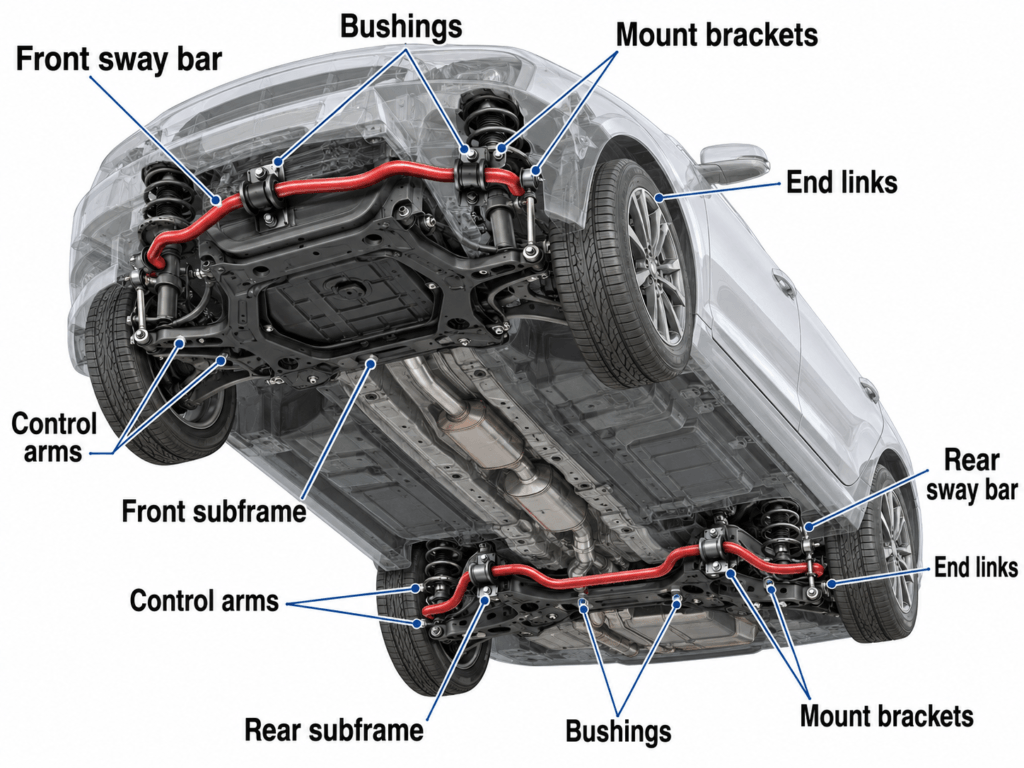
A front sway bar is normally mounted across the front of the vehicle, often on the front subframe below or behind the engine. A rear bar is mounted near the rear axle or rear suspension subframe.
Bushings and metal brackets hold the bar to the chassis or subframe. Its ends connect to moving suspension parts through end links, also called drop links. Depending on the layout, an end link may attach to a control arm, strut, steering knuckle, trailing arm, or axle housing.
Some vehicles use only a front bar. Others use bars at both ends so engineers can control overall roll stiffness and its front-to-rear distribution. Certain suspension designs provide part of the same effect through axle or spring geometry.
Main Parts of a Sway Bar System
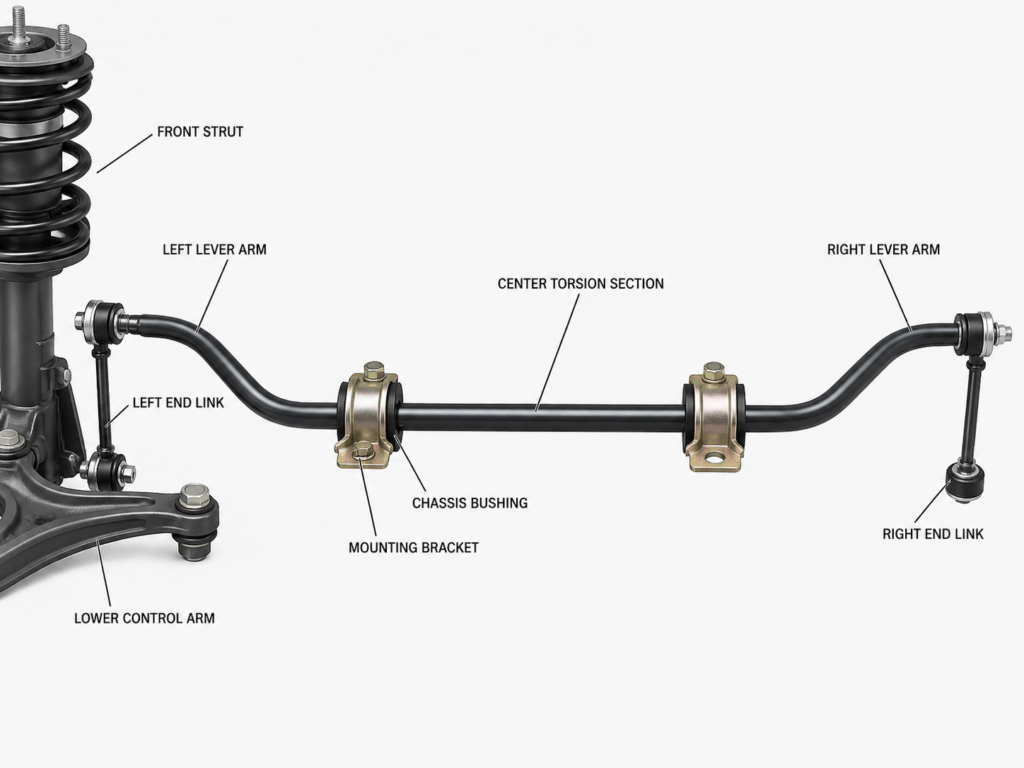
A sway-bar system contains:
- Main bar: The solid or hollow spring-steel member that twists.
- Chassis bushings: Flexible supports that let the bar rotate while controlling noise and unwanted movement.
- Mounting brackets: Clamps that secure the bar and bushings.
- End links or drop links: Short links that transmit suspension movement into the bar.
- Suspension attachment points: The control arm, strut, knuckle, axle, or other part through which wheel movement loads the bar.
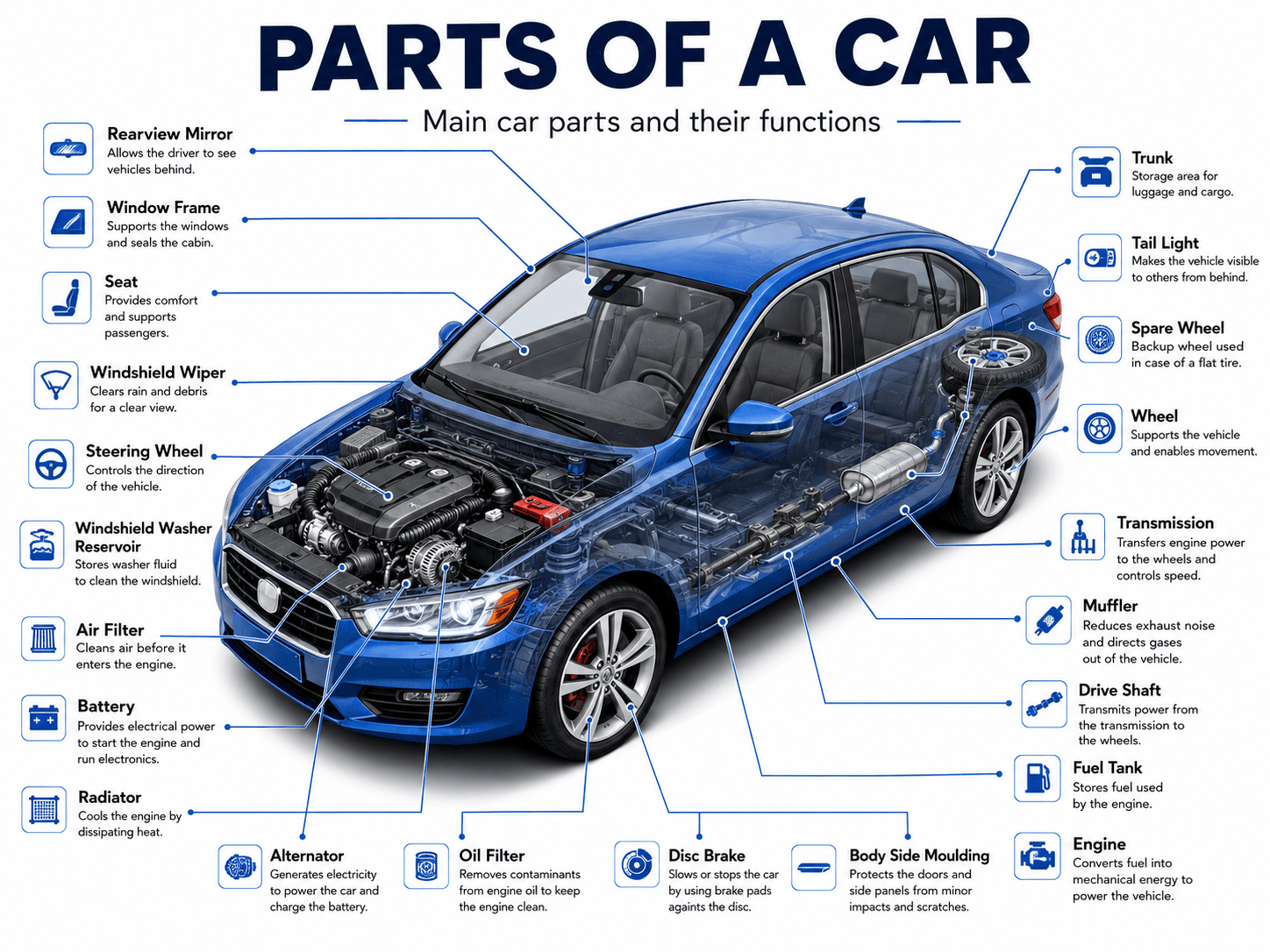
The sway bar works alongside the steering, suspension, axle, wheel, and tire components covered in our guide to the major parts of a car.
These parts affect how much of the bar’s calculated stiffness reaches the wheels. A bar can act softer than expected if its bushings, brackets, or attachment points flex.
How Does a Sway Bar Work?
In plain English, the sway bar resists a difference between the left and right suspension positions. If one side moves up and the other moves down, the bar twists and pushes back like a spring.
A right-hand corner shows the process clearly:
- The vehicle turns right. The tires generate lateral force to change direction.
- The left side becomes the outside of the corner. The right side is the inside.
- The body rolls left. The sprung mass creates a roll moment toward the outside.
- The outside suspension compresses. The left wheel moves upward relative to the body.
- The inside suspension extends. The right wheel moves downward relative to the body.
- Unequal suspension movement twists the bar. Its arms move in different directions relative to the chassis.
- The resulting torque opposes roll. It resists outside compression and inside extension, reducing the final body-roll angle.
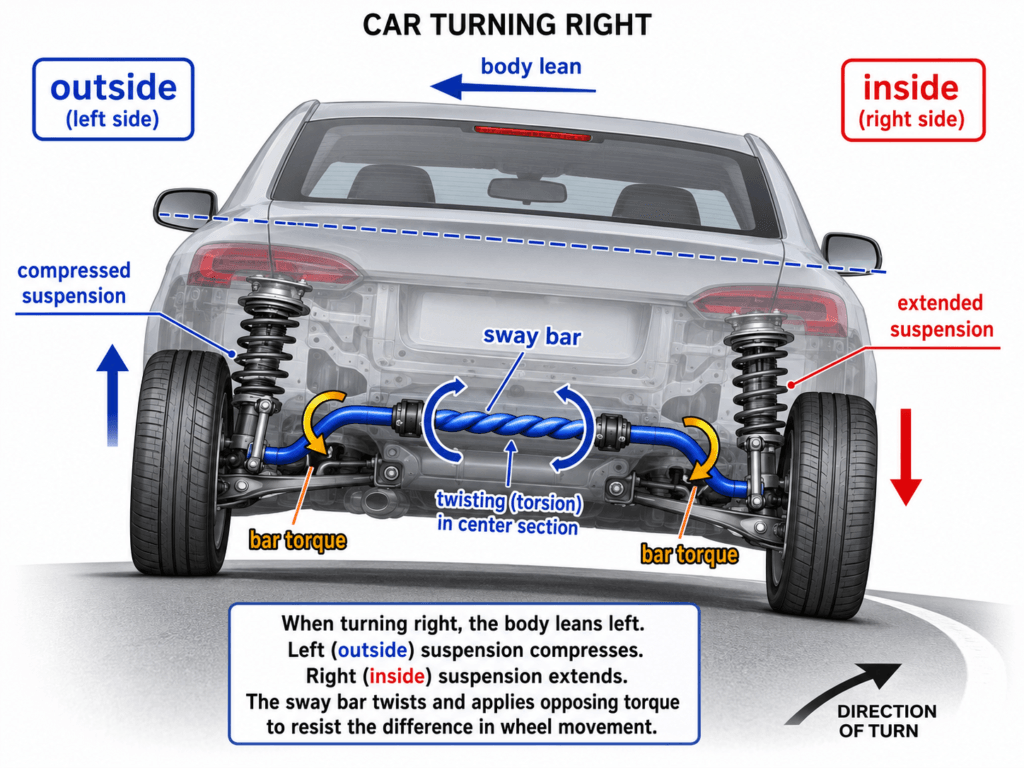
The bar stores elastic energy while twisted and releases it as the left-to-right difference decreases. This is why “torsion spring” is more accurate than saying the bar simply moves weight to the opposite wheel.
What Happens When Both Wheels Hit a Speed Bump?
When both wheels rise together by nearly the same amount, both ends of the bar move in the same direction. The bar mostly rotates in its bushings and experiences relatively little twist. The main springs and dampers handle most of a straight, evenly crossed bump.
When only one wheel hits a bump, one end moves more than the other. The bar twists and reacts through the opposite side of the axle. A very stiff bar can therefore make one-wheel bumps feel harsher and reduce independent wheel movement. Research into active roll control also reflects this basic trade-off between roll resistance, straight-line ride comfort, and response to uneven road inputs.
What Does a Sway Bar Actually Do?
The most obvious job is reducing body-roll angle. It can also make steering response feel quicker because the body takes less time to lean after a steering input. By limiting roll, it may help the suspension remain closer to its intended camber and toe conditions, although the result depends on geometry.
Front and rear sway bars also help tune handling balance. Changing roll stiffness at either axle can influence which tire pair reaches its cornering limit first.
What a Sway Bar Does — and What It Does Not Do
A sway bar reduces body roll, but it does not eliminate total lateral load transfer.
In a simplified steady corner, total lateral load transfer is influenced primarily by vehicle mass, lateral acceleration, center-of-gravity height, and track width. More mass, more lateral acceleration, or a higher center of gravity generally increases transfer from the inside tires toward the outside tires. A wider track generally reduces it.
The complete process includes geometric, elastic, tire, and unsprung-mass contributions. An anti-roll bar does not control every component. It most directly changes roll stiffness and the elastic lateral load-transfer distribution between the front and rear axles. Put simply, it changes how the suspension’s roll-resisting moment is shared; it does not make the overall load-transfer requirement disappear.
This matters because tires are load-sensitive. Adding load to an outside tire does not usually create an equal gain in cornering force to the amount lost as the inside tire is unloaded. Increasing one axle’s share of elastic lateral load transfer can therefore reduce that axle’s combined cornering capacity relative to the other axle.
A flatter vehicle does not automatically have more total grip. A stiffer bar may improve response and control geometry, but too much stiffness can overload one tire relative to the other, reduce rough-road compliance, or lift an inside wheel.
The bar also does not replace the springs or dampers. Springs support the vehicle and establish much of its ride and roll behavior. Dampers control movement and dissipate oscillation energy. The sway bar adds spring force mainly when the two wheels move differently.
A sway bar should also not be confused with an electronic stability-control system such as StabiliTrak. The sway bar is a mechanical suspension component, while stability control uses sensors, engine intervention, and selective braking to help correct a skid.
Front vs. Rear Sway Bar
These are general tendencies, not universal rules. Tires, alignment, weight distribution, drivetrain layout, suspension geometry, aerodynamics, and road surface can change the result.
| Change | Typical effect | Possible trade-off |
|---|---|---|
| Stiffer front bar | Less front roll; usually more understeer | Less front compliance and greater inside-front unloading |
| Softer front bar | Usually less understeer and more front compliance | More roll and slower response |
| Stiffer rear bar | Usually less understeer and more rotation | Greater oversteer tendency or inside-rear unloading |
| Softer rear bar | Usually more understeer and rear stability | Less rotation and slower response |
A stiffer front bar increases the front axle’s share of roll stiffness and usually its share of elastic lateral load transfer. The front tire pair may then lose combined cornering capacity sooner relative to the rear, producing more understeer.
A stiffer rear bar usually increases rear load-transfer share, helping the vehicle rotate more readily. Taken too far, it can produce abrupt oversteer or unload the inside rear tire. Testing and simulation research consistently show that roll-stiffness distribution must be tuned for the complete vehicle rather than treated as a universal formula.
Why Many Road Cars Use Substantial Front Roll Stiffness
Passenger vehicles are commonly tuned toward predictable understeer near the limit. When the front tires reach saturation first, the car tends to run wider rather than rotate sharply from the rear. That response is generally easier for an average driver to recognize and manage. Research comparing off-road vehicles with on-road passenger cars describes limit understeer as desirable for road vehicles because it produces a generally predictable and directionally stable response.
Front roll stiffness can support this balance, but it is only one factor. Weight distribution, tire sizes and characteristics, alignment, suspension kinematics, bushing compliance, drivetrain layout, aerodynamics, and electronic controls also affect understeer and oversteer. Different vehicle layouts may need very different spring, bar, tire, and geometry choices to reach similarly predictable behavior.
Why Are Some Sway Bars Stiffer Than Others?
Installed stiffness depends on the complete design, not only diameter.
- Outer diameter: A larger diameter greatly increases torsional stiffness when other dimensions remain unchanged.
- Inner diameter: On a hollow bar, inner diameter and wall thickness affect resistance to twist.
- Active torsion length: A longer twisting section is generally more compliant.
- Lever-arm length: Longer arms provide more leverage and usually reduce effective wheel stiffness. Shorter arms usually act stiffer.
- Adjustable mounting holes: Moving the end link inward shortens the effective arm and usually stiffens the setting; moving it outward usually softens it.
- Material: Shear modulus affects elastic stiffness, while strength and fatigue properties affect durability.
- Motion ratio: Attachment position and suspension geometry determine how much bar movement occurs for a given wheel movement.
- Bushing and bracket compliance: Flexible mounts absorb some input before torque reaches the suspension.
- Bar shape: Bends, transitions, and arm deflection influence the installed rate.
Experimental and finite-element studies confirm that sway-bar rate depends on several interacting geometric parameters, including arm length, cross-section, bushing position, and installation geometry.
Engineering Note: Why Diameter Matters So Much
For an ideal solid circular torsion section, the polar moment of area is proportional to diameter raised to the fourth power. A modest diameter increase can therefore create a much larger stiffness increase when material and length remain the same.
For a hollow circular section, stiffness depends on the difference between the fourth powers of the outer and inner diameters.
Readers interested in the underlying engineering can review this torsion reference for solid and hollow circular shafts from the University of Illinois. Material near the outside contributes strongly to torsional resistance, so a hollow bar can provide a favorable stiffness-to-weight ratio. A real sway bar also includes bends, arms, bushings, links, and suspension motion ratios.
Are Stiffer Sway Bars Better?
Not automatically. The correct stiffness depends on the vehicle and its use.
Normal Road Cars
A road car needs body control without becoming unpleasant on potholes or one-wheel bumps. Moderate roll stiffness usually provides a better compromise between response, comfort, and grip than maximum stiffness.
Performance and Track Cars
More roll stiffness can sharpen response and keep suspension geometry closer to its intended range. Adjustable bars also help tune balance. The stiffest setting is not always fastest, especially on rough tracks or curbs.
SUVs and Towing Vehicles
Tall vehicles may need substantial roll control because of a higher center of gravity and wider load range. Bar stiffness must still be matched with springs, dampers, tires, geometry, and payload. A suspension sway bar is not a trailer-hitch anti-sway device.
Off-Road Vehicles
Off-road vehicles often need one wheel to rise while the opposite wheel drops so the tires can follow uneven terrain.. A connected bar resists this articulation. Some vehicles therefore use manual or electronic disconnect systems for greater independent wheel travel at low speed, then reconnect the bar for road driving. Ford’s Bronco documentation specifically states that disconnecting the front stabilizer bar increases front-wheel articulation on uneven terrain.
Sway Bar vs. Strut Bar
A sway bar is a suspension spring designed to twist when the left and right wheels move differently.
A strut bar, or strut-tower brace, is a comparatively rigid chassis brace. It links the suspension towers to reduce body-structure movement around the upper strut mounts.
Put simply, a sway bar changes suspension roll stiffness. A strut bar reinforces the structure supporting the suspension.
What Parts Usually Wear Out?
The main steel bar is usually durable. Bushings and end links are more common wear points because they contain flexible or moving joints.
Symptoms can include clunking over small bumps, squeaking near the bushings, visible end-link play, damaged rubber, and reduced body control. Similar symptoms can come from other suspension parts, so the vehicle should be inspected before replacement. ZF’s workshop material lists knocking on uneven roads, imprecise handling, and increased body lean among possible signs of a faulty stabilizer link.
Frequently Asked Questions
Is a sway bar the same as an anti-roll bar?
Yes. Sway bar, anti-roll bar, stabilizer bar, and anti-sway bar are common names for the same suspension component.
Does every car have a sway bar?
No. Most modern passenger vehicles use at least one, but the arrangement depends on suspension design and handling targets.
Can a car drive without a sway bar?
It may still move, but body roll, steering response, and emergency handling can change significantly. A damaged or disconnected road-car system should be inspected and repaired.
Does a stiffer sway bar improve handling?
It can improve roll control and response, but excessive stiffness can reduce compliance and tire grip at that axle. The result depends on the whole vehicle.
Is a sway bar the same as a strut bar?
No. A sway bar twists to resist unequal suspension movement. A strut bar is a rigid chassis brace.
Why do off-road vehicles disconnect their sway bars?
Disconnecting the bar lets the wheels move more independently, increasing articulation on uneven terrain. It is normally reconnected for road use.
Conclusion
A sway bar is a torsion-spring component that reduces body roll by resisting unequal movement between the left and right suspension on one axle. It can improve response and help tune handling balance, but a larger or stiffer bar is not automatically better. The correct setup depends on tires, springs, geometry, road conditions, and the required balance between control, grip, comfort, and wheel articulation.