
A car door lock system uses a latch, striker, actuator, lock cylinder, rods or cables, clips, switches and wiring to keep the door closed and control locking and unlocking. The exact layout varies by vehicle. A door that will not lock, unlock, open or stay closed may have either a mechanical linkage fault or an electrical actuator or circuit fault.
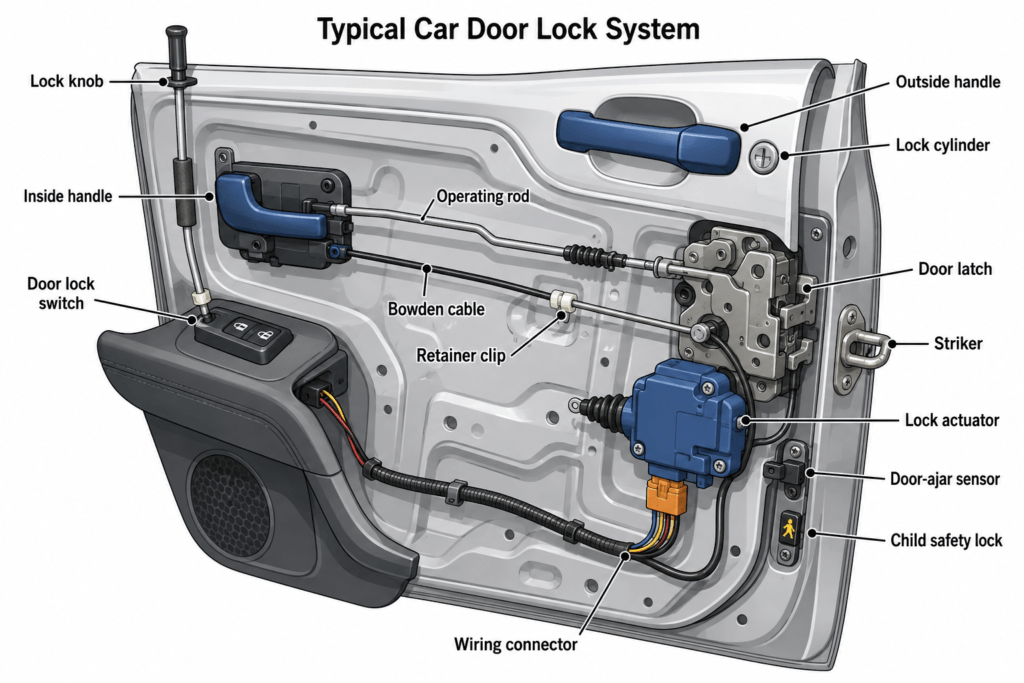
[INSERT IMAGE: car-door-lock-parts-diagram.webp — place immediately after the opening paragraph]
Contents
- Quick Summary of Car Door Lock Parts
- How a Car Door Lock System Works
- Main Car Door Lock Parts Explained
- Car Door Lock Symptoms and Likely Fault Areas
- Latch Problem vs Actuator Problem
- Basic Diagnostic Sequence
- Is It Safe to Drive With a Door Lock Problem?
- Common Diagnostic Mistakes
- Vehicle-Specific Differences
- When Professional Diagnosis Is Appropriate
- Frequently Asked Questions
- Conclusion
Quick Summary of Car Door Lock Parts
The table below separates the main mechanical and electrical components and shows the kind of symptom each one can produce. A symptom points toward an inspection area; it does not confirm that the named part has failed.
| Part | Main function | Common failure symptom |
|---|---|---|
| Door latch | Holds the door against the striker | Door will not close, open or stay latched |
| Striker | Provides the body-mounted locking point | Rattle, poor closing or misalignment |
| Lock actuator | Moves the power-lock mechanism | One door does not power-lock or unlock |
| Lock cylinder | Controls manual locking with a key | Key will not turn or cylinder spins freely |
| Rods and cables | Connect handles, cylinder and latch | Handle moves but door does not open |
| Retainer clips | Hold rods and cable ends in place | Loose or disconnected linkage |
| Door lock switch | Sends a lock or unlock request | System fails from one particular switch |
| Wiring and connector | Carry power, ground and control signals | Intermittent or completely dead lock |
| Child safety lock | Disables the rear inside handle | Rear door opens outside but not inside |
| Door-ajar sensor | Reports whether the door is open | Incorrect warning, light or alarm behaviour |
How a Car Door Lock System Works
The door latch is mounted near the rear edge of the door. When the door closes, the latch catches the striker attached to the body pillar. Pulling the inside or outside handle moves a rod, lever or flexible cable that releases the latch from the striker.
Locking the door does not normally release or secure the door directly against the body. Instead, the locking mechanism blocks or enables the handle-to-latch release path. This is why a door may close normally but refuse to unlock, or unlock correctly while still failing to open because a cable or rod has become disconnected.
In a power-lock system, the key fob or interior switch sends a request through the vehicle’s electrical system. Depending on the design, a body control module or door module may process the request before operating the actuator. The actuator then moves the lock mechanism into its locked or unlocked position.
Some vehicles use a separately replaceable actuator. Others combine the actuator, latch and door-ajar sensor in one assembly. Manufacturer parts listings also show designs with separate metal operating rods, Bowden cables or complete latch assemblies containing a motor and cable.
The exact design and procedure vary by make, model, model year, and production configuration. Confirm the correct service information for the specific vehicle.
Main Car Door Lock Parts Explained
1. Door Latch Assembly
The latch is the mechanical unit that catches the striker when the door closes. It holds the door securely until an inside handle, outside handle or another release mechanism moves the latch into its open position.
A latch may become worn, contaminated, jammed or mechanically bound. Incorrect striker alignment, damaged linkage or a handle that does not return fully can create similar symptoms.
Possible signs include:
- The door refuses to close.
- The door closes and immediately bounces back.
- The door will not open from either handle.
- Excessive handle force is required.
- The latch releases intermittently.
- The door rattles while driving.
A latch should not be replaced solely because the door will not open. Manufacturer diagnostic guidance advises checking manual operation, handles, cables, rods, clips, connectors and binding before treating latch replacement as the final repair step.
2. Door Striker
The striker is the reinforced metal loop, pin or bracket attached to the vehicle body. It gives the latch a fixed point to catch when the door closes.
A loose, damaged or incorrectly positioned striker may contribute to:
- Difficult closing
- Door rattling
- Uneven panel gaps
- Wind noise
- A door that reaches the body but does not latch completely
- A latch that feels as though it is striking the wrong position
Do not move a striker randomly. Its position affects latch engagement, door alignment and how firmly the weather seals are compressed.
A defective striker can become a safety-critical problem. A 2026 Nissan recall explains that an improperly manufactured striker could separate and prevent the latch from retaining the door while the vehicle was moving or during a crash.
3. Door Lock Actuator
The lock actuator is the electrical component that changes the lock mechanism between locked and unlocked positions. Depending on the design, it may use a small electric motor, reduction gears, a solenoid or an integrated latch mechanism.
Common actuator-related symptoms include:
- One door does not respond to the key fob.
- Locking becomes slow or intermittent.
- Clicking, buzzing or grinding comes from inside the door.
- Manual locking works but power locking does not.
- The lock knob moves only part of its normal travel.
- The actuator can be heard, but the lock does not complete its movement.
One affected door usually directs attention toward that door’s actuator, connector, wiring or linkage. If several doors stop operating at the same time, a shared fuse, power supply, switch, communication circuit or control module becomes more relevant.
Noise alone does not prove that the actuator is serviceable. It may run without producing enough movement, or the actuator may be working against a binding latch or incorrectly assembled linkage. Stellantis diagnostic guidance separates manual operation from powered operation and then checks for actuator sound, rod connection and latch movement.
4. Door Lock Cylinder
The lock cylinder is the mechanical key-operated component, most commonly fitted to the driver’s door. Turning the correct key moves a lever, rod or cable connected to the locking mechanism.
Possible fault signs include:
- The key will not enter fully.
- The key will not rotate.
- The cylinder turns without locking or unlocking the door.
- Manual operation works only intermittently.
- The mechanism feels loose behind the cylinder.
Do not force a stiff key. Excessive force can damage the key, cylinder, connecting lever or linkage. Check that the correct key is being used and follow the vehicle manufacturer’s instructions before applying any lock-specific lubricant.
5. Inside and Outside Door Handles
The handles normally do not hold the door closed. Their job is to transfer movement to the latch through a rod, lever or cable.
A damaged handle or disconnected connection may feel:
- Loose
- Unusually light
- Stiff
- Rough during movement
- Unable to return to its rest position
If the inside handle opens the door but the outside handle does not, inspect the outside handle’s rod, cable, clip and latch connection. If the outside handle works but the inside handle does not, check the inside linkage and, on a rear door, confirm the child safety lock position first.
Manufacturer diagnostic bulletins use the difference between inside-handle and outside-handle operation to narrow the inspection toward the relevant cable or linkage rather than replacing the entire latch immediately.
6. Lock Rods and Bowden Cables
Rods and cables carry movement between the handles, lock cylinder, lock knob, actuator and latch.
Older or simpler designs often use shaped metal rods. Other vehicles use Bowden cables, which contain a flexible inner cable moving inside an outer housing. Some doors use both systems in different parts of the mechanism.
Common linkage faults include:
- Bent rod
- Rod disconnected from a lever
- Broken or stretched cable
- Cable housing pulled out of its bracket
- Binding cable
- Incorrect routing
- Incorrect assembly after a previous repair
Ford’s parts catalogue lists door-lock operating rods as separate components, while other Ford listings show standalone latch cables and complete latch assemblies containing an actuator or cable. This illustrates why parts must be identified for the exact vehicle rather than ordered from a generic diagram.
7. Rod and Cable Retainer Clips
Small plastic or metal clips secure rods and cable ends to handles, cylinders and latch levers. These clips are inexpensive compared with a complete latch, yet one broken clip can disable the entire release path.
A failed clip may cause:
- Normal handle travel without latch release
- A metallic or plastic rattle inside the door
- Intermittent opening
- A rod falling away from its lever
- A connection that works only when moved by hand
Before ordering a complete latch, inspect whether the correct rod and clip are present, properly seated and securely retained. General Motors diagnostic guidance specifically calls for checking rod attachment and replacing or resecuring clips before replacing the latch.
8. Door Lock Switch
The interior door-lock switch sends a lock or unlock request. On older systems, the switch may control a relay or actuator circuit more directly. On many newer vehicles, it sends a signal to a door module or body control module.
If the locks work from the key fob and another interior switch but fail from one particular switch, the affected switch, connector or local wiring deserves attention.
A switch fault is less likely when the same door also fails to respond to every other command source. In that situation, the actuator, local wiring, connector, latch or linkage may be more relevant.
9. Wiring Harness and Electrical Connector
The door wiring harness carries power, ground, communication and switch signals. The section between the body and door bends whenever the door opens and closes, making that area an important inspection point for intermittent faults.
Possible wiring or connector symptoms include:
- The lock works only when the door is held in a certain position.
- Several electrical functions inside one door fail together.
- Operation changes when the harness is moved.
- The actuator receives no power or command.
- Connector terminals show corrosion, moisture or poor contact.
- A door-ajar warning appears intermittently.
No actuator sound does not automatically prove that the actuator has failed. The circuit may lack power, ground or a valid control signal. A General Motors bulletin documents door-lock and switch-bank faults caused by corroded door connectors, while Stellantis guidance calls for checking latch connectors and wiring to the body control module during door-ajar diagnosis.
Do not probe unknown wires, airbag circuits or communication wiring without the correct wiring diagram and approved test procedure.
10. Child Safety Lock
Rear doors commonly have a child safety lock on the door’s rear edge. When activated, it prevents the inside handle from opening the door. The outside handle may continue to work normally.
Before diagnosing a rear inside handle as broken, check the child safety lock position. Ford owner information confirms that the locks are set separately on each rear door and prevent the rear doors from opening from inside when engaged.
11. Door-Ajar Switch or Latch Sensor
The door-ajar switch reports whether the door is open or closed. It may be a separate plunger-type switch or a sensor integrated into the latch assembly.
A sensor, connector or circuit fault may cause:
- The door-open warning to remain on.
- The interior light to stay illuminated.
- The alarm to behave unexpectedly.
- Central locking to operate incorrectly.
- The vehicle to report an open door even though it is latched.
- Battery discharge caused by lights or modules remaining active.
Ford parts information shows that some complete latch-and-actuator assemblies also include the door-ajar switch. Stellantis service information directs technicians to inspect the latch connector and wiring to the body control module when ajar detection does not operate correctly.
Car Door Lock Symptoms and Likely Fault Areas
Use the pattern of the fault to decide what to inspect first. These entries are starting points, not confirmed diagnoses.
| Symptom | Areas to inspect first |
| Manual lock works, power lock does not | Actuator, wiring, connector, switch |
| Actuator makes noise but lock does not move | Actuator gears, binding latch, disconnected linkage |
| Handle moves but door stays closed | Rod, cable, clip, handle connection, latch |
| Door will not stay closed | Latch position, striker, binding handle or damaged retention part |
| Only the inside handle fails | Inside cable or rod, handle connection, child lock |
| Only the outside handle fails | Outside rod, cable, clip or handle |
| All doors stop power-locking | Shared fuse, supply, switch, module or control circuit |
| Lock works intermittently | Wiring, connector, actuator wear, moisture or binding |
| Door-open warning stays on | Door-ajar sensor, latch switch, connector or wiring |
| Key turns but lock does not move | Cylinder lever, rod, clip, cable or latch |
What the Symptom Does and Does Not Prove
A working manual lock with a failed power lock increases suspicion of an actuator or electrical problem, but it does not prove that the actuator motor itself is defective.
Actuator noise without full movement shows that part of the electrical command is reaching the door, but the gears, latch, rod, cable or mechanical travel may still be at fault.
A handle that moves freely can indicate disconnected linkage, although a broken handle lever or failed latch release can produce a similar feeling.
A door that will not stay closed requires immediate attention to the latch, striker and handle return position. It should not be treated as a normal power-lock inconvenience.
Latch Problem vs Actuator Problem
A latch problem normally affects the physical opening, closing or retention of the door. The door may fail to catch the striker, refuse to release, bounce back after closing or require abnormal force.
An actuator problem normally affects powered locking and unlocking. The door may still open, close and lock manually even though it does not respond electrically.
The distinction is useful, but it is not absolute. A weak actuator may be unable to overcome a binding latch. A working actuator may move while a disconnected rod fails to transfer that movement. An integrated latch-and-actuator assembly may also contain both mechanical and electrical faults in the same component. Manufacturer procedures therefore test manual operation, powered operation, handle behaviour, linkage and connectors before authorising replacement.
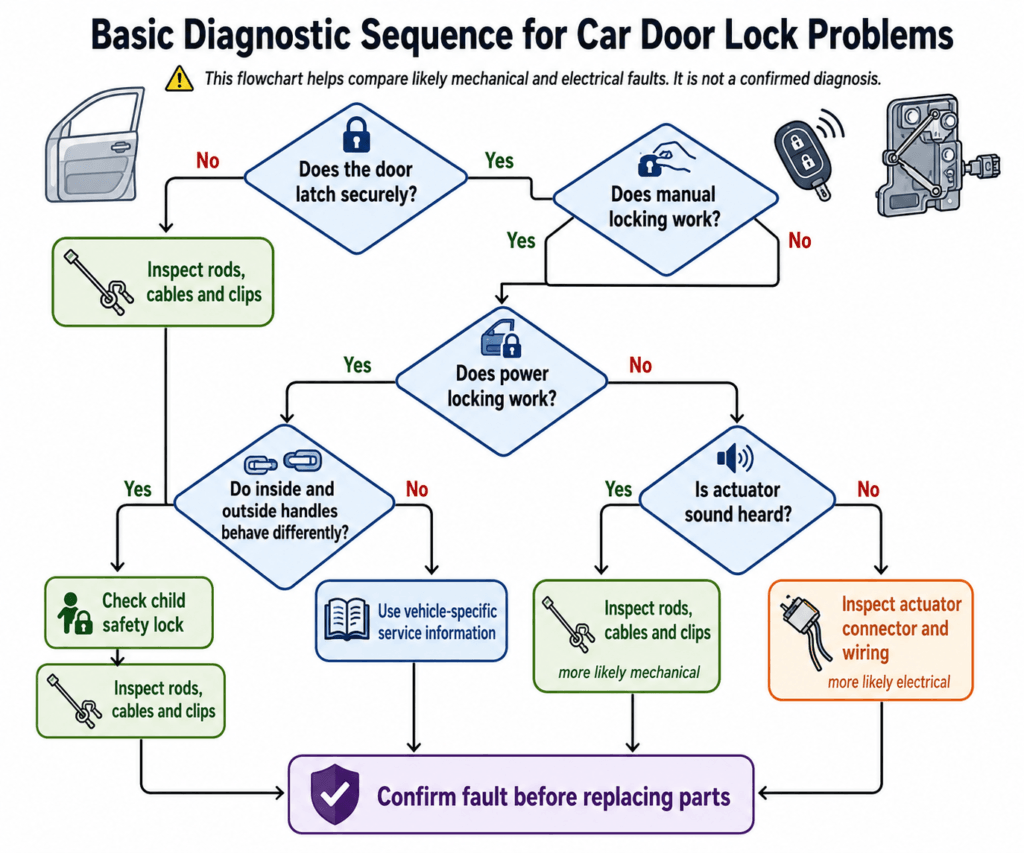
Basic Diagnostic Sequence
- Identify whether one door or several doors are affected.
One door suggests a local problem. Several doors may indicate a shared electrical or control-system fault. - Test manual locking and unlocking.
Check the key cylinder, lock knob and any manual lever without forcing them. - Test every available command source.
Compare the key fob, driver’s switch, passenger switch and manual operation. - Listen to the affected door.
Note whether the actuator is silent, clicks once, buzzes, grinds or moves weakly. - Compare the inside and outside handles.
A difference between them helps identify which linkage path needs inspection. - Check the rear child safety lock.
Do this before dismantling a rear door with a failed inside handle. - Confirm whether the door closes and latches securely.
Stop using the vehicle if the door cannot remain securely latched. - Use the correct wiring information before checking fuses or circuits.
Do not assume fuse locations, wire colours or terminal functions are universal. - Inspect the body-to-door harness and visible connectors.
Look for broken insulation, loose connections, corrosion or signs of moisture. - Remove the trim panel only with the correct service procedure.
Hidden screws, clips, wiring, moisture barriers and side-airbag equipment vary by vehicle. - Inspect rods, cables, clips and latch movement.
Confirm that each connection is present, correctly routed and moving through its full travel. - Replace a component only after the fault is isolated.
This sequence follows the same broad logic used in manufacturer service information: confirm the complaint, compare manual and powered operation, inspect cables and rods, check connectors and treat latch replacement as a final step after related faults have been excluded.
Tools and Information That May Be Needed
A basic external inspection may require only a flashlight and the vehicle owner’s manual. Removing a trim panel or testing an electrical circuit may require:
- Vehicle-specific service information
- Wiring diagram
- Plastic trim-removal tools
- Suitable hand tools
- Digital multimeter used with the correct test procedure
- Scan tool where the door module or body control module stores relevant faults
- Replacement door-panel clips
- Approved terminal-inspection tools
Do not apply universal voltage, resistance, torque or adjustment values. Use specifications for the exact make, model, year and production configuration.
Is It Safe to Drive With a Door Lock Problem?
Do not drive the vehicle if a door cannot latch securely, opens unexpectedly or will not remain fully closed. A latch or striker fault can affect door retention while the vehicle is moving or during a collision.
A failed power-lock function may be less immediately dangerous if the door still closes and latches mechanically. Even then, the fault can affect security, alarm operation, keyless entry and child-safety functions, so it should be inspected.
Do not tie the door closed, repeatedly slam it, hold it with a seat belt or attempt to bypass the latch. Arrange professional inspection or transportation of the vehicle when secure door retention cannot be confirmed.
Common Diagnostic Mistakes
- Replacing the actuator without checking its power, ground and control circuit
- Replacing the latch without inspecting rods, cables and retaining clips
- Ignoring an activated child safety lock
- Forcing a stiff key in the lock cylinder
- Moving the striker without documenting its original position
- Assuming actuator noise proves that the mechanism is working correctly
- Pulling the trim panel while cables or wiring remain attached
- Allowing the trim panel to hang from the handle cable or wiring harness
- Applying excessive lubricant near switches, motors or connectors
- Assuming every vehicle uses the same latch-and-actuator layout
General Motors service guidance specifically warns against allowing trim to hang from the handle cable or wiring and requires rod, cable, clip and connector checks before latch replacement.
Vehicle-Specific Differences
Door-lock construction varies considerably. Depending on the vehicle, you may find:
- A separate actuator attached to a mechanical latch
- A combined latch, actuator and door-ajar sensor
- Metal rods for every connection
- Flexible Bowden cables for one or both handles
- A mechanical child safety lever
- An electronic rear-door safety-lock system
- A direct electrical switch circuit
- A switch that communicates through a door or body control module
- A conventional key cylinder
- Keyless exterior handles with an emergency mechanical cylinder elsewhere
Parts catalogues should be checked with the VIN whenever possible. A component that is separately replaceable on one model may be available only as part of a complete assembly on another. Ford’s catalogue, for example, contains separate operating rods and cables as well as complete latch assemblies with an actuator, cable or door-ajar switch.
When Professional Diagnosis Is Appropriate
Professional diagnosis is recommended when:
- The door is closed and cannot be opened from either handle.
- The door will not latch or remain closed.
- Door trim must be removed while the door is shut.
- Side-airbag components or unfamiliar wiring are present.
- Several electrical door functions fail together.
- The fault is intermittent and cannot be reproduced easily.
- A scan tool or module-level diagnosis is required.
- Striker or door alignment appears incorrect.
- Wiring damage exists inside the body-to-door harness.
- The replacement procedure requires glass, regulator or carrier-panel removal.
Technical service bulletins are written for trained technicians with the tools and safety knowledge needed for the applicable vehicle. They should not be treated as universal instructions for every make and model.
Frequently Asked Questions
What is the difference between a door latch and a door lock actuator?
The latch mechanically holds the door against the striker and releases it when a handle operates. The actuator electrically changes the lock mechanism between its locked and unlocked positions.
Can a broken rod stop a car door from opening?
Yes. A bent or disconnected rod, broken cable or failed retaining clip can stop handle movement from reaching the latch even though the handle itself still moves.
Why does only one power door lock fail?
A fault affecting one door commonly involves that door’s actuator, connector, wiring, latch or linkage. When every door fails together, shared power supplies, switches, fuses or control systems become more relevant.
Why does the actuator make noise but the lock does not move?
The actuator may have damaged gears or insufficient movement, but the problem can also come from a binding latch, jammed rod, disconnected clip or incorrectly assembled linkage.
Are all car door lock parts sold separately?
No. Some vehicles offer rods, cables, cylinders, clips and actuators separately. Others use a combined latch-and-actuator assembly. Confirm the correct part using the VIN and manufacturer parts catalogue.
Conclusion
Car door lock parts operate as one connected mechanical and electrical system. The latch and striker retain the door, while the handles, rods, cables and clips release it. The actuator, switches, wiring and control system manage powered locking. Separating mechanical symptoms from electrical symptoms helps prevent unnecessary parts replacement.
For a wider look at the door shell, hinges, glass, regulator, seals and trim, read our guide to main car door parts. The supporting-page relationship keeps this article focused on the lock mechanism rather than repeating the complete door-parts topic.