

Contents
- Car Overheating at Idle:what are the causes+fixing steps and warnings
- Quick Answer
- Why Car Overheats at Idle But Not While Driving
- Idle vs Driving Overheating — What It Really Means
- Main Causes of Car Overheating at Idle
- 1. Cooling Fan Not Working Properly (Most Common)
- 2. Low Coolant Level or Hidden Leak
- 3. Trapped Air in Cooling System
- 4. Faulty Thermostat
- 5. Weak Water Pump
- 6. Radiator Blockage or Airflow Restriction
- 7. Overheating at Idle with AC On
- 8. Bad Radiator Cap
- 9. Early Head Gasket Signs (Less Common but Serious)
- Real Mechanic Insight
- Step-by-Step Diagnosis Flow (Save Your Money)
- What to Do If Your Car Overheats at Idle
- Can You Keep Driving Like This?
- How to Prevent Overheating at Idle
- FAQs
Car Overheating at Idle:what are the causes+fixing steps and warnings
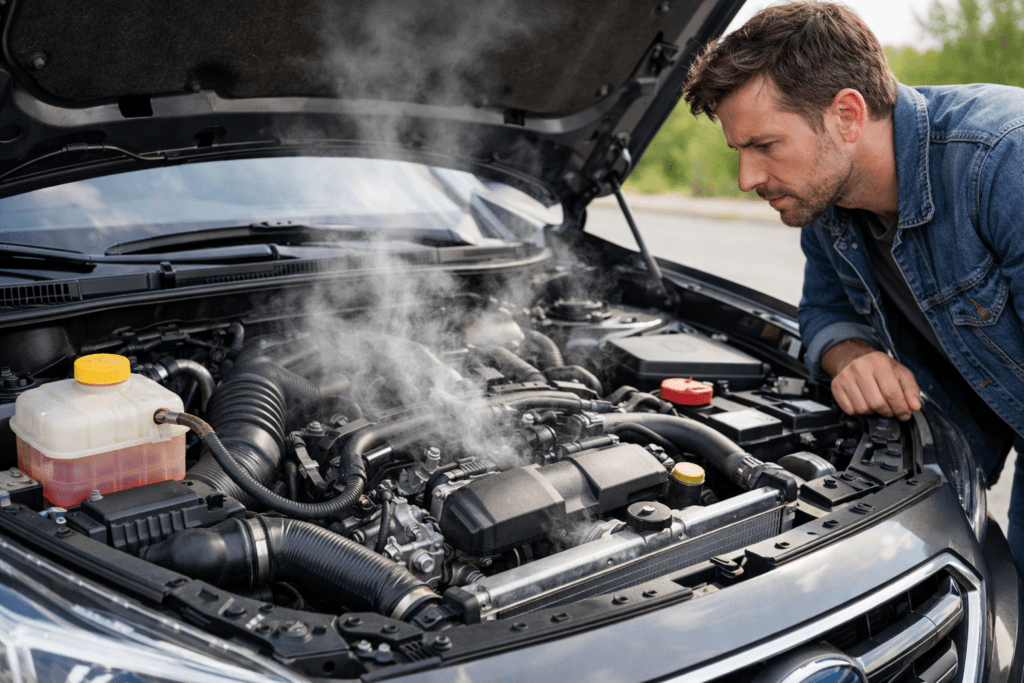
You are stuck at a red light. Everything feels normal. Then slowly… the temperature needle starts climbing. Not fast. Just enough to make you uncomfortable.
You press the accelerator, start moving, and suddenly everything goes back to normal.
That moment right there tells you something important.
This is not random overheating. This is a pattern problem. And in most real cases, it points to airflow or coolant circulation issues that only show up when the car is not moving.
I have seen people ignore this because the car “fixes itself” once they drive. Bad move. What starts as a small fan issue can easily turn into a blown head gasket if left unchecked.
Learn more about WHY ENGINE OVERHEATS
Quick Answer
Car overheating at idle usually happens due to:
- faulty radiator cooling fan
- low coolant level or hidden leak
- air trapped in the cooling system
- stuck or slow thermostat
- weak or failing water pump
- blocked radiator airflow
If the temperature drops once you start driving, the issue is most likely related to airflow or fan performance.
Why Car Overheats at Idle But Not While Driving
When your car is moving, natural air flows through the radiator and removes heat from the engine.
At idle, that airflow disappears.
Now your cooling system depends completely on:
- radiator fan
- coolant circulation
- system pressure
If any one of these is weak, heat builds up quickly while stopped. The moment you start driving again, airflow returns and temperature drops.
That is why this issue mostly appears:
- in traffic
- at red lights
- in drive thru lines
- while idling with AC on
Idle vs Driving Overheating — What It Really Means
Most articles skip this, but this is where real diagnosis begins.
| Situation | What It Means |
|---|---|
| Overheats only at idle | Cooling fan or airflow issue |
| Overheats at all speeds | Coolant circulation problem |
| Overheats with AC ON | Weak fan or airflow |
| Heater blows cold at idle | Air pocket or weak pump |
| Temperature fluctuates | Air trapped in system |
Understanding this difference can save you from replacing the wrong parts.
Main Causes of Car Overheating at Idle
1. Cooling Fan Not Working Properly (Most Common)
This is the number one cause. No debate.
At idle, your radiator depends entirely on the fan. If it is not working, heat has nowhere to go.
Common reasons:
- blown fuse
- bad relay
- failed fan motor
- faulty temperature sensor
- wiring issue
- fan control module fault
Signs:
- temperature rises when stopped
- drops while driving
- AC gets warm at idle
- fan not spinning
You should also check your cooling system basics guide here.
2. Low Coolant Level or Hidden Leak
Coolant carries heat away from the engine. If the level drops, heat stays trapped.
Possible leak points:
- radiator
- hoses
- water pump
- heater core
- reservoir cap
Sometimes there is no visible leak. Just a slowly dropping level or a faint sweet smell.
Related guide: coolant leak causes and fixes
3. Trapped Air in Cooling System
Very common after repairs.
Air pockets block coolant flow and create hot spots. This becomes obvious at idle.
Signs:
- gurgling sound
- heater inconsistent
- temperature fluctuates
- coolant level changes
If you recently changed coolant, this is highly likely.
4. Faulty Thermostat
The thermostat controls coolant flow.
If it sticks closed or opens late, heat builds up quickly.
Signs:
- sudden temperature spike
- upper radiator hose stays cool
- overheating comes and goes
Learn more about thermostat failure symptoms.
5. Weak Water Pump
The water pump keeps coolant moving.
If it becomes weak, coolant flow drops especially at low RPM.
Signs:
- overheating in traffic
- whining noise
- poor heater performance
- coolant leak near pump
6. Radiator Blockage or Airflow Restriction
Radiator can fail in two ways.
External blockage:
- dirt
- leaves
- bugs
- bent fins
Internal blockage:
- rust
- sludge
- old coolant
Result → heat cannot escape properly at idle.
7. Overheating at Idle with AC On
This is a strong clue.
AC adds extra heat load and forces the fan to work harder. If your system is weak, overheating will show up instantly when AC is on.
If this happens, focus on fan performance first.
8. Bad Radiator Cap
Small part but important.
If pressure is not maintained:
- coolant boils early
- bubbles form
- overheating happens faster
Cheap fix. Often ignored.
9. Early Head Gasket Signs (Less Common but Serious)
Not always the cause, but possible.
Signs:
- white smoke
- milky oil
- constant coolant loss
- bubbling after startup
But if overheating only happens at idle, simpler causes are more likely first.
Real Mechanic Insight
In real-world cases, around 70% of idle overheating problems come down to the cooling fan system.
Many drivers replace thermostat first. Then radiator. Then water pump.
And still the problem stays.
Later they find out it was just a relay or fan motor.
👉 Always check airflow first before replacing major parts.
Step-by-Step Diagnosis Flow (Save Your Money)
Follow this order:
- Check if radiator fan turns ON
- Check coolant level (engine cold)
- Look for visible leaks
- Bleed air from system
- Test thermostat
- Inspect radiator airflow
- Check water pump
- Pressure test system
Do not replace parts randomly. Diagnose first.
What to Do If Your Car Overheats at Idle
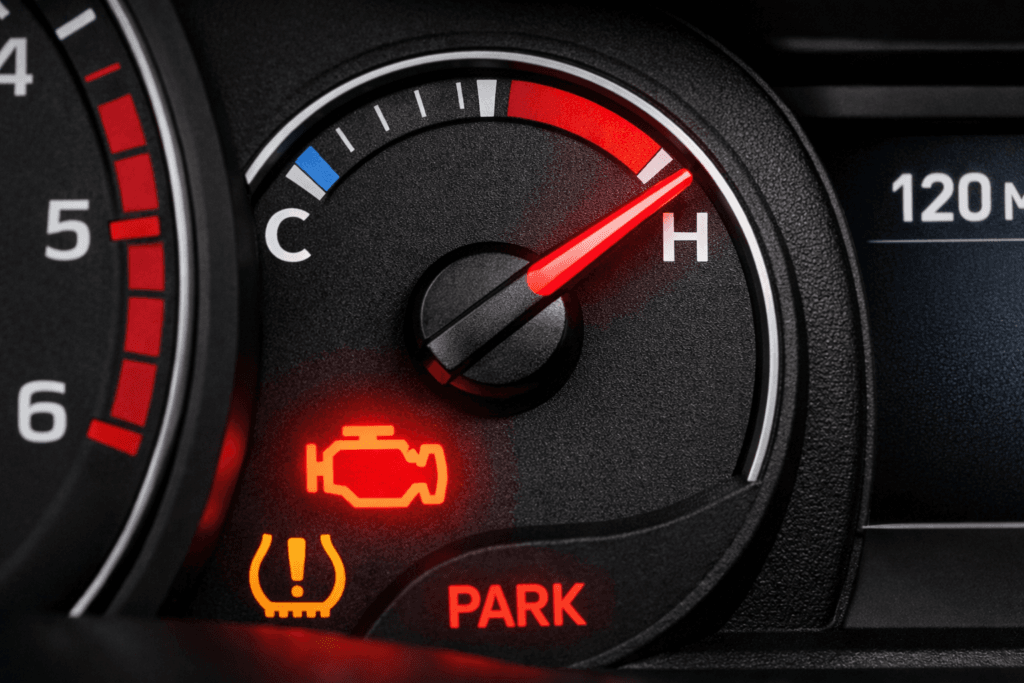
Step 1: Turn off AC
Step 2: Turn heater ON (temporary help)
Step 3: Monitor temperature
Step 4: Pull over if rising
Step 5: Shut engine OFF
Step 6: Let it cool completely
⚠️ Never open radiator cap while hot
Can You Keep Driving Like This?
Short answer: no.
Even if it cools while driving, damage is still happening.
Repeated overheating can lead to:
- blown head gasket
- warped engine head
- damaged seals
Small issue becomes big repair very fast.
How to Prevent Overheating at Idle
Simple habits:
- keep coolant at proper level
- flush coolant regularly
- inspect hoses
- clean radiator fins
- replace weak cap
- fix leaks early
- monitor fan performance
FAQs
Why does my car overheat only when idling?
Because airflow is low when stopped. Usually caused by a faulty fan or weak coolant circulation.
Why does my car overheat at idle with AC on?
AC increases heat load and exposes weak fan performance.
Can low coolant cause overheating at idle?
Yes. It reduces heat transfer and creates air pockets.
Is overheating at idle always serious?
Not always, but ignoring it can lead to serious engine damage.
Why does my car overheat in traffic but not highway?
At highway speed, airflow cools the radiator. In traffic, the system depends on the fan.
Pingback: Why Engines Overheat: Real Causes, Warning Signs & Fixes
Pingback: Oil In Coolant Reservoir: Signs, Causes, And What To Do Next -
Pingback: What Is Piston In An Engine? Function, Parts, Working, And Problems Explained -