
Contents
- Coolant is Disappearing With No Leak? 7 Hidden Causes Most Drivers Ignore
- Quick Answer
- Why Coolant Disappears With No Visible Leak
- Coolant Disappearing No Leak: Most Likely Causes
- Symptom-to-Cause Table (Fast Diagnosis)
- Coolant Loss With No Overheating — Is It Safe?
- How to Diagnose Coolant Disappearing With No Leak (Step-by-Step)
- Step 1: Check coolant when engine is cold
- Step 2: Inspect radiator cap (replace if weak)
- Step 3: Look for dried coolant residue
- Step 4: Check hoses, radiator, thermostat housing
- Step 5: Inspect inside cabin (heater core signs)
- Step 6: Watch exhaust smoke
- Step 7: Check engine oil condition
- Step 8: Perform pressure test
- Step 9: Do combustion leak test if needed
- Hidden Leak Locations Most Articles Miss
- Is It Normal to Top Up Coolant Regularly?
- Can You Drive With Coolant Disappearing?
- Repair Cost Breakdown
- Mechanic Insight (Real Talk)
- How to Fix Coolant Loss Properly
- FAQs
- Final Verdict
Coolant is Disappearing With No Leak? 7 Hidden Causes Most Drivers Ignore
Quick Answer
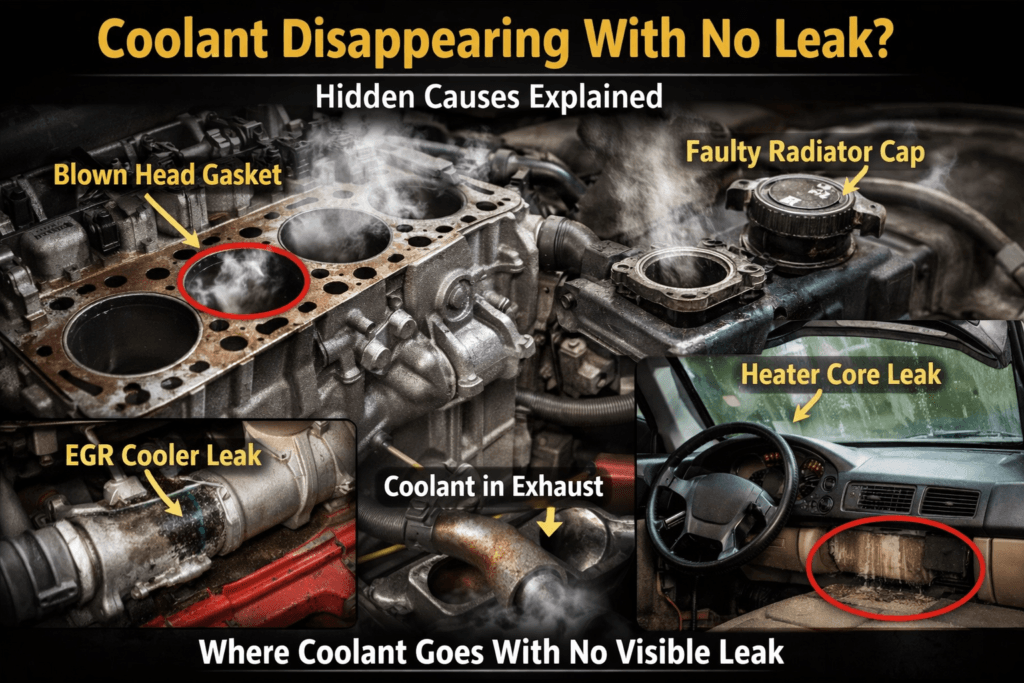
If your coolant is disappearing with no leak, it usually means the coolant is not leaking externally but escaping in hidden ways. The most common reasons are a faulty radiator cap causing pressure loss, small leaks that evaporate on hot engine parts, or internal issues like a head gasket or heater core leak where coolant gets burned or trapped inside the system.
This is not normal. If coolant keeps dropping, there is a fault that needs diagnosis before it leads to overheating or engine damage.
If overheating starts, you should first understand the main engine overheating causes before continuing diagnosis.
Why Coolant Disappears With No Visible Leak
A lot of drivers assume coolant loss should always leave a puddle. That is not how real-world cooling systems behave.
A cooling system works under pressure. When pressure drops or coolant finds a hidden path, it can disappear without leaving visible signs. This is why many people search for coolant disappearing no leak, coolant level dropping no leak, or losing coolant but no visible leak.In many cases, this connects directly with early Oil in Coolant Reservoir that drivers often ignore.
In many cases I have seen, the leak only appears when the engine is hot. Once the engine cools, everything looks dry again. That is where most drivers get misled.
Coolant Disappearing No Leak: Most Likely Causes
1. Faulty Radiator Cap or Reservoir Cap (Most Common)
This is one of the most ignored causes.
The cap keeps the system pressurized. If it fails, coolant escapes as vapor instead of liquid. This leads to coolant disappearing from reservoir with no visible leak.
Signs:
- slow coolant loss over time
- no puddle under car
- coolant smell after driving
Always check this first. Cheap fix, big impact.
2. Small External Leak That Evaporates
This is the most common real answer to coolant loss no visible leak.
Coolant may leak from:
- hoses
- clamps
- thermostat housing
- radiator seams
- water pump
Then it hits hot engine parts and evaporates instantly.
Look for:
- white or colored residue
- dried coolant marks
- smell after driving
3. Heater Core Leak (Hidden Inside Cabin)
This one fools a lot of people.
Coolant leaks inside the car, not outside.
Symptoms:
- sweet smell from vents
- foggy windshield
- damp carpet
- weak heating
If you notice these + coolant loss → heater core is a strong suspect.
4. Air Trapped After Coolant Service
If coolant was recently changed or system opened:
- air pockets can escape
- coolant level drops once or twice
BUT…
If coolant keeps dropping, it is NOT air anymore — it is a real problem
5. Blown Head Gasket (Serious)
This is where coolant disappears but no leak is visible.
Coolant enters combustion chamber → burns → exits exhaust.
Signs:
- white smoke
- bubbles in reservoir
- rough startup
- coolant loss with no leak
One mistake drivers make is ignoring early signs. I have seen cases where it starts small and becomes expensive fast.
6. Intake Manifold Gasket Leak
On some engines, coolant leaks internally into intake.
no external leak
coolant burns with fuel
Not universal, but important.
7. EGR Cooler Leak (Diesel Engines)
On diesel engines:
- coolant enters exhaust system
- burns away
- no visible leak
Rare, but critical for specific vehicles.
Symptom-to-Cause Table (Fast Diagnosis)
| Symptom | Likely Cause | Severity |
|---|---|---|
| Coolant level dropping no leak | Cap or small leak | Medium |
| Coolant smell under hood | External leak | Medium |
| Sweet smell inside car | Heater core | Medium-High |
| White smoke | Head gasket | High |
| Milky oil | Internal leak | Very High |
| Bubbles in reservoir | Combustion leak | High |
| Loss after long drive | Pressure issue | Medium |
Coolant Loss With No Overheating — Is It Safe?
Short answer: No
Many drivers think:
“temperature normal hai, sab theek hai”
Wrong.
I have seen engines lose coolant for weeks before overheating starts. By then, damage is already happening.
Coolant loss no overheating = early warning
How to Diagnose Coolant Disappearing With No Leak (Step-by-Step)
Step 1: Check coolant when engine is cold
Step 2: Inspect radiator cap (replace if weak)
Step 3: Look for dried coolant residue
Step 4: Check hoses, radiator, thermostat housing
Step 5: Inspect inside cabin (heater core signs)
Step 6: Watch exhaust smoke
Step 7: Check engine oil condition
Step 8: Perform pressure test
Step 9: Do combustion leak test if needed
This is the exact process most mechanics follow.If you suspect internal damage, checking related issues like oil in coolant reservoir can confirm deeper problems.
Hidden Leak Locations Most Articles Miss
- radiator cap vent
- reservoir cracks
- hose clamp connections
- thermostat housing
- water pump
- heater core
- intake gasket
- head gasket
- turbo lines
These explain most cases of coolant disappearing from reservoir
Is It Normal to Top Up Coolant Regularly?
No.
A sealed system should not lose coolant repeatedly.
If you keep adding coolant:
- there is a leak
- or internal problem
Simple.
Can You Drive With Coolant Disappearing?
You may drive short distance if:
- coolant slightly low
- no smoke
- no overheating
STOP driving if:
- temperature rises
- white smoke appears
- coolant drops fast
- engine runs rough
Ignoring this can destroy the engine.
Repair Cost Breakdown
| Problem | Cost |
|---|---|
| Radiator cap | $10 – $40 |
| Hose leak | $50 – $150 |
| Heater core | $200 – $800 |
| Intake gasket | $150 – $600 |
| Head gasket | $800 – $2500+ |
| Engine damage | $1500 – $4000 |
Mechanic Insight (Real Talk)
In most real cases I have seen, the cause is:
- bad radiator cap
- small evaporating leak
- heater core
- air after service
- head gasket
Not always worst-case scenario
But ignoring it makes it worse
How to Fix Coolant Loss Properly
- replace faulty cap
- fix leaks (hoses, radiator, pump)
- repair heater core if needed
- fix internal issues (gasket, engine)
- bleed system properly after repair
Most repeat problems happen due to poor bleeding
FAQs
Final Verdict
If your coolant is disappearing with no leak, the problem is hidden, not imaginary.
It is usually:
- a small leak
- pressure issue
- or internal engine fault
Start with simple checks, then move to proper testing.
That is how you avoid turning a small issue into a major repair.