
Contents
- Crankshaft Position Sensor Symptoms Causes Testing and Replacement Guide
- What Does a Crankshaft Position Sensor Do
- Where Is the Crankshaft Position Sensor Located
- Symptoms of a Bad Crankshaft Position Sensor
- What Causes Crankshaft Position Sensor Failure
- Common Crankshaft Position Sensor Codes
- How to Test a Crankshaft Position Sensor
- Bad Sensor or Bad Wiring
- Problems That Can Be Mistaken for a Bad Crankshaft Position Sensor
- Can You Drive With a Bad Crankshaft Position Sensor
- Crankshaft Position Sensor Replacement Cost
- Final Diagnostic Checklist
- FAQs
Crankshaft Position Sensor Symptoms Causes Testing and Replacement Guide

These are some of the most common signs of a bad crankshaft position sensor. Many drivers ignore them at first. Then the problem gets worse. The car may take longer to start one day. On another day it may not start at all. That is why this sensor matters so much. It gives the engine computer the timing reference it needs to control ignition and fuel delivery correctly. If the signal is weak unstable or missing the engine can misfire stall lose power or fail to start.Many drivers confuse this issue with serious engine damage, especially when signs like blown head gasket symptoms start appearing.
- Engine cranks but does not start.
- Car stalls without warning.
- RPM needle jumps for no clear reason.
- Engine runs rough even though fuel and spark parts look fine.
A lot of articles on this topic stop at a basic symptom list. That is not enough. A proper guide must also explain fault codes testing logic sensor types wiring issues reluctor wheel problems and the difference between a bad sensor and a bad circuit. That is what actually helps a reader diagnose the problem instead of guessing and replacing parts at random.
What Does a Crankshaft Position Sensor Do
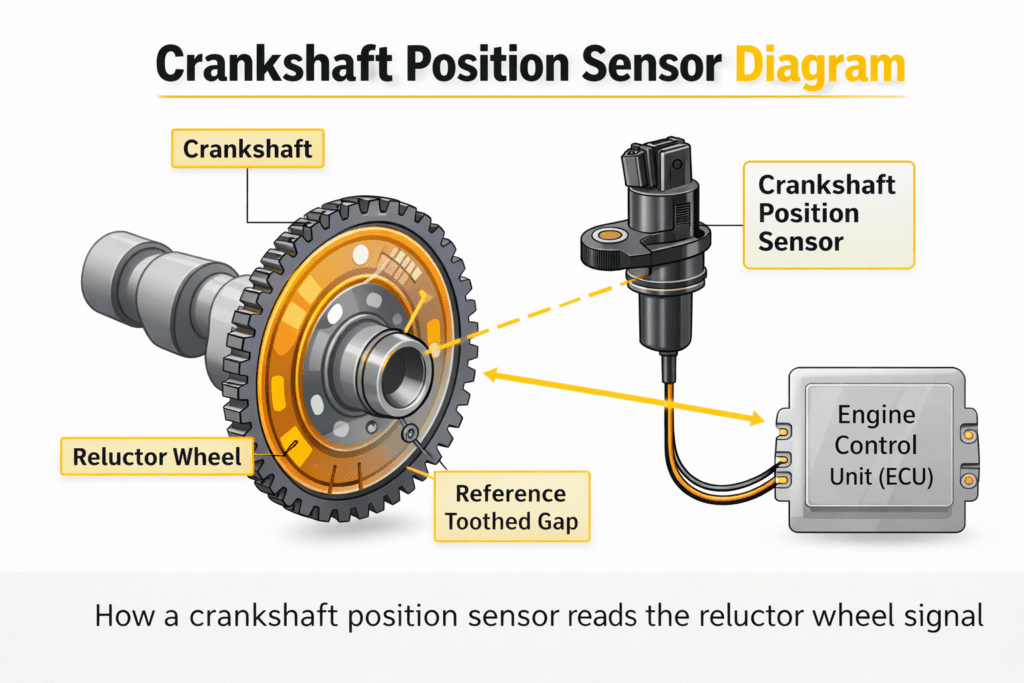
A crankshaft position sensor monitors crankshaft speed and crankshaft position. It sends that information to the engine control module so the module can manage ignition timing and fuel injection timing. Without this signal the engine computer does not know exactly when to trigger spark or fuel events. That is why the crankshaft position sensor is a core input sensor and not some small background part.
Featured Snippet Answer
A crankshaft position sensor tracks crankshaft speed and position and sends that data to the engine control module. The module uses this signal to control ignition timing fuel injection and engine synchronization. If the signal fails the engine may crank for too long stall run rough or not start at all.
Where Is the Crankshaft Position Sensor Located
The crankshaft position sensor location depends on the engine design. In many vehicles it sits near the crank pulley engine block flywheel or transmission bell housing. On some cars it is easy to reach. On others it sits in a tight awkward spot that increases labor time. That location difference is one reason replacement cost varies from one vehicle to another.
Symptoms of a Bad Crankshaft Position Sensor
A failing crankshaft position sensor can show up in several ways. Sometimes the symptoms are mild at first. Sometimes they are severe from day one. The most common signs are below.
1. Check Engine Light
This is often the first sign. The computer may store a crank sensor related trouble code when it sees a missing weak or irregular signal. A code points you in the right direction but it does not prove the sensor itself is bad because wiring or reluctor problems can trigger the same fault family.
2. Hard Starting
The engine may crank longer than usual before it starts. The signal may be too weak during cranking or may arrive inconsistently. When that happens the engine computer struggles to control timing correctly.
3. Cranks but Will Not Start
This is one of the strongest warning signs. The engine turns over but never fires. If the computer cannot detect a usable crank signal it may not be able to manage spark and fuel timing correctly enough to start the engine.In some cases, the problem may feel similar to ignition failure, especially when you face situations like key wont turn in ignition causes.
4. Random Stalling
Intermittent crank sensor failure often causes sudden stalling. The signal may drop out for a split second then return. That can shut the engine off without much warning.
5. Rough Idle and Misfires
A weak or unstable timing signal can throw off combustion events. The result may be rough idle misfires vibration and uneven running.Rough running is not always a sensor issue, because problems like white smoke from exhaust, black smoke from exhaust causes or blue smoke from exhaust causes can also disturb combustion.
6. Erratic RPM Reading
If the RPM signal in live data drops to zero during cranking or jumps around while the engine runs that is a strong clue. Many technicians use this as one of the first checks when they suspect a crank signal problem.
7. Poor Acceleration and Reduced Performance
The engine may feel flat delayed or inconsistent under load. If the timing reference is not stable the computer cannot optimize ignition and fuel delivery properly.
8. Lower Fuel Economy
Fuel economy can drop when combustion becomes unstable. It is not the strongest standalone symptom but it often appears with rough running hard starts and stalling.
Symptoms Table
| Symptom | What it usually means |
|---|---|
| Check Engine Light | Sensor or crank circuit fault detected |
| Hard starting | Weak or delayed crank signal |
| Crank no start | No usable timing reference |
| Random stalling | Intermittent signal dropout |
| Rough idle | Unstable timing input |
| Misfires | Incorrect spark or injection timing |
| Erratic RPM | Signal loss or signal distortion |
| Poor acceleration | Weak timing control under load |
The pattern matters more than one symptom alone.
What Causes Crankshaft Position Sensor Failure
Not every crank sensor code means the sensor body itself has failed. Common causes include internal sensor damage heat damage wiring faults corroded connector pins and reluctor wheel issues. Some vehicles also develop signal problems from harness rubbing or contamination near the sensor area. That is why diagnosis has to go beyond just reading one code and ordering one part.In some cases, electrical issues like alternator overcharging symptoms can affect sensor signals and create unstable engine behavior.
Causes Table
| Cause | How it affects the signal |
|---|---|
| Internal sensor failure | Weak signal or no signal |
| Damaged wiring | Intermittent or open circuit |
| Corroded connector | Poor signal transfer |
| Heat damage | Failure when engine warms up |
| Reluctor wheel issue | Distorted or missing trigger pattern |
| Oil or debris contamination | Reduced signal quality |
Common Crankshaft Position Sensor Codes
The most common code family linked to this problem includes P0335 P0336 P0337 P0338 and P0339. These codes point to circuit malfunction range or performance issues low input high input or intermittent signal faults.
Trouble Code Table
| Code | Meaning |
|---|---|
| P0335 | Crankshaft Position Sensor A Circuit Malfunction |
| P0336 | Crankshaft Position Sensor A Circuit Range or Performance |
| P0337 | Crankshaft Position Sensor A Circuit Low Input |
| P0338 | Crankshaft Position Sensor A Circuit High Input |
| P0339 | Crankshaft Position Sensor A Circuit Intermittent |
A code narrows the search. It does not finish the diagnosis.
How to Test a Crankshaft Position Sensor
This is the section where a strong article separates itself from generic content.
Step 1: Scan for codes
Start with a scan tool. Read stored codes pending codes and freeze frame data. Do not stop at the first crank code. Look for related misfire codes no start clues and RPM behavior.
Step 2: Check live RPM during cranking
If the engine cranks but live RPM stays at zero or behaves erratically the crank signal may be missing or unstable. This is one of the fastest practical checks.
Step 3: Inspect the connector and wiring
Check for loose pins corrosion broken insulation rubbed harness sections and oil contamination. A bad connector can create the same symptoms as a bad sensor.
Step 4: Identify sensor type
This matters a lot. Some crank sensors are inductive. Some are Hall effect. Testing method depends on the design. CarParts notes that the crankshaft sensor may be an inductive analog wave sensor or a Hall effect digital square wave sensor. Pico’s guided tests also separate Hall effect and inductive crankshaft signal evaluation.
Step 5: Test the signal correctly
An inductive sensor and a Hall effect sensor do not produce the same waveform. Pico’s guided tests show Hall effect crankshaft sensor evaluation during engine running and also separate testing for inductive crankshaft sensor output. If the waveform is weak missing or irregular the problem may be the sensor the circuit or the reluctor pattern.
Step 6: Use a scope when the problem is intermittent
A basic multimeter can help with power ground and continuity checks. For intermittent faults a scope is far better because it can reveal dropouts missing triggers or unstable waveform shape that a simple meter will miss.
Testing Methods Table
| Test method | What it helps confirm |
|---|---|
| Scan tool code read | Fault family and related conditions |
| Live RPM check | Whether a crank signal is reaching the computer |
| Wiring inspection | Harness and connector faults |
| Power and ground check | Circuit support to the sensor |
| Scope waveform test | Signal quality and dropout issues |
Bad Sensor or Bad Wiring
Many people replace the sensor first because it sounds simple. That is where money gets wasted.
A bad sensor often shows repeated no start hard start stalling or signal loss. A wiring problem often shows intermittent failure especially when the harness moves or the engine heats up. If a new sensor does not fix the issue the next step should be the circuit and reluctor wheel not another random part.
I have seen many cases where people blamed the sensor first and the real cause turned out to be a damaged connector or wire near a hot part of the engine. That is a common mistake and it is one reason crank sensor problems are often misdiagnosed.
Problems That Can Be Mistaken for a Bad Crankshaft Position Sensor
Several other faults can look similar:
- camshaft sensor issues
- ignition problems
- misfire related faults
- damaged reluctor wheel
- wiring faults
- timing related mechanical issues
Some engine issues such as coolant disappearing no leak or car overheating at idle can confuse the diagnosis and lead to wrong conclusions.
Can You Drive With a Bad Crankshaft Position Sensor
Sometimes the car will still run. That does not make it safe. A failing crank sensor can cause poor performance stalling and eventually prevent the engine from running at all. If the signal drops while driving the vehicle may stall in traffic or fail to restart.
The smart answer is simple. Diagnose it quickly and avoid unnecessary driving until the cause is confirmed.
Crankshaft Position Sensor Replacement Cost
Replacement cost depends on the vehicle and the sensor location. AutoZone says the DIY part cost is often about $30 to $100 and professional labor can add about $100 to $200 for a rough total of $130 to $300 depending on the vehicle.
Cost Table
| Item | Typical range |
|---|---|
| Sensor part | $30 to $100 |
| Labor | $100 to $200 |
| Total repair | $130 to $300 |
Final Diagnostic Checklist
Before replacing the crankshaft position sensor run through this order:
- scan all codes
- check freeze frame
- watch live RPM during cranking
- inspect connector and harness
- confirm sensor type
- test power ground and signal
- check reluctor wheel condition
- use a scope if the fault is intermittent
- replace the sensor only after the rest makes sense
That order gives the article real diagnostic value and makes it stronger than the average page that only lists symptoms.
FAQs
What are the symptoms of a bad crankshaft position sensor
The most common symptoms are hard starting crank no start random stalling rough idle misfires erratic RPM poor acceleration and a check engine light.
Will a bad crankshaft position sensor throw a code
Yes. The most common codes are P0335 P0336 P0337 P0338 and P0339. These indicate crank sensor circuit problems but they do not prove the sensor itself is the only possible cause.
Can a bad crankshaft position sensor cause a no start
Yes. If the engine computer does not receive a valid crank signal the engine may crank but not start because ignition and injection timing cannot be controlled correctly.
Can a crankshaft position sensor fail when hot
Yes. Heat related failure is a common pattern. The car may start cold then act up after the engine warms up.