
Contents
The Mathematics Behind Accurate Fuel Mileage Calculations
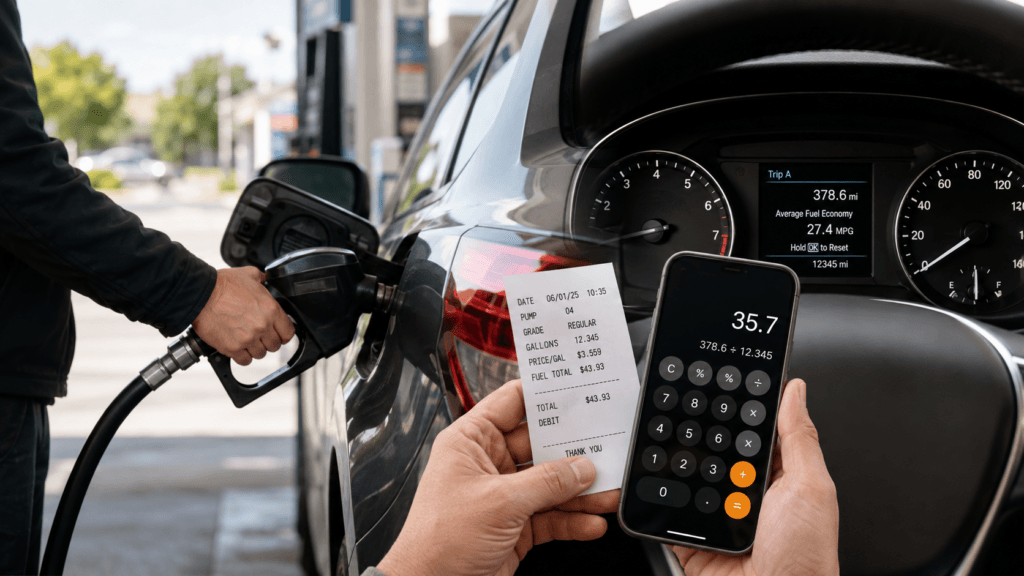
Calculating fuel economy requires tracking precise physical quantities rather than relying on digital estimations. A manual fuel mileage calculator relies on a simple formula: the total distance traveled between fuel stops divided by the exact volume of fuel required to refill the tank back to its maximum level. While the concept is straightforward, variations in units of measurement across different regions create confusion.
In North America, standard fuel economy uses miles per gallon (US MPG). One US liquid gallon equals exactly 3.78541 liters. Calculating US MPG requires recording the odometer reading at the fuel pump, filling the tank completely until the pump nozzle shuts off automatically, resetting the trip odometer, and driving normally until the next refueling. At the subsequent fill-up, you divide the miles logged on the trip odometer by the number of US gallons added to the tank.
In the United Kingdom and several Commonwealth nations, fuel economy is calculated using Imperial gallons. An Imperial gallon is noticeably larger than a US gallon, measuring 4.54609 liters. Because of this volume difference, a car operating in the UK will yield a numerical MPG figure roughly 20 percent higher than the exact same vehicle evaluated in US gallons. To convert liters directly into Imperial gallons, multiply the volume in liters by 0.219969 before dividing your miles by that result.
Continental Europe and much of the world express fuel consumption inversely as liters per 100 kilometers (L/100km). Instead of measuring distance traveled per unit of fuel, L/100km measures the volume of fuel needed to cover a fixed distance. The formula requires dividing the liters filled by the kilometers driven, then multiplying that quotient by 100. Lower numerical values indicate superior efficiency in this system. Converting between US MPG and L/100km requires dividing the constant 235.215 by the known figure. For example, a vehicle achieving 30 US MPG converts to approximately 7.84 L/100km.
Digital dashboard trip computers frequently report fuel economy figures that deviate from pump calculations by 3 to 10 percent. These onboard displays do not measure fuel volume in the tank directly. Instead, the Engine Control Module (ECM) calculates fuel consumption algorithmically based on commanded fuel injector pulse widths—or more precisely, the theoretical mass flow rate calculated per millisecond of injection time—multiplied by vehicle speed signals. Any real-world variance in fuel pump pressure, minor injector spray pattern degradation, or changes in tire rolling radius will cause the dashboard display to drift away from physical reality.
Why Your Calculated MPG Differs From EPA and Factory Ratings
Why does a vehicle rarely match its advertised fuel efficiency window during daily commuting? The gap between laboratory testing and road performance comes down to physics, thermodynamics, and atmospheric conditions.
Laboratory fuel economy testing follows standardized driving cycles performed on chassis dynamometers under controlled ambient temperatures. The tests eliminate wind resistance, altitude changes, aggressive acceleration, heavy cabin heating or cooling loads, and traffic congestion. On actual roads, aerodynamic drag increases quadratically with speed. A vehicle traveling at 70 mph encounters significantly higher air resistance than the same vehicle cruising at 55 mph, requiring disproportionately more horsepower and fuel to sustain momentum.
Aerodynamic profile plays a substantial role in this dynamic. Sleek sedans cut through the air with far less frontal drag than tall crossover SUVs or boxy trucks. The structural design and frontal surface area across different vehicle body styles establish the baseline energy required to overcome air displacement at highway speeds.
Fuel formulation directly alters energy density. Standard pump gasoline in many markets contains up to 10 percent denatured ethanol (E10). Ethanol possesses roughly 33 percent less energy per unit volume than pure petroleum distillate. Consequently, burning E10 gasoline decreases calculated fuel economy by 3 to 4 percent compared to unblended fuel. Winter-blend gasoline further reduces mileage due to higher concentrations of volatile, lower-energy hydrocarbons like butane added to aid cold-engine starting.
Driver habits and control inputs heavily influence fuel burn rates. Frequent short trips prevent the engine and catalytic converters from reaching optimal operating temperatures, locking the engine management system in warm-up enrichment cycles. Rapid acceleration opens the throttle body plate wide, signaling the engine computer to drop out of stoichiometric air-fuel target ratios and enter power enrichment mode. Even subtle driving habits, such as hovering near the physical position of the brake pedal during light deceleration, can induce minor brake pad drag that continuously consumes engine power.
Diagnostic Breakdown of Mechanical Faults That Destroy Fuel Economy
When an accurate fuel mileage calculator reveals a sudden or progressive drop in fuel economy, mechanical or electrical faults are usually responsible. A loss of efficiency always stems from unmetered fuel consumption, excessive internal engine friction, thermal inefficiency, or unwanted drivetrain drag.
Upstream Oxygen and Air-Fuel Ratio Sensors
The engine control module relies on upstream oxygen or wideband air-fuel ratio sensors to monitor combustion exhaust gases and fine-tune the stoichiometric ratio. Over time, silicon contamination, oil ash, or thermal aging causes these sensors to respond slowly or read artificial lean conditions. When a sensor falsely reports excess oxygen in the exhaust stream, the control unit commands a continuous positive fuel trim. This adds unneeded fuel to the combustion chambers, burning extra gasoline without triggering a diagnostic trouble code until the fuel trim exceeds programmed thresholds.
Stuck-Open Engine Thermostat
Modern internal combustion engines depend on tight thermal management to operate efficiently. If the thermostat fails to seal or becomes stuck in an open position, coolant flows continuously through the radiator even when the engine is cold. The engine struggles to reach its target operating temperature of 185 to 215 degrees Fahrenheit. Unaware of the mechanical thermal bypass, the engine computer assumes the motor is still warming up. It maintains a rich air-fuel mixture and retards ignition timing, draining fuel reserves unnecessarily.
Viscosity Breakdown and Incorrect Engine Oil Grade
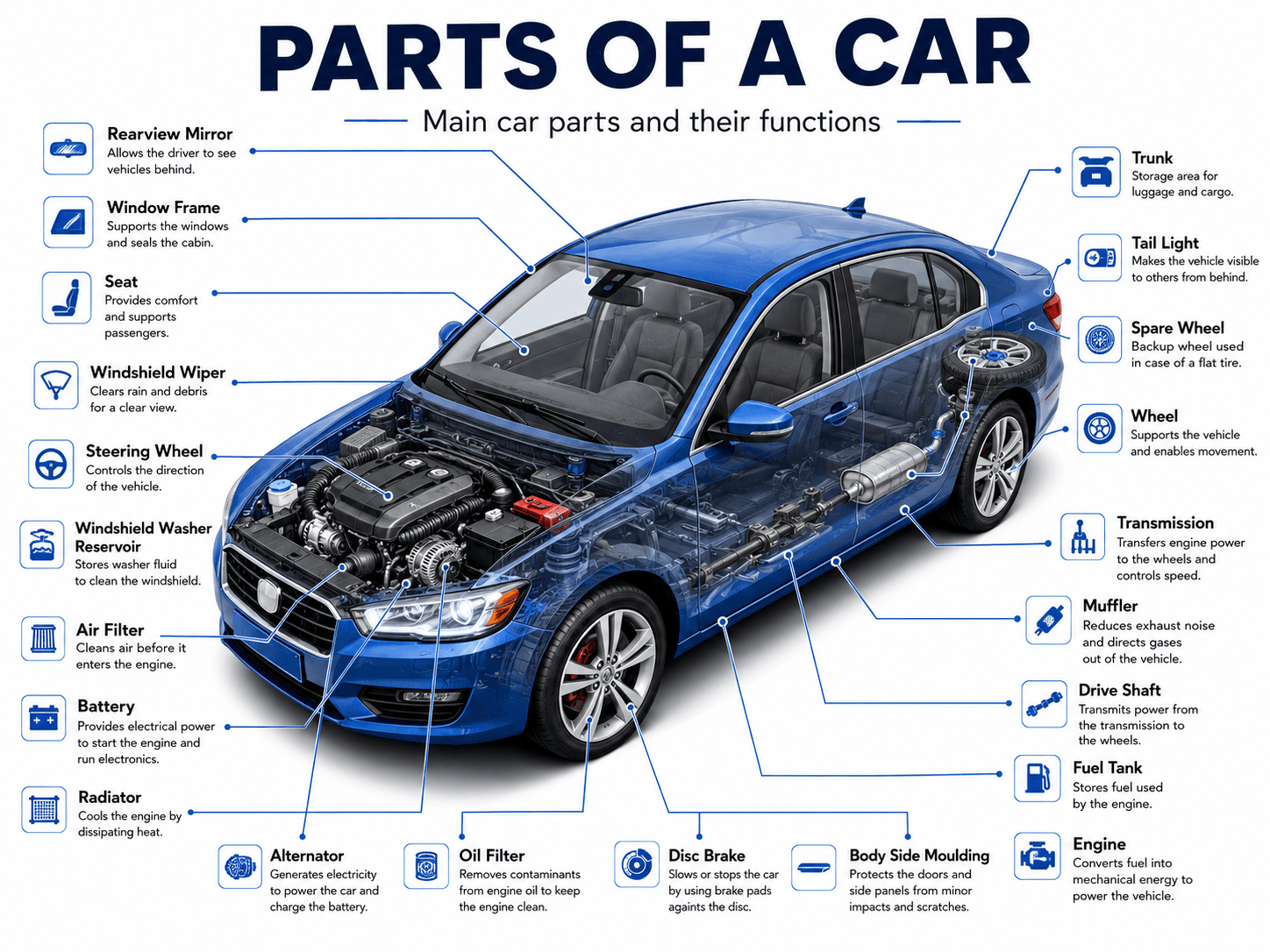
Engine oil reduces mechanical friction between reciprocating components. Using a higher viscosity oil than recommended—such as substituting 10W-30 into an engine engineered for 0W-20—forces internal pump assemblies and crankshaft counterweights to shear through thicker fluid films. This added hydrodynamic drag degrades overall fuel economy by 1 to 2 percent. Similarly, severely degraded, sludge-laden oil increases internal mechanical drag across critical basic car engine parts, converting engine power into waste heat rather than wheel torque.
Dragging Brake Calipers and Wheel Bearing Resistance
Friction outside the engine compartment forces the powerplant to work harder to maintain speed. A sticking brake caliper piston or seized slide pin prevents the brake pads from retracting fully off the rotor face. The resulting continuous drag creates immense kinetic resistance and localized heat. Failed or overtightened wheel bearings exert a similar drag effect on the hubs. You can identify this mechanical drag by measuring rotor or hub temperatures with an infrared thermometer immediately after a short drive without heavy braking.
Torque Converter Lockup Solenoid Failure
Automatic transmissions utilize a torque converter lockup clutch to establish a direct mechanical link between the engine crankshaft and transmission input shaft at cruising speeds. If the lockup solenoid fails, fluid pressure bypasses the clutch, allowing the torque converter to slip continuously. This hydraulic slip causes the engine to operate several hundred RPM higher than necessary on the highway, burning excess fuel while generating heat inside the transmission fluid circuit.
Diagnostic Process to Isolate and Resolve High Fuel Consumption
Systematic testing prevents unnecessary parts replacement when investigating low calculated fuel economy. Jumping straight to replacing spark plugs or fuel injectors without data verification often wastes money.
Step one: Connect an OBD-II scan tool capable of reading live sensor data and long-term fuel trim values. Observe Short-Term Fuel Trim (STFT) and Long-Term Fuel Trim (LTFT) with the engine fully warmed up at idle and at 2,500 RPM. Normal combined fuel trims should stay within plus or minus 5 percent. Combined fuel trims exceeding positive 10 percent indicate that the engine computer is constantly adding extra fuel to compensate for a lean condition, such as a vacuum leak, unmetered air entering past a cracked intake boot, or a dirty Mass Air Flow (MAF) sensor. Clean the MAF sensor wires with dedicated aerosol spray cleaner if air mass readings deviate from factory specifications at idle.
Step two: Verify engine operating temperature via live scan tool data rather than relying on dashboard gauge positions. Dashboard temperature needles are designed with wide buffer zones and often sit dead center even when coolant temperature lingers at a cold 150 degrees Fahrenheit. If live data shows coolant temperature failing to exceed 175 degrees after fifteen minutes of driving, replace the coolant thermostat to restore correct thermal management.
Step three: Focus on rolling resistance and mechanical drag checks. Inspect tire inflation pressures using a calibrated mechanical pressure gauge when tires are cold. Operating tires just 5 PSI below recommended manufacturer pressures increases rolling resistance significantly. Next, elevate the vehicle on a hoist to spin each wheel assembly by hand. Every wheel should rotate freely without scraping, pulsing friction, or bearing grinding noises.
Step four: Assess transmission efficiency and power transfer. Ensure the transmission locks up cleanly on the highway by monitoring engine RPM relative to vehicle speed. In modern step-automatic or continuously variable transmissions, sudden RPM flares during light throttle application at speed signal torque converter slippage or internal clutch wear across essential drivetrain components.
Frequently Asked Questions
How accurate are online fuel mileage calculators compared to manual fuel logging?
Online fuel mileage calculators use mathematically exact algorithms, making them 100 percent accurate for the raw data entered. However, overall calculation accuracy depends on the user entering exact fuel volumes from the pump nozzle and precise trip distance readings. Relying on fuel tank fill percentages or estimated miles introduces calculation errors.
Why did my fuel mileage drop suddenly without triggering a Check Engine Light?
A sudden drop in fuel mileage without a dashboard check engine light usually points to mechanical issues that lack dedicated electrical sensors. Common causes include under-inflated tires, dragging brake caliper slide pins, a stuck-open thermostat operating just above the diagnostic failure threshold, or switching to winter-blend fuel containing higher ethanol levels.
Using premium high-octane fuel in a vehicle designed and tuned for regular 87-octane gasoline will not increase fuel economy or power output. Premium fuel contains higher octane ratings to resist premature detonation under high compression, not extra energy density. However, if your vehicle manufacturer explicitly requires high-octane fuel, using regular gasoline forces the engine computer to retard ignition timing, which reduces fuel efficiency and engine output.
Practical Fuel Economy Takeaway
Accurate fuel mileage calculations serve as a primary window into your vehicle’s mechanical efficiency and operational health. By systematically tracking fuel consumption at the pump, analyzing long-term fuel trims, verifying cooling system operating temperatures, and eliminating parasitic chassis drag, you ensure that every drop of fuel burned translates efficiently into vehicle momentum.