
Contents
- Thermostat Stuck Closed Symptoms: 7 Warning Signs Your Engine Is Overheating Fast
- What does a thermostat do in a car?
- Thermostat stuck closed symptoms
- Symptom table: what you may notice
- Why a stuck closed thermostat is dangerous
- Stuck closed vs stuck open thermostat
- What causes a thermostat to stick closed?
- How to diagnose a thermostat stuck closed
- Can you drive with a thermostat stuck closed?
- How to fix it
- Prevention tips
- Final word
- FAQs
Thermostat Stuck Closed Symptoms: 7 Warning Signs Your Engine Is Overheating Fast
If your thermostat is stuck closed, coolant cannot flow to the radiator, so the engine heats up too fast. The most common signs are rapid overheating, a temperature gauge climbing into the red, steam from under the hood, coolant boiling or overflowing, and in some cars little to no cabin heat. Driving like this can lead to severe engine damage.
A lot of car problems start small and stay quiet for a while. A stuck closed thermostat usually does not stay quiet. It can go from a minor cooling system issue to a serious engine problem pretty fast. That is why this topic matters more than many drivers think.
Most people hear “bad thermostat” and think it is just a small part. That part is small. The damage it can cause is not. When the thermostat stays closed, hot coolant gets trapped inside the engine instead of moving to the radiator to cool down.That is when the temperature shoots up and the real trouble begins, often linked to deeper engine overheating causes.
What does a thermostat do in a car?
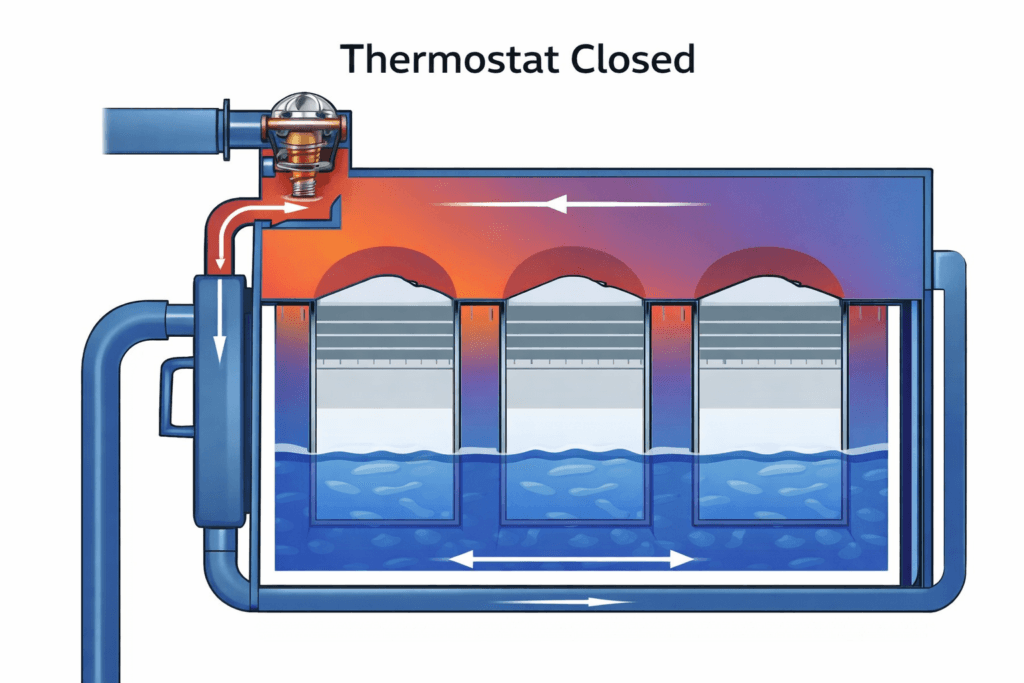
The thermostat controls coolant flow between the engine and the radiator. When the engine is cold, the thermostat stays closed so the engine can warm up faster. Once the engine reaches normal operating temperature, the thermostat opens and lets coolant circulate through the radiator.
That normal opening and closing is what keeps engine temperature stable. If the thermostat gets stuck closed, coolant stays trapped in the engine and heat builds quickly. That is why overheating becomes the main warning sign.
Thermostat stuck closed symptoms
Here are the main symptoms you should watch for.
1. Engine overheating very quickly
This is the biggest sign. A stuck closed thermostat blocks coolant circulation, so the engine cannot shed heat the way it should. The temperature gauge may rise much faster than normal and head toward the hot zone or red mark.
If you start the car and the gauge climbs unusually fast, that is a major red flag.
2. Temperature gauge climbing into the red
A high gauge reading is one of the clearest symptoms. Some vehicles may also show a coolant temperature warning light. YourMechanic notes that with a stuck closed thermostat the gauge may fail to level off and instead keep moving from cold to too hot.
A healthy engine warms up and then stabilizes. A stuck closed thermostat does not let that happen.
3. Steam from under the hood
When coolant gets too hot it can boil. That can create steam from the hood area. If you see steam while the gauge is high, stop driving as soon as it is safe. This is one of the classic overheating signs tied to a stuck closed thermostat.
4. Coolant boiling or overflowing
Pressure builds when coolant cannot circulate properly. That can force coolant into the overflow tank or even out of it. You may notice the reservoir acting strange or find coolant where it should not be. CarParts says a stuck closed thermostat can lead to overheating and cooling system damage, which fits this pattern.Coolant boiling or overflowing is one of the strongest warning signs, often seen in cases like Bubbles in Coolant Reservoir problem.
5. Warning light on the dash
Some cars will trigger a coolant temperature warning light or check engine light. A thermostat problem can set off cooling system warnings when engine temperature goes beyond the expected range.
6. Little heat or strange heater behavior
This one depends on vehicle design. Some cars may still have cabin heat for a while. Others may not. In many bad thermostat cases heater performance becomes abnormal because coolant flow and engine temperature are no longer being controlled properly. CarParts and other automotive sources note that thermostat faults can affect cabin heater performance.
7. Sweet smell or signs of hot coolant
If coolant overheats or escapes, you may notice a sweet smell near the engine bay. This is not always the first symptom but it often shows up when overheating gets worse.
Symptom table: what you may notice
| Symptom | What it usually means |
|---|---|
| Temperature gauge rises fast | Engine is overheating because coolant is trapped |
| Gauge reaches red zone | Serious overheating risk |
| Steam under hood | Coolant may be boiling |
| Coolant overflow | Pressure and heat are too high |
| Warning light appears | Engine temp or cooling system issue detected |
| Heater acts unusual | Coolant flow and temperature control are off |
These signs line up closely with what major automotive sources describe for stuck closed thermostat failures.
Why a stuck closed thermostat is dangerous
This is where many articles stay too shallow. They say “it overheats” and stop there. That is not enough.
Overheating is not the final problem. It is the beginning of bigger ones.
If you keep driving with a thermostat stuck closed, the engine can suffer severe damage. CarParts warns that a stuck closed thermostat can lead to extensive engine and cooling system damage. YourMechanic also explains that coolant cannot circulate through the radiator in this condition, causing extremely high engine temperature.
That kind of overheating can contribute to:
- Warped cylinder head
- Blown head gasket
- Coolant loss
- Engine wear
- In worst cases major engine failure
So yes. This is one of those issues you do not ignore.
Stuck closed vs stuck open thermostat
A lot of competing articles mix these two too loosely. They are not the same.
| Thermostat condition | Main result | Typical signs |
|---|---|---|
| Stuck closed | Coolant cannot reach radiator | Overheating fast. High gauge. Steam. Overflow |
| Stuck open | Coolant flows too early all the time | Engine runs too cool. Slow warm up. Weak heater. Worse fuel economy |
CarParts explains that stuck closed usually causes overheating while stuck open usually causes the engine to run too cool. PRO-CAT says the same in simpler form.
That distinction matters because the keyword here is thermostat stuck closed symptoms. So the real focus is heat building too quickly.
What causes a thermostat to stick closed?
Thermostats wear out with age and heat cycles. Internal parts can weaken. Corrosion or contamination in the cooling system can also contribute to failure.
Common causes include:
- Age and normal wear
- Corrosion
- Dirty or neglected coolant
- Debris in the cooling system
- Faulty thermostat housing or seal
This is why cooling system maintenance matters more than people think. Bad coolant does not only harm the radiator. It can shorten thermostat life too.
How to diagnose a thermostat stuck closed
You do not want to guess. Overheating problems can also come from low coolant, air pockets, radiator issues, a bad water pump, or failing fans.
Still, there are a few practical checks.
Check the temperature gauge behavior
If the engine warms up and then quickly climbs too high instead of stabilizing, that is one clue.
Feel the upper radiator hose carefully
CarParts notes that after the engine has had time to warm up, a cool upper radiator hose can suggest the thermostat is stuck closed because coolant is not flowing from the engine to the radiator. But they also warn this can happen with low coolant, air trapped under the thermostat, or a bad water pump too.
So this test helps. It does not prove everything by itself.
Remove and bench test the thermostat
One common method is to remove the thermostat and place it in hot or boiling water to see if it opens. CarParts specifically mentions this as a test used to check operation.
A proper shop can use scan data to verify coolant temperature behavior and rule out other faults. That is the smarter path if you are not fully sure.
Can you drive with a thermostat stuck closed?
No. Not safely.
If the engine is overheating, do not keep driving just because the destination is “only five minutes away.” Automotive sources consistently warn that stuck closed thermostats can cause severe overheating and serious engine damage.
If the gauge is rising hard or you see steam:
- Pull over safely
- Shut the engine off
- Let it cool completely
- Do not open the radiator cap while hot
That last point matters. Hot coolant systems are pressurized and dangerous.
How to fix it
In most cases the fix is simple in theory and important in practice: replace the thermostat.
Often the repair also includes:
- New gasket or O ring
- Coolant top up or replacement
- Inspection of thermostat housing
- Checking for air in the system
- Verifying fans and water pump if overheating was severe
A thermostat itself is usually not an expensive part. The real cost comes when people delay the repair and let overheating damage larger engine components.
Prevention tips
You cannot prevent every thermostat failure forever. But you can lower the risk.
Keep coolant fresh
Old or contaminated coolant increases the chance of corrosion and cooling system issues.
Use the correct coolant
Wrong coolant can create long term problems in the system.
Pay attention to the gauge
A temperature gauge is not decoration. If it starts behaving differently, take it seriously.
Fix small cooling issues early
Leaks, low coolant, and dirty coolant tend to create larger cooling problems later.
Final word
If you are searching for thermostat stuck closed symptoms, the short truth is this: the engine usually gets too hot too fast. That is the main pattern. A fast rising temperature gauge, steam, coolant overflow, and overheating warnings are the biggest signs.
Do not treat it like a minor annoyance. A stuck closed thermostat is a small part failure that can become a very expensive engine repair if you keep driving.
FAQs
What is the most common symptom of a thermostat stuck closed?
The most common symptom is engine overheating, usually with a temperature gauge climbing unusually high or into the red.
Can a stuck closed thermostat cause no heat?
It can cause abnormal heater behavior. Exact heater symptoms depend on vehicle design, but thermostat problems often affect cabin heat performance.
Will a stuck closed thermostat throw a code?
It can trigger warnings or codes related to coolant temperature or engine performance, though not every car will behave the same way.
How do I confirm a thermostat is stuck closed?
A common clue is overheating with a radiator hose that stays cool after warm up. A stronger check is removing the thermostat and testing it in hot water.
Is it expensive to fix a stuck closed thermostat?
Usually the thermostat repair itself is much cheaper than the engine damage that can happen if you ignore it. The actual price depends on vehicle and labor.