

The crankshaft is one of the most important parts inside a car engine. It changes the up-and-down movement of the pistons into smooth rotation that helps power the wheels. This motion passes through the connecting rods and creates the rotational energy needed to move the car.
In a typical four-cylinder engine, the crankshaft works with throws, bearings, and a flywheel to keep the engine stable. It then sends power through the clutch, gearbox, differential, and driveshafts, which finally move the vehicle.
Contents
What is crankshaft
Crankshaft
The crankshaft works as a power transmission unit inside the engine. It converts the reciprocating motion of the piston into rotating movement through the connecting rod. As the piston moves during combustion, the crankshaft begins to rotate and sends power through the drivetrain.
Its main parts include crankpins, crank webs, crank arms, cheeks, and main journals. These components support the shaft, guide the stroke, and help the engine produce steady movement during each revolution.
Parts of Crankshaft
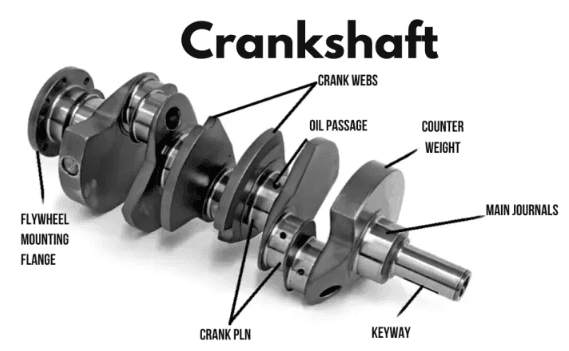
The Main parts of a crankshaft with its diagram:
- Crankpin
- Main journals
- Crank web
- Counterweights
- Thrust washers
- Oil passage and oil seals
- Flywheel mounting flange
Crankpin
The crankpin connects the inner workings of the crankshaft to the raw power that a car engine generates. It’s a cylindrical surface upon which the connecting rod attaches. This section fits around the large end of the connecting rod so that the pieces can move together as the engine operates.
As the engine runs, the motion of that piston is conveyed through the connecting rod to the crankpin in such a way as to help turn that linear movement into rotary energy. This part of the shaft is called connecting rod journal which allows for efficient power transfer by crankshaft.
Main Journals
The main journals are crucial parts of the crankshaft. These components sit on bearings that let the crankshaft spin easily as the engine runs. Most engines employ basic bearings, sometimes known as journal bearings, to sustain the shaft.
These bearings help control the strong forces produced as the engine rotates during operation. The main journals help the entire engine run smoothly by firmly holding the crankshaft while yet allowing movement.
.
Cranks internet
The most crucial part of the crankshaft is the crank web. The main journals are connected to the crankshaft by the crank web.
Counterweights
Counterweights are pieces of weight added to the crankshaft to help balance and stabilize its movement. They are usually attached to the crank web and carefully installed to create an opposite force that helps cancel reactions produced during engine operation.
When the crankshaft spins, these counterweights keep the motion smoother during rotation. This balancing becomes even more important at higher RPM, where engine parts move very quickly.
With proper counterweights, the crankshaft stays stable and allows the engine run more smoothly and efficiently.
Thrust Washers
Thrust washers are small but important components placed around the crankshaft to control its movement in the length direction. During engine assemble, these washers sit between the web and the saddle on specially machined surfaces.
They maintain a small gap that helps minimize unwanted lateral movement of the crankshaft. In many modern engines, this function is built into the main bearings, while in older types a separate thrust washer was commonly used to perform the same task.
Oil Passage and Oil Seals
The oil passage system inside the crankshaft helps deliver oil to important moving parts of the engine. A crankshaft oil passage runs through the shaft and connects the main bearing journals with the big end journal of the connecting rod. These paths include small oil passage hole sections that are carefully drilled through the crank web and toward the crankpin.
As the engine runs and combustion force drives the piston downward, the connecting rod transmits motion to the crankshaft while oil keeps circulating through every journal and bearing surface. Through its internal length, this oil travels along the crankshaft lubricating parts before returning to the crankcase.
At both ends of the crankshaft, oil seals are used to prevent oil from escaping. Their job is simple. They contain oil inside the engine so it does not leak out. The front end of the crankshaft uses front end oil seals, and this area is usually easier to reach if a failure happens.
The front oil seal sits near the pulley or timing gear, sealing the rotating shaft. On the opposite side, the rear end oil seal is often internally located near the main journals and flywheels. These seals are normally press fitted into a hole in the engine block above the oil pan.
Often known as a garter spring, the seal design normally has a shaped lip that presses the lip against the shaft to prevent oil spills.
Flywheel Mounting Flange
The part of the crankshaft used to mount the flywheel is the flywheel mounting flange. Normally bigger in diameter than the opposite end, these flanges are found at the wheel end of the shaft. This design provides a strong surface to mount the flywheels securely so engine power can transfer smoothly to the drivetrain.
Construction of Crankshaft
Strength, balance, and smooth rotation are fundamental principles of crankshaft building. Running on the main journals, main bearings support the crankshaft; each main bearing contributes to bearing a balanced load within the engine.
Parts like the crankarm work in opposition to moving forces so the shaft stays in equilibrium during use. Most crankshafts are made from alloy steel and may be forged, cast, machined, and grounded to form suitable journals.
These connect with the connecting rod and handle the force of the pistons during power strokes. The shaft must be strong enough to resist thrust and undue distortion. It is also carefully balanced to eliminate undue vibration caused by uneven weight.Many designs use offset cranks, and oil passages are drilled inside for oil travel to the connecting rod bearing.
Function of Crankshaft
The function of crankshaft is to turn piston motion into rotating power. At the crankshaft front end, a gear, sprocket, vibration damper, or fan belt pulley may be fitted.These help drive the camshaft, engine fan, water pump, and generator through a V-belt, while also reducing torsional vibration.
At the rear end, the flywheel is attached. The flywheel inertia keeps the engine rotating at a more constant speed.The number of main bearing numbers depends on engine design and cylinder numbers. More bearings can reduce the chance of crankshaft vibration and distortion in the shaft.Around every crankpin, especially in a 4-cylinder engine or 6-cylinder arrangement, a high degree of stiffness is required.Properly balanced crankshafts and flywheels are installed together to minimize engine vibration and so avoid damaging force on the engine and its bearings.
Types of Crankshafts
The following are the types of crankshafts:
- Fully built shaft
- Semi built shaft
- Welded shafts
- Solid single-piece shaft
- Forged crankshaft
- Cast crankshaft
- Billet crankshaft
Fully Built Shaft
A fully built shaft is a type of crankshafts design made by assembling several parts instead of using a single solid piece. In this method, the different components are produced separately and later joined using shrink-fitting. During this process, a crank web or other section is heated so the metal slightly expands. Once extended, components such the main journals and crank pin are shrunk-fitted together. The cooling process shrinks the metal back to its original diameter after it cools, therefore securing the components very firmly in place.
This type of fabrication was common in older style engines. Each section such as crank pins and journals could be made as separate components, then machined and bored to a thinner diameter for proper fitting. Many of these parts were also heat treated to increase strength. When assembled, the pieces fit together precisely, with the top portion holding the rotating assembly while the borehole ensures accurate alignment during installation.
Semi-Built Shaft
A semi-built shaft is a variation of the crankshaft design that combines features of a solid shaft and a fully built shaft. It uses an assembly of parts where the crank webs are often forged solid while other sections may be shrink-fitted to them. In this design, the main bearings and crankpins are formed through additional machining to achieve a smooth surface finish for better rotation.
In many cases, the structure may forge two webs into one piece, which helps keep the thickness controlled while overall weight is reduced. A small hole may be bored through the crankpin to reduce mass without affecting strength. This makes the crankshaft lighter while still able to endure heavy loads. Because of this balance, semi-built shafts are useful in high speed engines where parts must handle both shear stresses and bending stresses without failure.
Welded Shaft
Welded shaft or welded shaft designs joins both-sided separate components of a crankshaft including the crank web, crankpin, and main bearings. These components are initially created then linked utilizing submerged arc welding technology. This keeps the journals strong and mostly free of stress while the process stays mechanized and maintains continuous grain flow.
Because the webs can be made thinner, a smaller crankshaft or welded crankshaft can be produced with lower weight. The web thickness and width are often reduced, which can increase the overall length and create room for bearings with more length.
Solid Single Piece Shaft
A solid single piece shaft is one of the strongest forms of crankshafts. It is made from forgings or castings as single piece shafts and is widely utilized in low-speed engines and some high-speed engines. In some cases, crankshafts made from more than one part are bolted together with bolts and integral flanges.
This design must withstand heavy load during engine firing and resist cyclic tension, stresses, misalignment, and torsional vibration. Good support from main bearings also helps control axial vibration during operation.
Forged Crankshaft
A forged crankshaft or forged cranks design is known for being stronger than many cast cranks, which is why it is often used in high-stress engines and 16-valve engines. During the processes of manufacture, heated metal is placed between dies shaped like the final crank shape.
A hydraulic press then applies huge clamping forces, often measured in tons, as the die closes and tightens around the piece of metal. The metal is pressed into shape, making the crankshaft more durable. After that, heat treatment improves strength and dimensional stability.
Cast Crankshaft
A cast crankshaft or cast crankshafts design has been used for a long time and remains common in both diesel engines and petrol engines. It is usually made from malleable iron through a casting process, which makes it more inexpensive in design and manufacture.
That is why it stays a popular choice for many manufacturers. The structure can still withstand loads from all directions because of its uniform random metal grain structure.
Billet Crankshaft
A billet crankshaft or billet crank is often seen as the best type for a performance engine. It is usually machined from high-grade steel mixed with nickel, chromium, aluminium, molybdenum, and other elements.
Billet cranks are popular because they allow very precise shaping with the shortest machining time compared to some custom methods. This type of crankshaft removes the least amount of material needed while keeping great balance, evenness, and strong material design.
Faults of crankshaft
Rarely, crankshaft issues often occur under severe engine situations. Though its components are solid, the engine exhibits a few basic flaws.
Worn Journals
Worn journals usually happen because of insufficient oil pressure. When oil pressure drops, the crankshaft journal-bearings surfaces start touching the crankshaft, and extra clearance makes the problem worse. This worsens wear, creates damaged journals, reduces reliability, and can harm the engine and bearings, sometimes causing serious damage.
Fatigue
Fatigue is caused by repeated internal force on the crankshaft. Stress often builds as shear near the fillet between the journal and web. A smooth surface helps relieve stress and reduce points of weakness, but over time fatigue cracks and small cracks can still appear. These are often checked by Magna-fluxing.
Materials Used To Make Crankshaft
The materials used to make crankshaft must have high strength, good hardness, and durability. Steel is often considered ideal for crankshafts because it gives higher fatigue strength than many other materials with a similar cost. That is why commonly used crankshaft steels are widely preferred.
Materials used are:
- Manganese-Molybdenum Steel
- Nickel-chromium-molybdenum Steel
- Chromium-molybdenum Steel
- Nodular Cast Iron
Advantages of Crankshaft
The crankshaft supports effective and smooth operation of the engine. It helps transfer torque and engine power, which can lead to increased performance.
Disadvantages of Crankshaft
The bearings may fail if lubrication is poor. The overall cost of production is often high, and the crankshaft may heats up, causing increased friction.
Applications of Crankshaft
The applications of crankshaft are mainly in engines where this engine component efficiently converts reciprocating motion into circular motion, turning power into usable energy. It is the heart of an internal combustion engine and supports proper operation in a four-stoke cycle engine, where moving pistons go up and down during suction, compression, and exhaust strokes, while generating energy.