
Contents
- What Is a Piston? Function, Parts, Working, Types, and Common Problems
- Quick Answer
- Why the Piston Is So Important in an Engine
- Main Function of a Piston
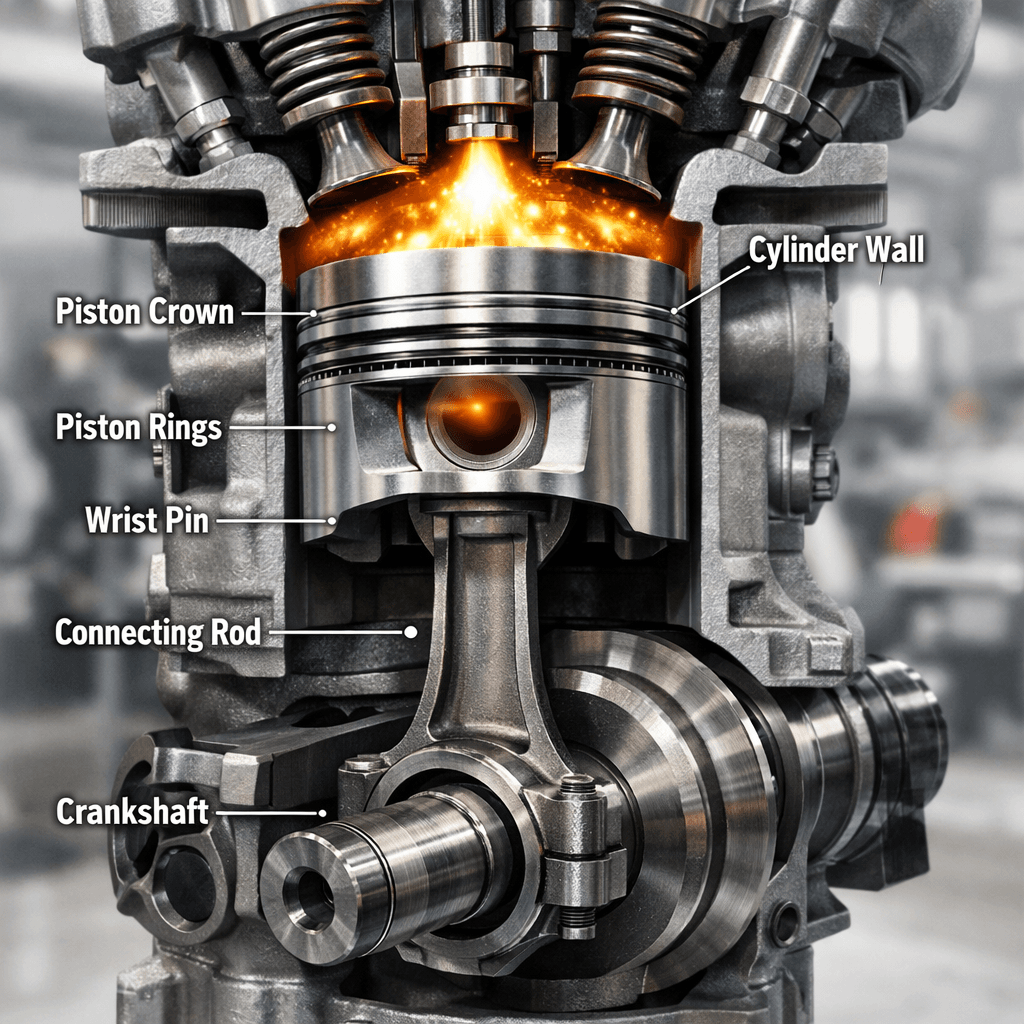
- Parts of a Piston
- How a Piston Works
- TDC and BDC
- Piston vs Cylinder vs Connecting Rod (Clear Comparison)
- Types of Pistons
- Petrol vs Diesel Piston
- What Material Is a Piston Made Of?
- Common Piston Problems
- Symptoms of a Bad Piston
- Piston Rings vs Piston
- Where Else Are Pistons Used?
- Final Thoughts
- FAQ
What Is a Piston? Function, Parts, Working, Types, and Common Problems
Quick Answer
A piston is a cylindrical engine component that moves up and down inside a cylinder. It compresses the air-fuel mixture, receives combustion force, and transfers that energy through the connecting rod to the crankshaft, helping generate power in an engine.
If you try to picture an engine in your head and think about what is actually doing the real work inside… the piston is one of the first parts that comes to mind.
It is not something you see every day. No lights, no sound by itself, no flashy movement from the outside. But without it, the engine is basically just a heavy block of metal sitting there doing nothing.
And honestly, this is where most articles stop — a simple definition and done. But if someone is searching this, they usually want the full picture. So let us actually break it down properly.You must know how Flashing Check Engine Light.
Why the Piston Is So Important in an Engine
The piston is not just “moving up and down.” That explanation is too small for what it actually does.
Inside the engine, the piston is dealing with:
- extreme heat
- very high pressure
- constant friction
- continuous motion
All at the same time.
One small design issue here, and everything starts going wrong — fuel economy drops, power reduces, oil starts burning, and in worst cases, the engine can fail completely.
That is why modern piston design focuses heavily on heat control, weight reduction, and friction management.
Main Function of a Piston
The piston has a few core jobs, and each one matters:
- Compress the air-fuel mixture before ignition
- Receive combustion pressure on its top surface (crown)
- Transfer that force to the crankshaft via the connecting rod
- Seal the combustion chamber using piston rings
- Control oil so it does not enter the combustion area excessively
In simple terms, the piston is one of the key parts that keeps the engine cycle running again and again.
Parts of a Piston
A piston is not just a simple metal piece. It has multiple sections:
| Part | Function |
|---|---|
| Piston Crown | Faces combustion pressure |
| Piston Rings | Seal gases + control oil |
| Ring Grooves | Hold rings in position |
| Piston Skirt | Guides movement in cylinder |
| Wrist Pin (Piston Pin) | Connects piston to connecting rod |
| Pin Boss | Supports the wrist pin |
Most competitors stop here… but the real understanding comes when you connect this with movement.
How a Piston Works
1. Intake Stroke
Piston moves down → air-fuel mixture enters cylinder
2. Compression Stroke
Piston moves up → mixture gets compressed
3. Power Stroke
Spark ignites mixture → explosion pushes piston down
4. Exhaust Stroke
Piston moves up → burnt gases exit
This cycle keeps repeating. That up-down motion gets converted into rotation by the crankshaft.
TDC and BDC
This is where beginners usually get confused.
- TDC (Top Dead Center): piston highest position
- BDC (Bottom Dead Center): piston lowest position
Every stroke happens between these two positions.
Adding this makes your article instantly more “expert-level” than competitors.
Piston vs Cylinder vs Connecting Rod (Clear Comparison)
| Component | Role |
|---|---|
| Piston | Moves up and down |
| Cylinder | Space where piston moves |
| Connecting Rod | Links piston to crankshaft |
This comparison section is missing in most pages — strong SEO advantage.
Types of Pistons
Different engines use different piston designs:
Flat-Top Piston
Simple and widely used
Dish Piston
Lower compression design
Dome Piston
Higher compression, performance engines
Trunk Piston
Common in automotive engines
Petrol vs Diesel Piston
| Feature | Petrol Engine Piston | Diesel Engine Piston |
|---|---|---|
| Compression | Lower | Much higher |
| Strength | Moderate | Stronger |
| Shape | Simpler | More reinforced |
| Heat Load | Lower | Higher |
Diesel pistons are designed to handle much higher pressure and temperature.
What Material Is a Piston Made Of?
Most modern pistons are made from:
- Aluminum alloy → lightweight + good heat transfer
- Steel (in heavy engines) → stronger, handles high pressure
Modern designs focus on:
- reducing friction
- improving durability
- handling extreme heat
Common Piston Problems
This is where most articles fail badly. They stay theoretical.
Here are real issues:
Worn Piston Rings
→ oil burning, smoke, compression loss
Piston Slap
→ knocking noise (especially cold start)
Cracked Piston Crown
→ caused by overheating or detonation
Scuffing / Seizure
→ poor lubrication → metal damage
Blow-By
→ gases leak past rings → efficiency loss
Symptoms of a Bad Piston
If piston or rings fail, you may notice:
- Blue or gray smoke
- Loss of engine power
- High oil consumption
- Knocking sound
- Poor compression
- Engine misfire
This section directly matches user intent → ranking boost.
Piston Rings vs Piston
Many people confuse this.
- Piston: main moving part
- Piston Rings: sealing components around piston
Rings fail more often than piston itself.
Where Else Are Pistons Used?
Not just cars:
- compressors
- pumps
- hydraulic systems
So piston is a broader mechanical concept.
Final Thoughts
The piston may look like a simple metal cylinder, but it is doing one of the hardest jobs inside the engine.
It handles pressure, heat, motion, sealing, and force transfer — all at once, continuously.
Calling it just “a part that moves up and down” is technically correct… but honestly, it barely explains how important it really is.