
Contents
- Car Body Parts: Names, Diagram and Functions
- Car Body Parts Names List
- Car Body Parts Diagram
- Parts of Car Body
- 1. Body Shell
- 2. Hood or Bonnet
- 3.Front and Rear Bumpers
- 4. Fender
- 5. Roof
- 6. Doors
- 7. Window Glass
- 8. Mirrors
- 9. Trunk or Decklids
- 10. Head Light
- 11. Tail Lights
- 12. Fog Lamp
- 13. Indicator Lights
- 14. Bumper Grille
- 15. Crash Guard or Bullbar
- 16. Quarter Panel
- 17.Fender vs Quarter Panel
- 18. Cowl Panel
- 19. Wiper Blade
- 20. Radiator Supports
- 21. Fender Liners
- 22. Door Handle
- 23. Quarter Window
- 24. Sunroof
- 25. Mud Flaps
- 26. Wheels
- 27. Hubcap
- 28. Number Plate
- Which Car Body Parts Can Be Repaired or Replaced?
- Body Parts vs Related Car Components
- Method Note
- Final Words
- FAQ
Car Body Parts: Names, Diagram and Functions
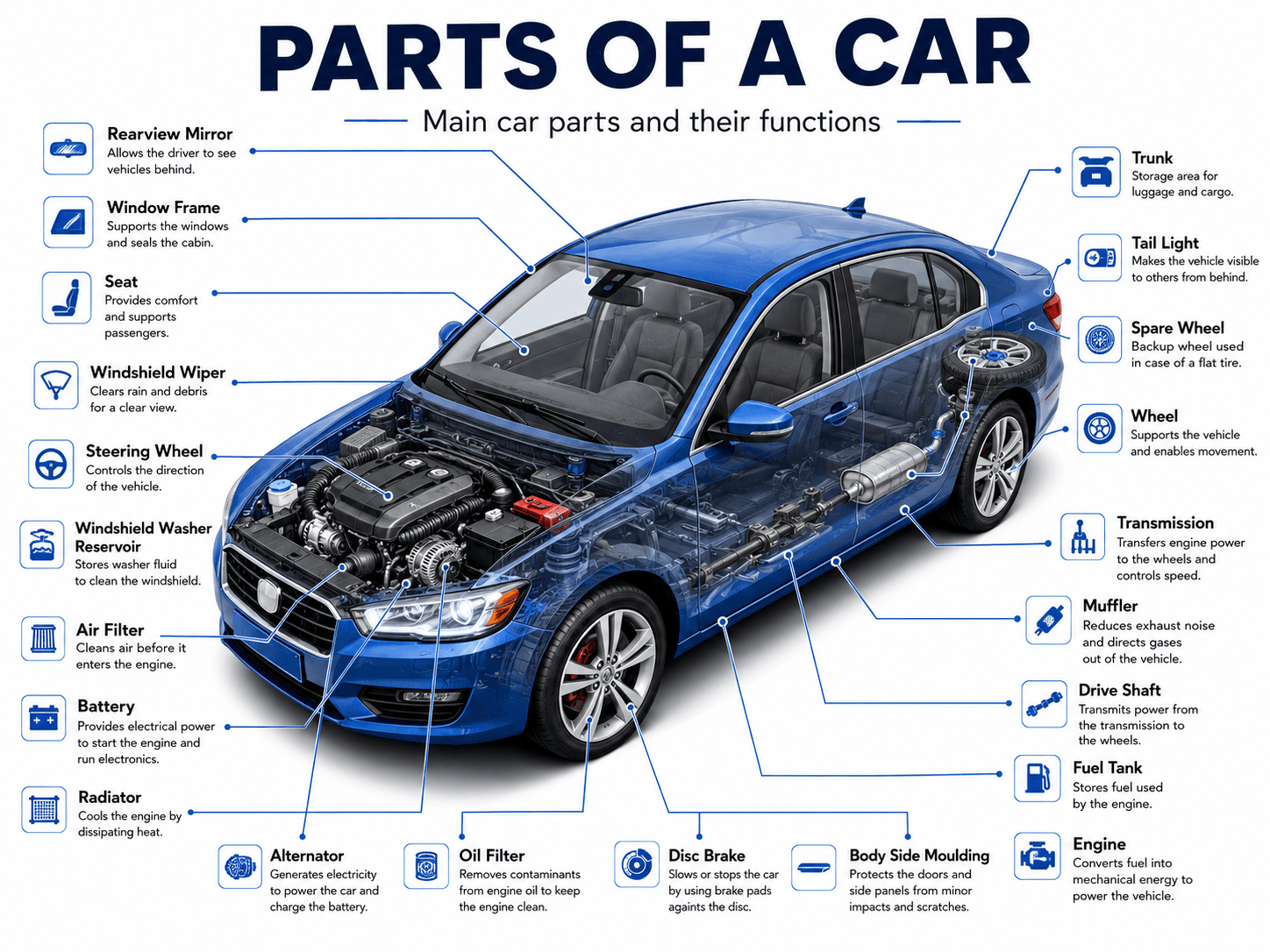
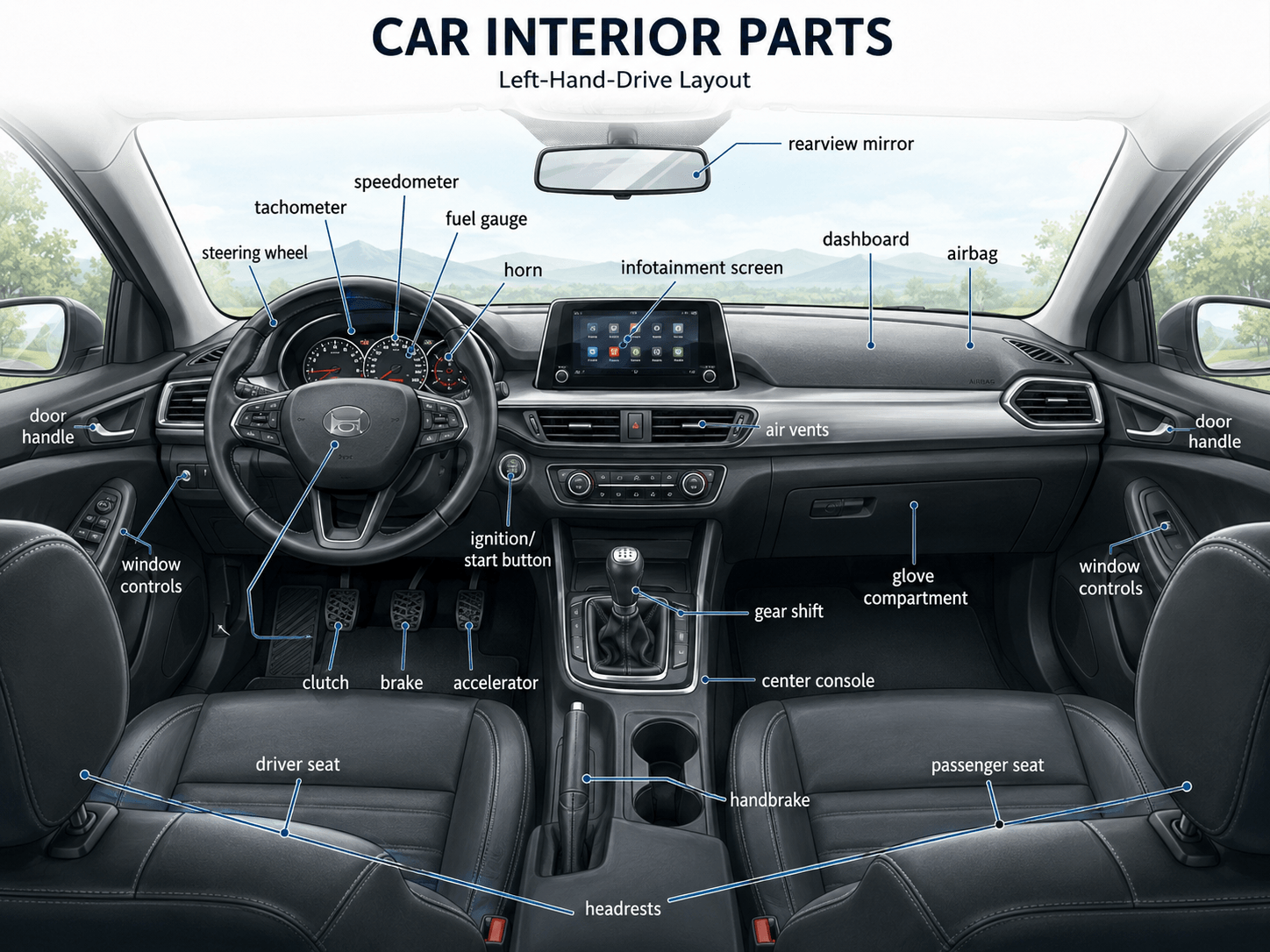
Car body parts include the exterior panels, structural sections, glass and lighting assemblies that shape and protect a vehicle. Common names include the hood, bumpers, fenders, doors, roof, pillars, quarter panels, rocker panels, trunk lid, windshield, mirrors and lights. The labeled diagram below shows where each part is located and explains its main function.
Car Body Parts Names List
| Area | Main body parts |
|---|---|
| Front | Hood, bumper cover, grille, fenders, headlights and cowl |
| Side | Doors, rocker panels, A/B/C pillars, mirrors and quarter panels |
| Rear | Trunk lid or liftgate, rear bumper, tail lights and rear body panel |
| Upper body | Roof panel, roof rails, windshield and rear glass |
| Lower structure | Floor pan, frame rails, wheelhouses and crossmembers |
Car Body Parts Diagram
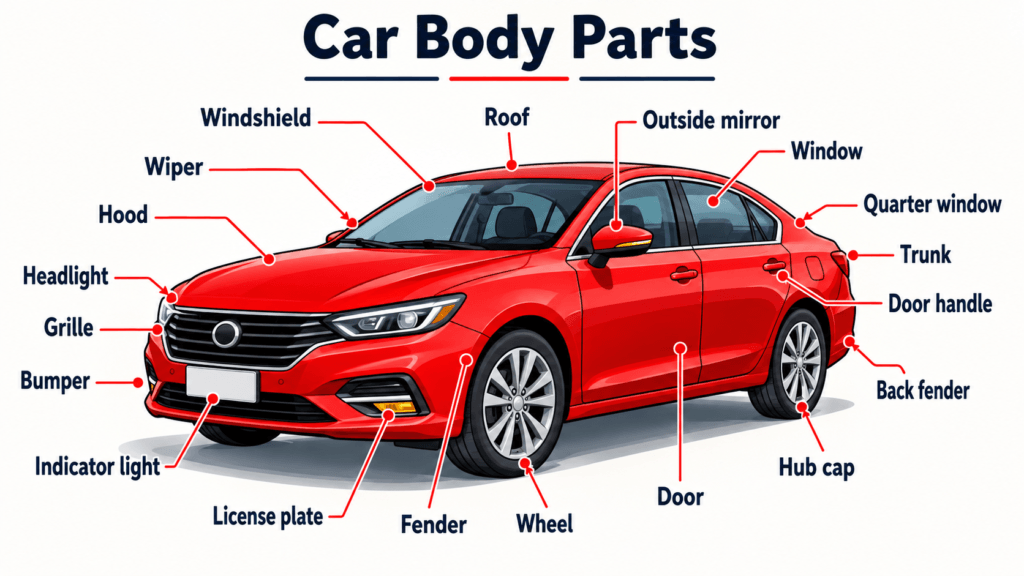
Parts of Car Body
1. Body Shell
The body shell is the main assembled structure of the vehicle before mechanical systems, trim, glass and interior components are installed. In most modern passenger cars, the body and underlying structure form a unibody construction. Some trucks and SUVs instead use a separate body mounted on a frame. Construction varies by vehicle design.
2. Hood or Bonnet
The hood or bonnet (used in some countries) is a thin sheet of material, usually hinged, that rests over the engine in nearly all motor vehicles. Under the hood, you can find the engine, battery, coolant, windscreen fluid, cooling fan, compressor, alternator, and many more.
It is an important element of the vehicle that provides immediate access for servicing, repair, and maintenance, while also protecting components from direct sunlight and dirt. It includes an added mechanism like a hidden latch to hold it securely in place when looking or inspecting your car.
3.Front and Rear Bumpers
The visible bumper cover is usually a molded outer panel that gives the vehicle its shape and appearance. Behind it may be an energy absorber, reinforcement beam, brackets and sensors. The complete bumper system helps manage minor impacts, but its materials and construction vary by vehicle. A cover with light cosmetic damage may be repairable, while damaged reinforcement or mounting points require proper inspection.
4. Fender
A fender is a curved body part placed above the wheels of a car. It is both a safety item and part of the car’s overall appearance. Its main purpose is to protect passenger compartments by preventing road mud, rocks, and liquids from being thrown in the air by a rotating tire.
5. Roof
Above the passenger compartment, it is among the most important components of a vehicle that rests atop the car. It is meant to protect passengers from wind, rain, and sun.
While hiding wiring, hardware, electrical components, antennae, and other accessories, many car roofs also include headliners that insulate against heat and noise. Some roofs are removable for leisure uses in certain situations.
6. Doors
Car doors are the main door structures used for opening and closing the side of a car. They are usually hinged on the outside of a vehicle and secured to a frame, sometimes potentially to a device depending on the design.
Their main job is to allow entering and exiting the vehicle. Many other door types also include windows, allowing an inhabitant to see from the interior of the vehicle. A door may be locked and can be operated manually or by a power source, especially when it is part of a minivan, luxury vehicle, or custom modification.
7. Window Glass
Window glass is used in cars mainly for vision. On the side of a car, that vision controlled by the glass becomes incredibly useful for both driver and passenger to see where they are going.
Another primary reason for the use of window glass is that it lets in natural sunlight and even artificial street lighting. Common types of window glass include single-layer toughened glass and laminated safety glass.
8. Mirrors
There are two types of mirror that are side-view mirrors and rear-view mirrors. Mirrors are another crucial body component.
Side-view Mirror
Outside the driver’s line of sight, side mirrors enable driver to observe behind the vehicle. This warns the motorist of risks and possible rear-end collisions.
One great advantage is the convex shape, which can offer greater general visibility along the side of the vehicle, hence helping to minimize blind spots.
Rear-View Mirror
A rear-view mirror or rear-view mirrors serve multiple purposes and help keep you safe by giving the driver a more alert driving experience. Its main job is providing a view behind the driver without turning their head, which is especially important when the vehicle is in reverse.
9. Trunk or Decklids
The trunk or decklids, also called trunk lid or dickey, is the rear storage space referred to in a car. It provides space for luggage at the rear of the vehicle in cars like a sedan, coupe, or convertible.
In general, its intended use is storage and carrying cargo. This important storage area should be cleaned from time to time, because loading excess luggage makes the engine work harder, using more fuel.
10. Head Light
Head lights or headlights have the main job to help you see the roadway and drive fatigue-free and safely. They include low beam headlights and high beam headlights, both attached to the front of the car.
They help the driver see the roadway at night and also alert other drivers that the car is present. Among types of lights on cars, each light type has its own purpose.
11. Tail Lights
Tail lights or taillights are a vital element of vehicle safety. They allow your vehicle to be viewed in low visibility conditions and inform other drivers when you are slowing down.
A tail light is usually red and may stay ON when the vehicle is on. The brake light is the primary illuminated red light that turns on while braking. Remember the brake light and tail lights are NOT the same.
12. Fog Lamp
Fog lamps direct light under fog so drivers can see the road surface without beams reflecting off the fog. There are two main types used in vehicles: front fog lamps and rear fog lamps.
Front fog lights often use yellow light or selective yellow to filter blue light and reduce glare, though not all yellow lamps are fog lamps and not all fog lamps are yellow.
Rear fog lamp gives a bright red light similar to a brake light, turned on in limited visibility. It helps make your vehicle more specific in low-traffic situations, especially when driving much slower, so other vehicles can see you if one is behind you, helping tell the other driver your position and impress on other drivers to stop or take care.
13. Indicator Lights
Indicator lights come in red, orange, white color, and are found on the front, rear, left side, right side of a vehicle. They communicate an intention to change direction (left or right) and help manage the flow of traffic.
Drivers should use them properly so the other drivers get time to react and make the turn safely. Always turn the indicator off immediately after you complete the turn to avoid confusing other drivers.
14. Bumper Grille
The bumper grille is a part of the front structure of a vehicle that allows ventilation and in many cases acts as a safety feature. It helps the engine keep cool when you drive your car, as it creates a vacuum that pulls air in.
The grille provides ventilation to the engine bay, helps protect the radiator, and facilitates the intake of cold air into the radiator of your vehicle. Depending on locations, it is also commonly used for front wheel brake cooling, cowl, passenger compartment ventilation, and even near the rear trunk lid in rear-engine vehicles.
15. Crash Guard or Bullbar
Crash guards or bullbars mount to the car’s front frame or chassis and are most frequently found on strong SUV models. They protect your car in the event of an accident and are considered vital vehicle body parts.
These are designed to help the vehicle keep on moving after a crash, made of heavily steel to prevent damage to the front of the vehicle. Along with protection, they also act as an accessory that improves good design and looks.
16. Quarter Panel
The quarter panel is the exterior side panel around the rear wheel opening. It normally extends between the rear door or side opening and the trunk, liftgate or tail-light area. Unlike many front fenders, a quarter panel is commonly welded or bonded into the body structure and may require cutting and refinishing during replacement.
17.Fender vs Quarter Panel
A fender is normally the exterior panel surrounding a front wheel opening. On many vehicles, it is bolted in place and can be removed separately. A quarter panel is normally the rear-side body panel between the rear door area and the trunk or tail-light section. It is commonly welded or bonded into the body structure, so replacement usually requires more extensive body repair.
18. Cowl Panel
The cowl panel or cowl panels are a significant cover that fills the gap between the hood and windshield of a car. It helps brace the dashboard, while preventing unwanted accesses to internal areas.
It also protects the windshield wiper system and helps prevent access to the cabin filter system.
19. Wiper Blade
The wiper blade or wiper blades are present on almost all vehicles like cars, trucks, buses and are very important for driver visual clarity. They remove snow, water, and debris from the front window, allowing the vehicle operator to see what may be ahead.
Especially useful during rain weather, when water droplets on the windshield can continually interfere with driver’s vision and cause major accidents. It is made up of rubber. They are degradable and their performance diminishes over time, so it is important to replace them every 6–12 months.
20. Radiator Supports
Radiator supports or radiator support parts secure and mount the vehicle’s radiator. They are made from steel, plastic, and aluminum.
Their main purpose is to secure the radiator under the hood of the vehicle, helping to protect it from being damaged. They also houses the condenser assembly and cooling fan system to protect while the vehicle is operational.
21. Fender Liners
A fender liner or fender liners sits around every vehicle wheel, with separate fender liners often used on each side. They are designed to help keep dirt, mud, water, environmental toxins, and contaminants from getting into the engine bay and ultimately causing damage to the car.
They also keep the wires and other components around the wheel well from corroding. It is not recommended to drive a vehicle with a bad fender liner or no fender liner, because the liner works as a buffer and barrier for the car’s engine, hood, radiator, headlights, and windshield.
22. Door Handle
A door handle or door handles enable the driver and passengers to enter and exit the car. It is one of the most functional parts of a car and can also house the door locks that unlock the vehicle from the outside or inside.
A variety of door handle types are available, depending on the car make and model.
23. Quarter Window
A quarter window is a small side window located in front of the front-door glass or behind the back-door glass. A fixed quarter window is often placed near the corner of the vehicle around the C-pillar.
It is designed to give a quick view of the road around the vehicle so the driver can safely turn, accelerate, park, and change lanes. It is typically found on old vehicles, often small triangular in shape at the front, and separate from the main window.
24. Sunroof
A sunroof provides a clean view of the sky, extra ventilation, sunlight, and an open feeling inside the car. It is a type of panel in the roof of a car that may slide or pop out to allow light into the vehicle.
It can be quite pricey because you pay for all the mechanisms that operate the sunroof. It is also expensive to fix because rubber, glass, motor, and other components may need frequent service maintenance.
25. Mud Flaps
Mud flaps are useful on a car, SUV, or truck because your vehicle must deal with tires that are constantly exposed to mud, dirt, rocks, salt, water, and other elements on roads.
They are intended to catch dirt and stones and prevent it from coming to your vehicle at the back and front. A vehicle without mud flaps often needs to be maintained more regularly, causing loss of time and other things that matter.
26. Wheels
Wheels are among the most basic components and also important components of a car body. They creates rotary motion so a car can travel from one point to another.
The rubber wrapped around the wheel is tire that grips road. Wheels cannot rotate properly without a tire. There are many different types of tires sold in the market.
27. Hubcap
A hubcap is a decorative disk found on a wheel of an automobile. It covers the center of the wheel, and its primary purpose is to cover the wheel hub and fasteners while helping keep dirt and moisture from entering the wheel itself.
It also helps improve the appearance. Driving without hubcap allows dirt collect in the tire. It also helps keep foreign substances from damaging your wheel, prolonging its life.
28. Number Plate
A number plate is required under the Motor Vehicle Act, where the government mandates that every vehicle must have a number plate with certain specifics. For any vehicle, there are four important factors, and the number plate numbers give it a unique identity.
Today, all the vehicles on the road must show registration on the front sides and back sides of the vehicle.
Which Car Body Parts Can Be Repaired or Replaced?
| Part | Common attachment | Common damage | Usually repaired or replaced? |
|---|---|---|---|
| Hood | Hinges and bolts | Dents, corrosion and bent edges | Minor dents may be repaired; severe distortion may require replacement |
| Front fender | Usually bolted | Dents, scrapes and wheel-arch corrosion | Often repairable or replaceable separately |
| Door shell | Hinges and bolts | Dents, intrusion damage and corrosion | Repair depends on the condition of the inner structure and reinforcement |
| Bumper cover | Clips, screws and brackets | Scratches, cracks and deformation | Small damage may be repaired; major cracks may require replacement |
| Quarter panel | Commonly welded or bonded | Dents, collision folds and corrosion | Repair may be preferred where appropriate; replacement is more extensive |
| Rocker panel | Structural welds or bonding | Crushing, corrosion and impact damage | Requires structural repair assessment |
| Trunk lid or liftgate | Hinges and bolts | Dents, misalignment and latch damage | Often repairable or replaceable |
| Pillars and roof rails | Structural construction | Buckling, cracks and collision damage | Professional structural assessment is required |
Body Parts vs Related Car Components
Not every visible component is technically a body panel. The radiator belongs to the cooling system, the dashboard is an interior component, and wheels and hubcaps belong to the wheel assembly.
Wiper blades, number plates, mud flaps and bull bars are exterior equipment or accessories.
They may attach to the body, but they should not be classified as primary car body panels.
Method Note
This guide classifies visible exterior panels, structural body sections, glass and lighting assemblies. Attachment and repair methods vary by model, so collision repairs should be checked against the vehicle manufacturer’s body-repair procedure.
Safety: Damage to pillars, rocker panels, roof rails, floor sections or frame rails can affect the vehicle’s structure and safety-system operation. Significant collision damage should be assessed by a qualified body-repair technician.
Final Words
Understanding the names and locations of car body parts makes it easier to describe damage, communicate with a repair shop and identify the correct component.
Exterior panels such as fenders, doors and bumper covers may sometimes be repaired or replaced separately. Structural areas such as pillars, rocker panels, floor sections and frame rails require more careful assessment because their repair methods vary by vehicle design.
FAQ
What are the main body parts of a car?
The main body parts include the hood, bumpers, fenders, doors, roof, pillars, rocker panels, quarter panels, trunk lid or liftgate, glass, mirrors and exterior lights.
Is a fender the same as a quarter panel?
No. A fender normally surrounds a front wheel opening and is often bolted on. A quarter panel surrounds a rear wheel opening and is commonly welded or bonded into the body.
Is the bumper cover the complete bumper?
No. The visible bumper cover is only the outer panel. Reinforcement beams, energy absorbers, brackets and sensors may be installed behind it.
Which car body parts are structural?
Depending on the vehicle, pillars, rocker panels, roof rails, floor sections, frame rails, crossmembers and wheelhouses may contribute to the structure. Exact repair rules vary by model.