
Contents
15 Car Wheel Parts: Names, Functions & Diagram Explained
The basic parts of a car wheel can be understood better with a diagram and a quick explanation. From small cars to big trucks, every vehicle depends on a simple wheel mechanism for movement. Even though modified cars come in many bodies, designs, and sizes, most auto parts of the wheel follow the same concept. Some older designs have become obsolete, while others appear as a newer version of the same idea.
A wheel is a circular part that rotates on bearing connected to the axles. This system allows heavy things to be transported, creating smooth movement while carrying loads or doing labor in machines. Wheels produce rotatory motion,which helps to transport objects from one place to another. Without wheels, cars and trucks would just sit still like expensive lawn ornaments.
Since there are multiple parts of a wheel, each performs a particular job, so here is a of important pats of wheels.
Parts of Car Wheel
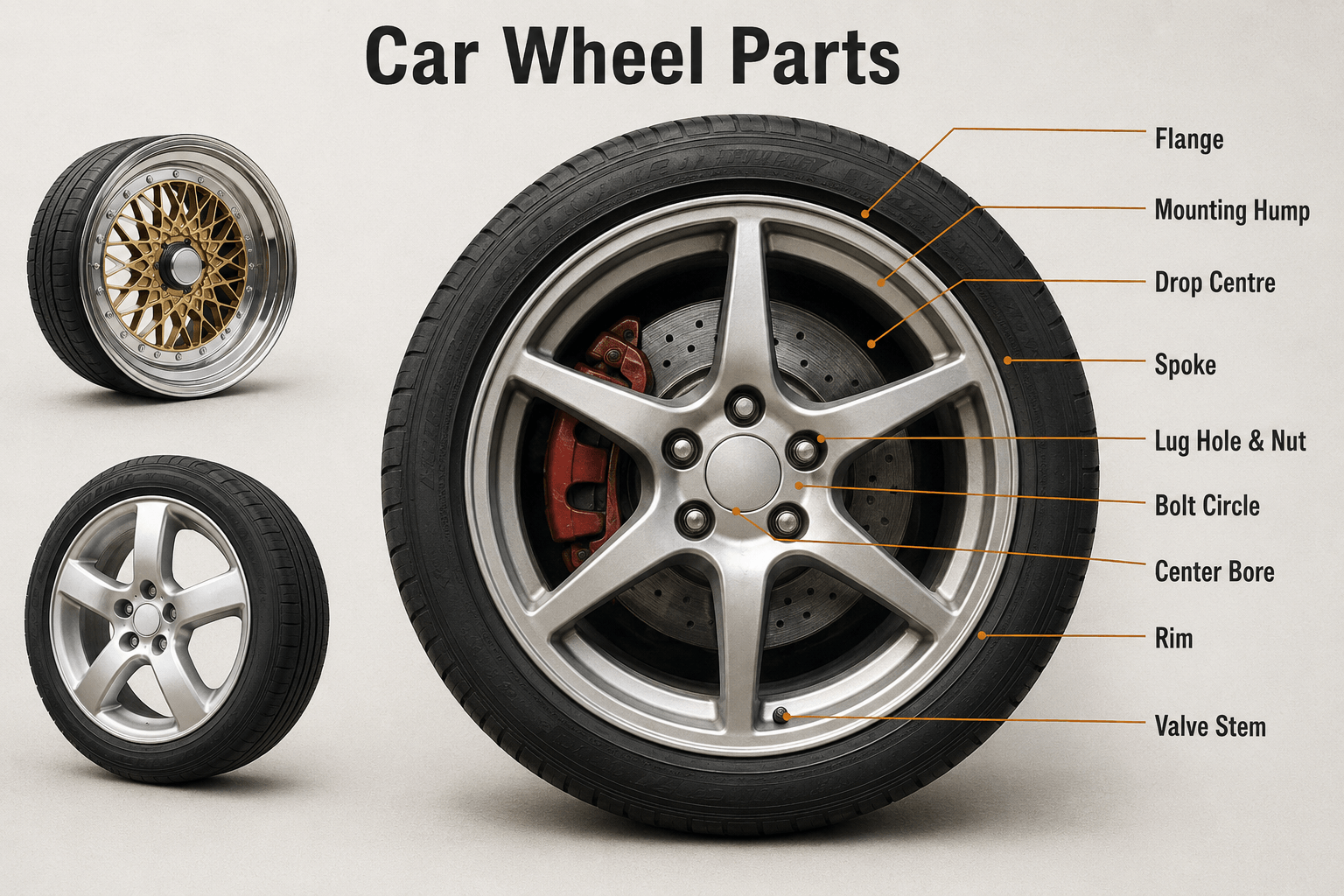
The main parts of car wheel or car wheel parts include:
- Wheel Bearing
- Wheel Rims
- Tire
- Wheel Hub
- Wheel Fasteners
- Barrel
- Bolt Circle
- Outer Lip
- Flanges
- Centre Bore
- Valve System
- Spoke
- Center Cap
- Beads
- Lug Hole
1.Wheel Bearings
Wheel bearings are antifriction bearings designed to provide low friction while the turning wheels move around the stationary parts of the vehicle. They usually include an inner race, a rolling element, and an outer race. Their main purpose is to help the wheels spin free while reducing friction.
They are installed in wheel hubs at the center of the wheel, connecting the wheel to the metal axle shaft. By helping wheels rotate smoothly in a vehicle application, they support the load type of the car and maintain safe performance even at maximum bearing speed.
2.Wheel Rims
Wheel rims or rims are the outer edges of car wheels responsible for holding the tire securely. They support and seal the tire to ensure a proper fitting. The rim is commonly made of steel and is mounted and bolted to the hub.
Traditional steel rims are strong but heavier. Many modern cars use aluminum alloy rims with added materials. These materials make the wheel lighter, which helps to decrease weight. Today, custom rims are also popular for customization, colorful styling, and unique styling, though they may come with added cost.
3.Tire
The tire or tires support the weight of the vehicle and help absorb impact or shock from the road. They provide traction for torque, braking forces, and grip on the road surface during directional travel.
A tire is made of flexible rubber with an outer surface filled with compressed air. It works with the suspension system and covers the wheel rims so the metal wheel is not directly rubbing or touching ground. The tire surface contains threads that improve road contact.
Over time they wear out and must be replaced. Some types include studded tires, grooved patterns, or notched patterns that improve friction and help with channeling water or debris away from the contact area.
4.Wheel Hub
The wheel hub or wheel hub assembly connects and attaches car wheels to the vehicle. It allows the wheel to spin freely while helping the driver drive safely. Modern hubs often integrate safety systems such as the anti-lock braking system (ABS) and traction control systems (TCS).
Located at the center of the wheel, the hub is where the rim attached, along with brake pads, calipers, rotors, and tires. Many hubs use five bolts with a lug nut to secure the wheel firmly.
5.Wheel Fasteners
Wheel fasteners include wheel studs and other components that hold the wheel firmly in place. The rim mounts onto the hub or axle flange using threaded bolts or studs that are usually pressed into hub or bolted to hub.
These fasteners create a tight joint between the wheel and axle. Each stud head passes through a stud hole positioned around the axle center in the hub flange unit and aligns with the center of rim.
6.Barrel
The barrel is the inner wheel part located between the outboard face and the inboard rim edge. Its main job is mounting the tire and providing enough inner diameter space for brake components.
Most wheels include a drop center, allowing easier installation depending on the mount wheel type used for front-wheel drive vehicles or rear-wheel drive vehicles. These drop centers and flanges help prevent tire slipping during car motion.
7.Bolt Circle
The bolt circle, also called the bolt pattern or bolt circle diameter, refers to the layout of the lug bolt area. It describes the number of lugs positioned around an imaginary circle passing through the centers of lugs or lug bolt holes.
Often labeled as BCD, this measurement is important in wheel design and compatibility. Car brands such as Nissan and Mercedes follow specific patterns, and matching them ensures proper cross-fit wheels during car manufacturing.
8.Outer Lip
The outer lip is the visible wheel area near the rim edge. This area often shows damage if a wheel collapse occurs from wheel impact with a pothole.
The lip depth affects the look of the wheel face, and a deeper outer lip can highlight the design. However, it is also more exposed to impact damage, so the spokes support and structure near the wheel edge must remain strong.
9.Flanges
Flanges or wheel flange sections act as a connector between vehicle wheels and the axle components such as the drive axle or spindle. These structural components run along the wheel sides.
Their purpose is to minimize tire slip by holding the tire tightly. They work together with lug nuts in the mounting method to keep the tire held snugly even on uneven road surfaces.
10.Center Bore
The center bore is the wheel center opening, a machined opening that helps center the wheel on the vehicle hub. When properly aligned, the wheel becomes hub-centric, which helps vibration limit during driving.
Although it may appear as an empty space, it is a functional area providing axle support and carrying the car weight. Correct hub collar diameter, central bore diameter, and wheel fitting are required to achieve the desired fit.
11.Valve System
The valve system allow tires to inflate and deflate properly. Each valve controls air entering the tire, maintaining correct tire pressure for safety.
12.Spokes
Spokes create the rim connection between the outer rim and the wheel plate center where the lug holes or bolt holes are located. These structures support the wheel attachment.
Spokes also help protect outer edge areas from minor impacts. Different spoke designs, including classic spokes or intricate design patterns, influence both spoke stability and strength depending on the design material.
13.Center Cap
The center cap or car wheel center cap covers the middle of the wheel to provide wheel rims protection and tires protection from dirt and sunlight effects. This helps maintain the look of the wheel when parked in public parking areas.
Placed where the wheel center and spokes meet, the removable center cap can also change the rim appearance. Many wheel models use custom caps to give a more finished appearance.
14.Beads
Beads or tire beads help anchor tire edges to the outer surface of wheel. These sections contain tension wires surrounded by a rubber pack that tightly grips the wheel frame.
This design ensures efficient energy transfer between tire and wheel. If damaged beads occur, the vehicle shake can become noticeable at high speeds because the tire cannot maintain an airtight fit along the wheel side.
15.Lug Hole and Nut
A lug hole or lug holes are openings positioned along the bolt circle of the wheel’s centered disc. Each hole fits a lug nut used for wheel hub fastening.
The nut threads onto a threaded wheel stud connected to the vehicle axle. This keeps the wheel properly aligned through wheel centering and ensures secure wheel securing. The nut fastener often has a round end or conical tapered end to hold the wheel tightly.
Conclusion
In simple terms, wheels are vital car parts with circular shapes that create rotary motion to roll automobile systems forward. Without them there would be no carriage movement from point A to B, making them a truly vital automobile component.