
Contents
- Car Shakes at Idle But Smooths Out While Driving: Here Is What Is Really Going On
- What This Problem Actually Means
- What Causes Car Shakes At Idle But Smooths Out While Driving?
- Why Your Car Shakes More at Idle Than While Driving?
- How to Diagnose This Yourself: Step-by-Step
- Quick Cause and Fix Reference
- When the Shaking Is Serious Enough to Stop Driving?
- Frequently Asked Questions
- FINAL WORDS
Car Shakes at Idle But Smooths Out While Driving: Here Is What Is Really Going On
You pull up to a red light. The engine is running while your foot is on the brake and then suddenly the whole cabin starts shaking. The seat vibrates. The steering wheel shudders in your hands and it felt like something is seriously wrong. Then the light goes green and you press the gas and within seconds the car drives perfectly smooth. No shaking. No vibration. Almost like nothing happened.
If that describes exactly what are you experiencing, you are dealing with a very specific and common problem. The good news is that this pattern, shaking only at idle but smooth while moving, actually helps narrow down the cause significantly. Not every rough idle is the same, and the fact that your car smooths out when driving tells a mechanic a lot about where to look.
This guide explains what is happening, why it happens specifically at idle and not while driving, every likely cause in order of how common they are, and what you should do about each one.
What This Problem Actually Means

While the car is stopped and its engine is running to its lowest RPM. At this speed, the engine has the least momentum and the least power to cover up internal imbalances.
When you accelerate and drive, two things change. First, the RPM rises, and the increased combustion frequency smooths out minor timing or fuel inconsistencies. Second, road vibration and wind noise naturally mask cabin vibrations. So a problem that was already there becomes impossible to feel once you are moving.This is why the pattern you are experiencing is so telling.
What Causes Car Shakes At Idle But Smooths Out While Driving?
Worn or Fouled Spark Plugs
This is where the diagnosis should start in almost every case. Spark plugs ignite the compressed air-fuel mixture in each cylinder. When a plug is old, oil-fouled, or has too wide a gap, it produces a weak or inconsistent spark. That cylinder either misfires or fires late.
At idle, one weak cylinder is enough to make the entire engine shake. At higher RPM, the same weak cylinder’s misfire is masked by the momentum of the other cylinders firing rapidly. The shake disappears when you drive, but the plug is still failing.
Check the plug condition. Carbon buildup, oil fouling, and electrode erosion are all visible to the eye. Most plugs need replacement between 30,000 and 100,000 miles depending on type.
If you suspect oil is getting into the plug wells, that is a separate problem. It often points to a leaking valve cover gasket or bad spark plug tube seals, which can cause misfires and rough idle.
Faulty Ignition Coils
The ignition coil delivers the high-voltage spike that fires the spark plug. As most of the modern engines use individual coils on each cylinder. So When one coil weakens, it struggles to fire its cylinder at idle, but can still fire under the higher electrical demand of normal driving because the reduced cycle time gives it a moment to recover between sparks.
The engine may feel rough when the car is stopped. But when you press the gas, the RPM goes up and the vibration becomes harder to notice.An OBD2 scanner can help confirm this problem. If you see codes like P0301, P0302, P0303, or P0304, it usually means one cylinder is misfiring.A simple way to test the coil is to move it to another cylinder. If the misfire code moves to that cylinder, the ignition coil is likely the problem.
Vacuum Leaks
Your engine depends on hoses and gaskets that maintains the precis pressure in the intake manifold. When a hose cracks or loosens, unmetered air may leaks into the intake. This extra air leans out the fuel mixture in a way that the ECU struggles to fix properly while the engine is idling
At idle, the engine uses very little airflow and runs a very precise mixture. A vacuum leak at idle may creates a noticeable disruption. At higher RPM, the throttle is opened and the extra air from the leak becomes a smaller percentage of total airflow. So the engine compensates better and the shake disappears.
A hissing sound near the engine, especially at idle, is often the first clue. An OBD2 scanner showing P0171 or P0174 lean codes confirms it. Short-term fuel trims above +10% at idle almost always point to a vacuum leak or a dirty MAF sensor.
Worn or Broken Engine Mounts
Engine mounts do two things: they hold the engine to the chassis, and they absorb the engine’s natural vibration through rubber or fluid-filled damping. When a mount wears out or cracks, the engine’s vibration transfers directly into the cabin.
Here is the specific diagnostic test for this cause. With the car stationary, shift from Park to Drive and hold the brake. If the shaking gets noticeably stronger in Drive than in Park or Neutral, engine mounts are highly suspect. This happens because putting the transmission in Drive places torque load on the engine, which stresses the mounts.
When you drive, the car’s forward motion and road input mask the vibration from worn mounts. This explains perfectly why the car shakes at idle but feels fine on the road.
You can do a visual check by opening the hood and having someone rev the engine while you watch. If the engine lurches, rocks, or moves excessively in the bay, at least one mount is compromised.
Dirty Throttle Body or Faulty Idle Air Control Valve
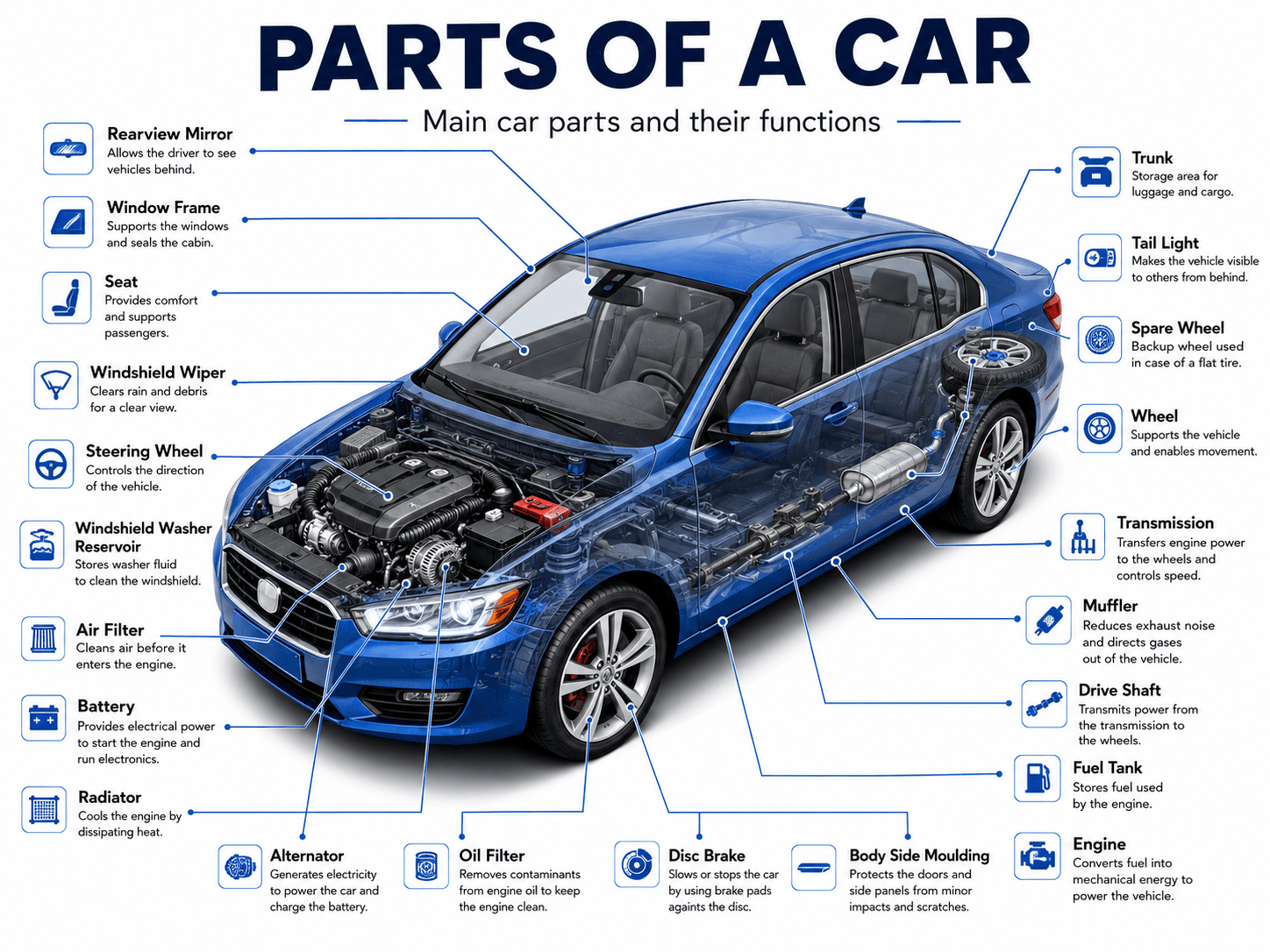
The throttle body controls how much air enters the engine. The idle air control valve, on vehicles that have one, fine-tunes airflow specifically at idle to compensate for accessory loads like AC, power steering, and the alternator. Carbon deposits build up on both over time.
At idle, the throttle plate is nearly closed. Even a small carbon deposit on the throttle plate or IAC valve disrupts the carefully controlled airflow the engine needs at low RPM. At driving speeds, the throttle plate opens wide and the carbon deposit becomes irrelevant.
A throttle body cleaning costs very little if done as a DIY job, and it fixes this issue immediately in most cases. If the IAC valve is sticking or has failed electrically, cleaning helps but replacement may be necessary.
Clogged Fuel Injectors
Each injector must spray a precise mist of fuel into its cylinder. Carbon deposits from combustion gradually block the injector tip, reducing fuel delivery and disrupting spray pattern. At idle, the fuel demand is low and the timing is precise. A partially clogged injector cannot deliver its quota cleanly, causing an imbalance.
At higher RPM, the fuel demand increases and the fuel pressure behind the injector helps push past a partial clog more effectively. The imbalance decreases and the shake goes away.
A fuel system cleaner added to the tank helps with mild deposits. Professional ultrasonic cleaning or injector replacement handles more severe cases.
Loose Battery Terminals or a Weak Alternator
This cause is less common but worth checking, especially if the shaking is accompanied by electrical symptoms like flickering headlights or slow cranking. A loose or corroded battery terminal can create a resistance in the electrical circuit that causes voltage drop at idle RPM. The engine management system may not receive stable voltage, causing erratic idle behavior.
The alternator charges the battery and powers all electrical systems while the engine runs. If it is weak, the load at idle may not be met, and the ECU can react by slightly altering ignition timing, which creates rough idle. At higher RPM, the alternator generates more power and the problem disappears.
Check the battery terminals first. They should be clean, tight, and free of white or green corrosion. A simple battery and alternator load test at any auto parts store can rule this out.
Crankshaft Position Sensor Failing Intermittently
The crankshaft position sensor tells the ECU exactly where each piston is at every moment, allowing perfect timing of spark and fuel injection. When this sensor starts failing, the signal it sends becomes intermittent. At idle, where timing precision matters most and there is no extra RPM headroom to cover timing errors, even a brief signal dropout causes a misfire and a shake.
At driving speed, the engine’s momentum and higher RPM tolerate brief sensor dropouts better. The shake seems to go away. This is one of the harder causes to catch because it does not always set a code until the sensor fails more completely.
More detail is in this guide on the crankshaft position sensor.
Why Your Car Shakes More at Idle Than While Driving?
At idle your engine is running at its lowest speed. It is not getting much air. It is not using much fuel. It also has no road movement to help hide vibration. Every cylinder must fire consistently and If one cylinder does not produce the same power as the others, you feel it through the steering wheel, seat, floor or sometimes dashboard.
When you drive, the higher RPM means the combustion events happen so fast and so frequently that a single weak cylinder has less relative impact on the whole engine. The physics of rotating mass smooths things out. That is the core reason your car shakes at idle but not while driving.
How to Diagnose This Yourself: Step-by-Step
Step 1. Plug in an OBD2 scanner and read all codes, including pending codes. Look for P030X misfire codes, P0171/P0174 lean codes, and any sensor-specific codes.
Step 2. Check live data. Look at short-term fuel trims at idle. Above +10% means lean, which points to a vacuum leak or MAF issue. Watch misfire counters to see which cylinder is accumulating misfires.
Step 3. Shift test. Engine running, foot on brake, shift from Park to Neutral to Drive. Does the shake change character? Worse in Drive = mounts. Same in all positions = combustion or sensor issue.
Step 4. Visual inspection. Open the hood with the engine running. Listen for hissing near hoses and the intake manifold. Look for cracked rubber hoses. Watch the engine for excessive movement.
Step 5. Pull the air filter and inspect it. A visibly black, clogged filter affects idle quality and takes two minutes to check.
Quick Cause and Fix Reference
| Cause | Key Symptom | Fix | Rough Cost |
|---|---|---|---|
| Worn spark plugs | Rhythmic shake, P030X code | Replace plugs | $30–$200 |
| Bad ignition coil | Shake on one cylinder, P030X | Swap test, replace coil | $80–$250 |
| Vacuum leak | Hissing sound, lean codes | Replace hose or gasket | $50–$200 |
| Worn engine mounts | Worse in Drive, engine rocks | Replace mounts | $200–$550 |
| Dirty throttle body | Carbon buildup, erratic RPM | Clean throttle body | $75–$180 |
| Faulty IAC valve | Hunting idle, surging RPM | Clean or replace IAC | $100–$250 |
| Clogged fuel injectors | Rough idle, poor economy | Clean or replace injectors | $100–$300 |
| Weak alternator | Electrical symptoms + shake | Load test, replace | $200–$600 |
| Crankshaft sensor | Intermittent, hard to catch | Replace sensor | $150–$350 |
| Loose battery terminal | Flickering lights + shake | Clean and tighten | $0–$20 |
When the Shaking Is Serious Enough to Stop Driving?
If the check engine light is flashing, not just steady but flashing, stop driving. A flashing CEL means an active severe misfire is happening right now. Unburned fuel entering the catalytic converter during a misfire can overheat and destroy it within miles. A catalytic converter replacement costs $800 to $2,500. The spark plug or coil that caused it costs $30 to $80. The math is not complicated.
Also stop driving immediately if the shaking is accompanied by engine knocking. A misfiring engine that is also knocking can indicate an internal problem that gets worse with every mile. Read more about what that combination means in this guide on engine knocking when accelerating.
If the shake is mild and the check engine light is steady, not flashing, you can drive carefully to a shop within a day or two. Do not let it drag on for weeks.
Frequently Asked Questions
Why does my car shake at idle but stop shaking when I give it gas?
Because giving the car gas raises RPM. At higher RPM, the engine has more momentum to smooth out misfires and more airflow to tolerate a vacuum leak. The problem is still there, but the conditions that make it visible, low RPM and low load, go away when you accelerate.
Is it safe to drive if my car only shakes at idle?
It depends on the cause. Misfires are not safe to drive with for long because they damage the catalytic converter. Worn engine mounts are less urgent but can get worse. Vacuum leaks cause lean running which can harm the engine over time. Do not ignore any of these.
Can a bad engine mount really cause shaking only at idle?
Yes. At idle, the engine vibrates at a lower frequency that resonates more with worn mounts. At driving speed, road noise and cabin movement mask the vibration from the mounts. The shift-to-Drive test, where shaking increases in Drive compared to Neutral, is the clearest way to identify this.
My car shakes and also has a check engine light. What should I do first?
Read the codes first. An OBD2 scanner, free to use at most auto parts stores, will tell you exactly which system is triggering the light. This single step eliminates hours of guessing.
Can a dirty air filter cause this specific problem?
A severely clogged air filter can cause rough idle by restricting airflow. At driving speed, the higher throttle opening demands more airflow and the engine works through the restriction more effectively. Replacing the air filter is cheap and takes five minutes. It should always be the first mechanical check before anything else.
FINAL WORDS
The reason your car shakes at idle but while driving while driving it became smooth, its not a mystery. It is a physics problem. Your engine at idle has the least ability to mask its own weaknesses. Sometimes, support system is not performing consistently enough to keep combustion balanced at low RPM.
Find what that thing is, fix it early and the car will idle the way it is supposed to: quietly, smoothly, and without drama at every red light.