
Contents
- Engine Misfire Symptoms: 11 Warning Signs You Should Never Ignore
Engine Misfire Symptoms: 11 Warning Signs You Should Never Ignore
A healthy engine always feels smooth. It starts clean. It accelerates without hesitation. It does not shake at idle and it does not struggle under load. The moment that smooth behavior disappears you are most likely dealing with engine misfire symptoms.
From workshop experience I can tell you one thing very clearly. Most drivers ignore early engine misfire symptoms because the car still runs. That is the biggest mistake. A small misfire can turn into engine knocking when accelerating or even damage expensive parts if it keeps getting ignored.
An engine misfire simply means one or more cylinders are not burning fuel properly. That happens when spark fuel air compression or timing is not correct. When that balance breaks the engine starts showing engine misfire symptoms in different ways.
Quick Answer
Engine misfire symptoms include rough idle shaking hesitation during acceleration loss of power hard starting stalling poor fuel economy fuel smell uneven exhaust sound smoke and check engine light. A flashing check engine light with shaking is the most dangerous condition because it can damage the catalytic converter quickly.
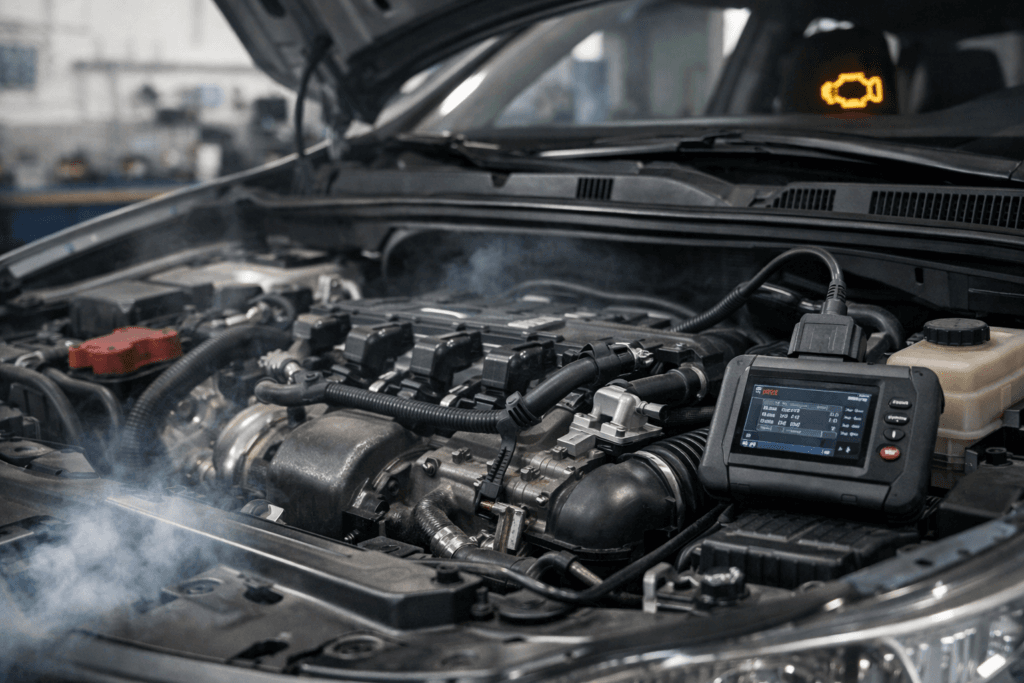
What Is An Engine Misfire
Every engine cylinder works like a small power unit. It pulls air and fuel compresses it and ignites it at the right moment. If one cylinder fails the engine becomes unbalanced. That imbalance creates engine misfire symptoms.
Sometimes drivers confuse this with other issues like ticking noise in engine causes or general vibration. But misfire has a specific pattern. It feels uneven. It feels like power is missing.
Most Common Engine Misfire Symptoms
1. Rough Idle
A rough idle is one of the first engine misfire symptoms. The car is stopped but the engine feels unstable. You may feel vibration in the steering wheel or seat.
This is different from normal vibration. If the engine feels uneven only at idle and improves when driving then it strongly points toward engine misfire symptoms.
2. Shaking Or Vibration
When a cylinder does not fire correctly the engine loses balance. That creates shaking. This is one of the clearest engine misfire symptoms.
Do not confuse this with brake or wheel vibration. If the shaking is present while standing still it is most likely engine related.
3. Hesitation During Acceleration
If the car hesitates when you press the accelerator that is a classic engine misfire symptom. The engine struggles to deliver power.
This can also feel similar to car squeaks when reversing or other mechanical noises but the difference is response. Misfire affects acceleration directly.
4. Loss Of Power
Loss of power is another strong engine misfire symptom. The car feels weak especially on hills or during overtaking.
Sometimes drivers think it is just low engine performance. But if power loss comes with roughness then it is most likely engine misfire symptoms.
5. Hard Starting
If your engine takes longer to start or starts rough then it can be one of the engine misfire symptoms.
Cold starts reveal weak ignition parts. This is also where problems like key wont turn in ignition causes get confused with engine issues. But once the engine cranks rough start points toward misfire.
6. Stalling
A severe misfire can cause stalling. The engine fails to maintain stable combustion and shuts off.
This is no longer a small issue. When engine misfire symptoms reach this stage immediate diagnosis is required.
7. Check Engine Light
A check engine light is a major indicator of engine misfire symptoms.
- Steady light means problem exists
- Flashing light means serious misfire
A flashing light should never be ignored.
8. Poor Fuel Economy
When fuel is not burned properly the engine becomes inefficient. This leads to poor fuel economy.
This symptom is often ignored because it builds slowly. But combined with rough running it becomes a strong sign of engine misfire symptoms.
9. Uneven Exhaust Sound
Misfire changes how exhaust sounds. You may hear popping or irregular sound.
This can also overlap with black smoke from exhaust causes or other combustion issues.
10. Fuel Smell
If you smell fuel from exhaust it means fuel is not burning correctly. That is one of the clear engine misfire symptoms.
This condition can also damage the catalytic converter.
11. Smoke From Exhaust
Different smoke colors can point to deeper issues:
- White smoke from exhaust may indicate coolant problem
- Black smoke from exhaust causes relate to rich mixture
- Blue smoke from exhaust causes point toward oil burning
If smoke appears with rough running then the misfire may be linked with a bigger issue like coolant in oil symptoms or internal damage.
Engine Misfire Symptoms By Driving Situation
Misfire At Idle
Common causes:
- vacuum leak
- injector issue
- weak spark
This can also relate to cooling issues like coolant disappearing no leak in advanced cases.
Misfire When Accelerating
Common causes:
- ignition coil failure
- spark plug wear
- fuel delivery problem
This pattern is very common and strongly linked with engine misfire symptoms.
Misfire On Cold Start
Common causes:
- spark plugs
- injector leak
- compression issue
Cold start misfire can sometimes overlap with coolant boiling but not overheating or early head gasket problems.
Misfire Under Load Or Highway
If the car misfires on highway then possible causes include:
- fuel delivery weakness
- overheating conditions
- restricted cooling
This connects with car overheating on highway causes and radiator fan not working symptoms.
Engine Misfire Symptoms And Causes Table
| Symptom | Likely Cause | Urgency |
|---|---|---|
| Rough idle | spark plug coil vacuum leak | Medium |
| Jerking | ignition or fuel issue | High |
| Hard start | ignition or compression | Medium |
| Stalling | severe misfire | High |
| Flashing light | active misfire | Very High |
| Fuel smell | incomplete combustion | High |
| Smoke | internal issue | High |
What Causes Engine Misfire Symptoms
Ignition Problems
- bad spark plugs
- weak ignition coils
Fuel Problems
- clogged injector
- low fuel pressure
Air Problems
- vacuum leak
- incorrect air mixture
Mechanical Problems
- low compression
- valve damage
- blown head gasket symptoms
Mechanical causes are serious and should not be ignored.
Can You Drive With Engine Misfire Symptoms
Short answer is yes for very mild cases but not recommended.
Do not drive if:
- engine is shaking badly
- check engine light is flashing
- power loss is severe
Diagnosis Steps
- Check engine codes
- Identify when misfire happens
- Inspect spark plugs
- Check coils and injectors
- Test compression if needed
FAQs
What are the most common engine misfire symptoms?
Common engine misfire symptoms include rough idle shaking hesitation loss of power hard starting stalling poor fuel economy fuel smell and check engine light.
Can bad spark plugs cause engine misfire symptoms?
Yes. Bad spark plugs are one of the most common causes of engine misfire symptoms and can lead to rough running poor acceleration and hard starting.
Can I drive with engine misfire symptoms?
You can in some mild cases but it is not recommended. If the engine is shaking badly or the check engine light is flashing then stop driving and get it checked.
Why does my car misfire when accelerating?
This usually happens because the engine struggles under load. Common causes include weak ignition coils worn spark plugs or fuel delivery problems.
Can engine misfire symptoms damage the catalytic converter?
Yes. A serious misfire can send unburned fuel into the exhaust and damage the catalytic converter.
Final Verdict
Engine misfire symptoms should never be ignored. A small issue can turn into major engine damage if left untreated. The earlier you diagnose the problem the cheaper it is to fix.