
Contents
- Fender vs Quarter Panel: What Is the Difference?
- Fender vs Quarter Panel at a Glance
- What Is a Fender?
- What Is a Quarter Panel?
- Fender vs Quarter Panel: Key Differences
- Is the Panel Above the Rear Wheel a Fender or Quarter Panel?
- Fender Repair vs Quarter-Panel Repair
- Can a Quarter Panel Be Replaced?
- How to Identify the Damaged Panel
- Common Identification Mistakes
- Safety and Repair Considerations
- Frequently Asked Questions
- Is a fender the same as a quarter panel?
- Is the rear fender called a quarter panel?
- Where is the quarter panel located?
- What is a car fender?
- Is a fender bolted or welded?
- Is a quarter panel welded to the car?
- Can a quarter panel be replaced?
- Which costs more to replace, a fender or quarter panel?
- Can a dented quarter panel be repaired?
- Is the quarter panel part of the car’s structure?
- What is the panel above the rear wheel called?
- Final Summary
- Method and Limitations
Fender vs Quarter Panel: What Is the Difference?
A fender normally surrounds a front wheel opening, while a quarter panel normally surrounds a rear wheel opening. Front fenders are often removable panels secured with bolts. Quarter panels are commonly welded, bonded or integrated into the rear body structure. The exact panel design and attachment method vary by vehicle.
Quick answer
Fender location: Around a front wheel opening
Quarter-panel location: Around a rear wheel opening
Typical attachment: A front fender is often bolted, while a quarter panel may be welded, bonded, riveted or integrated into a larger body-side assembly
Typical repair complexity: Fender replacement is commonly less involved than quarter-panel replacement
Vehicle-specific warning: Panel names, materials and approved repair methods must be confirmed using the exact vehicle’s OEM information
The terms are sometimes used interchangeably in everyday conversation, especially when someone refers to a “rear fender.” In collision repair and parts identification, however, they usually describe different exterior car body parts with different locations, attachment methods and repair considerations.
Fender vs Quarter Panel at a Glance
| Feature | Fender | Quarter panel |
|---|---|---|
| Typical location | Front side of the vehicle, between the front door, hood and front bumper area | Rear side of the vehicle, between the rear door or side opening and the tail-light, trunk or liftgate area |
| Wheel opening | Normally forms the visible outer edge of a front wheel opening | Normally forms the visible outer edge of a rear wheel opening |
| Common attachment | Often attached with bolts, screws, clips and brackets | Commonly welded, bonded, riveted or integrated into a larger body-side assembly |
| Removal | Frequently removable without cutting the main body shell | Removal may require separating factory joints and following an OEM replacement procedure |
| Typical damage | Dents, scrapes, corrosion, torn mounting points and damage near the bumper or door edge | Dents, creases, corrosion, tears and damage extending toward the rocker, pillar, roof rail or rear body |
| Repair complexity | Often easier to access, remove or replace | Commonly more involved because surrounding trim, glass, lights or adjacent panels may be affected |
| Possible structural role | The outer fender is usually primarily an exterior closure panel, but hidden supporting parts behind it may be structural | Depending on construction, the quarter panel or the body-side assembly around it may contribute to stiffness and load transfer |
| Common terminology | Front fender, wing in British English or front outer panel in some parts information | Quarter panel, rear quarter, rear side outer panel or part of an outer uniside assembly |
These are common passenger-vehicle arrangements rather than universal rules. I-CAR’s vehicle-specific repairability information shows that sectioning permissions and factory-seam replacement options differ between manufacturers and models. Some vehicles have published procedures for an outer quarter panel, while others restrict sectioning or require work at particular factory joints.
What Is a Fender?
A fender is the exterior body panel normally positioned around a front wheel opening. It creates the visible shape above and beside the front tire while helping contain mud, water and road debris thrown up by the wheel.
On a typical passenger car, the fender sits next to several other components:
- The hood is above and inward from its upper edge.
- The front bumper cover meets its forward edge.
- The front door meets its rear edge.
- The wheel opening forms its lower curved area.
- The inner wheelhouse and fender liner sit behind it.
The visible outer fender should not be confused with the inner wheelhouse, fender apron or plastic fender liner. These parts are positioned close together, but they perform different jobs.
The outer fender provides the visible painted surface. The plastic liner shields the wheelhouse from water and debris. The wheelhouse and apron components form part of the inner body around the suspension and engine compartment.
Fender design also differs across vehicle types. Many modern passenger cars use a separate outer front fender. Some trucks, classic cars and specialty vehicles use wider bolt-on panels, composite parts, integrated flares or body structures that do not follow the most common passenger-car layout.
Understanding how the fender relates to other parts of a car makes it easier to identify whether a visible dent affects only an exterior panel or extends into the inner body.
Where Is the Fender Located?
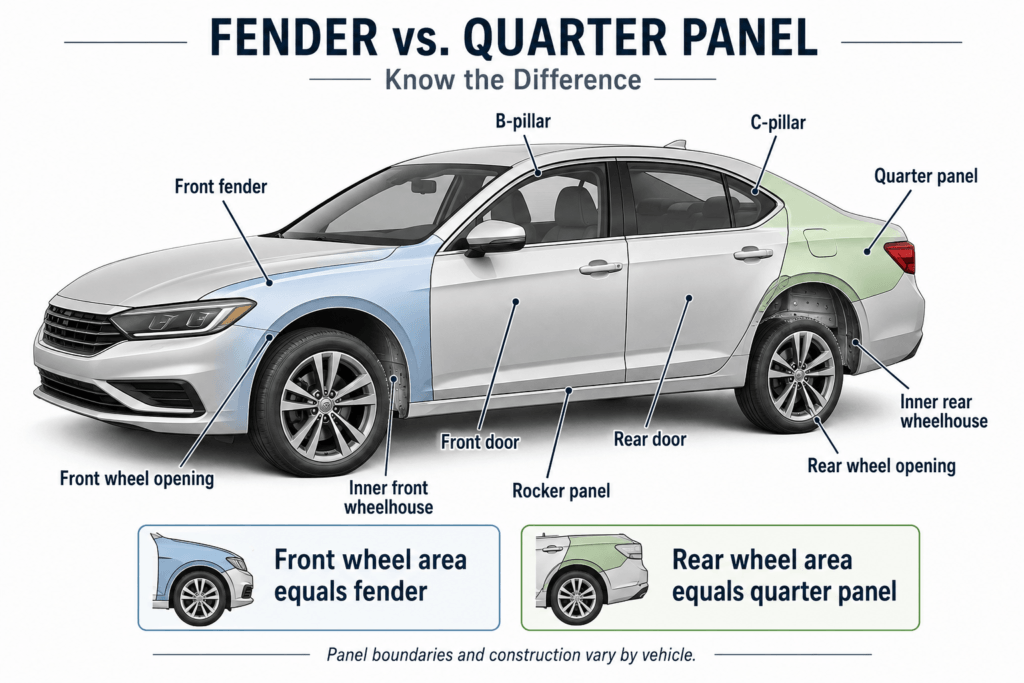
The fender is normally found directly above and around a front wheel.
A practical way to identify it is to start at the front tire and look upward. The painted metal or composite panel surrounding the upper wheel opening is usually the fender. Its rear edge commonly creates a vertical panel gap beside the front door.
Toward the front, the fender may meet the headlamp, grille support area or bumper cover. Along the top, it usually follows the side of the hood and may be attached beneath the hood opening.
How Is a Fender Attached?
Many front fenders are secured with bolts, screws, clips or brackets. Fasteners may be located along the engine-compartment edge, door-jamb edge, rocker area, wheel opening and bumper connection.
This arrangement can allow the outer panel to be removed without cutting the main body shell. Removal may still require taking off adjacent items such as the bumper cover, headlamp, wheelhouse liner, side trim or door-related components.
Not every fender is a simple bolt-on steel panel. Some vehicles use aluminium, plastic or composite outer panels. Others may use adhesives, specialised fasteners or integrated body designs. The service manual and parts information for the exact vehicle should always be checked before assuming how the panel is attached.
Common Fender Damage
Common forms of fender damage include:
- Shallow parking dents
- Scrapes and paint transfer
- Creases around the wheel opening
- Corrosion along the lower edge
- Cracks in plastic or composite panels
- Torn bumper or liner mounting points
- Distortion near the hood or door gap
- Damage to brackets behind the visible panel
A fender may appear to have only cosmetic damage while its mounting brackets, wheelhouse or apron are also distorted. Uneven hood, door or bumper gaps can indicate that the damage extends beyond the visible skin.
What Is a Quarter Panel?
A quarter panel is the rear-side exterior body panel that normally surrounds a rear wheel opening. It usually extends from the area behind the rear door or side opening toward the tail-light, trunk or liftgate.
On many vehicles, the panel also connects visually or physically with the rocker panel, rear wheelhouse, rear body panel, roof side or roof rail. It may be manufactured as part of a much larger body-side assembly instead of as a small independent panel.
The arrangement depends partly on body style.
On a four-door vehicle, the front edge of the quarter panel is normally behind the rear door. On a two-door coupe, it may extend forward alongside the rear seating area and meet the longer front door. On a hatchback or SUV, it may reach upward beside the rear side glass and liftgate opening.
The relationship between the quarter panel and the door opening also makes accurate terminology important. The panel beside the rear door is not part of the door itself. For a detailed explanation of adjacent components, see this guide to car door parts and mechanisms.
Where Is the Quarter Panel Located?
The quarter panel is normally located above and around the rear wheel.
Its forward edge commonly begins behind the rear door or behind the side opening on a two-door vehicle. Its rear section may meet the tail-light pocket, trunk opening, liftgate opening or rear bumper area.
Depending on vehicle design, its upper portion may extend toward the roof rail or surround part of the fixed rear side window. Its lower section may join the rocker panel or lower rear body structure.
The visible quarter panel is different from the inner rear wheelhouse. The outer panel creates the painted exterior surface, while the inner wheelhouse forms the internal enclosure around the rear tire and may connect to other structural body components.
How Is a Quarter Panel Attached?
Quarter panels are commonly attached through a combination of factory welds, structural adhesive, mechanical fasteners or other manufacturer-defined joining methods.
On many unibody vehicles, the outer quarter panel is part of an outer body-side or uniside assembly. Replacing it may involve separating factory joints or sectioning the service part only where the manufacturer permits.
There is no universal cutting or joining location. I-CAR’s OEM Partial Part Replacement Search distinguishes between vehicles with published sectioning procedures, approved factory-seam replacements, no published procedure and explicit restrictions against sectioning.
Even vehicles from different manufacturers—or different models from the same manufacturer—may require different repair approaches. The most recent OEM body-repair manual remains the controlling source.
Common Quarter-Panel Damage
Quarter panels commonly receive damage from:
- Side impacts near the rear wheel
- Parking collisions
- Scrapes against posts or walls
- Sharp dents along body lines
- Creases extending into the wheel opening
- Corrosion around the arch or lower panel
- Tearing near the bumper connection
- Damage extending into the wheelhouse
- Distortion near the rear door opening
- Damage around the tail-light pocket
A dent near the centre of a wide, accessible area may be repairable without panel replacement. Damage close to a folded edge, wheel-opening flange, pillar, roof rail or rocker connection may be more complicated.
Fender vs Quarter Panel: Key Differences
Location
The simplest difference is location.
A fender normally surrounds a front wheel opening. A quarter panel normally surrounds a rear wheel opening.
If the damaged panel meets the hood and front bumper, it is probably a fender. If it meets the trunk, liftgate or tail-light area, it is probably a quarter panel.
Construction and Attachment
A front fender is often manufactured as a separate removable exterior panel. It may be secured to brackets and surrounding body components using bolts, screws or clips.
A quarter panel is more commonly joined to the main body shell. Its connections may extend along the door opening, rocker area, wheelhouse, roof-side structure, trunk opening or rear body panel.
That difference affects access. A technician may be able to unbolt a damaged fender after removing nearby trim. Quarter-panel removal can require factory-joint separation, controlled cutting and manufacturer-approved joining methods.
These are tendencies rather than fixed rules. I-CAR’s vehicle matrices show that outer-uniside and quarter-panel procedures vary. For example, its Ford Fiesta information identifies an available outer-uniside sectioning procedure, while other vehicle entries show different permissions and restrictions.
Repair and Replacement
Fender replacement is often less involved because the panel may be removable. The work can still include alignment, transferring brackets or trim, corrosion protection and refinishing.
Quarter-panel replacement usually affects a larger work area. Interior trim, lights, bumper components, rear glass or other nearby parts may need to be removed or protected. Factory joints must be identified, and the replacement panel must be fitted without disturbing restricted high-strength areas.
Both repairs may require paint blending into adjacent panels. A newly refinished fender may need colour blending into the front door or hood. A quarter-panel repair may require blending into the rear door, roof-side area, trunk panel or adjacent rear body surface.
Structural Importance
The visible outer front fender is usually considered an exterior body panel rather than a main structural reinforcement. However, the components behind it—including the apron, rail, wheelhouse and suspension-related mounting areas—may be structural.
The quarter-panel area can be more closely integrated with the body shell. The outer panel itself may contribute to stiffness, while the inner wheelhouse, pillars, rocker, roof rail and reinforcements behind it can have clear structural functions.
It is therefore unsafe to decide that rear-side damage is cosmetic based only on the outer surface. The surrounding body structure must be inspected and measured where necessary.
Is the Panel Above the Rear Wheel a Fender or Quarter Panel?
On most modern passenger cars, the painted exterior panel above a rear wheel is called the quarter panel.
People sometimes call it a rear fender, and that wording may appear in informal discussions or on vehicles with separate rear fenders. However, collision-repair manuals and parts catalogues for typical unibody passenger cars commonly use terms such as quarter panel, rear quarter or outer body side.
A pickup truck may use different terminology. The outer panel around a truck’s rear wheel can be part of the pickup box, bedside or box-side assembly rather than a passenger-car-style quarter panel.
Fender Repair vs Quarter-Panel Repair
The decision to repair or replace either panel depends on material, damage location, access, corrosion, panel shape and the vehicle manufacturer’s requirements.
Appearance alone does not determine repairability.
When a Fender May Be Repaired
A fender may be repairable when:
- The dent is shallow and the paint remains suitable for paintless dent repair.
- The damaged area can be accessed without harming nearby components.
- Conventional metal repair can restore the original contour.
- The wheel-opening edge and mounting points remain correctly positioned.
- Corrosion has not significantly weakened the panel.
- The material permits the intended repair method.
Paintless dent repair may suit certain smooth dents where the coating is intact and access is available. Sharp creases, stretched metal and damage along complex body lines may require conventional repair and refinishing.
When a Fender May Need Replacement
Replacement may be considered when:
- The panel is badly torn or folded.
- Several body lines are heavily distorted.
- Corrosion is extensive.
- Important mounting points are damaged.
- A composite or plastic panel is cracked beyond an approved repair.
- Repair would not restore correct gaps and alignment.
- The manufacturer restricts the proposed repair method.
Before replacing the fender, the hidden wheelhouse, apron, brackets and nearby rail area should be checked. Installing a new outer panel will not correct misalignment in the structure beneath it.
When a Quarter Panel May Be Repaired
A quarter panel may be repairable when:
- The dent is limited to an accessible outer area.
- The metal has not been excessively stretched.
- The damage does not extend into the inner wheelhouse or structural connections.
- The wheel-opening flange and adjacent gaps can be restored correctly.
- Corrosion is localised and can be removed using an approved repair.
- The proposed method follows material and OEM restrictions.
Paintless dent repair may be possible on suitable minor dents. Conventional repair may be used for more defined damage when access, material and panel condition allow it.
When Quarter-Panel Replacement May Be Required
Replacement may be considered when the panel has:
- Extensive tears or severe folding
- Large areas of stretched metal
- Major corrosion
- Damage across several reinforced edges
- Destruction around the wheel opening
- Damage that prevents correct door or trunk alignment
- An unrepairable tail-light pocket or body-side connection
- Damage extending into an area where repair is restricted
Replacement should not be chosen from a generic rule such as dent size alone. The repairer must consider the complete body construction, available OEM procedures and the condition of the inner wheelhouse and adjacent reinforcements.
Can a Quarter Panel Be Replaced?
Yes. A quarter panel can be replaced, but the procedure is usually more involved than removing and installing a typical bolt-on front fender.
Depending on the vehicle, quarter-panel replacement may require:
- Removing interior trim and sound insulation
- Removing or protecting rear glass
- Removing lights, bumper parts and exterior trim
- Exposing and separating factory joints
- Cutting the service panel only at approved locations
- Preparing the replacement panel
- Using welding, bonding, riveting or a manufacturer-defined combination
- Restoring seam sealer
- Restoring cavity wax and corrosion protection
- Measuring and confirming body alignment
- Refinishing the panel
- Blending colour into adjacent panels
The replacement location and joining method must come from the body-repair procedure for the specific make, model and model year.
I-CAR’s repairability resources illustrate why this confirmation is necessary. Vehicle entries may identify one or more approved OEM sectioning locations, factory-seam replacement options, no procedure or a warning not to section a particular component.
How to Identify the Damaged Panel
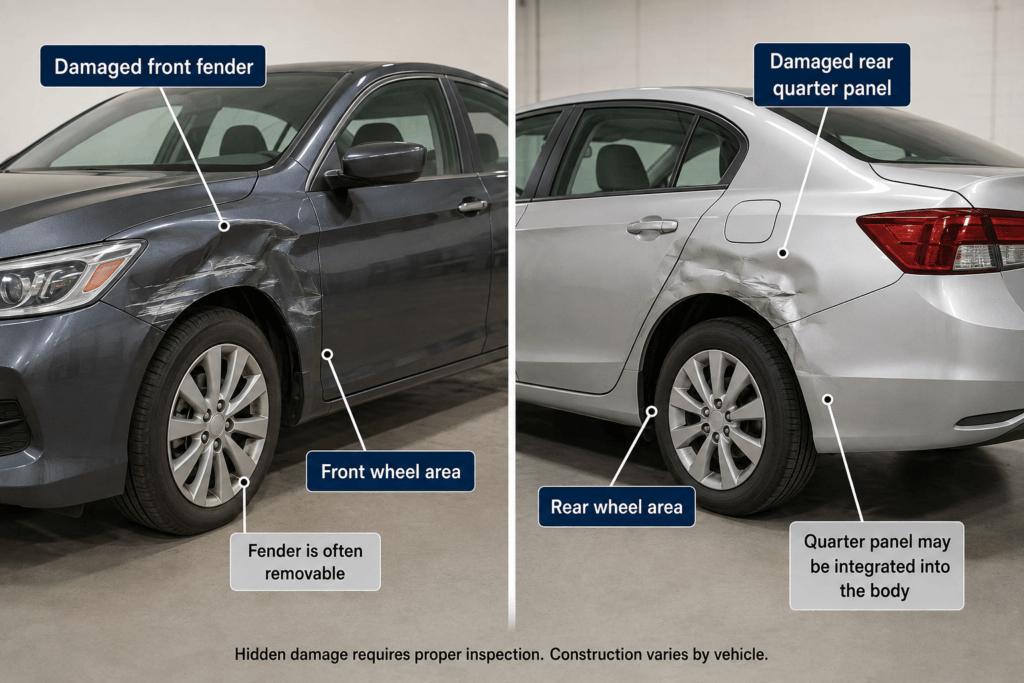
Use this checklist before ordering a part or describing collision damage:
- Identify whether the damage is around the front or rear wheel.
Front-wheel damage usually involves the fender. Rear-wheel damage usually involves the quarter panel or pickup-box side. - Check whether the panel meets the hood or the trunk and liftgate area.
A panel beside the hood is normally a fender. A panel beside the trunk, liftgate or tail-light is normally a quarter panel. - Inspect the panel gap next to the door.
The fender normally meets the front door. The quarter panel normally begins behind the rear door or beside the rear seating area on a two-door vehicle. - Distinguish the outer panel from the bumper cover and wheelhouse liner.
The painted plastic bumper and the liner inside the wheel opening are separate components. - Confirm the part name using an OEM parts diagram or body-repair manual.
This is particularly important for SUVs, vans, pickups, composite-bodied vehicles and models with unusual body-side construction.
Common Identification Mistakes
Calling the Rear Quarter Panel a Front-Style Fender
“Rear fender” is common informal language, but it can cause confusion when ordering parts or describing a repair. A typical unibody passenger car usually identifies the rear wheel-opening panel as a quarter panel.
Confusing the Bumper Cover With the Fender
The bumper cover is normally a moulded plastic part at the front or rear of the vehicle. The fender is the panel above and behind the front bumper corner.
A scrape can cross both parts, so separate damage estimates may be needed.
Confusing the Wheelhouse Liner With the Outer Fender
The fender liner is the plastic or fabric-like shield inside the wheel opening. It is not the painted outer fender.
A collision may damage the outer fender, liner, brackets and inner wheelhouse at the same time.
Calling the Rocker Panel a Quarter Panel
The rocker panel runs below the doors along the lower side of the body. The quarter panel sits above and behind it around the rear wheel.
Damage can cross the joint between these areas, but they are not the same part.
Treating a Pickup Bedside as a Passenger-Car Quarter Panel
A pickup’s rear wheel opening is often formed by the bedside or pickup-box side. Its attachment and replacement procedure may differ significantly from a passenger-car quarter panel.
Assuming the Attachment Method From Appearance
A smooth exterior surface does not reveal every factory joint. Adhesive, welds, rivets and reinforcements may be hidden behind trim, seam sealer or overlapping panels.
The exact method must be confirmed from the vehicle’s repair information.
Safety and Repair Considerations
Warning: visible panel damage may hide structural damage
Damage near a pillar, rocker, wheelhouse or suspension area should not be treated as cosmetic until the underlying body has been inspected. Correct-looking paint and panel surfaces do not prove that reinforcements, mounting points or safety-related components remain undamaged.
A structural inspection may be required when damage is close to:
- A, B, C or D pillars
- Rocker panels
- Roof rails
- Inner wheelhouses
- Frame or unibody rails
- Suspension mounting areas
- Seat-belt anchor locations
- Airbag mounting areas
- Impact-sensor or driver-assistance sensor locations
Panel gaps can provide useful clues. A door that rubs, a trunk opening that is no longer square or a wheel opening that appears shifted may suggest deeper movement. These observations are symptoms rather than confirmed diagnoses.
The repair process may also disturb factory corrosion protection. Any removed seam sealer, coatings, cavity wax or protective finish should be restored according to manufacturer instructions.
Electrical connectors and sensors may be positioned behind bumper corners, quarter trim, wheelhouses or nearby body panels. Components should be identified before drilling, cutting, heating or pulling operations begin.
This article does not provide step-by-step cutting or welding instructions. Those operations require suitable training, equipment, material identification and access to the current OEM repair procedure.
Frequently Asked Questions
Is a fender the same as a quarter panel?
No. A fender normally surrounds a front wheel opening, while a quarter panel normally surrounds a rear wheel opening. The two panels may also use different attachment and replacement methods.
Is the rear fender called a quarter panel?
On most modern passenger cars, yes—the exterior panel around the rear wheel is normally called a quarter panel. “Rear fender” may still be used informally or for vehicles with separate rear fenders.
Where is the quarter panel located?
The quarter panel is located on the rear side of the vehicle around the rear wheel opening. It normally sits behind the rear door or side opening and extends toward the tail-light, trunk or liftgate.
What is a car fender?
A car fender is the exterior body panel that normally surrounds a front wheel opening. It forms part of the vehicle’s visible front-side body and helps contain water, mud and road debris.
Is a fender bolted or welded?
Many front fenders are bolted to the body, but not all vehicles use the same design. Some panels may use adhesives, clips, specialised fasteners or integrated construction.
Is a quarter panel welded to the car?
Quarter panels are commonly welded or otherwise joined to the main body shell. Depending on the vehicle, the manufacturer may specify welding, bonding, riveting or a combination of joining methods.
Can a quarter panel be replaced?
Yes. Replacement is possible, but it may involve separating factory joints, removing adjacent components and joining the new panel according to a vehicle-specific OEM repair procedure.
Which costs more to replace, a fender or quarter panel?
Quarter-panel replacement is usually more involved because the panel may be integrated into the body shell and require additional removal, joining, corrosion protection and refinishing work. Actual cost depends on the vehicle, location, damage and required procedure.
Can a dented quarter panel be repaired?
Many quarter-panel dents can be repaired when the damage, access, material and surrounding structure allow it. Severe tearing, corrosion, stretched metal or damage near reinforced connections may change the repair decision.
Is the quarter panel part of the car’s structure?
It can contribute to the body-side assembly, but its exact structural classification depends on vehicle construction. The pillars, rocker, roof rail, wheelhouse and reinforcements behind it may have more significant structural roles.
What is the panel above the rear wheel called?
On most passenger cars, it is called the quarter panel. On a pickup, the comparable visible area may be called the bedside or pickup-box side.
Final Summary
The main difference between a fender and a quarter panel is their location and typical construction.
A fender normally surrounds a front wheel and is often a removable exterior panel. A quarter panel normally surrounds a rear wheel and is commonly joined to a larger body-side structure.
That difference usually makes quarter-panel replacement more involved, but neither panel should be judged by appearance alone. A minor-looking dent can hide damage to brackets, wheelhouses, pillars or other supporting components.
Confirm the exact part name with an OEM parts diagram. For repair or replacement, follow the current body-repair procedure for the vehicle’s make, model and model year.
Method and Limitations
This guide compares common passenger-vehicle body construction. Panel names, attachment methods and approved repair procedures vary by manufacturer and model. Confirm the exact construction through the vehicle’s OEM parts information and body-repair manual.
The explanations are based on recognised collision-repair terminology and the principle that sectioning, joining and replacement decisions must follow vehicle-specific manufacturer information. No universal repairability limit, labour time, repair price, panel thickness, welding location or structural classification has been assumed.