

Contents
- Introduction
- What is a Car Engine?
- How Does a Car Engine Work?
- Four Stroke Cycle
- Car Engine Parts Names with Diagram
- List Of Car Engine Parts Names
- Parts of A Car Engine
- #1. Engine Block
- #2. Pistons
- #3. The Crankshaft
- #4. The Camshaft
- #5. The Connecting Rod
- #6. Timing Belts
- #7. Spark Plugs
- #8. Cylinder Head
- #9. The Oil Pan
- #10. Engine Valve
- #11. Combustion Chamber
- #12. Intake Manifold
- #13. Exhaust Manifold
- #14. Piston Ring
- #15. Gudgeon Pin
- #16. Cam
- #17. Flywheel
- #18. Head Gasket
- #19. Cylinder Liner
- #20. Crankcase
- #21. Engine Distributor
- #22. Distributor O ring
- #23. Cylinder Headcover
- #24. Rubber Grommet
- #25. Oil Filter
- #26. Camshaft Pulley
- #27. Timing Belt Drive Pulley
- #28. Water Pump
- #29. Turbocharger and Supercharger
- #30. Oil Pans Drain Bolt
- #31. The valvetrain
- #32. The rocker arms
- #33. The pushrods/lifters
- #34. Throttle Body
- #35. The fuel injectors
- #36. Air Intake System
- #37. Air Filter
- #38. Fuel Delivery System
- #39. Lubrication System
- #40. Cooling System
- FAQs
Introduction
Even with electric vehicles and alternative fuel-powered vehicles growing fast, internal combustion engines still explain how a car engine works as a complex machine with various parts working simultaneously to power your vehicle. These different parts and their functions help you identify problem areas and take appropriate action when the engine as a machine burns fuel and converts fuel into mechanical power. In modern vehicles, the ICE or internal combustion engine uses fuel, combustion, and fuel ignition to ignite fuel and create a reaction that moves mechanical parts, including pistons and the crankshaft, so torque is applied to wheels and vehicle wheels begin car moving. As a heat engine, it turns the heat of combustion into energy, mechanical work, power, motion, and wheel movement through proper engine parts, engine functions, engine reaction, piston movement, crankshaft turning, and torque generation. This automotive machine, or vehicle power system, shows how a modern engine, whether a gasoline engine using gasoline or a diesel engine using diesel fuel, depends on fuel conversion, mechanical energy, and the full engine mechanism for smooth car movement.
Read more:Parts Of Car
What is a Car Engine?
An engine is a machine that burns fuel. In most vehicles, internal combustion engines ignite fuel and creates a reaction that helps to move mechanical parts. Using gasoline or diesel fuel, they push pistons up and down that turn the crankshaft, and move the vehicle wheels. As a heat engine, the heat of combustion supports energy conversion into mechanical work and torque for the wheels, leading to car moving. This fuel combustion and combustion process create engine power, vehicle motion, mechanical energy, and power generation inside an automotive engine, where fuel ignition, piston motion, crankshaft rotation, and wheel movement all work together.
How Does a Car Engine Work?
When I first learned this, I used an ancient two-stroke Saab and an old chainsaw as easy examples because both showed oily smoke, exhaust, and basic engine principles in a very direct way, even if a Ford or Ferrari explains the same idea with more refinement. Inside a car, pistons move in metal tubes called cylinders, and the best bicycle analogy is to imagine your legs pushing pedals while the crankshaft acts like the rotating center, the rods work a bit like shins, and the final force reaches the drive wheel or in cars the car drive wheels. This piston movement and engine crankshaft turning can happen in two to 12 cylinders depending on the vehicle engine, where each piston up and down motion comes from tiny controlled explosions created by a fuel and oxygen mixture, ignition, a combustion stroke, and a power stroke. The heat, expanding gases, and push on the piston down inside each cylinder are why internal combustion engines and gasoline powerplants work, especially in a four-stroke engine that repeats the intake stroke, compression stroke, exhaust stroke, and burn cycle. In simple words, air brings oxygen so the engine can burn fuel, the valves open with a syringe effect as the piston downward motion pulls ambient air through the intake system and intake valves, then by sealing cylinder space during upward movement the engine creates compression of the intake charge. That leads to the combustion cycle, energy release, rising pressure, strong piston force, mechanical motion, and the full engine cycle process, all managed by the fuel ignition system, combustion reaction, engine airflow, pressure build, and final gas expansion.
Four Stroke Cycle
Intake Stroke
The intake stroke begins when the piston descends through the cylinder bore, moving from top dead center TDC toward bottom dead center BDC while the intake valve open position stays active and the exhaust valve shut state keeps flow controlled. This downward motion creates vacuum or negative air pressure, pulling in the air fuel mixture through the open intake valve.
Compression Stroke
Next comes the compression stroke, where the intake valve closes and the combustion chamber is sealed as crankshaft rotation completes the first full revolution and the piston upwards travel starts to compress fuel and air mixture.
Power Stroke
Then the power stroke happens with spark plug ignition, firing the air fuel mixture so combustion gases create gas expansion and leave the piston forced down.
Exhaust Stroke
After that, the exhaust stroke starts as the exhaust valve opens and the piston travels up for exhaust gas release from the cylinder. A thin fresh oil coating supports piston lubrication, and this full combustion cycle of four strokes relies on valves, piston, crankshaft, cylinder, piston rings, and oil for efficiency, performance, and durability. In real engines, intake and exhaust valves, cams, the camshaft, timing belt, timing chain, and engine crankshaft must stay synchronized, especially in a multi cylinder engine where staggered cycles, evenly spaced combustion, a balanced engine, and quiet operation matter. That is how gasoline engines change chemical energy into mechanical energy, although friction loss in mechanical elements always affects energy conversion a little.
Car Engine Parts Names with Diagram
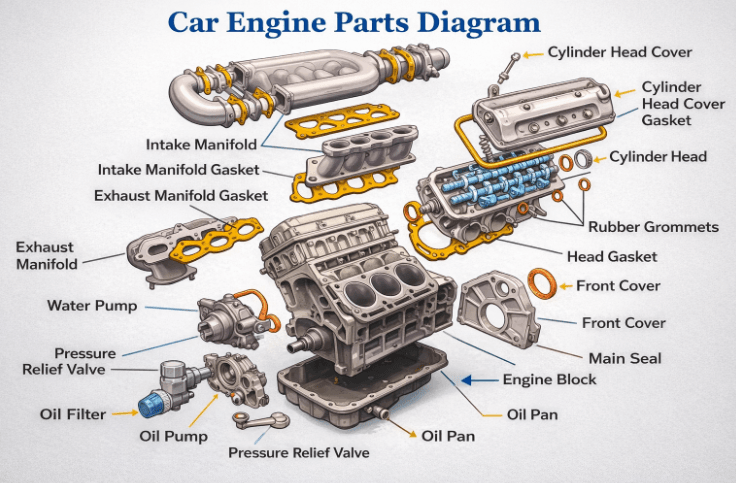
A car engine parts diagram makes everything easier because it shows the engine block, combustion chamber, cylinder head, pistons, crankshaft, camshaft, timing chain, valves, rocker arms, pushrods, lifters, injectors, spark plugs, oil pan, distributor, connecting rods, piston ring, and flywheels in one place. I always tell beginners to study the diagram location of major engine components first, because clear part placement, visual representation, engine structure, mechanical layout, component identification, and overall engine system view improve diagram understanding very quickly.
List Of Car Engine Parts Names
A practical list of car engine parts names usually starts with theEngine Block – Piston – Cylinder Head – Crankshaft – Camshaft – Timing Belt – Engine Valves – Oil Pan — – Combustion Chamber – Intake Manifold – Exhaust Manifold – Spark Plugs – Connecting Rod – Piston Ring – Gudgeon Pin – Cam — – Flywheels – Head Gasket – Crank Case – Cylinder Liner – Distributor – Distributor O Ring – Cylinder Head Cover — – Rubber Grommet – Camshaft Pulley – Oil Filter – Water Pump – Timing Belt Drive Pulley – Oil Pan Drain Bolt — – Turbocharger – Supercharger – Starter Motor Compared with electric vehicle parts, which often have reduced components, these remain the main engine parts people usually learn first.
Parts of A Car Engine
A vehicle engine is made of many mechanical parts, and learning car engine parts is easier when you see how these engine components work together in one engine system. The main core engine parts include the engine block, cylinder block, combustion chamber, cylinder head, pistons, crankshaft, camshaft, timing chain, valve train, valves, rocker’s arms, pushrods, lifters, fuel injectors, and spark plugs.
#1. Engine Block
The engine block or cylinder block is the core of the engine, usually made from aluminum or iron. It contains holes that form the cylinders, along with water flow paths and oil flow paths that help cool and lubricate the engine. These oil paths, water flow paths, pistons, crankshaft, and camshaft all fit inside this main engine housing. It may have four cylinders or twelve cylinders, depending on the vehicle, and can be arranged as inline, flat, or V shape based on the engine layout, engine structure, lubrication paths, cooling paths, and cylinder arrangement.
Common Symptoms of Bad Engine Block
Common bad engine block symptoms include poor engine performance, low engine compression, visible engine smoke, and engine overheating. You may also notice leaking antifreeze, discoloration in car’s oil, discoloration in antifreeze, leaking oil, leaking coolant, or frozen coolant near the radiator. In many cases, excessive smoke from the exhaust, low levels of coolant, a coolant leak, overheating signs, engine damage symptoms, and compression loss appear together.
#2. Pistons
The pistons are a cylindrical apparatus with a flat surface that helps transfer energy from combustion to the crankshaft and propel the vehicle. They travel up and down inside each cylinder, helping create the rotation of the crankshaft. At high engine speed, they may move at 1250 RPM or around 2500 times per minute. With piston rings, they create compression, reduce friction, and deal with constant rubbing against the cylinder wall, making piston movement, energy transfer, combustion force, and reciprocating motion possible.
Functions performed by the piston
Important piston functions include heat dissipation, support for combustion, and sealing of the combustion chamber. They help with gas leakage prevention, oil penetration prevention, and guides movement of the connecting rod. They also support continuous gas exchange, variable volume, chamber sealing, gas exchange, rod guidance, combustion efficiency, and proper volume creation inside the combustion chamber.
Most Common Symptoms for Bad Piston
Typical bad piston symptoms include overall loss of power, poor performance, white exhaust smoke, gray exhaust smoke, and excessive oil consumption. You may also feel low power for acceleration, notice smoke from exhaust, face acceleration issues, and see signs of engine weakness or power loss.
#3. The Crankshaft
The crankshaft changes the up and down motion of the pistons into rotation and helps with power delivery to other parts of the car. It sits in the lower section of the engine block and includes crankshaft journals, a shaft, and bearings. This machined mechanism and balanced mechanism works with the connecting rod, almost like a jack-in-the-box, converting reciprocal motion into shaft rotation. It supports engine speed, piston motion conversion, the lower engine section, and the full rotating assembly, while often linking to the camshaft through rubber belts.
Symptoms of a Bad or Failing Crankshaft Position Sensor
Common bad crankshaft position sensor symptoms include issues starting the vehicle, intermittent stalling, and a check engine light. Other signs include uneven acceleration, engine misfires, a vibrating engine, rough idle, and reduced gas mileage. These often show up as starting problems, stalling, acceleration problems, vibration, idle issues, and fuel economy loss.
#4. The Camshaft
The camshaft works with the crankshaft through the timing chain to control the intake valves and outtake valves so they open and close on a specific timeline. Depending on the design, it may sit in the engine block or cylinder heads of modern vehicles. Systems like Dual Overhead Camshaft, DOHC, Single Overhead Camshaft, and SOHC use a sequence of bearings that stays lubricated in oil for better longevity. Its job is to regulate timing, manage the opening and closing of valves, and convert rotary motion into up and down motion through lifters, pushrods, rockers, and valves, keeping valve timing, engine timing control, and the overhead camshaft system working smoothly.
Symptoms of a Bad Camshaft
Typical bad camshaft symptoms include an active check engine light, flashing check engine light, loss of power, steady popping, and backfire through the intake manifold or exhaust. You may also hear loud ticking sounds or tapping sounds, find metal debris in the engine oil, or notice a cylinder misfire and increased emissions. Other warning signs include misfiring, visible signs of damage, engine noise, oil contamination, and exhaust backfire.
#5. The Connecting Rod
The connecting rod links the piston to the crankshaft in a piston engine and turns reciprocating action into crankshaft rotation. It works through pivoting between the piston end and shaft end, forming a strong mechanical connection inside the internal combustion engine. It acts much like early water mills or a water wheel creating spinning action, and supports reciprocating motion, rod movement, the crank mechanism, piston linkage, rotational conversion, and the idea of a forerunner mechanical design.
Symptoms of a Bad Connecting Rod
Common bad connecting rod symptoms include low compression, engine knocking sounds, and rod knock. In worse cases, low oil, poor oil pressure, a visibly bent rod, or a damaged rod can lead to a seized engine. These problems often appear as compression loss, knocking noise, oil pressure issues, engine seizure, and serious rod damage.
#6. Timing Belts
The timing belts connect the camshaft and crankshaft using a timing belt made of heavy-duty rubber with cogs that grip pulleys, almost like a bicycle chain but quieter. This rubber belt wraps like a chain around pulleys with precise teeth to ensure engine timing, proper belt drive, and synchronized movement of all connected parts so certain actions happen at certain times for smooth functioning of the engine and accurate engine synchronization.
Symptoms of Bad Timing Belt
Common bad timing belt symptoms include a ticking noise, loud engine noise, or the engine won’t turn over. Sometimes the engine acts up around 2,000 RPM or 4,000 RPM, along with engine misfires, smoke, fumes, and oil leaks near the front of the motor, leading to startup failure, rough engine behavior, RPM issues, and a front oil leak.
#7. Spark Plugs
Spark plugs, also called a spark plug or sparking plug, are an electrical device with two electrodes placed in the cylinder head of an intrinsic ignition engine. They create a spark across an air gap using electricity from a high-tension ignition system to ignite air-fuel mixture. Built to handle high temperatures, electric stress, and several thousand volts, they deliver spark energy through the spark gap. The insulator, insulator shape, and correct working temperature prevent carbonization, short-circuiting, preignition, and damage. Power comes from the ignition coil or magneto, sending electrical energy through a heavily insulated wire to the plug firing end, where the gasoline air mixture inside the combustion chamber ignites through electrical discharge. These are essential in internal combustion engines, where compressed aerosol gasoline is ignited by an insulated center electrode, connected through a magneto circuit, grounded terminal, and secure plug base for reliable combustion ignition.
Symptoms of bad spark plugs can include
Typical bad spark plug symptoms include reduced gas mileage, lack of acceleration, hard starts, engine misfires, and rough idling. These show as poor fuel economy, starting problems, idle issues, acceleration loss, and general ignition problems.
#8. Cylinder Head
The cylinder head sits on top of the engine’s cylinders, forming the top of the chamber and main combustion space. Fixed with cylinder bolts and sealed by a head gasket, it houses valve springs, valves, lifters, pushrods, rockers, spark plugs, fuel injectors, and camshafts. It manages control passageways for intake air, guiding it during the intake stroke, while exhaust passages remove exhaust gases during the exhaust stroke. These entry points and exit points control air, fuel, and gases in the upper engine section, making it key for airflow control, gas passageways, and overall engine head components.
Symptoms of a Cracked Cylinder Head
Common cracked cylinder head symptoms include white smoke or steam from the exhaust pipe, low coolant level, and engine overheating. You may also notice rough running, misfiring, or combustion gases entering the cooling system, along with illuminated warning lights, coolant-oil intermix, coolant loss, and other overheating signs.
#9. The Oil Pan
The oil pan is a vital part yet a simple part of the engine’s lubrication system, where oil circulates to keep engine parts lubricated, reduce friction, and ensure the engine works smoothly. It acts as oil storage, a metal part attached as an engine attachment with a gasket for oil containment, oil leak prevention, and a fully sealed oil system, making it an essential lubrication component.
Symptoms of a Bad Oil Pan
Signs of bad oil pan symptoms include a low oil warning light, a puddle of oil under your car, or when the oil level dropped unexpectedly. You may also face engine overheating, a burning smell, and clear oil leak, warning light, or low oil level issues.
#10. Engine Valve
An engine valve or engine valves control air intake, fuel entry, and the exit of exhaust gases. These include intake valves and exhaust valves, usually two to four valves per cylinder inside the cylinder head. In an OHV engine, they work with the camshaft, lifter, pushrod, and rocker arm, while an OHC engine uses a different setup like a bucket tappet or camshaft follower. Supported by a valve spring and sealed on a valve seat, the system ensures valve operation, proper valve mechanism, smooth airflow control, and controlled gas exit within the valvetrain system.
The symptoms of bad valves include
Common bad valve symptoms include issues in a cold engine, problems during off-throttle braking, unstable idling, excessive oil consumption, and excessive smoke. You may also notice loss of engine power, engine braking issue, idle problem, increased oil use, and clear power loss.
#11. Combustion Chamber
The combustion chamber is the area of the engine where energy transformed during the combustion process happens using fuel, air, and electricity. This creates pressure and an explosive reaction that pushes pistons to move up and down, producing car power. Problems like oil in the combustion chamber, oil burning, or blue-grey-colored exhaust gases occur when oil enters chamber due to worn valves, piston rings, or worn valve seals that seep into cylinders overnight, causing blue-tinted exhaust fumes in the morning. This combustion area works as an energy conversion zone, generating explosive force, high chamber pressure, and visible exhaust fumes.
#12. Intake Manifold
The intake manifold in a car engine manages and distributes airflow to the cylinders through the throttle valve and throttle body. In engines like V6 engines and V8 engines, it has separate sections or separate parts that guide intake air from the air filter, intake boot, and snorkel into the intake manifold plenum and runners. It adjusts the amount of airflow based on engine rpm, improving airflow distribution, air path, and overall engine breathing using the plenum, intake runners, and precise throttle control.
Symptoms Of A Bad Intake Manifold
Common bad intake manifold symptoms include a check engine light, misfires, rough idle, and loss in engine performance. You may also see external coolant leaks, engine overheating, along with idle issues, coolant leak, overheating, performance loss, and warning signs like a warning light.
#13. Exhaust Manifold
The exhaust manifold is a metal unit made from cast iron or a stainless steel unit that collects engine exhaust gas from multiple cylinders and sends it to the exhaust pipe. Working with exhaust valves, its construction is similar to an inlet manifold, and it functions in both petrol engines and diesel engines to manage exhaust gas flow, proper gas collection, and efficient exhaust routing, ensuring smooth engine outflow.
Symptoms of a Cracked or Bad Exhaust Manifold
Typical bad exhaust manifold symptoms include a check engine light, burning smells, and performance problems. You may notice sluggish acceleration, poor fuel economy, loud exhaust noise, or visible damage, along with acceleration issue, fuel economy loss, engine warning, exhaust sound, and clear crack signs.
#14. Piston Ring
A piston ring is a metallic split ring fitted on the outer diameter of a piston in an internal combustion engine or even a steam engine. It helps in sealing the combustion chamber with minimal loss of gases, preventing leakage into the crankcase, and supporting heat transfer between the piston and cylinder wall. It also ensures proper quantity of oil, controls lubrication by regulating engine oil consumption, and works by scraping oil from cylinder walls back to the sump. Usually made from cast iron or steel, it handles ring sealing, oil control, gas sealing, heat movement, and overall ring material durability.
Main functions of piston rings in engines
Key piston ring functions include sealing the combustion chamber, ensuring minimal loss of gases, protecting the crankcase, and improving heat transfer from piston to cylinder wall. They also help in maintaining proper quantity of oil, regulating engine oil consumption, scraping oil, and supporting lubrication control, gas retention, and effective chamber sealing.
Symptoms of Bad Piston Ring
Common bad piston ring symptoms include discolored exhaust, excessive exhaust, oil leaks, and profuse oil consumption. You may also notice declining engine performance, low acceleration, or oil in the intake manifold, along with exhaust discoloration, oil use, performance decline, acceleration loss, and intake oil.
#15. Gudgeon Pin
The gudgeon pin, also known as a wrist pin, is an important component in an internal combustion engine that forms a strong connection between the piston and connecting rod. It supports connecting rods, transfers motion to wheels and cranks, and acts as a moving joint for smooth piston linkage, rod connection, and efficient rotational link inside the engine.
#16. Cam
The cam is an integral part of the camshafts, where cams mounted on camshaft help control inlet valve timing and control exhaust valve timing. This engine part follows a specific cam profile to manage timing control, precise valve actuation, and smooth engine operation as a key camshaft component.
#17. Flywheel
The flywheel, located at the rear of the crankshaft, helps keep the vehicle running smoothly by storing inertial energy from engine firing pulses. It maintains constant speed, and in an automatic transmission, a flexplate (thinner than flywheels) works with a fluid coupling device or torque converter. The toothed outer ring gear connects with the starter motor’s pinion gear when the ignition key is turned to the start position, allowing the starter motor rotates flywheel and begins engine turning. This system supports rotational inertia, acts as part of the starting system, and functions as a key transmission component.
Symptoms of a Bad Flywheel
Common bad flywheel symptoms include slipping gears, difficulty where you cannot change gears, a burning odor, and vibrations of the clutch or clutch chatter. You may also face being unable to start, inconsistent starts, engine stalling, and engine vibrations with clutch engaged, showing gear change problem, starting issues, clutch vibration, engine vibration, and burnt smell.
#18. Head Gasket
The head gasket is an important part of a car engine that acts as a seal between the engine block and cylinder head, connecting the two main parts that contain pistons, cylinders, valves, and spark plugs. It helps seal combustion gases, keeps cylinders sealed, and prevents coolant leaking or engine oil leaking. Built from thin layers of steel, it is durable and longer lasting, supporting gasket sealing, combustion sealing, and acting as a coolant barrier and oil barrier, especially in modern cars with engine downsizing and stronger structures like the car frame or skeleton of car body.
Signs Your Head Gasket Is Blown
Typical blown head gasket signs include engine overheating, white smoke from tailpipe, and low coolant level. You may also notice rough idle, engine knock, or contaminated engine oil, along with overheating, smoke, coolant loss, idle issue, oil contamination, and knocking.
#19. Cylinder Liner
The cylinder liner is a thin metal cylinder-shaped part fitted into an engine block to form a cylinder. It is one of the most important functional parts inside the interior of an engine, creating the inner wall of a cylinder and a smooth sliding surface for piston rings. It helps in retaining lubricant, reducing wear from rubbing action of the piston skirt, maintaining a thin oil film, and protecting cylinder walls from damage, while controlling liner wear, supporting engine interior surface, and improving lubricant retention.
#20. Crankcase
The crankcase acts as the housing for the crankshaft in a reciprocating internal combustion engine, often integrated into the engine block in modern engines. In two-stroke engines, it works with a crankcase-compression design to manage the fuel air mixture entering the cylinder, while in four-stroke engines, the bottom of the crankcase stores engine’s oil as an oil sump. It also handles exhaust gasses and blow-by from the combustion chamber, forming the lower half of the engine with main bearing journals, bearing caps, and full crankshaft housing, acting as the engine casing and oil reservoir area in the lower engine housing.
#21. Engine Distributor
The engine distributor or distributor uses an enclosed rotating shaft in spark-ignition internal combustion engines to manage mechanically timed ignition by routing secondary current and high voltage current from the ignition coil to the spark plugs in the correct firing order and correct timing. It works alongside magneto systems or in modern computer-controlled engines with crank angle sensors and position sensors, using a mechanical breaker switch or inductive breaker switch within the ignition coil primary circuit, all housed in a distributor housing for proper ignition timing control, voltage routing, and smooth operation as an ignition system component.
Symptoms of a Bad Engine Distributor
Common bad distributor symptoms include the car won’t start, engine misfiring, backfiring, and car shaking, often with a check engine light or high-pitched noise under the hood. These issues lead to failed emissions test, ignition failure, rough engine, vibration, emission issue, and overall startup problem.
#22. Distributor O ring
The distributor o ring or o-ring sits around the distributor shaft to seal the distributor housing, helping with engine sealing and oil leak prevention at the base of the distributor. This rubber seal works as a sealing component, also called a distributor base seal or engine seal ring, ensuring proper leakage prevention.
Symptoms of a Bad or Failing Distributor O Ring
Typical bad o ring symptoms include oil leaking near the base of the distributor, along with lack of power, engine running rough, and engine misfire, leading to oil leak issue, rough engine, power loss, and misfiring.
#23. Cylinder Headcover
The cylinder headcover or cylinder head cover in modern four-stroke engines protects upper actuation elements like valves, while supporting the engine control unit and crankcase ventilation. It shields peripheral devices, provides engine protection from dirt protection and foreign objects, acting as an engine cover, upper engine housing, and strong protective cover for the valve housing.
#24. Rubber Grommet
A rubber grommet is used to protect holes and cover holes, helping to reduce vibration, eliminate sharp edges, and protect engine valve areas. It fits into a pass through hole, acting to shield valve parts, prevent damage, and serve as a flexible rubber component for vibration reduction, hole protection, edge protection, and valve shielding.
#25. Oil Filter
The oil filter handles waste removal from engine oil, removing harmful particles, dirt, and metal fragments to support engine protection and smooth operation. By filtering garbage and providing cleaner oil, it maintains oil cleanliness within the filtration system. Most automotive oil filter manufacturers recommend oil filter replacement every second oil change, around 3,000-mile cycle, 6,000 miles, or 12,000 miles, depending on use, making it key for engine maintenance and contaminant removal.
#26. Camshaft Pulley
The camshaft pulley or cam pulley is part of the timing system, controlling the rate of rotation and camshaft control to operate poppet valves for air intake and exhaust in the cylinders. It articulates with timing chain to rotate camshaft with perfect synchronicity alongside the crankshaft, ensuring timing synchronization, smooth pulley system operation, and accurate rotational control of camshaft movement.
#27. Timing Belt Drive Pulley
The timing belt pulley is a specialized pulley system with teeth and pockets designed for proper belt engagement based on pulley body diameter. It ensures timing control, helps prevent misalignment, and supports the belt drive system through a toothed pulley design for perfect synchronization and alignment control.
Symptoms Of a Bad Timing Belt Pulley
Typical bad pulley symptoms include shaky belt motion, encumbered belt motion, and visible wear on pulleys. You may also hear belt squealing, whining noises, knocking noises, or slapping noises, often caused by damaged bearings, leading to belt noise, alignment issue, and pulley wear.
#28. Water Pump
The water pump or vehicle water pump is a belt-driven pump powered by the crankshaft power, working like a centrifuge to move cooled fluid from the radiator through a center inlet and circulate fluid across the engine. It is a key cooling component that supports coolant circulation, proper pump operation, and continuous fluid movement for effective engine cooling.
Common Causes of Water Pump Failure
Common failure causes include contaminated coolant, excessive contaminants, poor coolant supply, or mixed coolant types. Problems in engine coolants and weak inhibitor technology reduce engine protection, while cavitation, bubbles, and vapor cavities in a pressurized pump cause implosion, leading to pump damage, worn pump walls, and overall coolant contamination or bad coolant chemistry.
Symptoms of a Failing Water Pump in Your Car
Typical bad water pump symptoms include leaking coolant, overheating engine, and coolant leaks into oil, along with unusual engine noise, clear overheating, coolant mixing, noise issue, and leak problem.
#29. Turbocharger and Supercharger
A turbocharger and supercharger use turbocharging and supercharging to increase power output by compressing air entering the engine air intake, allowing more compressed air and more fuel burn for more power. A turbocharger turbine uses exhaust gases, heat energy, and velocity to push air into cylinders through a small compressor or impeller, while a supercharger mechanical drive works as a belt driven system connected to the crankshaft or even an electric motor. Though turbo lag may occur, both systems provide boost, improve engine size efficiency, increase power, and deliver strong airflow boost in a supercharged engine or turbocharged engine for better engine performance enhancement.
The symptoms of a damaged or failing turbo are
Common turbo failure symptoms include loss of power, slower acceleration, louder acceleration, and difficulty maintaining high speeds. You may also see blue smoke, grey smoke, or exhaust smoke, along with an engine dashboard light, performance drop, speed issue, and warning warning light.
Symptoms of a bad supercharger may include
Typical bad supercharger symptoms include ticking sound, unusual motor noise, decreased fuel efficiency, and immediate loss of power, showing fuel economy loss, power drop, and general noise issue.
#30. Oil Pans Drain Bolt
The oil pan drain bolt or oil drain plug sits at the bottom of the engine on the oil pan, allowing you to drain oil during an oil change. Problems like oil leak, need for gasket replacement, a bolt cross-threaded issue, or using an oversized oil drain plug can damage threads and require oil pan replacement. A worn drain plug may cause an engine oil puddle, visible damage, dropping oil level, and engine performance problems, affecting the full drain system as a key oil plug component.
#31. The valvetrain
The valvetrain is an important engine part responsible for valve movement control, connecting valves, pushrods, lifters, and rocker arms to the cylinder head. It works as a complete valve system and engine mechanism, ensuring smooth valve operation system.
#32. The rocker arms
The rocker arms connect to cams on the camshaft and press down to operate the valve system, controlling air intake into the chamber and exhaust flow out. This rocker mechanism supports accurate valve operation, airflow control, and proper exhaust release.
#33. The pushrods/lifters
Pushrods and lifters in overhead valve engines transfer motion from camshaft lobes to rocker arms, replacing direct contact and ensuring smooth motion transfer, precise valve actuation, and reliable engine linkage through mechanical transfer.
#34. Throttle Body
The throttle body helps regulate air amount entering the engine air intake, adjusting the opening size based on driver input to control engine power output and RPMs. It plays a key role in airflow control, using the throttle valve to improve engine response, accurate air regulation, and smooth intake control.
#35. The fuel injectors
Fuel injectors are central to the combustion process, controlling fuel supply by moving fuel into the cylinders through different fuel injection systems like direct fuel injection, ported fuel injection, and throttle body fuel injection. They manage fuel delivery, create a fine fuel spray, and support proper combustion support within the injection system.
#36. Air Intake System
The air intake system ensures clean air delivery to the engine through an air filter that remove impurities. Using ducts and tubes, it guide air toward the intake manifold and throttle body, improving airflow control, engine performance, and overall air path system for better intake airflow and air distribution.
#37. Air Filter
The air filter is an engine component placed before the intake manifold to manage airflow distribution into the cylinders via the throttle valve. In engines like V6 engines and V8 engines, it works with multiple components, independent sections, and parts like intake boot, snorkel, throttle body, intake manifold plenum, and runners to control engine rpm control and airflow quantity. As a filtration component, it handles air cleaning and supports smooth intake system flow.
#38. Fuel Delivery System
The fuel delivery system manages the engine fuel supply, ensuring the correct fuel amount mixes with incoming air. It includes the fuel pump, fuel injectors, and fuel tank, supporting fuel injection into the intake manifold to create the air fuel mixture inside the cylinders. Through compression and ignition, it supports fuel mixture preparation, precise fuel flow control, and efficient fuel system components working together.
#39. Lubrication System
The lubrication system helps reduce friction and reduce wear in all moving parts by circulating engine oil through an oil pump and a network of channels that distribute oil across engine components. This ensures proper lubrication, supports engine damage prevention, continuous friction reduction, smooth oil circulation, and a reliable lubrication network.
#40. Cooling System
The cooling system manages engine heat to ensure overheating prevention and avoid severe damage. It uses water or coolant to regulate temperature, with the water pump helping to circulate coolant through the engine and radiator, where heat dissipation happens into the surrounding air. A thermostat maintains optimal temperature, improving efficiency, longevity, and overall temperature control system performance.
FAQs
What are the basic parts of a car engine?
The basic parts of a car engine include the engine block, pistons, crankshaft, camshaft, cylinder head, valves, spark plugs, timing belt or timing chain, intake manifold, exhaust manifold, oil pan, and fuel injectors. All of these parts work together to convert fuel into mechanical power.
What is the function of a car engine?
The main function of a car engine is to burn fuel and convert it into mechanical energy. This mechanical power moves the pistons, turns the crankshaft, creates torque, and helps the vehicle wheels move.
How does a four-stroke engine work?
A four-stroke engine works through four main steps: intake stroke, compression stroke, power stroke, and exhaust stroke. In this process, the engine pulls in the air-fuel mixture, compresses it, ignites it for power, and then pushes out exhaust gases.
Why is the engine block important?
The engine block is important because it is the main structure of the engine. It holds major components like the cylinders, pistons, crankshaft, oil flow paths, and water flow paths, making it the foundation of the whole engine system.
What are common symptoms of bad engine parts?
Common symptoms of bad engine parts include engine overheating, rough idling, power loss, oil leaks, coolant leaks, engine misfires, check engine light, unusual noises, smoke from the exhaust, and poor fuel economy.
Pingback: How To Find Car Mileage (Accurate Methods + Easy Steps) -