
Contents
- How to Improve Car Fuel Efficiency: 10 Tips That Actually Work
- 1. Stop Flooring It, Stop Slamming the Brakes
- 2. That Extra 10 mph Costs More Than You’d Guess
- 3. Cruise Control Helps — But Only on Flat Ground
- 4. Tire Pressure Is the Cheapest Fix on This List
- 5. Maintenance You’re Probably Putting Off
- 6. Your Trunk Is Heavier Than You Think
- 7. Take the Roof Box Off When You’re Not Using It
- 8. Windows Down in the City, AC on the Highway
- 9. One Trip Beats Three
- 10. Stop Guessing, Start Tracking
- See Your Real Numbers, Not a Guess
- Quick Questions People Ask
- How much can I really improve my fuel efficiency?
- Does how I drive matter more than the car I drive?
- Windows or AC — which actually saves more fuel?
- How often should I actually check tire pressure?
- Do those fuel additives you see advertised actually work?
- Is leaving a roof box on really that big a deal?
- How do I actually know if any of this is helping?
How to Improve Car Fuel Efficiency: 10 Tips That Actually Work
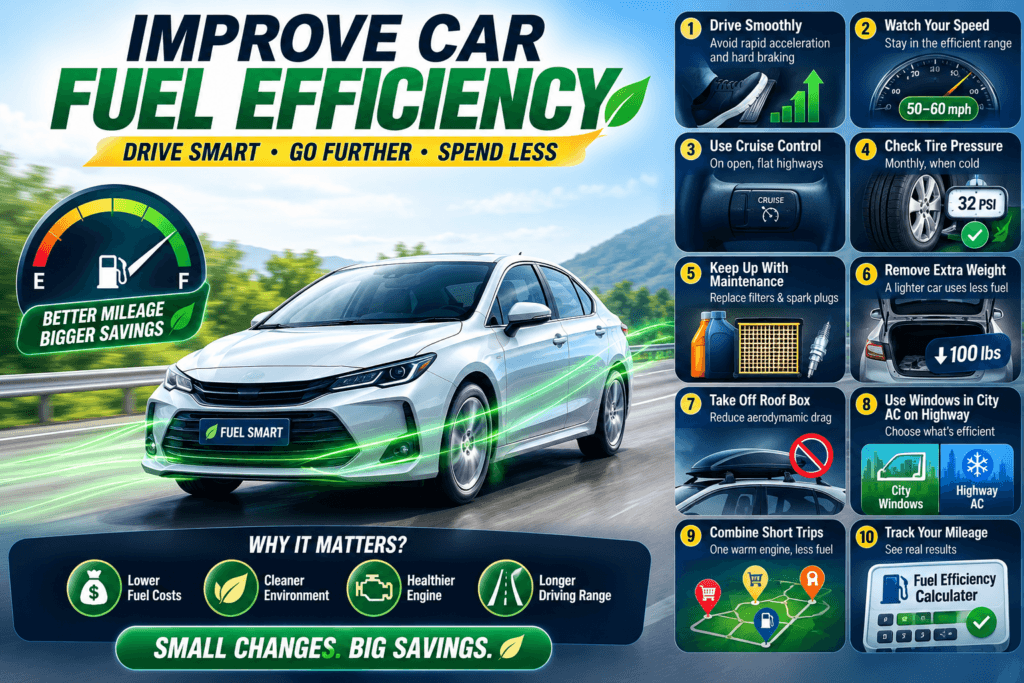
Gas prices keep creeping up, and you’ve probably stood at the pump doing quick math in your head more than once. Here’s the part nobody tells you: you actually control a lot more of your fuel bill than you think. Not through some gadget or a fancy additive — just through habits. Driving habits can make a noticeable difference, especially if you regularly accelerate hard, brake late, or spend long periods idling. Many of the easiest changes cost nothing, while maintenance problems may require proper inspection and repair.
1. Stop Flooring It, Stop Slamming the Brakes
If you take one thing from this whole article, make it this one. Jamming the accelerator and then stomping the brake a few seconds later — drivers call it “jackrabbiting” — burns fuel for absolutely nothing. You’re converting gas into speed inefficiently, then throwing that energy away as heat the moment you brake hard. The EPA has actually measured this: aggressive driving can tank your highway mileage by up to 33%, and knock off another 5% around town.
So ease into the throttle. Look past the car directly in front of you — three or four cars ahead — so you catch a red light or a slowdown early and can just lift off the gas instead of stabbing the brake at the last second.
2. That Extra 10 mph Costs More Than You’d Guess
Cars are happiest somewhere between 50 and 60 mph. Go faster, and wind resistance doesn’t rise gently — it climbs roughly with the square of your speed, so it snowballs fast. Cruising at 65 instead of 75 can bump your fuel economy by up to 20%.
Nobody’s asking you to putter along under the limit. Just know that the last 10-15 mph you don’t really need is quietly one of the most expensive habits behind the wheel.
3. Cruise Control Helps — But Only on Flat Ground
Turns out your foot isn’t as steady as you think it is. Cruise control removes those constant tiny throttle adjustments a human leg makes without even noticing, and on flat highway stretches, Edmunds testing clocked roughly 7% better fuel economy because of it.
Hills are where it gets tricky, though — cruise control can gun the engine to hold speed up an incline, which sometimes works against you. Use it on the open, flat highway; go manual in hilly terrain.
4. Tire Pressure Is the Cheapest Fix on This List
Soft tires flex more, which means more rolling resistance and your engine grinding away just to hold speed. Get this right and you’re looking at a 0.6-3% efficiency gain — small on paper, but for every single psi you’re under, you lose about 0.2%, and that adds up over a year of driving on tires nobody bothered to check.
Grab a gauge once a month, check them cold before you’ve driven anywhere, and match the number to the sticker inside your driver’s door — not the number molded into the tire itself, which is just the max rating.
5. Maintenance You’re Probably Putting Off
A clogged air filter chokes airflow into the engine, so it works harder than it should. Tired spark plugs misfire just enough to waste fuel without you noticing anything’s wrong. None of this is expensive to fix — it’s the kind of thing that gets pushed back a service or two because the car “still runs fine.” Stick to your recommended service intervals and you avoid this problem entirely.
6. Your Trunk Is Heavier Than You Think
Golf clubs from three months ago. Tools you swore you’d return. A box that was supposed to go to the donation center weeks back. None of it feels heavy on its own, but every extra 100 lbs you’re hauling costs roughly 1% in efficiency — more if you drive something smaller and lighter. Clear it out once a month and you’ll be surprised how much accumulates.
7. Take the Roof Box Off When You’re Not Using It
A lot of people mount a cargo box once for a road trip and just leave it there for convenience. Don’t — anything sitting on your roof creates serious drag, and a mounted cargo box can cut highway mileage by 8-25%. That’s a big number for something bolted on “just in case.” If you genuinely need the extra space often, a rear-mounted carrier does the same job with a fraction of the drag.
8. Windows Down in the City, AC on the Highway
This one sounds backward, but it isn’t. Running the AC adds engine load and costs roughly 5% in efficiency, so at low city speeds, cracking the windows instead is the smarter move — drag barely matters when you’re only going 25 mph. Get up to highway speed, though, and the math flips: open windows now create more drag than the AC would have cost you. So: windows in town, AC on the motorway.
9. One Trip Beats Three
A cold engine is a thirsty engine — it takes a few minutes of driving before everything’s up to its efficient operating temperature. Run three separate short errands and you pay that cold-start penalty three separate times. Bundle the grocery run, the fuel stop, and the pharmacy into one loop instead, and the engine only has to warm up once.
10. Stop Guessing, Start Tracking
Here’s the thing almost nobody does: actually check whether any of this is working. Most drivers have a vague sense of their mileage at best, which makes it impossible to tell if smoother driving or better tire pressure is really moving the needle — or if it’s all in their head.
See Your Real Numbers, Not a Guess
This is exactly what our free fuel efficiency calculator is built for — punch in your distance traveled and fuel used, and get your actual mileage on the spot. Try a few of these habits for a week, run the numbers again, and you’ll see the difference in black and white instead of just hoping it’s working.
Quick Questions People Ask
How much can I really improve my fuel efficiency?
Somewhere between 15-25% for most people who stick with the driving and maintenance changes above — some drivers do even better.
Does how I drive matter more than the car I drive?
For any given car, yes. Driving habits move the needle more than almost any single maintenance fix or upgrade.
Windows or AC — which actually saves more fuel?
Depends on speed. Windows win in the city; AC wins on the highway, where open windows create more drag than the AC costs you.
How often should I actually check tire pressure?
Monthly, cold, matched against the sticker inside your driver’s door — never the number stamped on the tire.
Do those fuel additives you see advertised actually work?
Mostly no. Independent testing rarely backs up the big mileage claims, and they’re not a replacement for basic maintenance.
Is leaving a roof box on really that big a deal?
Yes — 8-25% worse highway mileage isn’t a small effect. Take it off when you’re not using it.
How do I actually know if any of this is helping?
Track it. Log your distance and fuel before you start, make a few changes, then check your numbers again with a fuel efficiency calculator instead of just assuming.