

Bolts are a mechanical fastener with external threads, usually used in conjunction with a nut to join parts together. They work by being inserted through pre drilled holes in the material being fastened, then tightened with proper tightening torque to hold everything firmly. Unlike screws, bolts always feature external threads and usually require nut support to function properly, because the nut threads onto bolt and helps create a secure joint around the drilled hole where the bolt is inserted.
For a clearer understanding, refer to the bolt parts diagram with labels, which illustrates the various components of bolts.
Understanding how these components work together can be simplified with a bolt parts diagram with labels.
In simple terms, bolting means using bolts for fastening, though types of bolting as a phrase is not commonly used as a direct reference in everyday repair talk. More often, people talk about bolts as fasteners in machines, structures, and fittings. The word can also be associated with completely different uses like fabric bolting, bolting machines, and even the fabric industry, where the meaning changes and does not refer to metal fasteners in the usual mechanical sense.
You can know more about types of bolts
Contents
- Parts of Bolts and Bolted Joints
- Nuts as Bolt Components
- Washers as Bolt Components
- FAQS
- What are the main components of a bolt assembly?
- How do fine and coarse bolt threads differ in performance?
- What is the role of washers in bolted joints?
- How can you identify a bolt’s metric or imperial sizing?
- Which bolt types are best for applications with restricted backside access?
- Which bolt manufacturers are notable in Michigan?
Parts of Bolts and Bolted Joints
A bolt parts diagram with labels can help visualize these critical elements.
For those unfamiliar with bolt construction, a bolt parts diagram with labels can be incredibly useful.
The details of the bolt shaft are often highlighted in a bolt parts diagram with labels.
To fully grasp the mechanics, consult a bolt parts diagram with labels.
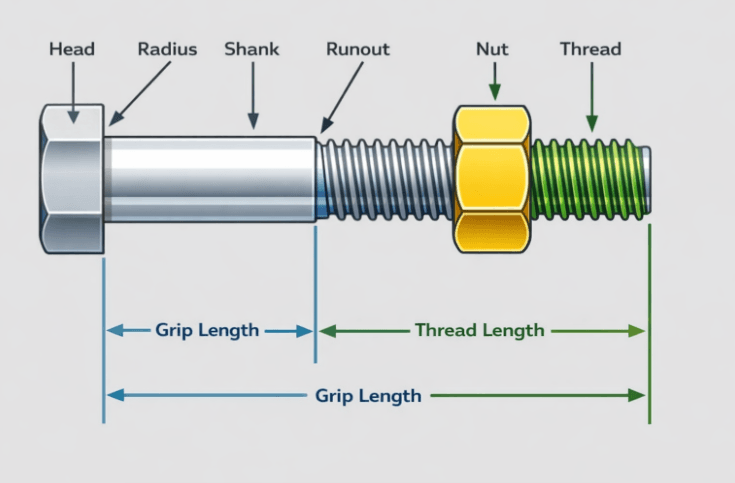
Knowing the several parts of bolts and bolted joints matters since these critical parts are designed to hold various portions of assemblages firmly fastened. Threads on bolts help to create a strong link; they are most often coupled with a coordinating nut.
The pieces must stay aligned with the bolt going across unthreaded holes for the joint to function as it should; they then must be tightened using the nut.
The thread’s design is better understood with a bolt parts diagram with labels.
Bolt Shaft
Visual aids such as a bolt parts diagram with labels can enhance comprehension of bolt head structures.
The bolt shaft is the round component that resists shear forces and helps prevents lateral movement between connected components. It is usually divided into two main parts.
Common types of bolt heads can be found illustrated in a bolt parts diagram with labels.
1. The shank, or body
For clarity on countersunk bolt heads, refer to a bolt parts diagram with labels.
The shank or body is the unthreaded segment of the bolt just below head level. It gives better fit inside the bolt hole, creates smooth contact and accurate contact, and distributes stress across the fastened materials and assemblies. If a bolt lacks shank and has a fully threaded shaft, vibrations can make the assembly loosen more easily.
Understanding dome bolt heads is made easier with a bolt parts diagram with labels.
2. The thread
In bolted joints, a bolt parts diagram with labels can clarify the role of nuts.
The thread is the continuous spiral ridge on the outer part of the bolt shaft. It lets the nut engage through proper threading so the parts are pushed and pulled together. The threads match those inside nut and establish a strong bolted joint. A bolt may have a partly threaded shaft or be fully threaded.
Bolt Head
A washer’s function is well depicted in a bolt parts diagram with labels.
For a comprehensive view, a bolt parts diagram with labels is highly recommended.
The bolt head is built to endure axial forces and hold the secured materials firmly together. It is the part a wrench or driver uses when it applies torque for tightening or loosening, and it comes in various shapes and designs.
The components of a bolt assembly can be easily understood with a bolt parts diagram with labels.
Hex Bolt Heads
In summary, for all bolt types and their functions, a bolt parts diagram with labels serves as a valuable reference.
Hex bolt heads possess a six sided hexagonal shape that is easily grasped by different tools, especially wrenches. That is why they are one of the most common bolt head types.
Countersunk Bolt Head
Countersunk bolt heads are characterized by a conical form with a flat top and often a recessed slot. Screwdrivers or hex socket tools can apply torque to drive bolt heads axially so they sit flush with the surface.
Dome Bolt Heads
Dome bolt heads have a smooth, rounded outline that looks neat but can be more challenging to grip with external tools.
Nuts as Bolt Components
To identify the best bolt types, refer to a bolt parts diagram with labels for guidance.
Nuts play a key role in a bolted joint by providing a threaded hole that matches the bolt. When tightened, they create clamping force that helps bind parts together and control axial movement. This action builds compression and friction between surfaces, as the bolt threads and nut threads work together to hold everything in place.
To reduce loosening caused by vibrations or impacts, extra support like lock washers, jam nuts, split pins, or thread locking fluids is often used. These additions help secure joint strength and keep the assembly stable over time.
Washers as Bolt Components
A washer is a thin, flat disc with a central hole, usually placed under bolt head or nut. It helps evenly distribute load from a threaded fastener over a larger area, which is useful for preventing deformation in the materials being fastened, especially softer materials like plastic, rubber, and urethane.
It can also absorb vibrations, lowering the risk of bolt thread loosening. Some specialized washers also make waterproof seals that stop liquids from infiltrating the bolt joint.
FAQS
What are the main components of a bolt assembly?
The main components of a bolt assembly are the bolt, shaft, head, nut, and washer. The shank is the unthreaded part of the shaft, while the threads engage to distribute load and prevent material deformation.
How do fine and coarse bolt threads differ in performance?
Fine threads and coarse threads differ in performance. Fine threads offer better resistance to loosening and more precise alignment for high strength assemblies. Coarse threads are less likely to cross thread, allow quicker installation, and are more suitable for softer materials.
What is the role of washers in bolted joints?
The role of washers in bolted joints is to distribute load from a threaded fastener across a larger area, prevent deformation in fastened materials, and absorb vibrations. Some also use waterproof seals to block liquid penetration.
How can you identify a bolt’s metric or imperial sizing?
To identify a bolt as metric sizing or imperial sizing, look at the format. Metric bolts use nominal diameter, thread pitch, and length in millimeters, such as M10 1.0 x 20. Imperial bolts use inches and threads per inch or TPI, like ¼”-20 x 2”.
Which bolt types are best for applications with restricted backside access?
The bolt types best for applications with restricted backside access are blind bolts and expansion bolts. They are ideal where there is limited access or no access to the opposite side of the material, while still allowing secure fastening from one side.
Which bolt manufacturers are notable in Michigan?
Among bolt manufacturers notable in Michigan, Conformance Fasteners is well known. It is based in Michigan, manufactures a wide range of bolts such as flanged bolts, elevator bolts, and carrier bolts, has ISO 9001:2008 certification, and a strong presence in the automotive industry.
Pingback: 34 Types Of Bolts And Their Uses -