

Bolts come in many different types, each designed for a specific purpose depending on the material, load, and application. From construction and heavy machinery to simple household use, choosing the right type of bolt plays an important role in creating a strong and secure connection.
Understanding these different types helps in selecting the proper fastener for better performance and long term reliability.
you can know more about parts of bolt
Contents
- What are the different types of bolts?
- Anchor Bolts
- Cast-in-place anchor bolts
- Drilled-in-place anchor bolts
- Headed anchor bolts
- Bent anchor bolts
- Arbor Bolts
- Blind Bolts
- Carriage Bolts
- Elevator Bolts
- Eye Bolts
- Flange Bolts
- Serrated Flange Bolts
- Hanger Bolts
- Hex Bolts
- J-Bolts
- Lag Bolts
- Machine Bolts
- Pentagon Tamper Proof Bolts
- Plow Bolts
- Rock Bolts
- Sex Bolts or Chicago Bolts
- Shoulder Bolts
- Socket Head Bolts
- Square Bolts
- Structural Bolts
- Stud Bolts
- T-Head Bolts
- Tap Bolts
- Toggle Bolts
- Tork Bolts
- Track Bolts
- U-Bolts
- Expansion Bolts
- Industrial Bolts
- Metric Bolts
- Stainless Steel Bolts
- Thru-Bolts
What are the different types of bolts?
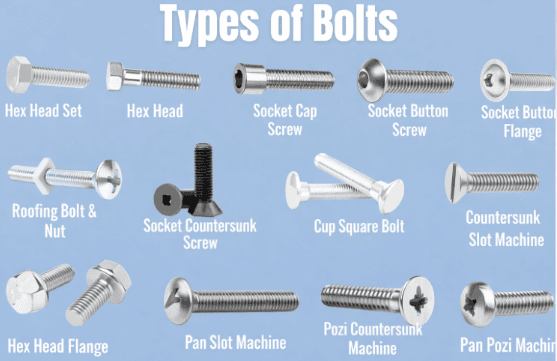
There are many different types of bolts, but the most common ones include anchor bolts, arbor bolts, blind bolts, and carriage bolts, each used for a specific purpose.
Anchor Bolts
anchor bolts are mainly used on concrete surfaces in the construction industry, especially for fixing steel poles, façade systems, and reinforced concrete walls. Common types include cast in place anchor bolts, drilled in place anchor bolts, headed anchor bolts, and bent anchor bolts.
Cast-in-place anchor bolts
cast in place anchor bolts are installed during the concrete mixture stage. After drilling hole and fixing bolt in place, the concrete settles into remaining spaces, so the bolt does not dislodge easily.
Drilled-in-place anchor bolts
drilled in place anchor bolts are used after wet concrete becomes hardened concrete. An ample sized hole is made, and adhesives help stabilize connection.
Headed anchor bolts
headed anchor bolts have a bolt head at the non threaded end which is embedded in concrete material. The head can be hexagonal shape or square shape, helping in securing structural elements like poles, rails, and columns.
Bent anchor bolts
bent anchor bolts use a bent portion of the shaft for preventing pull out when force applied in concrete material. They come in L profile or J profile, commonly used for fastening light poles and street signages.
Arbor Bolts
arbor bolts are pre assembled bolts with a washer permanently attached to the head. They often feature a sinker design, ridges, and a dark finish or black finish, and sometimes have reverse threads. These are mostly used in electric saws to secure saw blade.
Blind Bolts
blind bolts are a specialized type used where there is restricted access. They combine features of hex bolts and rivets, offering good tensile strength to support loads. Installed in a pre drilled hole, they are ideal for limited space where only one side access is possible, using parts like a pin, collar, and sleeve.
Carriage Bolts
carriage bolts are partially threaded with a smooth shank, a round head, and a square neck that prevents turning during tightening. Also called plow bolts or coach bolts, they are widely used in wood applications. They provide strong tensile strength and shear strength, often made from stainless steel with ratings around 90,000 psi.
They are fixed using a nut and washer, and their size measurement is taken from under the head. A proper pilot hole helps fitting, and the flat end helps reduce surface damage.
Elevator Bolts
elevator bolts were first linked with elevator construction, where a broad flat head helped secure components without obstructing movement. Their flat round thin head usually sits flush with the surface, while the threads partway up the shaft and the square neck, much like a carriage bolt, help create a secure connection and prevents turning during installation. They come in various materials, diameters, lengths, and sizes.
These bolts are still widely used in conveyors where a smooth surface supports proper operation and helps prevent vibrating or prevent shifting. They are also useful for fastening soft materials such as softwoods, fabrics, and plastics.
Eye Bolts
eye bolts are easy to spot because the main distinguishing feature is a head shaped like a metal ring or circle. They are available with shoulder and without shoulder, and shoulder eye bolts are usually stronger because they offer greater support. Some types have threads full length of the bolt with a flat end, while others use a ring shaped head where the threads stop below the shoulder.
There are also special forms like anchor eye bolts for masonry, screw eyes with a threaded wood screw and pointed end that screw into wood to hang pictures and plagues, plus ring eye bolts with a ring attached for a chain link. Pigtail eye bolts are low strength eye bolts with a head bent into a helix that is not fully closed, while roller eye bolts have rollers in the eye to make passing cables or rope easier and more efficient.
Flange Bolts
flange bolts have a built-in circular washer like flange beneath the head. This shape helps distribute clamping force across a larger area, which is why they are common in vehicles. They are often used to secure outer casing around engine systems and transmission systems, adding extra protection.
They also appear in piping systems, where they help firmly join the ends of two flanged pipes without needing a separate washer.
Serrated Flange Bolts
serrated flange bolts have a washer integrated into the head, making the whole fastener a single solid unit with extra strength and stability. They often have threads full length of the bolt and a flat end, while the built-in washer helps spread pressure.
These bolts come in a wide range of sizes, styles, and materials, and some are custom made for specific applications. They distribute load evenly across the entire surface of the bolt head, making them useful for attaching exhaust systems and securing pipes. Common choices include carbon steel and stainless steel for added strength and durability.
Hanger Bolts
hanger bolts are headless bolts with different types of threads at each end. One side usually has lag screw threading and the other has machine screw threading, often with a blunt tip. They are sold in stainless steel, zinc plated steel, galvanized steel, and brass. Some include a square shoulder that serves as a head and prevents installation beyond thread length.
Because of this dual thread design, they work in both metal applications and wood applications. To install one, it helps to drill a pilot hole, lubricate with wax or oil, then use a wrench or use a drill bit to tighten the bolt.
Hex Bolts
hex bolts are known for the six sided hexagonal head and their distinctive appearance. They may be unslotted, with full length threading or partial threading, and they come in a wide range of materials, types, styles, sizes, and dimensions. Their exceptional tensile strength and versatility make them useful in a broad array of applications.
They fit well into pre tapped holes or can be paired with nuts, then tightened using a wrench, socket, spanner, or sometimes even a hex key depending on design. Their shape gives easy grip from multiple angles, which helps with easy installation and easy removal. They are usually categorized by size, material, finish, full threading, partial threading, length, metric thread size, thread pitch, and even number of threads per inch.
J-Bolts
J bolts have a curved end resembling the letter J and threads at the opposite end, giving them two points of contact for securing materials. Their shape allows easy insertion into pre drilled holes, while the flat end of the J and the threaded portion work together to hold parts in place.
They are often used for anchoring walls to the ground, connecting beams in construction, and holding support beams. In outdoor spaces like gardens and parks, they help secure benches and playground equipment to concrete surfaces. In industrial settings, they are also used to fasten machinery, presses, and conveyor belts to the facility floor.
Lag Bolts
lag bolts, also called a lag screw, usually come with a hexagonal head or square head and a threaded shank. Some have full length threading, while others cover only a significant portion. Their tapered shank and tapered threads make them ideal for driving into wood.
They rely on friction between connected materials to create a stronger connection and help with preventing slippage. Because of their larger size, they are chosen for stronger secure connections where excellent surface grip matters. They allow easy installation into wood and make assembling large pieces quicker, though they can be difficult to remove, so careful planning is important.
Machine Bolts
machine bolts usually come with a hexagonal head or square head and standard right hand threads, available as fully threaded or partially threaded. They are tightened with a nut using a socket wrench, and are made from carbon steel, stainless steel, or bronze for better corrosion resistance. With grades 2 5 8, they offer different levels of tensile strength and hardness, helping create strong secure connections when the correct torque is applied, otherwise it may lead to joint failure.
Pentagon Tamper Proof Bolts
Pentagon tamper proof bolts, also called penta bolts, are industrial fasteners made from stainless steel with a five sided head in a pentagon shape. Their recessed design gives debris resistance and reduces tripping hazards, making them common in city infrastructure, municipal infrastructure, and government infrastructure like manhole covers, waterworks, valve boxes, meter boxes, ground vaults, electrical junction boxes, and concrete enclosures. These security bolts provide strong tamper resistance and need a specially designed tool, available in forms like penta head bolts, machine bolts, washer head bolts, captive style bolts, and lag bolts.
Plow Bolts
plow bolts feature a flat head, domed head, or convex head with a tapered neck and either fully threaded shank or partially threaded shank. With a square neck and 80 degree taper, plus right hand threads, they provide a flush surface and clean finish. Their larger head diameters make them ideal for heavy equipment, often in grades 5 and 8.
Rock Bolts
rock bolts are threaded steel bars inserted into drilled holes in rock faces to stabilize rock and improve worker safety. They can be fully grouted using resin or cement, or partially grouted for faster installation. A threaded end, free end, face plate, and nut help distribute load across the rock mass, preventing shifting and loosening. Types include self drilling rock bolts, MDX bolts, and fiber reinforced polymer rock bolts.
Sex Bolts or Chicago Bolts
sex bolts, also called Chicago bolts, include a barrel shaped female component with internal threads and a threaded male component. The flange provides a stable bearing surface and an even connection, making them useful for sensitive materials. Common uses include paper binding, helmets, railing systems, furniture, playground equipment, signage, and bathroom partitions.
Shoulder Bolts
shoulder bolts have a larger diameter shank with a smaller threaded portion, and come with a hexagonal head or round head. The smooth cylindrical section adds stability under vibrations and heavy loads, while the low profile design works well in tight spaces. They are often used as a shaft, dowel, or in rotating bearings, guides, axles, pivot points, and mounting pins, especially in plastic injection molds to align mold halves.
Socket Head Bolts
socket head bolts have a cylindrical shape with a barrel head and a hexagonal socket used with an Allen wrench. They allow recessed installation in limited space or a countersunk hole for a flush surface. Known for high tensile strength, yield strength, and shear strength, they are used in demanding applications. Variants include button heads, flange heads, low profile heads, self locking heads, and vented heads for releasing fluids or gases.
Square Bolts
square bolts or square head bolts have a four sided head, sometimes compared to a six sided head alternative. Their design provides a larger surface area, better torque, and higher stripping resistance and breaking resistance. They are often used in heavy machinery, sometimes with pointed tips for easier fitting into pre drilled holes.
Structural Bolts
structural bolts are heavy duty fasteners used with hex nuts to join structural steel members. Built to ASTM standards, they provide high proof load, yield strength, and tensile strength. Types like SAE Grade 9 or grade 9 hex cap screws reach up to 180000 PSI, making them ideal for steel constructions, manufacturing machinery, and bulldozers. Coatings like yellow zinc chromate improve corrosion resistance.
Stud Bolts
stud bolts are headless bolts with either a fully threaded cylindrical design or partially threaded cylindrical design, allowing nuts on both ends for a tight connection. Some include an unthreaded middle section. They are widely used in high pressure piping systems, wheel hub assemblies, and pipeline flange connections. Variants include double end stud, tap end stud, flange stud, and wheel stud, with finishes like rounded ends, flat ends, or chamfered ends.
T-Head Bolts
T head bolts have a T shaped head or rectangle head, also called hammerhead bolts, designed to fit into slots and lock with a 90 degree turn. Their threaded shank and options like square neck, long extended T, flat head T, or domed T allow use in guide rails, channeling systems, and flush fittings, providing a stable connection.
Tap Bolts
tap bolts are fully threaded bolts with a hexagonal head and right hand threads, often with a chamfered end or rounded end for thread protection and easy entry. They are used in pre drilled holes with a nut and washer, often in stainless steel or hardened steel for corrosive environments, such as securing motors or adjusting pulley tension.
Toggle Bolts
toggle bolts, also known as butterfly anchors, are used for heavy loads on walls like drywall. A fully threaded bolt works with a metal wing toggle that expands inside a pilot hole, creating a secure hold. Types include spring toggle bolts where metal wings fold and open inside the wall.
Tork Bolts
Tork bolts, also called shear bolts or breakaway bolts, are security fasteners designed with a breakaway connector. During installation, the upper hexagonal head snaps off at maximum torque, leaving a smooth surface that ensures tamper security and prevents removal with conventional tools.
Track Bolts
track bolts have a round head, circular head, or oval shape with a round face, used in railway signals, footbridges, and trackside equipment. Made from high strength steel with grades from 8.8 to 10.9, they provide exceptional durability under extreme wear in high speed rail traffic.
U-Bolts
U bolts are U shaped fasteners with threaded ends, made from steel, stainless steel, copper, or brass. They are used for piping support to guide pipes and hold pipes in place. Types include non gripped U bolts for axial movement and gripped U bolts that act as anchors to restrict pipe movement.
Expansion Bolts
expansion bolts include a bolt, nut, and expansion sleeve, ideal for limited backside access. When placed in a pre drilled hole, the sleeve expands outward, creating a firm secure grip even under vibrations and shock loads. They are used in brick, stone, and concrete, often as single use applications.
Industrial Bolts
industrial bolts are robust fasteners built for extreme weather conditions and chemical exposure. Types include hex bolts, leg bolts, eye bolts, U bolts, and stud bolts. Made from materials like steel, stainless steel, titanium, bronze, brass, and aluminum, with coatings like zinc coating or hot dip galvanizing, they ensure strength, durability, performance, and safety in securing machinery, platforms, and floors.
Metric Bolts
metric bolts follow the metric system using thread pitch, shaft lengths, and diameters based on ISO standards in millimeters. Unlike the imperial system, they define threads by metric pitch and adjacent thread peaks, instead of threads per inch. They come in many sizes with multiple strength grades.
Stainless Steel Bolts
stainless steel bolts come in over 150 grades, including Grade 304 and Grade 316, often labeled 18 8 or A2. These iron based alloys contain at least 10 percent chromium, giving strong corrosion resistance, acid resistance, and heat resistance. They are widely used in marine environments, food preparation, and medical instruments due to their hygienic properties and clean look.
Thru-Bolts
thru bolts are friction anchor bolts used in concrete substrates. They include a nut, washer, shank, expansion taper, and expansion clip. Installed in a drilled hole of matching diameter, the process involves cleaning the hole, inserting the bolt, then tightening the nut so the clip expands and creates strong clamping force. Proper spacing and edge distance ensure safe installation in brick, concrete, and cement.
Pingback: Understanding The Essential Parts Of A Bolt -