
Contents
P0420 Code: Meaning, Symptoms, Causes, and Fixes
If your check engine light turned on and a scan tool pulled up a P0420 code, you are not alone. This is one of the most common diagnostic trouble codes across all vehicle makes and models. Understanding what this code actually means can save you hundreds of dollars in unnecessary repairs. This article breaks down the P0420 code in plain language covering what triggers it, what symptoms to watch for, what causes it, how to properly diagnose it and how to fix it the right way.
What Does P0420 Code Mean?
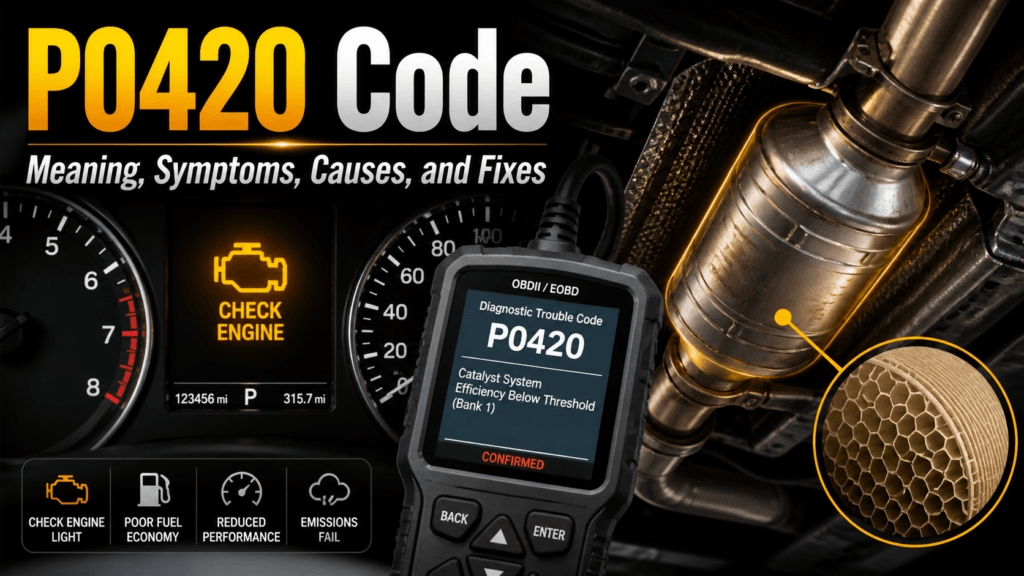
The P0420 code stands for “Catalyst System Efficiency Below Threshold Bank 1.” In simple terms, your vehicle’s dashboard computer has detected that the catalytic converter on Bank 1 is not cleaning exhaust gases as efficiently as it should. Bank 1 refers to the side of the engine that contains cylinder number one. When the system detects efficiency has dropped below the acceptable threshold, it stores the P0420 code and turns on the check engine light.
Your vehicle uses two oxygen sensors positioned before and after the catalytic converter to monitor its performance. The upstream sensor measures the oxygen content in exhaust gases entering the converter while the downstream sensor monitors what comes out. Under normal conditions the downstream sensor should show a fairly steady reading because the catalytic converter is doing its job. When the ECU or PCM detects that the downstream sensor is mimicking the upstream sensor too closely. It determines that the converter is no longer processing exhaust efficiently and triggers the P0420 code.
Symptoms of P0420 Code
Not every P0420 case comes with dramatic symptoms. In many situations the check engine light is the only obvious sign. However depending on the root cause and how long the issue has been present,you may notice one or more of the following symptoms that point directly to this code.
Check Engine Light
The check engine light is almost always the first and most noticeable symptom of a P0420 code. In most cases it is the only symptom that a driver notices especially in the early stages. Because the check engine light can represent dozens of different fault codes.The only way to confirm P0420 is to connect an OBD-II scanner and read the stored codes. Do not ignore this light assuming it will resolve on its own.
Reduced Engine Power
Some vehicles enter a reduced power mode when certain fault codes are active. With a P0420 code you may notice sluggish acceleration or a general lack of responsiveness particularly at highway speeds. This happens because the PCM is altering fuel delivery and timing in response to the detected inefficiency. Not all vehicles exhibit this symptom but it is more common when the catalytic converter is severely clogged.
Poor Fuel Economy
A failing catalytic converter or a malfunctioning oxygen sensor can disrupt the air-fuel ratio your engine runs on. When the ratio is off the engine burns more fuel than necessary to compensate. If you find yourself filling up more often than usual without a change in driving habits,the P0420 code and its underlying cause could be the reason.
Rotten Egg Smell
A sulfur or rotten egg smell coming from the exhaust is a classic sign of a failing catalytic converter. The converter normally neutralizes hydrogen sulfide in exhaust gases and converts it into odorless sulfur dioxide. When the converter degrades,it can no longer complete this conversion properly and the raw sulfur smell passes through the exhaust. If you notice this smell in combination with a P0420 code,the catalytic converter is likely damaged internally.
Rough Idle or Misfire
If the P0420 code is caused by misfires or fuel injector problems you may also experience rough idling or engine hesitation. In this case the catalytic converter is not necessarily the primary problem. The misfires send unburned fuel into the converter which overheats and damages it over time. Fixing the misfire is essential before any other repair is performed.
Causes of P0420 Code
Multiple issues can trigger a P0420 code and not all of them involve the catalytic converter itself. Jumping straight to replacing the converter without a proper diagnosis is one of the most expensive mistakes a vehicle owner can make. Here are the most common causes you need to rule out before spending money on parts.
Bad Catalytic Converter
The most common cause of a genuine P0420 code is a worn out or internally damaged catalytic converter. Over time the precious metal catalyst inside the converter degrades and loses its ability to oxidize harmful pollutants. High mileage vehicles are most susceptible to this. A converter can also be physically damaged by road debris or destroyed internally by engine problems like oil burning or coolant contamination. When the converter itself is the confirmed cause,replacement is the only real fix.
Faulty Oxygen Sensor
A faulty downstream oxygen sensor is one of the most frequently misdiagnosed causes of P0420. If the sensor is sending incorrect voltage signals to the ECU, the computer may falsely interpret the data as poor converter performance even when the converter is perfectly functional. Before condemning the catalytic converter,always verify that both the upstream and downstream oxygen sensors are reading correctly. A simple live data scan can reveal whether sensor behavior is abnormal.
Exhaust Leak
An exhaust leak located between the upstream oxygen sensor and the catalytic converter can introduce outside air into the exhaust stream. This extra oxygen throws off the sensor readings and causes the ECU to misread the catalytic converter’s performance. Exhaust leaks are often accompanied by a ticking or hissing sound from the engine bay and should be inspected visually before any other diagnosis is attempted.
Engine Running Rich or Lean
When an engine runs too rich, it pushes excess unburned fuel into the exhaust system. That unburned fuel enters the catalytic converter and burns inside it causing extreme heat that physically melts or breaks down the internal substrate. Over time,this destroys the converter from the inside out.
Similarly,a lean condition stresses the converter differently. Diagnosing the air-fuel ratio through live scanner data is an important step in any P0420 diagnosis because replacing the converter without fixing a rich or lean condition will simply destroy the new converter.
Misfires or Fuel Injector Problems
Engine misfires send raw unburned fuel directly into the exhaust system. When this fuel reaches the catalytic converter, it ignites and creates temperatures far beyond what the converter is designed to handle. A leaking or stuck-open fuel injector causes the same problem. If the vehicle has any misfire codes stored alongside P0420 those must be resolved first or the catalytic converter will fail again regardless of how many times it is replaced.
Is It Safe to Drive With P0420?
In the short term driving with a P0420 code is generally possible. The code itself does not disable the engine or cause immediate mechanical failure in most cases. You can typically continue driving the vehicle for routine errands while you gather information and schedule a proper diagnosis. The engine will still start and run though you may notice minor performance or fuel economy changes depending on the root cause.
However ignoring a P0420 code for an extended period is not a good idea. If the underlying cause is a rich running condition or misfires continued driving will accelerate damage to the catalytic converter and may eventually harm the oxygen sensors and other exhaust components. A severely clogged converter can also restrict exhaust flow to the point where engine performance suffers significantly. Addressing the root cause promptly is always the smarter and more cost-effective approach.
How to Diagnose P0420 Code
Diagnosing P0420 correctly requires a systematic approach. Guessing without data leads to unnecessary parts replacement and wasted money. A proper diagnosis takes less time than most people expect and the steps below will guide you through it in order.
Step 1: Scan for Other Codes
Before doing anything else connect an OBD-II scanner and pull all stored codes. Other codes present alongside P0420 provide critical context. Misfire codes like P0300 through P0308 or fuel system codes like P0171 or P0172 tell you that the catalytic converter may be a victim of another problem rather than the root cause. Address companion codes first before focusing on P0420.
Step 2: Inspect the Exhaust System
Perform a thorough visual inspection of the entire exhaust system from the exhaust manifold to the tailpipe. Look for cracks at the manifold gaskets loose flex pipes corroded flex joints and damaged sections near the catalytic converter. Start the engine and listen carefully for any ticking or hissing that indicates a leak. An exhaust leak near the upstream sensor can mimic converter failure and is a quick and inexpensive fix compared to converter replacement.
Step 3: Check Oxygen Sensor Readings
Using a scanner capable of displaying live data monitor both the upstream and downstream oxygen sensor voltages while the engine is at operating temperature. The upstream sensor should switch rapidly between low and high voltage readings showing normal cycling. The downstream sensor should hold a relatively steady voltage if the converter is working properly. If the downstream sensor is switching rapidly just like the upstream sensor the converter has lost efficiency. If the downstream sensor shows an abnormal flat line or erratic voltage it may be a bad sensor rather than a bad converter.
Step 4: Test for Misfires or Fuel Issues
Check live data for any misfires occurring on individual cylinders. Also review the short-term and long-term fuel trims to see if the engine is running rich or lean. Fuel trims above plus or minus ten percent indicate a fueling problem that needs to be corrected before any exhaust or converter repairs are made. Addressing misfires and fuel delivery issues at this stage prevents repeat failures.
How to Fix P0420 Code
Once you have diagnosed the root cause fixing P0420 becomes straightforward. The repair path depends entirely on what the diagnosis revealed. Below are the most common fixes matched to their causes.
Replace the Catalytic Converter
If the catalytic converter itself is confirmed as the cause replacement is necessary. For most passenger vehicles a direct-fit OEM or high-quality aftermarket converter is the recommended choice. California and certain states require CARB-compliant converters so check your local regulations before purchasing. Prices vary considerably between OEM and aftermarket options. After replacement clear the code and drive through a complete readiness cycle to confirm the repair.
Replace Faulty O2 Sensors
If live data points to a malfunctioning downstream oxygen sensor replacement is the fix. Always use a quality sensor that matches the vehicle specification. In some cases replacing only the downstream sensor resolves P0420 without any work on the converter at all. If both sensors are high mileage and showing signs of wear replacing both upstream and downstream sensors at the same time is a reasonable approach to avoid a repeat visit.
Repair Exhaust Leaks
Exhaust leaks are one of the easiest and least expensive causes of P0420 to fix. Depending on the location the repair may involve replacing a gasket tightening a flange or welding a crack. Fixing an exhaust leak between the manifold and the upstream sensor often resolves the code entirely without touching the catalytic converter or sensors. Always inspect for leaks before any other repair.
Fix Misfires Fuel or Air-Fuel Ratio Issues
If misfires or fuel system faults are present those must be repaired before anything else. Replace faulty spark plugs ignition coils or fuel injectors as needed. Correct any vacuum leaks or mass airflow sensor faults contributing to a rich or lean condition. Confirm that fuel trims have returned to normal after repairs. Only after the engine is running correctly should you reassess whether the catalytic converter also needs replacement.
Common Diagnosis Mistakes
One of the most costly mistakes vehicle owners and even some technicians make is replacing the catalytic converter the moment P0420 appears. The converter is the most expensive component in the diagnosis chain and replacing it without ruling out other causes is a gamble that often fails. A new converter installed on an engine still burning oil, running rich or misfiring will fail in a short period.
The smarter approach is to scan for all stored codes inspect for exhaust leaks and verify oxygen sensor performance first. Many P0420 cases resolve completely once a bad oxygen sensor is replaced or an exhaust leak is repaired. Always follow a diagnostic process rather than reacting to the code itself. The P0420 code identifies a symptom within a system and your job as a diagnostician is to find the actual cause.
P0420 Repair Cost
Repair costs for P0420 vary widely depending on the root cause and vehicle make. Understanding the cost ranges helps you budget appropriately and avoid being overcharged.
Diagnostic Cost
A professional P0420 diagnosis at a shop typically costs between 80 and 150 dollars. Some shops will apply the diagnostic fee toward the repair cost if you proceed with the work. Independent shops often charge less than dealerships for the same diagnostic service.
Oxygen Sensor Replacement Cost
Replacing an oxygen sensor typically costs between 150 and 300 dollars including parts and labor. The downstream sensor behind the converter is often less expensive to access than the upstream sensor. OEM sensors cost more but generally offer better longevity than budget alternatives.
Catalytic Converter Replacement Cost
Catalytic converter replacement is the most expensive repair associated with P0420. Aftermarket converters typically range from 200$ to 600$ for the part alone while OEM converters can cost considerably more. Total repair cost including labor usually falls between 400$ and 2000$ depending on the vehicle and the type of converter required.
Exhaust Leak Repair Cost
Exhaust leak repairs are generally the least expensive fix. Simple gasket replacements or flange tightening can cost as little as 50 to 150 dollars. More involved welding repairs on cracked pipes may run 150 to 400 dollars. Either way this is significantly less expensive than a converter replacement.
FAQs About P0420 Code
Can a bad O2 sensor cause P0420?
Yes. A faulty downstream oxygen sensor is one of the most common causes of a false P0420 code. If the sensor is sending incorrect signals the ECU may interpret a healthy catalytic converter as failing. Always test sensor performance with live data before replacing the converter.
Can catalytic converter cleaner fix P0420?
In some mild cases a catalytic converter cleaner added to the fuel tank may temporarily improve converter efficiency enough to clear a marginal P0420 code. However this is not a reliable or permanent fix. If the converter is genuinely degraded or physically damaged cleaner will not restore it.
Will P0420 clear itself?
P0420 will not clear itself in most cases. Once the fault conditions are met and the code is stored it remains until the root cause is repaired and the code is manually cleared with a scanner or until the battery is disconnected. Driving the vehicle without a repair will typically cause the code to return within one or two drive cycles.
How urgent is P0420 code?
P0420 is not an emergency code that requires immediate stopping. You can typically continue driving while scheduling a diagnosis. However do not ignore it long term. Ongoing damage to the catalytic converter and related components will make the eventual repair more expensive the longer it goes unaddressed.
Is P0420 expensive to fix?
The cost depends entirely on the root cause. A bad oxygen sensor costs 150 to 300 dollars to fix. An exhaust leak may cost as little as 100 dollars. A genuine catalytic converter replacement is the most expensive path ranging from 400 to 2000 dollars. Proper diagnosis first is the best way to avoid paying for an expensive repair that was never needed.
Final Thoughts
The P0420 code points to a real efficiency problem in your vehicle’s emission control system but it does not automatically mean you need a new catalytic converter. The key is diagnosing the root cause methodically before spending money on parts. Oxygen sensor faults exhaust leaks engine misfires and fuel delivery problems can all trigger this code and are far less expensive to fix than a converter. Take the time to scan for companion codes test your O2 sensor live data and inspect the exhaust physically. A thorough diagnosis protects your investment and ensures the repair actually solves the problem the first time.