
Contents
- Understanding Tire Pressure Sensor Fault: Causes Symptoms and Fixes
- What Is a Tire Pressure Sensor?
- How Does a Tire Pressure Sensor Work?
- Types of Tire Pressure Sensors
- What Does the TPMS Warning Light Mean?
- Common Causes of Tire Pressure Sensor Faults
- Symptoms of a Faulty Tire Pressure Sensor
- How to Troubleshoot and Fix Tire Pressure Sensor Issues
- When to Seek Professional Help
- Tire Pressure Sensor Replacement and Parts
- FAQs
Understanding Tire Pressure Sensor Fault: Causes Symptoms and Fixes
Driving on underinflated or overinflated tires is one of the most ignored road safety risks. Incorrect tire pressure reduces vehicle control shortens tire life and increases fuel consumption. In serious cases it can cause a blowout at high speed. Most drivers do not notice the problem until real damage has already been done.
Modern vehicles come with a Tire Pressure Monitoring System known as TPMS. At the center of this system is the tire pressure sensor. This guide covers what the sensor does, why it fails, what warning signs it produces and how to fix it. It also explains when you need to stop guessing and get professional help.
What Is a Tire Pressure Sensor?
A tire pressure sensor is a small battery-powered electronic device installed inside each tire of a vehicle. It is typically mounted on the valve stem or attached to the inner rim. The sensor is compact enough that most drivers never see it during routine use but it plays a direct role in keeping the vehicle safe on the road.
Each sensor continuously monitors air pressure inside its tire and transmits that data wirelessly to the vehicle’s onboard computer. When pressure drops or rises beyond safe limits the system notifies the driver through a dashboard alert. Without a functioning sensor the TPMS system has no reliable data and the driver has no early warning.
How Does a Tire Pressure Sensor Work?
The sensor uses a pressure transducer to take real-time readings of the air inside the tire. These readings are converted into a wireless signal and sent to the vehicle’s ECU. Most sensors transmit updated data every 60 to 90 seconds while the vehicle is in motion.
When pressure falls below roughly 25 percent of the recommended level the system activates a dashboard warning light. Proper inflation protects against uneven tread wear excessive heat buildup and poor fuel economy. The sensor acts as the earliest warning in the chain by alerting the driver before conditions become genuinely unsafe.
Types of Tire Pressure Sensors
There are two main types of TPMS sensors used in modern vehicles. Both serve the same purpose but they work in completely different ways.
Direct Tire Pressure Sensors
Direct TPMS sensors are physically mounted inside the tire on the valve stem or wheel rim. They measure the actual air pressure inside each individual tire and send that precise value wirelessly to the car’s computer. This type gives accurate real-time readings for each tire separately.
Indirect Tire Pressure Sensors
Indirect TPMS does not measure air pressure directly. Instead it uses data from the Anti-lock Braking System to monitor wheel rotation speed. When a tire loses pressure its diameter decreases slightly and its rotation speed increases. The system detects this change and flags a possible pressure issue. Indirect systems are less accurate and require recalibration after every tire rotation or replacement.
Direct vs Indirect TPMS — Quick Comparison
| Feature | Direct TPMS | Indirect TPMS |
| Measurement Method | Actual air pressure reading | Wheel rotation speed comparison |
| Accuracy | High — exact PSI per tire | Lower — estimated only |
| Hardware Required | Physical sensor in each tire | Uses existing ABS sensors |
| Internal Battery | Yes — sealed inside sensor | Not required |
| Recalibration Needed | After sensor replacement | After every tire rotation or change |
What Does the TPMS Warning Light Mean?
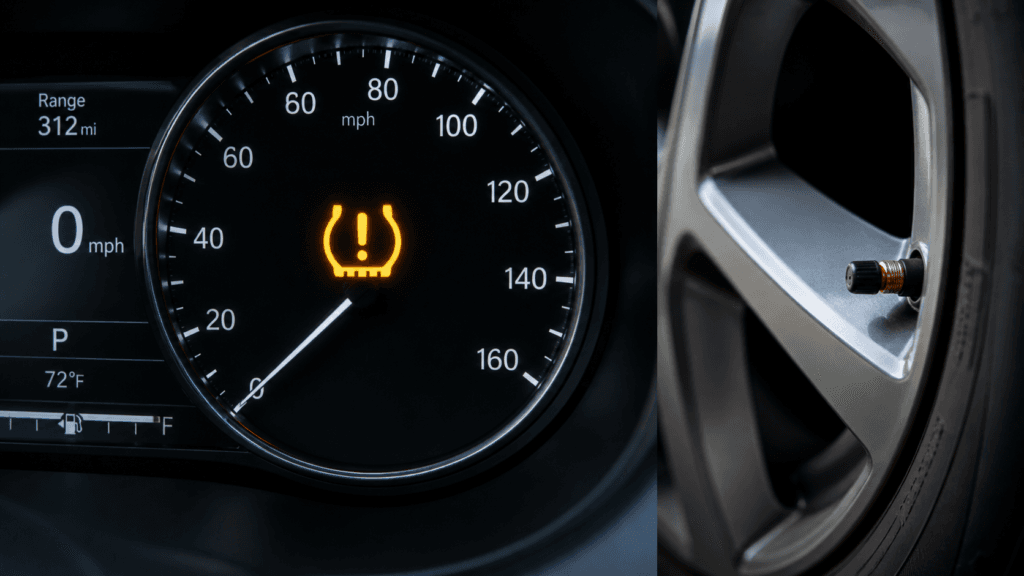
The TPMS warning light is typically an amber symbol shaped like a tire cross-section with an exclamation mark in the center. It sits on the dashboard and is designed to be immediately visible to the driver. On most vehicles it activates when one or more tires drop below the recommended pressure threshold.Some dashboard alerts are related to tire pressure, while others point to electrical or charging problems. For example, a service battery charging system warning usually means the vehicle has detected an issue with the battery, alternator, or charging circuit.
Some warning lights can also be connected to stability and braking systems. For example, the ESP BAS light usually points to a problem with electronic stability control, brake assist, or related sensors.
The warning light can appear for three distinct reasons. Tire pressure is too low. Tire pressure is too high. Or the sensor it self has developed a fault. A steady light usually means pressure is outside the safe range. A flashing or blinking light typically points to a tire pressure sensor fault or a TPMS system malfunction. Ignoring either situation puts both the vehicle and the driver at risk.
Common Causes of Tire Pressure Sensor Faults
A tire pressure sensor fault can develop for several reasons. Identifying the actual cause determines whether a simple reset will fix the problem or whether a replacement is unavoidable.
Dead or Weak Sensor Battery
TPMS sensors run on sealed internal batteries that cannot be recharged or swapped out separately from the sensor unit. Average battery life falls between five and ten years depending on driving frequency and climate. Once the battery dies the sensor stops transmitting data and the system registers a fault. This is the single most common cause of TPMS failure in vehicles that are several years old.
Physical Damage to the Sensor
The sensor sits inside the tire and faces road conditions during every drive. Hitting a deep pothole at speed striking a curb or road debris impacting the wheel can crack or shift the sensor out of position. The damage is often invisible from outside the tire but the internal components stop functioning correctly after impact.
Corrosion Around the Valve Stem
Road salt moisture and accumulated road grime accelerate corrosion around the valve stem where the sensor is mounted. Over time this corrosion damages the electrical connections inside the sensor or seizes the valve assembly completely. Vehicles driven through winter conditions on salted roads are the most vulnerable to this type of failure.
Improper Installation or Tire Service
TPMS sensors are delicate components that can be broken during routine tire work. Over-tightening the valve stem nut using the wrong torque or careless use of tire mounting equipment can damage or destroy the sensor. Tire rotations and seasonal tire swaps are the most common situations where sensors are accidentally damaged by inattentive technicians.
TPMS Software or Communication Error
The onboard computer managing TPMS can develop software glitches or signal communication errors that trigger a false fault warning. A failed firmware update an incomplete reset process or a compatibility issue after sensor replacement can all cause the system to report an error even when the physical sensors are working normally.
Symptoms of a Faulty Tire Pressure Sensor
A faulty tire pressure sensor does not always mean the tire itself has a problem. The sensor can fail while actual tire pressure remains at the correct level. Recognizing the difference between a real pressure issue and a sensor fault prevents unnecessary repairs and wasted time.
- TPMS warning light stays on continuously even after all tires have been inflated to the correct pressure
- Dashboard pressure readings do not match the values taken with a handheld manual gauge at the valve stem
- Blank display or error code appears where one or more tire pressure readings should be shown
- Frequent false low-pressure alerts appear and disappear without any actual change in tire condition
- The fault appears immediately after tire service such as a rotation replacement or seasonal swap
A TPMS warning is different from a brake-related warning, but both should be taken seriously. If your dashboard shows a service brake assist warning, the issue may involve the braking support system rather than tire pressure.
How to Troubleshoot and Fix Tire Pressure Sensor Issues
Before assuming a sensor needs replacement it is worth working through a logical series of checks. A significant number of TPMS faults can be resolved without purchasing any new hardware.
Check and Adjust Tire Pressure Manually
Use a quality handheld tire pressure gauge to check each tire individually. Compare the reading against the manufacturer-recommended PSI found on the sticker inside the driver door jamb or in the owner’s manual. Do not use the number printed on the tire sidewall as that figure is the maximum rated pressure not the correct operating pressure. Inflate or deflate as needed then drive for several minutes to allow the sensors to update.
Reset the TPMS System
Many vehicles allow a manual TPMS reset through the dashboard settings menu or through a dedicated reset button located beneath the steering column. The exact process varies between manufacturers. Consult the owner’s manual for the correct procedure specific to the vehicle. Some systems reset automatically after the vehicle is driven at a consistent speed for ten or more minutes once correct pressure has been set in all tires.
Inspect Tires and Valve Stems Visually
Look for visible damage on each tire including sidewall cuts bubbles and embedded nails or debris. Examine each valve stem for cracks corrosion or physical deformation. A damaged or corroded valve stem can cause simultaneous air loss and sensor failure. When corrosion is significant the valve stem and sensor typically need to be replaced together as a single unit.
Replace the Faulty Sensor
When the battery is confirmed dead or the sensor has suffered physical damage replacement is the only solution. The replacement sensor must match the vehicle’s TPMS frequency and communication protocol. After installation the new sensor ID must be programmed into the vehicle’s ECU using a TPMS scan tool. Without this programming step the warning light will remain active regardless of how good the new sensor is.
Recalibrate the TPMS System
After any tire rotation replacement or repair the TPMS system requires recalibration. This step resets the baseline readings stored in the vehicle’s computer so it can accurately interpret data from the current tire setup. On indirect systems recalibration is mandatory after every tire change. Skipping recalibration is the most common reason a warning light stays on after an otherwise successful repair.
Troubleshooting Summary
| Step | Action Required | DIY Possible? |
| 1 | Check and adjust tire pressure manually | Yes |
| 2 | Perform TPMS reset via dashboard | Yes |
| 3 | Visually inspect valve stems and tires | Yes |
| 4 | Replace dead or damaged sensor | Partially |
| 5 | Recalibrate TPMS after repair | Shop recommended |
When to Seek Professional Help
If the TPMS warning light stays on after correctly inflating all tires or if pressure readings are missing for one or more positions on the dashboard the problem is beyond a basic reset. The same applies if the system shows incorrect readings after multiple reset attempts. At this point the sensor hardware or the TPMS control module itself needs direct diagnostic testing with professional equipment.The same rule applies to other safety-related dashboard warnings. If you see a service airbag light, it should be diagnosed quickly because it may affect how the airbag system works during a collision.
A trained technician uses dedicated TPMS scan tools to read individual sensor IDs check battery voltage status detect signal transmission failure and pull software fault codes from the vehicle’s computer. These tools identify the exact fault source instead of guessing. Hidden damage from a past impact or moisture intrusion inside a sealed sensor housing is not detectable through visual inspection alone and requires professional-grade equipment to confirm.
Tire Pressure Sensor Replacement and Parts
When a TPMS sensor reaches the end of its battery life or sustains damage beyond use it must be replaced as a complete unit. The sealed internal battery cannot be replaced independently from the sensor body. Replacement sensors are stocked at auto parts stores tire shops and vehicle dealerships. They are also widely available through online retailers at varying price points.
Before purchasing confirm that the replacement sensor is compatible with the vehicle’s specific year make and model and that it operates on the correct radio frequency for the region. Installing an incompatible sensor results in a unit the vehicle’s computer cannot detect or communicate with. A tire shop can typically handle both physical installation and ECU programming in a single service visit.
FAQs
What does a tire pressure sensor fault mean?
A tire pressure sensor fault means one or more sensors in the TPMS system are not functioning correctly. The cause may be a dead battery physical damage or a communication failure between the sensor and the vehicle’s computer. It does not always indicate that actual tire pressure is low.
How can I reset my tire pressure sensor?
Inflate all tires to the correct PSI first. Then use the TPMS reset option in the vehicle’s dashboard menu or locate the dedicated reset button near the steering column. Drive at a steady speed for approximately ten minutes. Some systems reset automatically once correct pressure is confirmed across all tires.
What causes a tire pressure sensor to stop working?
The most common causes are a depleted internal battery after five to ten years of use physical damage from road impact or curb contact corrosion around the valve stem and accidental damage during tire mounting or rotation. Software faults in the TPMS control module are less frequent but also possible.
Can I drive with a faulty tire pressure sensor?
A vehicle can be driven with a faulty sensor but it is a poor choice from a safety standpoint. The TPMS system will not alert the driver to genuine pressure loss. This increases the real risk of driving on a severely underinflated tire without knowing it which can lead to a blowout or rim damage.
How much does it cost to replace a tire pressure sensor?
A single TPMS sensor typically costs between 20 and 100 dollars depending on the vehicle and brand. Labor and programming fees at a shop add to that total. Replacing all four sensors at the same time is usually more cost-effective than replacing them individually as they fail over time.