
Contents
Bank 1 vs Bank 2 Meaning: Which Side Is It and Where Is Your O2 Sensor Located
You see a code on your scanner. It says Bank 1 Sensor 1 or Bank 2 Sensor 2. Now you don’t know which side of the engine to check. Bank 1 and Bank 2 are engine-side labels that your vehicle uses for the diagnostics. These labels matter most when your codes involve oxygen sensors or catalytic converters.
Bank 1 is the engine side that holds cylinder number 1. Bank 2 is the opposite side and it only exists on engines that have two rows of cylinders. You can identify Bank 1 by finding cylinder number 1 in your engine layout.
Most people get confused because Bank 1 is not always on the driver side. The location depends entirely on the engine design and what the manufacturer decided. Guessing will almost always lead you to the wrong sensor.
Oxygen sensors and diagnostic trouble codes use these bank labels directly. Codes like P0135, P0155, P0420 and P0430, all include bank and sensor numbers. You need to understand what those numbers mean before you touch anything under the hood.
This article will explain bank location, sensor position, upstream vs downstream differences and how to confirm the exact sensor using a repair manual or OBD2 scan tool. By the end you will know exactly where to look and what to replace.
What Are Bank 1 and Bank 2
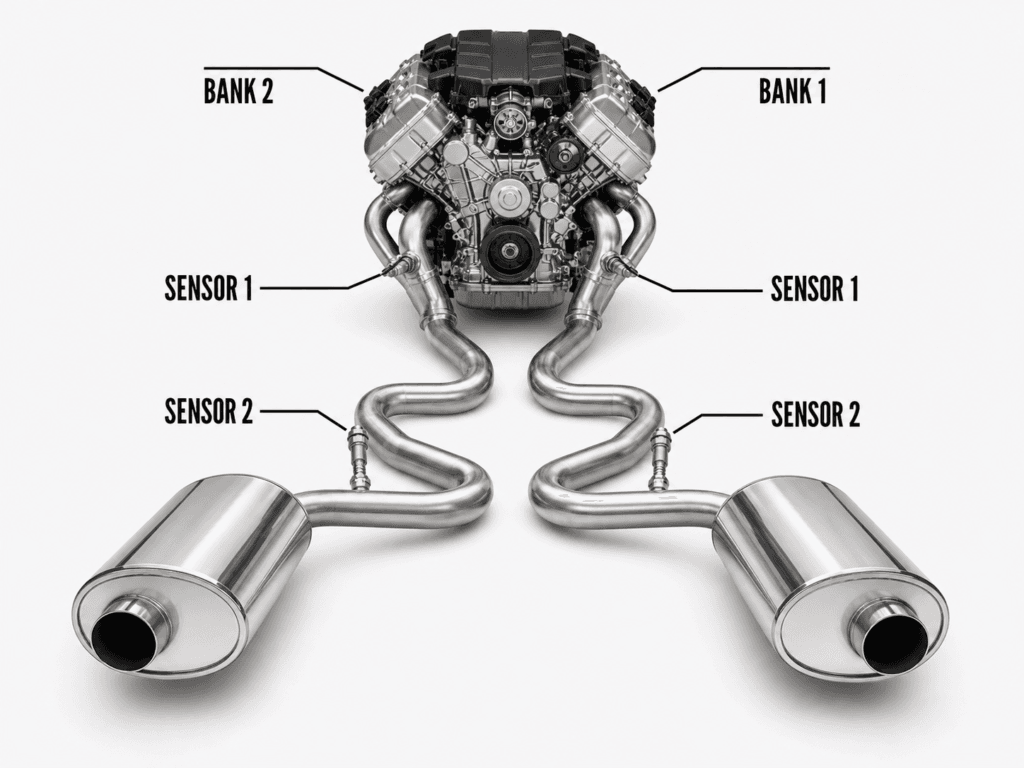
Bank 1 is the side of your engine that contains cylinder number 1. That is the full definition. It does not mean left side. It does not mean driver side. It simply means whichever side of the engine holds that first cylinder in the manufacturer’s numbering order.
Bank 2 is the opposite side of Bank 1. Bank 2 only exists on engines that have two separate rows of cylinders. V6 engines have two banks. V8 engines have two banks. V10 engines have two banks. Any engine built in a V shape will have a Bank 1 and a Bank 2.
If your vehicle has an inline four-cylinder engine all four cylinders sit in one straight row. There is only one bank on that engine. Every oxygen sensor code on a four-cylinder will reference Bank 1 only. You will never see Bank 2 on a single-bank engine.
Bank numbers and sensor numbers are two completely different things. A lot of people mix them up and that mistake costs them time and money. Bank tells you which side of the engine to look at. Sensor number tells you where on that side the oxygen sensor is positioned. You need both pieces of information before you start looking for anything.
The physical side where Bank 1 sits changes from one vehicle to another. A Toyota and a Ford may both have V8 engines but Bank 1 may be on completely different sides. Engine design and manufacturer decisions control where cylinder number 1 is placed.
This is exactly why guessing left or right is risky. Without checking your specific vehicle’s cylinder layout or repair manual you have a real chance of working on the wrong side entirely.
| Term | Meaning |
| Bank 1 | Engine side containing cylinder number 1 |
| Bank 2 | Opposite side on V-type two-bank engines |
| Sensor 1 | Upstream oxygen sensor before the catalytic converter |
| Sensor 2 | Downstream oxygen sensor after the catalytic converter |
Difference Between Bank 1 and Bank 2 When Locating O2 Sensors
Bank 1 and Bank 2 are engine sides. That is all they are. They tell you which physical side of the engine you need to look at when a diagnostic code comes up.
Sensor 1 and Sensor 2 are oxygen sensor positions. They tell you where on that engine side the sensor is sitting. One is before the catalytic converter and one is after it.
Bank 1 is the side that holds cylinder number 1. Bank 2 is the other side. On a V-type engine both sides run exhaust through their own set of oxygen sensors and their own catalytic converter.
Cylinder numbering is decided by the manufacturer. Different brands number their cylinders in different ways. This is the main reason Bank 1 does not always land on the same side of the engine across all vehicles.
Here is what you should never assume when reading a bank-related code:
- Bank 1 is not always on the left side of the engine
- Bank 1 is not always on the driver side
- Bank 1 is not always on the passenger side
- Bank 2 is simply the opposite of wherever Bank 1 is on your specific engine
The only safe way to confirm about which side is Bank 1 is to find a cylinder numbering diagram for your exact engine. Many vehicles also have an under-hood sticker or label that shows the firing order and cylinder layout.
If you replace a sensor on the wrong bank,you will still get the same fault code after the repair. The scan tool will still show the same problem because the actual faulty sensor was never touched. Checking first saves you from doing the job twice.
How to Locate an Oxygen Sensor
Locating an oxygen sensor comes down to two pieces of information. The first is the bank number which tells you which side of the engine to look at. The second is the sensor number which tells you whether the sensor is located before or after the catalytic converter. Every O2 sensor on your vehicle falls into one of four positions: Bank 1 Sensor 1 / Bank 1 Sensor 2 / Bank 2 Sensor 1 / Bank 2 Sensor 2.
Bank 1 Sensor 1 Location
Bank 1 Sensor 1 is located on the Bank 1 side of the engine before the catalytic converter. It is an upstream sensor. Its job is to measure the exhaust gases coming out of the engine before those gases reach the catalytic converter. This sensor directly influences how your engine manages the air-fuel mixture.
Bank 1 Sensor 2 Location
Bank 1 Sensor 2 is located on the Bank 1 side of the engine after the catalytic converter. It is a downstream sensor. It does not control the air-fuel mixture. Its job is to monitor how well the catalytic converter is doing its work by reading the exhaust gases that come out after the converter.
Bank 2 Sensor 1 Location
Bank 2 Sensor 1 is located on the opposite side of Bank 1 and before the catalytic converter on that side. It is the upstream oxygen sensor for Bank 2. This sensor only exists on engines that have two banks such as V6 V8 and V10 engines. On a four-cylinder engine this position does not exist.
Bank 2 Sensor 2 Location
Bank 2 Sensor 2 is located after the catalytic converter on the Bank 2 side of the engine. It is the downstream sensor for Bank 2. It checks how efficiently the catalytic converter on the Bank 2 side is processing the exhaust gases that pass through it.
Upstream vs Downstream Oxygen Sensors
Upstream means before the catalytic converter and Downstream means after the catalytic converter. That is the simplest way to understand the difference between these two sensor positions.
Sensor 1 is the upstream sensor. It sits in the exhaust pipe before the exhaust gases enter the catalytic converter. This sensor reads the oxygen content in the exhaust and sends that data to your engine control unit. The ECU uses that data to adjust the air-fuel mixture going into the engine.
Sensor 2 is the downstream sensor. It sits after the catalytic converter in the exhaust path. This sensor checks whether the catalytic converter is actually doing its job. If the converter is working properly the downstream sensor will show a relatively steady reading compared to the upstream sensor.
Before blaming an oxygen sensor, also check common ignition problems like bad spark plug symptoms, because poor combustion can affect exhaust oxygen readings.
Think of exhaust flow like water moving through a pipe in one direction. The upstream sensor sits at a point before the water passes through a filter. The downstream sensor sits after that filter. One measures what goes in and the other checks what comes out.
Both sensors report data to the ECU but they serve completely different purposes. Mixing them up or replacing the wrong one will not fix your problem and may introduce new fault codes.
How to Locate an O2 Sensor With an OBD2 Scan Tool
An OBD2 scan tool is one of the most reliable ways to confirm which oxygen sensor is causing a problem before you start disconnecting anything. This method helps you avoid replacing a perfectly good sensor on the wrong bank or the wrong position.
Before you do anything let the engine cool down completely. Oxygen sensors sit on the exhaust system and exhaust parts stay dangerously hot for a long time after the engine runs. Never touch or unplug a sensor on a hot exhaust pipe.
Follow these steps once the engine is cool and you are ready to check:
- Turn the ignition to the ON position without starting the engine
- Connect your OBD2 scanner to the diagnostic port usually found under the dashboard on the driver side
- Read the trouble codes and write down the exact bank and sensor number shown in the code
- Switch to the live data screen on your scanner and find the oxygen sensor readings
- Carefully unplug one sensor at a time only when it is safe and accessible then watch which reading disappears or flat lines on the live data screen
- Once you confirm which sensor dropped off the live data reconnect it securely
- Repeat this process if needed until you are certain which sensor matches the code
This process takes a little extra time but it removes all guesswork from the job.
FAQs
What Is Bank 1
Bank 1 is the engine side that contains cylinder number 1. That is the direct answer. The physical location of Bank 1 changes depending on how the engine is built and how the manufacturer decided to number the cylinders. On some vehicles Bank 1 is on the driver side. On others it is on the passenger side. You cannot assume the position without checking the repair manual or cylinder layout diagram for your specific vehicle and engine.
Is Bank 1 Left or Right
Bank 1 is not always left and it is not always right. The side where Bank 1 sits depends entirely on the vehicle and the engine layout. Two vehicles with the same engine displacement can still have Bank 1 on opposite sides because of how each manufacturer numbers the cylinders. The only reliable way to confirm Bank 1 position is to check the service manual or find a cylinder numbering diagram specific to your make model and engine.
Is Bank 2 Driver Side or Passenger Side
Bank 2 is not always the driver side and it is not always the passenger side. Bank 2 is simply the opposite side of Bank 1 on any engine that has two banks. Since Bank 1 can be on either side depending on the vehicle Bank 2 moves with it. On a four-cylinder inline engine Bank 2 does not exist at all. Always confirm Bank 1 first and Bank 2 will be whatever side is left.
Are Bank 1 and Bank 2 Sensors the Same
The sensors themselves may look similar and in some vehicles they may even share the same part number. But their locations and diagnostic labels are completely different. A Bank 1 Sensor 1 is the upstream sensor on the Bank 1 side. A Bank 2 Sensor 1 is the upstream sensor on the Bank 2 side. Installing a sensor in the wrong position or labeling it incorrectly will lead to the wrong code being cleared and the real problem staying unfixed.
Which O2 Sensor Is Bank 1 Sensor 2
Bank 1 Sensor 2 is the downstream oxygen sensor on the side of the engine that contains cylinder number 1. It is positioned after the catalytic converter on the Bank 1 side. Its main job is to monitor catalytic converter efficiency by reading exhaust gases after they have already passed through the converter. A code pointing to Bank 1 Sensor 2 usually means there is a converter efficiency issue or the downstream sensor itself has failed.
Is Bank 1 Upstream or Downstream
Bank 1 is neither upstream nor downstream. Bank 1 is an engine side not a sensor position. Upstream and downstream describe where a sensor sits in relation to the catalytic converter. Sensor 1 is the upstream position and Sensor 2 is the downstream position. Bank 1 simply tells you which side of the engine those sensors are on. You need both the bank number and the sensor number together to identify any specific oxygen sensor on your vehicle.
Can You Swap Upstream and Downstream O2 Sensors
In most cases, you should not swap upstream and downstream oxygen sensors. These sensors often have different connector types different wire lengths different thread sizes and different internal calibrations built for their specific position in the exhaust.
Putting a downstream sensor in an upstream position or the other way around can cause false readings incorrect air-fuel adjustments and new trouble codes that were not there before. Always replace each sensor with the correct part for that specific position.
What Is the Difference Between Upstream and Downstream Oxygen Sensors
Upstream oxygen sensors measure exhaust gases before they enter the catalytic converter and send that data to the ECU to help control the air-fuel mixture going into the engine. Downstream oxygen sensors measure exhaust gases after they exit the catalytic converter and report whether the converter is working efficiently.
Both sensors communicate with the ECU but they serve entirely different functions. Upstream sensors influence engine performance directly while downstream sensors are primarily there to monitor emissions equipment health.
Final Words
Bank 1 is the engine side that contains cylinder number 1. Bank 2 is the opposite side and it only exists on engines with two banks. These are not left or right labels. They are diagnostic references tied to your specific engine layout. Sensor 1 is the upstream position before the catalytic converter and Sensor 2 is the downstream position after it.
Always confirm the correct bank and sensor position before replacing anything. Use your repair manual check the under-hood cylinder diagram or use an OBD2 scan tool to verify which sensor is actually causing the code. One step of confirmation before the repair is far better than replacing the wrong part and pulling the same code all over again.