
Contents
- Bad Fuel Pressure Regulator Symptoms (Complete Guide with Causes and Fixes)
- What is a Fuel Pressure Regulator?
- How does Fuel Pressure Regulator work?
- Top Symptoms of a Bad Fuel Pressure Regulator
- 1. Engine Misfire
- 2. Poor Fuel Efficiency / Mileage Drop
- 3. Black Smoke from Exhaust
- 4. Difficulty Starting / No Start
- 5. Weak Acceleration / Loss of Power
- 6. Strong Fuel Smell
- 7. Check Engine Light
- 8. Rough Idle / Fluctuating RPM
- 9. Engine Backfires
- 10. Black / Sooty Spark Plugs
- 11. Deceleration Problems
- 12. Fuel in Vacuum Hose
- 13. Fuel in Engine Oil (Dipstick Smell)
- 14. Noisy Fuel Pump
- Symptoms Explained in Depth
- Causes of a Bad Fuel Pressure Regulator
- Bad Fuel Pressure Regulator vs Bad Fuel Pump (Critical Section)
- How to Diagnose a Bad Fuel Pressure Regulator
- Can You Drive with a Bad Fuel Pressure Regulator
- How to Fix or Replace a Fuel Pressure Regulator
- How Long Does a Fuel Pressure Regulator Last
- Preventing Fuel Pressure Regulator Failure
- FAQs
Bad Fuel Pressure Regulator Symptoms (Complete Guide with Causes and Fixes)
In a vehicle, fuel is one of the main things that keeps the engine alive. The fuel pump moves gas from the tank but it does not decide exactly how much fuel the engine should receive at every moment. That job belongs to the fuel pressure regulator. Its role is to help maintain the correct pressure so the injectors can deliver the right amount of fuel for idle cruising and acceleration. When the regulator starts failing the engine may run rich or lean and that can lead to hard starting,rough idle,weak acceleration,black smoke, poor fuel economy,fuel smell misfires and in some cases fuel inside the vacuum hose which is one of the clearest signs of diaphragm failure.
The short version is simple. A bad fuel pressure regulator throws off fuel delivery. Too much pressure can flood the engine and create a rich condition. Too little pressure can starve the engine and create a lean condition. Either way combustion becomes unstable and the vehicle starts showing noticeable drivability problems.
What is a Fuel Pressure Regulator?
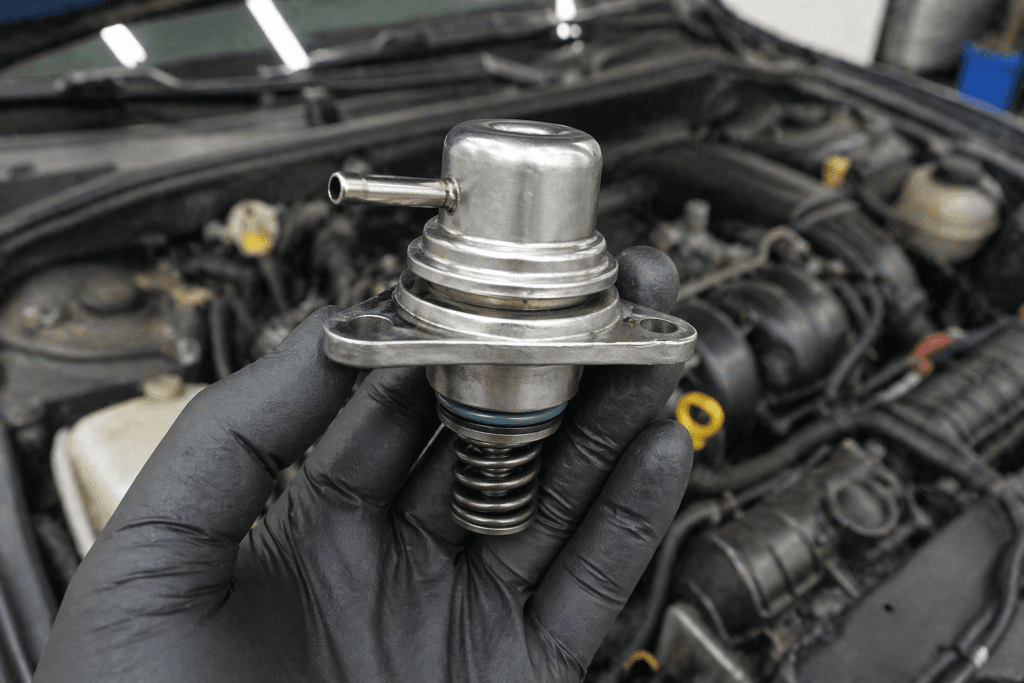
A fuel pressure regulator is a fuel system component that helps keep injector pressure where it should be,so the engine gets a stable air fuel mixture. In older return style systems it usually works with a diaphragm spring and vacuum reference to bleed excess fuel back to the tank.
In many modern returnless systems,the regulating function is often integrated into the fuel pump module and controlled electronically rather than using the old external vacuum referenced layout.
That matters because not every modern car will have an external regulator you can see on the rail. But the symptom logic is still similar. If fuel pressure is not being controlled correctly,then the injectors cannot meter fuel cleanly and the engine starts running poorly.
How does Fuel Pressure Regulator work?
When you turn the key on,the fuel pump primes the system and sends fuel toward the rail. In a traditional vacuum referenced setup the regulator uses fuel pressure on one side of a diaphragm and spring or manifold vacuum on the other side to open or close a return path. If pressure rises too high it opens more and sends excess fuel back. If pressure drops it closes more to keep pressure up. That is how the injectors keep seeing a usable pressure difference across operating conditions.
If the regulator sticks open than pressure can stay too low and the engine may hesitate,misfire or struggle under load. If it sticks closed pressure can stay too high and the engine may run rich foul plugs and produce black smoke. If the diaphragm ruptures,raw fuel can be pulled into the intake through the vacuum hose.
Top Symptoms of a Bad Fuel Pressure Regulator
1. Engine Misfire
An engine misfire is one of the most common symptoms. When fuel pressure becomes unstable the injectors stop delivering fuel consistently. That can cause rough idle,hesitation under load,vibration and weak response. Misfire is tricky because it can also come from ignition coils,spark plugs,injector faults or vacuum leaks. But when it appears together with fuel smell,poor,mileage or black smoke:the regulator becomes a much stronger suspect.
2. Poor Fuel Efficiency / Mileage Drop
A failing regulator can hurt fuel economy in both directions. If pressure is too high,the engine runs rich and burns more fuel than needed. If pressure is too low,the engine may compensate in ways that still increase fuel use and reduce efficiency. In real life the driver usually notices more fuel stops and fewer miles per tank before they notice anything else.
3. Black Smoke from Exhaust
Black smoke usually points to a rich condition. Too much fuel is entering the cylinders and not all of it is burning completely. That extra unburned fuel leaves the tailpipe as dark smoke and soot. A stuck closed regulator or excessively high fuel pressure can do this. Black smoke can also come from other causes like injector problems or restricted air flow so it should be diagnosed rather than guessed.
4. Difficulty Starting / No Start
An engine needs the right fuel pressure to start cleanly. If pressure is too low the engine may crank without firing because there is not enough fuel at the injectors.
If pressure is too high,the engine may flood. Some vehicles show long cranking first and then become hard no start cases later. Before blaming the regulator you still need to rule out the battery starter,fuel pump and related wiring.If your car cranks but fails to start, it’s also smart to check your service battery charging system to ensure the alternator is providing enough voltage.
5. Weak Acceleration / Loss of Power
When the regulator fails the engine may feel flat when you press the pedal. A lean condition from low pressure often causes hesitation,weak pull and poor response under load. The car may feel sluggish even though the throttle input is normal. This symptom overlaps with a weak fuel pump clogged filter or injector issues so it should be tested with pressure readings instead of guesswork.
6. Strong Fuel Smell
A strong fuel smell inside or around the vehicle is a red flag. The regulator itself can leak at seals or the system can be pushed into abnormal pressure that exposes leaks elsewhere. Any raw fuel smell should be treated seriously because it can become a fire risk.
7. Check Engine Light
Modern vehicles monitor rail pressure and air fuel behavior. When actual pressure does not match what the control system expects the ECU may trigger the check engine light and store fuel pressure or mixture related codes. A bad regulator can contribute to codes such as P0089 and related fuel pressure faults though the final cause still needs testing because the pump sensor filter and wiring can also be involved.
8. Rough Idle / Fluctuating RPM
At idle the engine is very sensitive to pressure changes. A weak or unstable regulator can cause surging shaky idle or RPM hunting because injector delivery is no longer stable. This symptom becomes even more suspicious if it appears with misfire fuel smell or black plugs.
9. Engine Backfires
When the engine runs excessively rich unburned fuel can move into the hot exhaust and ignite there. That can create backfires or popping especially during deceleration.
It is not the most common symptom on every car but it does happen when fuel control gets badly out of balance.
10. Black / Sooty Spark Plugs
If the regulator is causing a rich mixture the spark plugs can become black and carbon fouled. That soot buildup weakens ignition quality and can worsen misfire rough idle and poor starting. When plugs are black the smart move is not to stop at replacing plugs. You need to ask why the engine is running rich in the first place.
11. Deceleration Problems
This symptom is not discussed well in many articles but it is real in rich running cases. If the engine keeps carrying extra fuel,it may feel slow to settle when you lift off the throttle. In some cases excess fuel in the exhaust can also trigger popping during deceleration. It is not the first symptom most drivers notice but when it appears with black smoke and backfire it fits the pattern.
12. Fuel in Vacuum Hose
This is the smoking gun symptom on vacuum operated regulators. If you disconnect the vacuum hose and find or smell raw fuel inside that hose,the regulator diaphragm is almost certainly ruptured.
Fuel should not be there. This is one of the quickest and most valuable checks you can do on an older style external regulator.
13. Fuel in Engine Oil (Dipstick Smell)
This one is rarer but serious. In some systems fuel contamination of the oil can happen through sealing failures or severe overfueling problems. If the dipstick smells strongly of fuel,the oil can lose lubricating strength and engine damage risk goes up fast. This is not exclusive to the regulator because injectors and pump issues can also do it. But it is a critical clue that should never be ignored.
14. Noisy Fuel Pump
A bad regulator can force the pump to work harder than normal especially if the regulator is stuck closed or pressure control is unstable. Drivers sometimes hear a stronger whirring or whining sound than usual. A noisy pump does not prove the regulator is bad but when paired with drivability symptoms it becomes an important clue.
Symptoms Explained in Depth
Why Rich Condition Happens
A rich condition happens when injector pressure stays too high or the regulator does not relieve excess pressure properly. The injectors end up delivering more fuel than the available air can burn. That creates black smoke,sooty plugs,fuel smell, backfire and poor mileage. Rich running can also overload the catalytic converter over time.
Why Lean Condition Happens
A lean condition happens when the regulator bleeds off too much fuel or cannot maintain proper pressure under load. Then the injectors receive less usable pressure and fuel delivery drops. That causes hesitation,misfire,loss of power and sometimes hard starting. Lean running under load is more dangerous than many drivers realize because combustion temperatures can rise and drivability gets worse fast.
How Fuel Pressure Affects Combustion
Combustion quality depends on having the right amount of atomized fuel at the right time. Fuel pressure that is too high or too low changes injector behavior and the final air fuel mixture. Once that balance moves away from target,the engine stops running smoothly and starts leaving clues through smoke idle,quality plug,condition fuel trims and starting behavior.
Causes of a Bad Fuel Pressure Regulator
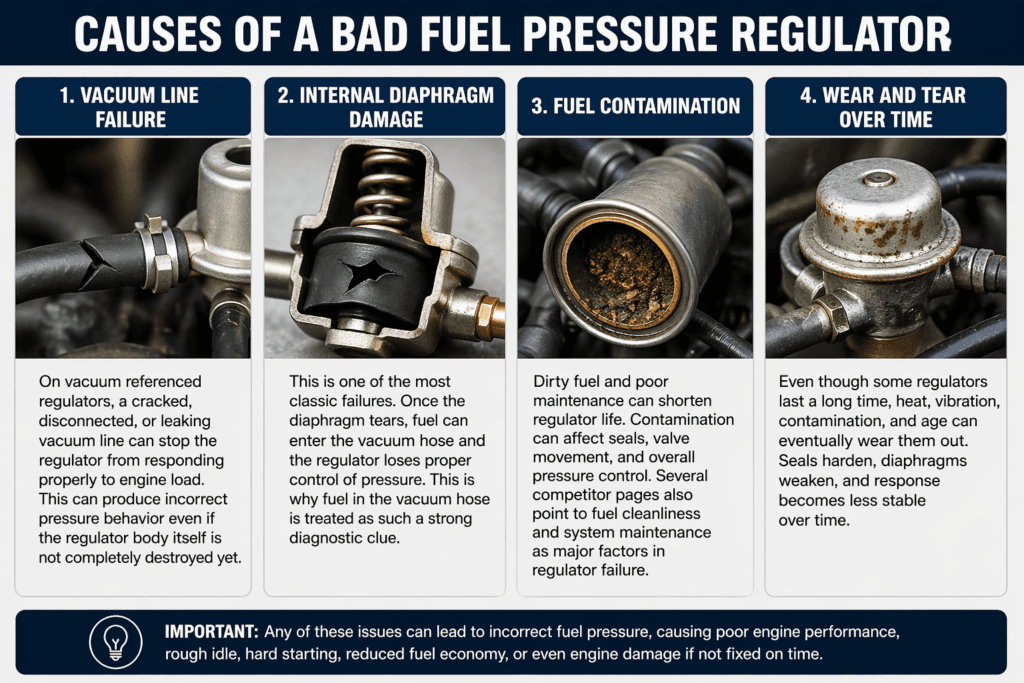
Vacuum Line Failure
On vacuum referenced regulators a cracked disconnected or leaking vacuum line can stop the regulator from responding properly to engine load. That can produce incorrect pressure behavior even if the regulator body itself is not completely destroyed yet.
Internal Diaphragm Damage
This is one of the most classic failures. Once the diaphragm tears fuel can enter the vacuum hose and the regulator loses proper control of pressure. This is why fuel in the vacuum hose is treated as such a strong diagnostic clue.
Fuel Contamination
Dirty fuel and poor maintenance can shorten regulator life. Contamination can affect seals valve movement and overall pressure control. Several competitor pages also point to fuel cleanliness and system maintenance as major factors in regulator failure.
Wear and Tear Over Time
Even though some regulators last a long time heat vibration contamination and age can eventually wear them out. Seals harden diaphragms weaken and response becomes less stable over time.
Bad Fuel Pressure Regulator vs Bad Fuel Pump (Critical Section)
| Problem | Regulator Issue | Fuel Pump Issue |
|---|---|---|
| Fuel pressure | Too high or too low | Usually low |
| Starting | Hard start or flood or crank no start | Crank no start more common |
| Acceleration | Can be rich or lean depending on failure mode | Usually weak under load |
| Vacuum hose fuel | Possible on vacuum style regulator | No |
| Pump noise | Sometimes secondary | Common clue |
| Black smoke | More possible if pressure too high | Less typical by itself |
This is where many articles stay weak. Symptoms overlap but there are clues that help separate them.
A bad pump usually causes low pressure only. A bad regulator can cause either low pressure or high pressure depending on how it fails. Also a pump problem will not put fuel inside the regulator vacuum hose. That one difference is extremely useful during diagnosis.
How to Diagnose a Bad Fuel Pressure Regulator
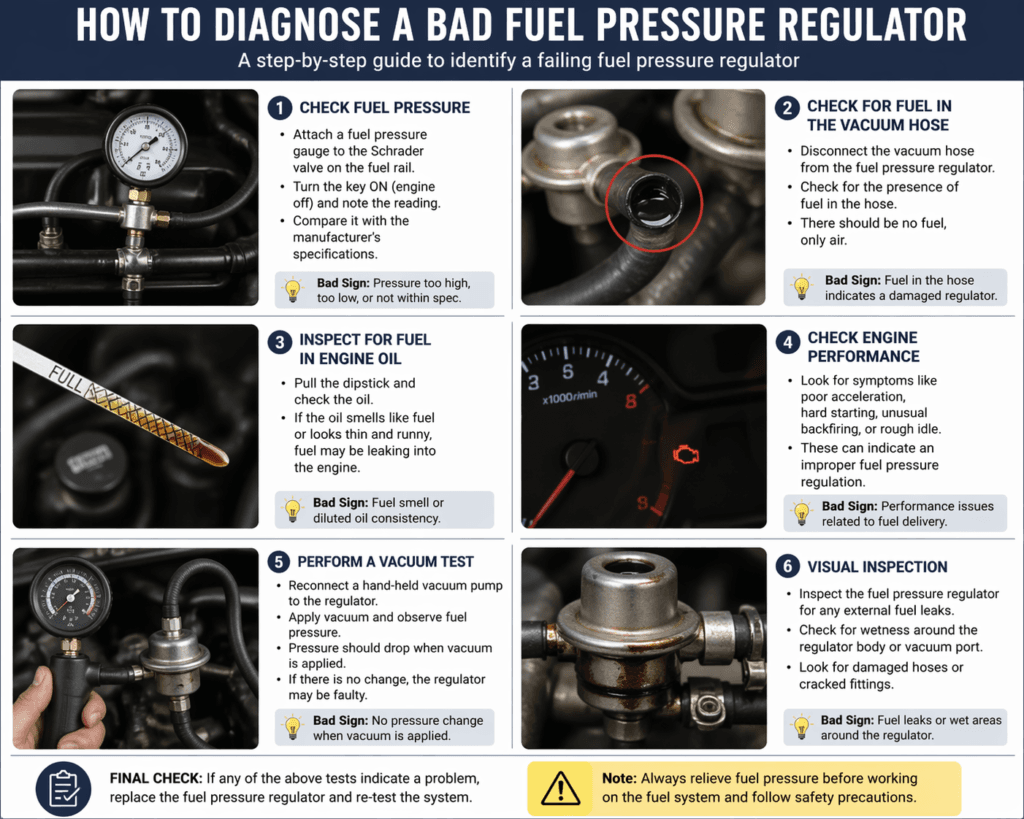
Check Fuel Pressure with Gauge
Use a fuel pressure gauge and compare readings to factory spec. A simple key on engine off reading plus idle reading can reveal a lot. On many systems the idle pressure should react when vacuum changes.
Inspect Vacuum Line for Fuel Leak
Disconnect the vacuum line carefully and inspect for raw fuel or strong fuel smell. Fuel inside that hose points strongly to a ruptured diaphragm.
Look for Fuel in Vacuum Hose
This deserves its own step because it is such a strong clue. If fuel is present there do not keep chasing random parts first. The regulator moves much higher on the suspect list immediately.
Observe Exhaust Smoke
Black smoke supports a rich condition. No smoke does not prove the regulator is fine but visible black smoke with poor mileage rough running and plug fouling fits the pattern well.
Can You Drive with a Bad Fuel Pressure Regulator
You may be able to drive a short distance but it is not smart to ignore it. The engine can stall,run dangerously rich,wash cylinders,foul plugs, damage the catalytic converter or create a fuel leak hazard. If the symptom is only mild, the car might still move. That does not mean it is safe to keep using it normally.
How to Fix or Replace a Fuel Pressure Regulator
Repair vs Replacement
Most failed regulators are replaced,not repaired. Once the diaphragm or valve section fails, replacement is usually the proper fix. Before replacing it confirm pressure readings and inspect the vacuum hose so you do not mistake a weak pump clogged filter or sensor issue for a regulator fault.
Cost Estimate
Cost varies a lot by vehicle and whether the regulator is external or integrated into the fuel pump module. Typical examples from automotive repair content put replacement anywhere from around $100 to $600 total with many external regulator jobs taking about 1 labor hour. Some easier jobs land around the $250 to $400 range while integrated systems can cost more.
How Long Does a Fuel Pressure Regulator Last
There is no perfect mileage number for every car. Many regulators last a long time and may even approach the life of the vehicle under good conditions. Fuel quality heat contamination and maintenance habits affect that lifespan heavily.
Preventing Fuel Pressure Regulator Failure
Use clean quality fuel. Replace the fuel filter on schedule where applicable. Do not ignore drivability symptoms early. Keep the fuel system clean and fix vacuum leaks quickly. Small fuel delivery problems often become larger and more expensive when the car is driven for too long without diagnosis.
FAQs
What are the first signs of a bad fuel pressure regulator
The first signs are usually rough idle poor acceleration poor fuel economy hard starting or black smoke depending on whether the engine is running lean or rich.
Can a bad regulator cause misfire
Yes. Unstable fuel pressure changes injector delivery and can cause misfire especially at idle or under load.
Will it throw a code
Often yes. Fuel pressure and mixture faults can trigger the check engine light and may set codes such as P0089 or related pressure faults depending on the vehicle and failure mode.
Can it damage engine
Yes. A rich condition can damage the catalytic converter and a lean condition can increase heat and drivability stress. Fuel leaks also create a safety risk.