
Contents
- Bad Ignition Coil Symptoms: Causes and Fixes
- Why ignition coil symptoms are easy to misread
- The most reliable bad ignition coil symptoms
- 1. Engine misfire that keeps coming back
- 2. Rough idle that feels uneven and annoying
- 3. Hesitation when you accelerate
- 4. Loss of power that makes the car feel lazy
- 5. Hard starting especially when the engine is cold
- 6. Check engine light that comes with performance issues
- 7. Worse fuel economy with no good reason
- 8. Engine shaking under load
- 9. Intermittent stalling in worse cases
- Symptoms by situation: when the coil usually gives itself away
- Bad ignition coil vs bad spark plug vs bad injector
- Frequently Asked Questions
- What are the most common bad ignition coil symptoms?
- Can a bad ignition coil cause rough idle and engine shaking?
- How do I know if my ignition coil is bad or it is a spark plug problem?
- Will a bad ignition coil always trigger a check engine light?
- Can a bad ignition coil cause loss of power and poor acceleration?
- Is it safe to drive with a bad ignition coil?
- What OBD codes indicate a bad ignition coil?
- Can one bad ignition coil affect the whole engine?
- How long can you drive with a bad ignition coil?
- Should I replace all ignition coils or just one?
Bad Ignition Coil Symptoms: Causes and Fixes
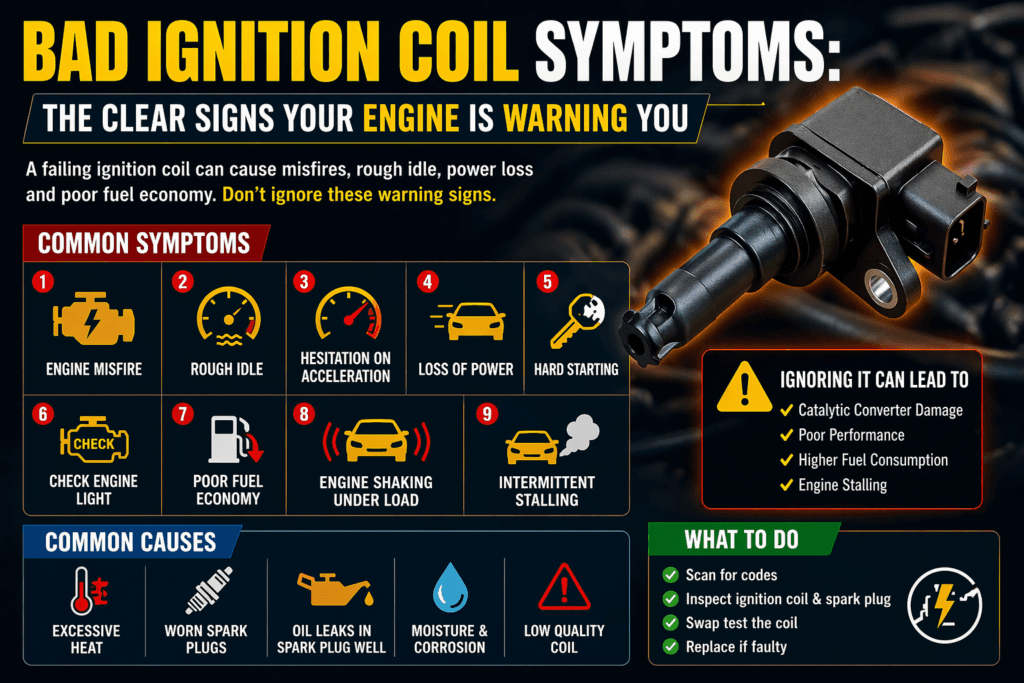
Bad ignition coil symptoms usually show up as engine misfire, rough idle, weak acceleration, hard starting, power loss, poor fuel economy, and a check engine light. In many cars, the problem feels worst during acceleration, or when the engine is under load. The best way to confirm it is with code scanning, coil swap testing, and spark plug inspection.
A bad ignition coil can fool people. Sometimes it feels like a fuel issue. Sometimes it acts like a bad spark plug. Sometimes the car only misfires when you push it harder. That is why this problem gets misdiagnosed all the time. I have seen people replace plugs, sensors, injectors, and even fuel parts before checking the coil properly. So if your car feels off, and you are trying to figure out whether the coil is the reason, this guide will help you do it the smart way.
Why ignition coil symptoms are easy to misread
The ignition coil has one job. It turns low battery voltage into the high voltage needed to fire the spark plug. When that spark becomes weak, delayed, or inconsistent, the air fuel mixture in the cylinder does not burn the way it should. That is where the trouble starts.Many drivers confuse ignition coil issues with bad spark plug symptoms, because both can cause misfire and rough idle.
The reason this issue confuses so many drivers is simple. A failing coil does not always die in one clean moment. It can weaken slowly. It can fail only when hot. It can act up only under load. It can work fine at idle, and then struggle badly on the road. That is why you need to pay attention to the pattern, not just one symptom.
The most reliable bad ignition coil symptoms
Not all symptoms carry the same weight. Some are much stronger clues than others.In some cases, ignition system failure combined with engine overheating causes can make performance issues worse.
1. Engine misfire that keeps coming back
This is the biggest one. If your engine is misfiring, and the same cylinder keeps showing trouble, then the coil moves high on the suspect list. A misfire caused by a weak or faulty ignition coil can feel like the engine skips a beat. Sometimes it is mild. Sometimes it shakes the whole car.
A random one time hiccup is not enough on its own. A repeated engine misfire is where you start paying attention.
2. Rough idle that feels uneven and annoying
A rough idle, from a bad ignition coil, usually feels like the engine is not fully happy, even though the car is standing still. The RPM may feel slightly unstable. The cabin may vibrate more than usual. You may feel a faint shake through the steering wheel, or the seat.
This is one of those symptoms people ignore for too long, because the car still starts, and still moves. But rough idle is often the early stage warning.
3. Hesitation when you accelerate
This is very common with ignition coil problems. You press the throttle, and the response feels delayed, weak, or broken. The car may hesitate for a moment before pulling. In worse cases, it may jerk during acceleration.
That happens because the spark becomes unreliable when the engine needs more from the ignition system. Under load, a weak ignition coil gets exposed faster.
4. Loss of power that makes the car feel lazy
Sometimes the engine still runs, but it does not feel strong anymore. The car may struggle uphill. It may feel slow during overtakes. It may stop pulling cleanly in the mid range.
This type of power loss can point to different problems, but when it appears together with misfire, rough idle, or hesitation, the ignition coil becomes a serious suspect.
5. Hard starting especially when the engine is cold
A failing ignition coil can make startup harder, because the spark is not strong enough to light off the mixture cleanly. In some cars, this shows up as longer cranking. In others, the engine starts, but sounds rough for the first few seconds.
If your car is harder to start in the morning, and then seems a bit better later, that can still fit a coil failure pattern.
6. Check engine light that comes with performance issues
A check engine light by itself proves very little. But a check engine light, plus rough running, plus misfire symptoms, is a much stronger signal.
The engine computer may detect a cylinder misfire, or an ignition circuit issue. That does not automatically mean the coil is dead. It means the coil must be tested instead of guessed.
7. Worse fuel economy with no good reason
If a cylinder is not burning fuel properly, the engine becomes less efficient. That can lead to poor fuel economy. Many drivers notice the drop without understanding why.
You fill up more often. The engine feels weaker. The car seems to be working harder. That is not always a coil issue, but it is part of the pattern.
8. Engine shaking under load
Some cars hide the problem well at idle, then start shaking when you climb a hill, or accelerate hard. This is one of the classic signs of a weak ignition coil. It happens because the spark demand rises under pressure, and the weak coil cannot keep up.
If the engine shakes more during load than at idle, do not ignore that detail. It matters.
9. Intermittent stalling in worse cases
This does not happen in every case, but it can happen. A severely failing coil may cause the engine to stall, especially when hot, or during low speed driving. If the spark cuts out badly enough, the engine can simply stop.
That moves the issue from annoying to risky.
Symptoms by situation: when the coil usually gives itself away
This is the part many articles miss. Drivers do not just notice symptoms. They notice when the symptoms happen.
At idle
If the car shakes while standing still, the coil may be weak enough that even low speed combustion is unstable. Rough idle and slight vibration fit well here.
During acceleration
If the car stumbles, jerks, or hesitates when you press the throttle, then the coil becomes more suspicious. A weak spark often fails hardest when demand rises.
Under heavy load
Car full of passengers,
Air conditioning on,
Uphill road,
Fast merge onto a motorway
These moments stress the ignition system more. A borderline coil can suddenly feel much worse here.
When hot
Some ignition coils fail after heat builds up. The car may start and drive normally, then begin misfiring later. That makes diagnosis tricky, because the problem may disappear again after the engine cools down.
On cold start
Other coils struggle more during startup, and the first minutes of driving. If the engine feels rough when cold, but improves later, that still deserves attention.
Severe misfire can sometimes lead to combustion issues that may appear similar to white smoke from exhaust.
Bad ignition coil vs bad spark plug vs bad injector
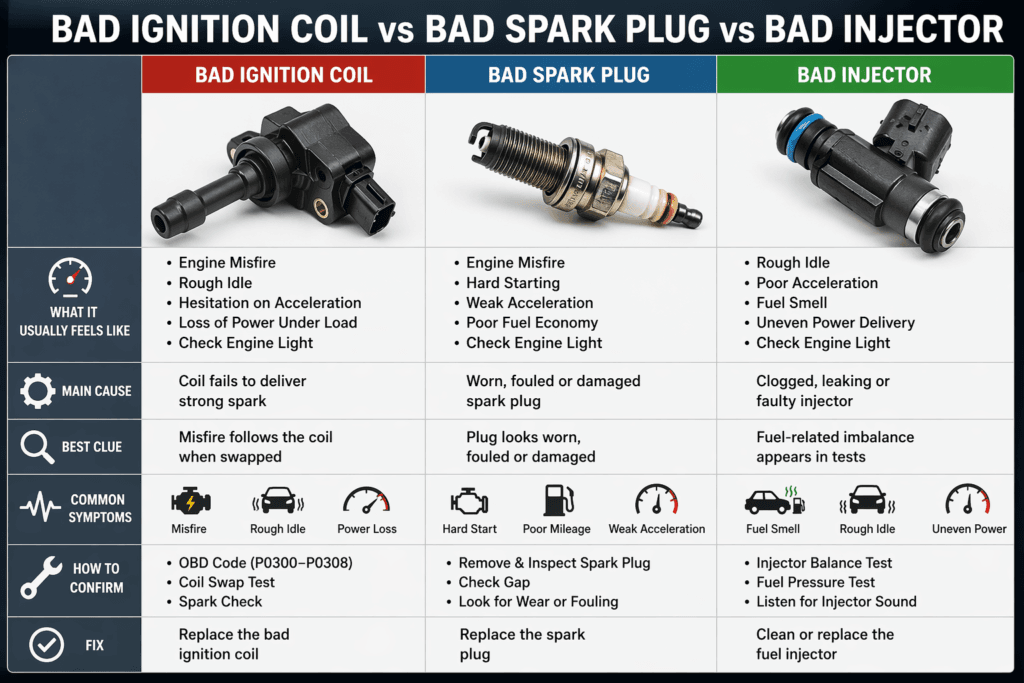
This is where many people waste money. The symptoms can overlap. But the pattern still matters.
| Problem | What it usually feels like | Best clue |
|---|---|---|
| Bad ignition coil | Misfire, rough idle, hesitation, power loss under load | Misfire follows the coil when swapped |
| Bad spark plug | Misfire, hard start, weak combustion, rough running | Plug looks worn, fouled, cracked, or over-gapped |
| Bad fuel injector | Rough running, poor response, fuel smell, uneven cylinder delivery | Fuel related imbalance shows up during testing |
| Wiring or connector issue | Intermittent cut out, random misfire, electrical style faults | Physical connector or wiring damage is found |
The point is simple. Do not throw parts at the car. If you replace the coil without checking the plug, you may miss the real cause. If you replace the plug without checking the coil, you may still have the same misfire tomorrow.
Frequently Asked Questions
What are the most common bad ignition coil symptoms?
The most common bad ignition coil symptoms include engine misfire, rough idle, hard starting, loss of power, engine hesitation, and a check engine light. In many cases, the car also shows poor fuel economy and shaking under load when the ignition coil becomes weak or faulty.
Can a bad ignition coil cause rough idle and engine shaking?
Yes, a bad ignition coil can cause rough idle and noticeable engine shaking. When the coil fails to deliver a strong spark, the combustion becomes uneven, which makes the engine vibrate, especially at idle or low speed driving.
How do I know if my ignition coil is bad or it is a spark plug problem?
To confirm whether it is a bad ignition coil or a spark plug issue, you need to inspect the spark plug and perform a coil swap test. If the misfire moves with the coil, the coil is faulty. If the plug shows wear or damage, then the spark plug may be the main cause.
Will a bad ignition coil always trigger a check engine light?
No, a bad ignition coil does not always trigger a check engine light immediately. Some coils fail gradually and only show symptoms like misfire or hesitation before the engine computer detects a fault and stores a code.
Can a bad ignition coil cause loss of power and poor acceleration?
Yes, a failing ignition coil can cause loss of power and poor acceleration. Since the spark is weak, the engine cannot produce full power, especially during acceleration or under load conditions.
Is it safe to drive with a bad ignition coil?
Driving with a bad ignition coil is not recommended. A continuous misfire can damage the catalytic converter, reduce performance, and increase fuel consumption. It can also make the car unsafe during overtaking or high speed driving.
What OBD codes indicate a bad ignition coil?
Common OBD codes related to ignition coil problems include P0300 to P0308 for misfires and P0350 series codes for ignition circuit faults. However, these codes only point to a problem and do not confirm the coil without proper testing.
Can one bad ignition coil affect the whole engine?
Yes, even one bad ignition coil can affect the whole engine. A single cylinder misfire can cause rough idle, engine shaking, and uneven performance, making the entire engine feel unstable.
How long can you drive with a bad ignition coil?
You can drive for a short distance in some cases, but it is not safe for long. A failing ignition coil can get worse quickly and lead to severe misfire or stalling. It is best to diagnose and fix the issue as soon as possible.
Should I replace all ignition coils or just one?
You can replace one ignition coil if only one is faulty. However, if the vehicle has high mileage and multiple coils are old, replacing more than one may prevent future failures. Always inspect spark plugs before making the decision.