
Contents
- What Is a Car Suspension System?
What Is a Car Suspension System?
A car suspension system exists to keep the tire’s contact patch pressed against the road surface under every operating condition, maximizing tire-to-road friction so the driver retains steering control, braking traction, and cornering stability.
Every bump, pothole, or mid-corner ripple feeds vertical energy into the vehicle. Left unmanaged, that energy would bounce the cabin and unload the tire exactly when grip matters most. The suspension’s job is to absorb and dissipate that energy before it disrupts either the tire’s contact or the occupants.
Split the vehicle into two masses to understand this:
- Sprung mass — everything the springs support: body, chassis, engine, occupants. This is what you want isolated from road disturbance.
- Unsprung mass — everything the springs don’t support: wheels, tires, brakes, hubs, and (on solid-axle vehicles) the axle housing itself. This mass must follow the road directly, bump for bump.
Lower unsprung weight lets the wheel react to a bump faster without transferring as much motion into the chassis — which is why lightweight forged wheels and aluminum control arms are a performance-engineering staple: cut unsprung mass, and both ride quality and outright grip improve together, without touching the spring rate at all.
The Mechanics of Shock Absorption: How It Works
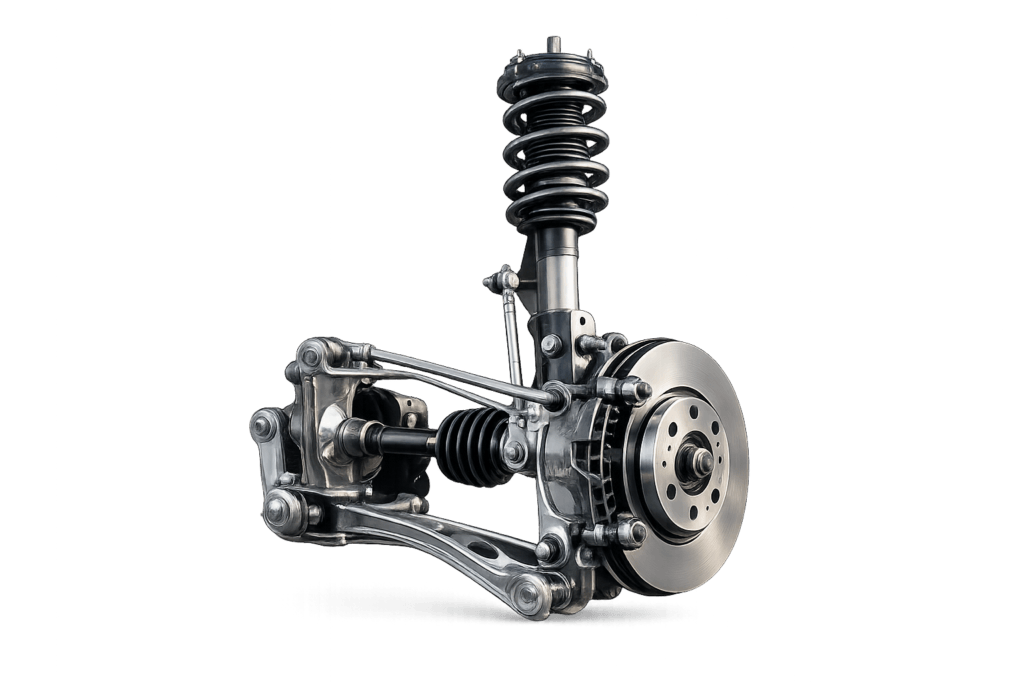
Suspension works as a repeating energy-management loop:
- Jounce. The tire meets a bump and the wheel moves upward relative to the chassis (compression travel).
- Energy storage. The spring compresses, converting road energy into stored potential energy.
- Rebound. The spring releases that energy, pushing the wheel back down toward its free length.
- The problem. An unrestrained spring is underdamped — it would keep the car bouncing like a pogo stick after every bump.
- Damping. The shock absorber’s piston forces hydraulic fluid through small, calibrated valves. That resistance converts the oscillation’s kinetic energy into heat, which dissipates through the shock body.
- Result. A well-damped suspension approaches critical damping — the bounce is arrested in one cycle, not five.
This loop repeats independently at every wheel, several times a second on rough pavement — which is why suspension calibration is really an exercise in managing energy transfer, not simply cushioning bumps. The key distinction: a spring’s force depends on displacement — how far it’s compressed. A damper’s force depends on velocity — how fast the piston moves. That’s why the same pothole barely registers at low speed but hits hard through the damper at high speed.
Core Components of a Car Suspension System
Springs: The Load-Bearing Energy Reservoir
- Coil springs — wound spring steel, space-efficient, and tunable to a progressive rate. The default inside MacPherson strut and double wishbone front ends.
- Leaf springs — stacked, curved steel strips. The oldest design still in use, prized for raw load capacity on trucks and vans. In a Hotchkiss-drive rear axle, the leaves also locate the axle and resist torque reaction, removing the need for separate trailing arms — though many modern trucks now pair coil springs with trailing arms instead, trading some load capacity for a smoother ride.
- Torsion bars — a steel bar anchored at both ends that twists (rather than compresses) to generate spring force. Packages flat; popular in older Chrysler/Mercedes front ends and some trucks. Anti-roll bars use the same twisting principle but only for roll control, not primary springing.
- Air springs — a compressed-air rubber bellow managed by a compressor and ECU. Enables load-leveling and adjustable ride height; standard on buses, luxury SUVs, and heavy trucks with variable payloads.
| Spring Type | Load Capacity | Common Application |
| Coil Spring | Low – Moderate | Passenger cars, most MacPherson & double wishbone setups |
| Leaf Spring | High – Very High | Trucks, vans, heavy trailers, solid rear axles |
| Torsion Bar | Moderate – High | Older Chrysler/Mercedes fronts, select trucks; anti-roll bars |
| Air Spring | Adjustable | Luxury SUVs, buses, heavy trucks with variable payload |
Shock Absorbers (Dampers)
A damper is a hydraulic cylinder — a piston with calibrated valve shims moves through oil-filled tubes. Damping force is velocity-sensitive: a slow movement produces little resistance, a sharp hit produces a lot, almost instantly.
- Twin-tube: inner working tube + outer reserve tube. Standard OEM design, comfort-tuned.
- Monotube: single tube with a nitrogen-charged floating piston, resists fluid aeration. Dissipates heat faster, dominates performance and off-road use.
Compression and rebound are usually valved differently — softer on compression, firmer on rebound — which is why a failing damper often shows up first as excess bounce on rebound. The choice between the two designs is fundamentally a comfort-versus-durability trade-off, which is why most factory family cars run twin-tube and most performance or off-road builds run monotube.
MacPherson Struts: The Structural Pivot Point
A MacPherson strut combines the damper and coil spring into one assembly that also acts as a structural suspension member, not just a shock in a housing. The upper mount includes a thrust bearing so the entire strut rotates with the steering knuckle when the driver turns the wheel; the lower end bolts rigidly to the knuckle, carrying static weight and cornering loads that a plain shock never would.
Because it’s structural, strut angle directly affects camber and caster — a bent strut throws off alignment in a way a simple shock never could. This is also why swapping a worn shock absorber is usually a simple bolt-in job, while swapping a strut is a bigger undertaking that calls for a follow-up wheel alignment. Eliminating the upper control arm also frees up engine-bay width, which is why MacPherson dominates transverse-engine, front-wheel-drive economy cars.
Control Arms & Bushings
Control arms (A-arms) link the wheel hub to the chassis, constraining vertical travel while resisting lateral (cornering) and longitudinal (braking/acceleration) loads. In a double wishbone setup, unequal-length upper and lower arms — an SLA, or Short-Long-Arm, geometry — are tuned to control camber gain: how camber angle changes as the suspension compresses. (Camber angle is the wheel’s tilt from vertical; negative camber means the top leans inward.) This keeps the outside tire’s contact patch flatter during body roll in hard cornering.
At each arm’s pivot point, a bushing isolates road vibration from the cabin:
- Rubber — comfort-oriented, absorbs more NVH, but deflects slightly under hard cornering load.
- Polyurethane — stiffer, holds geometry precisely under load, but transmits more road noise.
Independent vs. Dependent Suspension: Layout Comparison
Independent suspension (MacPherson, double wishbone, multi-link) lets each wheel move without affecting the other. Dependent suspension (solid or live axle) links both wheels through one rigid beam, so a bump on one side partially transfers to the other. The unsprung-weight gap between them comes down mainly to one part: a live axle carries its differential as unsprung mass, while independent layouts mount the differential to the chassis instead.
| Criteria | Independent | Dependent (Solid/Live Axle) |
| Mechanical Linkage | Each wheel on its own arms/strut | Both wheels joined by a rigid axle beam |
| Ride Comfort | Higher — bump stays isolated to one corner | Lower — force transfers across the axle |
| Unsprung Weight | Lower — lighter per-wheel assemblies | Higher — axle housing and diff are unsprung |
| Off-Road Articulation | Limited droop; camber changes through travel | Superior sustained articulation; camber stays constant to the axle |
| Manufacturing Cost | Higher — more joints and bushings | Lower — fewer parts, easier mass production |
Engineering Trade-offs & Real-World Use Cases
Sports cars choose double wishbone because SLA geometry can be tuned to gain negative camber as the outside wheel compresses through body roll, keeping the tread flat against the road exactly when cornering load is highest. A MacPherson strut’s single pivot point can’t match that level of camber control, which is part of why serious performance cars increasingly run double wishbone at all four corners, not just the front.
Budget commuters rely on MacPherson struts because eliminating the upper control arm saves space and cost in a tight, transverse-engine front-wheel-drive layout — fewer bushings and joints to manufacture and service, at the cost of some cornering precision and more camber loss under body roll. It’s why the design remains the default front suspension on hatchbacks, sedans, and crossovers.
Heavy trucks depend on leaf springs for sheer durability: stacked steel leaves carry loads from empty to several tons reliably, and in a Hotchkiss-drive axle they also locate the axle and resist torque reaction without extra linkage — fewer parts, more field-repairable, at the cost of ride refinement. It’s exactly why you’ll still find them under nearly every pickup truck and cargo van on the road.
Maintenance & Diagnostics: Reading Real-World Symptoms
The Bounce Test. Push down firmly on each corner and release. A healthy shock or strut settles within one small extra bounce; a failing damper keeps oscillating two or more times, because it can no longer generate enough hydraulic resistance to arrest the spring’s motion. Other signs: oil residue on the shock body, cupped tire wear, exaggerated nose-dive or squat, and clunking over bumps, often traced to the strut mount bearing rather than the damper itself.
Worn Control Arm Bushings. Bushings degrade gradually as rubber dries out, cracks, or separates from its metal sleeve after years of heat cycling and repeated load, letting the control arm shift slightly under acceleration, braking, or cornering force. The consequences:
- Camber can drift dynamically even when a static alignment check looks fine.
- Toe develops small, load-dependent shifts — a compliance-related change that feels like vague or wandering steering.
- Tire wear turns uneven, typically inner-edge or feathered across the tread.
This is why a proper alignment check should always include a physical inspection of bushings and ball joints for play — dialing in camber and toe means little if the reference point itself can move.
Frequently Asked Questions
Does unsprung weight really matter?
Yes — lighter wheels, hubs, and brake components track the road surface more closely, keeping the tire planted instead of skipping over small bumps. That’s why unsprung mass reduction is treated as a priority in motorsport and performance chassis work.
Is a strut the same as a shock absorber?
No. A shock absorber only damps motion. A strut — like a MacPherson strut — combines the damper and spring into one structural unit that also locates the wheel, which is why replacing a strut affects alignment and replacing a shock usually doesn’t.
How often should suspension components be inspected?
As a general guideline, every 20,000–30,000 km (roughly 12,000–20,000 miles) — sooner if the roads are rough or the vehicle is used for towing or aggressive driving.
Does worn suspension affect fuel economy and tire life?
Yes, directly. Inconsistent tire contact from a blown damper or off-spec camber/toe raises rolling resistance and wears tires unevenly, which shows up as both higher fuel consumption and a shortened tread life.