
Contents
- What Is a CVT Transmission? How It Works, Pros & Cons
- What Does CVT Stand For?
- How a CVT Transmission Actually Works
- Not Every CVT Works the Same Way
- The “Rubber-Band Effect,” Explained Properly
- CVT vs. Automatic Transmission: Quick Comparison
- The Real Pros of a CVT Transmission
- The Real Cons of a CVT Transmission
- Is CVT Reliability Actually a Problem? (The Honest Answer)
- How Long Do CVTs Actually Last?
- Which 2026 Cars Still Use a CVT?
- Frequently Asked Questions
- The Bottom Line: Is a CVT Right for You?
What Is a CVT Transmission? How It Works, Pros & Cons
Pop the hood — or really, the spec sheet — on a new Corolla, CR-V, or Rogue, and you’ll spot three letters that don’t explain themselves: CVT. No clutch pedal. No gear numbers on the shifter. Just Park, Drive, and a transmission that never seems to “shift” at all.
That’s not a trim-level gimmick. It’s a genuinely different way of connecting an engine to the wheels, and once you understand it, half the confusing reviews about CVTs start making sense.
Before going deep on this one specifically, it helps to see where a CVT sits alongside the other car transmission types — manual, traditional automatic, and dual-clutch.
What Does CVT Stand For?
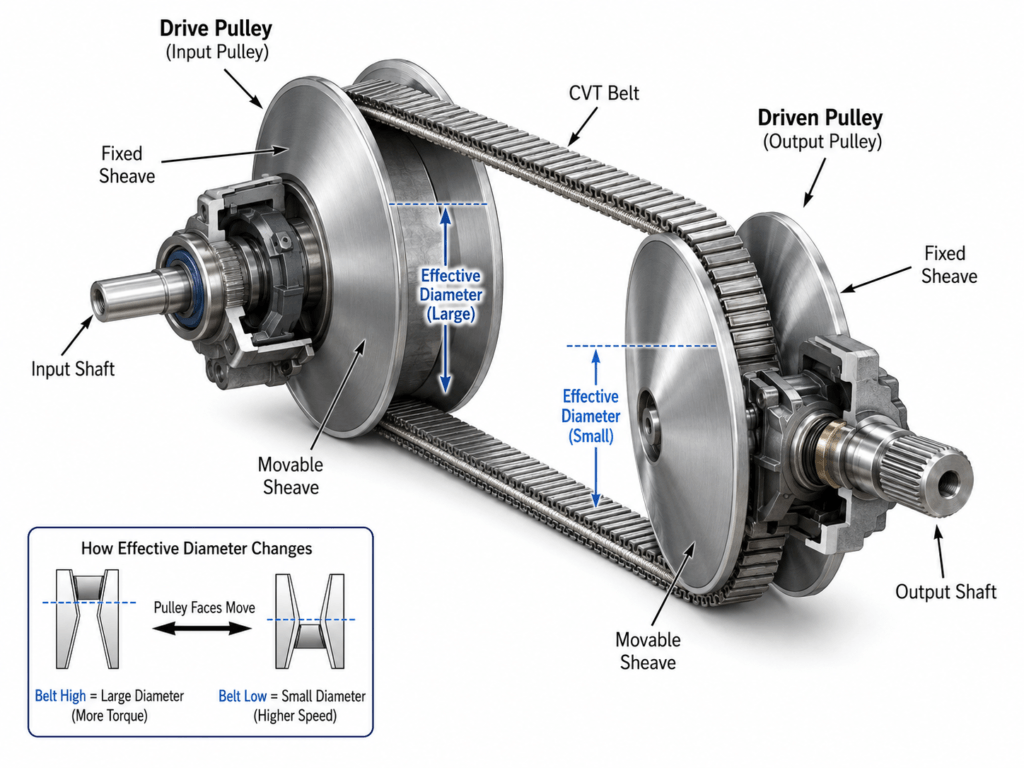
CVT stands for Continuously Variable Transmission. Instead of shifting between a fixed set of gears the way a traditional automatic does, it uses two adjustable pulleys connected by a belt or chain to produce a virtually unlimited range of ratios, all within one mechanical range.
No first gear. No fourth gear. No gears, really. Just one continuously adjustable ratio that slides wherever the engine needs it.
How a CVT Transmission Actually Works
The Belt-and-Pulley System (No Gears Involved)
Picture an old drill press or a shop table saw with a manual speed-adjustment lever. Turn it, and a V-belt slides up and down a cone-shaped step-pulley, spinning the chuck faster or slower without a single gear tooth involved. A CVT runs on almost the exact same principle — just automated, hydraulic, and a lot more precise.
Inside a CVT sit two pulleys. Each one is really two cone-shaped halves facing each other, like a pair of traffic cones nose to nose. One pulley bolts to the engine side — the drive pulley. The other connects to the wheels — the driven pulley. A steel belt or chain rides in the V-shaped groove between each pulley’s two halves.
Hydraulic pressure squeezes the halves of each pulley together or lets them spread apart. Squeeze the drive pulley shut, and the belt gets forced up onto a bigger effective diameter. Let it open, and the belt drops onto a smaller one. The driven pulley does the opposite at the same moment.
That’s the entire trick. Change the effective diameter of two pulleys in opposite directions, and the gear ratio changes with them — smoothly, with no gaps, no clutch packs, no planetary gearset.
Steel Belt or Chain: What’s Actually Inside
Most CVTs use a steel push-belt: hundreds of thin steel segments held together by two flexible steel bands, closer to a caterpillar track than a rubber fan belt. Other designs, including some Audi and Nissan units, use a link-plate steel chain instead. Chains generally tolerate more torque; belts tend to run quieter.
Either way, nothing inside is actually made of rubber. That’s just the sensation the system produces under hard acceleration — more on that shortly.
Why It Feels Different From a Regular Gear Shift
A traditional automatic has to interrupt power, however briefly, every time it changes gear. You feel that as a small shove: the 1-2 shift, the 2-3 shift, each one its own tiny event.
A CVT never does that. There’s no gear to leave and no gear to enter. The ratio just slides, continuously, the whole time you’re driving. That’s exactly why a CVT feels so smooth under light throttle, and exactly why it feels so strange under hard throttle — which brings us to the transmission’s most famous nickname problem.
Not Every CVT Works the Same Way
Lump every “CVT” into one bucket and you’ll miss real differences between brands. At least four flavors are on sale right now.
Belt-and-pulley CVT — the classic design above. Nissan (branded Xtronic), Subaru (branded Lineartronic), and Honda all run variations of it. Common in economy cars and compact crossovers.
Electronic CVT (eCVT) — don’t let the name fool you; there’s no belt in sight. It’s a planetary gearset blending power from a gas engine and one or two electric motors, with software handling the “shifting” electronically. Toyota, Lexus, and Ford lean on this heavily across their hybrid lineups, and it’s generally the most durable version on the road.
Intelligent Variable Transmission (IVT) — Hyundai and Kia’s answer to the rubber-band complaint. Same chain-and-pulley concept underneath, but the software deliberately fakes stepped shift points so it drives more like a familiar automatic.
Direct Shift-CVT — Toyota’s hybrid approach, standard on several Corolla and Camry trims. A real, physical first gear handles launch — the point where a belt struggles most — then hands off to a conventional CVT belt above roughly 25 mph. A real gear off the line, belt-driven efficiency at speed.
Knowing which flavor is under the hood matters more than knowing “it’s a CVT.” A Toyota eCVT and an early-2010s Nissan belt CVT have almost nothing in common besides the name.
The “Rubber-Band Effect,” Explained Properly
Floor the accelerator in a CVT car, and something strange happens. The engine note rises fast and just holds there — loud, steady, almost like the throttle stopped working. Meanwhile, the car is still gathering speed underneath that sound, slowly catching up to a noise you’re already hearing.
That mismatch — engine screaming, speed lagging behind — is the rubber-band effect. It’s named for the sensation, like stretching a rubber band before it finally snaps forward, not for anything actually made of rubber inside the gearbox.
Here’s what’s really happening. Under hard acceleration, the transmission’s control unit jumps engine RPM straight to the point of peak power and holds it there on purpose, while the pulley ratio itself does the work of building road speed. Engine sound and vehicle speed get deliberately decoupled, because that’s the most efficient way to accelerate — even though it breaks every instinct you’ve built up driving cars with normal gears.
It’s a bit like flooring a boat with an outboard motor. The engine screams to its power band immediately. The hull takes its sweet time catching up. Nothing’s wrong; that’s just how the physics shakes out.
Automakers know this bothers people. That’s exactly why Hyundai’s IVT and Honda’s programmed “shift” points both fake stepped ratio changes under hard acceleration — an unnecessary shift, engineered back in on purpose, purely so the car feels like it’s changing gears the way you expect it to.
CVT vs. Automatic Transmission: Quick Comparison
One quick clarification before the table: a CVT is technically a type of automatic — no clutch pedal, no manual gear selection. But “automatic” in everyday car-shopping language almost always means the traditional torque-converter design, so that’s the comparison below. (The full technical classification gets covered in more depth in the main transmission guide.)
| What You’re Comparing | CVT | Traditional Automatic |
|---|---|---|
| Mechanism | Steel belt or chain + two variable pulleys | Planetary gears, clutch packs, torque converter |
| Shifting feel | No discrete shifts; ratio changes continuously | Noticeable, stepped shifts |
| Sound under acceleration | Engine holds high RPM (the “rubber-band” feel) | Engine rises and falls with each gear |
| Fuel economy | Usually the more efficient of the two | Slightly behind, though the gap has narrowed |
| Repair/replacement cost | Often $4,000–$7,500 | Often $2,500–$6,000 |
| Best for towing | Not generally recommended for heavy loads | Better suited, especially with a tow package |
| Typical lifespan | 100,000–200,000+ miles with proper fluid care | 150,000–250,000 miles, long track record |
| Where you’ll find it | Compact cars, hybrids, small crossovers | Trucks, SUVs, sedans, performance vehicles |
If you’re weighing a CVT against the full manual-vs-automatic picture, our manual vs automatic comparison breaks down the exact same repair-cost math side by side.
The Real Pros of a CVT Transmission
Better Fuel Economy, Without Trying
A CVT can hunt for the single most efficient RPM at whatever speed you’re holding, then just stay there. A traditional automatic is stuck picking the closest of six, eight, or ten fixed ratios and living with the compromise. That difference shows up at the pump — often a few extra miles per gallon on the same car — and it’s a big part of why Toyota, Honda, and Nissan lean on CVTs so heavily in their economy models.
A Genuinely Smooth Ride
Under normal, easy driving, a CVT is arguably the smoothest transmission on the market. No shift shock. No hunting for the right gear on a hill. No downshift jolt tapping the brakes into a corner. It just glides.
Lighter and Cheaper to Build
Fewer internal parts means a CVT weighs less than a comparable automatic, which helps both fuel economy and a manufacturer’s bottom line. That’s a real reason CVTs took over the economy-car segment so completely — they’re genuinely cheaper to produce at scale, before the mpg benefit even enters the math.
Confident Hill Starts and Stop-and-Go Driving
Because a CVT isn’t locked into a fixed gear, it can sit at whatever ratio makes the most torque available the instant you need it — pulling away on a hill, merging into fast traffic, creeping through a parking lot. There’s none of the “gear hunting” some conventional automatics do on a moderate grade.
The Real Cons of a CVT Transmission
Repair Costs That Can Wreck a Budget
Here’s the number a lot of competing guides skip entirely: a full CVT replacement typically runs $4,000 to $7,500, parts and labor included. That’s noticeably higher than a comparable traditional automatic rebuild, and there’s a specific reason why.
Most CVTs are effectively sealed units. There’s no bolt-in rebuild kit sitting on a shelf at the local parts store, and far fewer independent shops carry the specialized tooling or training to rebuild the internals correctly. When something fails — usually the belt, the pulleys, or the internal seals — the practical fix is often a full remanufactured or dealer-sourced replacement, not a repair. Scarcity of expertise drives the price up just as much as the parts do.
Heat Is the Real Enemy
A CVT’s belt rides against its pulleys under constant clamping pressure the entire time you’re driving. That friction generates heat, and heat is what actually kills most CVTs — not mileage by itself. Heat breaks down the specialized CVT fluid faster than normal driving would suggest, and degraded fluid loses the exact friction properties that keep the belt from slipping.
Stop-and-go traffic, mountain driving, towing, and hot climates all pile on extra thermal stress. A shudder under light acceleration, a whining or grinding noise that worsens with speed, or a burning smell are all worth a same-week appointment with a mechanic — not a “let’s see how it goes” situation.
Not Built for Towing or Heavy Loads
Sustained heavy load generates exactly the kind of heat a CVT handles worst. Most manufacturers either rate CVT-equipped models for very light towing only, or skip a tow rating entirely. A few current crossovers now carry modest tow ratings, but that’s still well short of what a proper truck-grade automatic and factory tow package deliver. If regular towing is part of the plan, check the exact rating for your specific trim rather than assuming.
It Can Feel… Boring
Some drivers genuinely don’t mind the rubber-band sensation. Plenty of others find it disconnecting — an engine note with no clear relationship to how fast the car is actually going. There’s no gear to row through, no rev-matched downshift, nothing to feel except one long, flat surge. For commuting, that’s arguably a feature. For anyone who actually enjoys driving, it’s usually the first complaint they bring up.
Is CVT Reliability Actually a Problem? (The Honest Answer)
Short answer: it depends entirely on which CVT, and which years, you’re talking about. Painting every CVT with the same brush is where most car-buying advice goes wrong.
Nissan’s Xtronic CVT, built by supplier Jatco, is the case that gives the whole technology its bad reputation. Certain model years — Rogue (2014–2018), Pathfinder (2015–2018), and the related Infiniti QX60 (2015–2018), among others — developed a well-documented pattern of overheating, shuddering, and outright failure, in some cases well under 100,000 miles. Owners took Nissan to court over it. Multiple class-action settlements followed, and Nissan set aside more than half a billion dollars to extend CVT warranty coverage to 84 months or 84,000 miles across roughly three million vehicles. Nissan never admitted the CVTs were defectively designed — standard practice in a settlement — but the size of that warranty extension speaks for itself.
That’s a real, serious, well-documented reliability problem. It’s also specific to one supplier’s units from one era, not a verdict on CVTs generally.
Toyota and Honda tell a completely different story. Both brands have run CVTs and eCVTs for well over a decade with a strong reliability record, and some Prius and Corolla Hybrid units are documented well past 250,000 miles on the original transmission. Subaru’s Lineartronic has drawn its own share of complaints, mostly on earlier units, but nothing close to the scale of Nissan’s Jatco problem.
The honest takeaway: CVT reliability is a brand-and-model question, not a technology question. Before buying anything with a CVT, five minutes checking that specific model’s ownership forums and any open technical service bulletins tells you more than any blanket “CVTs are bad” opinion ever will.
How Long Do CVTs Actually Last?
Properly maintained, a modern CVT should comfortably clear 100,000 to 200,000 miles, and plenty go well beyond that. Toyota’s eCVT hybrid systems, in particular, have documented cases stretching past 250,000 miles on the original unit.
The word doing all the work in that sentence is “maintained.” CVT fluid isn’t the same as regular automatic transmission fluid, and it degrades faster than the “lifetime fluid” language in some owner’s manuals implies. Independent transmission shops generally recommend a fluid change every 30,000 to 50,000 miles — meaningfully more often than some manufacturers officially suggest — specifically because heat wears out the fluid’s properties long before it looks obviously dirty.
Skip that maintenance, drive hard in a hot climate, or tow more than the vehicle is rated for, and the same transmission can fail in well under 100,000 miles. That’s the pattern behind most of the worst CVT reliability stories — not necessarily a bad design, just a fluid interval nobody followed.
Which 2026 Cars Still Use a CVT?
CVTs have consolidated into two very different jobs in 2026: cheap, efficient economy cars, and hybrid powertrains at every price point.
Belt-driven CVTs, still common in:
- Nissan Sentra, Versa, Kicks, Altima, Rogue (Xtronic)
- Subaru Impreza, Crosstrek, Outback, Forester, Ascent, and the automatic-trim WRX (Lineartronic)
- Honda Civic, Accord, CR-V, HR-V
- Mitsubishi Outlander and Outlander Sport
- Hyundai Venue, Elantra, Kona, and Kia Soul, Forte, Seltos (badged IVT)
Electronic CVTs (eCVT), standard across:
- Every current Toyota and Lexus hybrid, including Corolla Hybrid, Camry (now hybrid-only), RAV4 Hybrid, Prius, Sienna, Crown, and the Lexus ES/RX/NX hybrid lines
- Ford’s hybrid lineup, including Maverick Hybrid and Escape Hybrid
Where you won’t find one: any Tesla, any Porsche, any Volkswagen, most full-size trucks (F-150, Tundra, Tacoma), and performance-focused models like the Civic Type R or Toyota GR86 — all of which stick with a traditional automatic, dual-clutch, or manual gearbox.
Subaru’s Legacy didn’t make it to 2026 — production ended in 2025 after 35 years on sale, one more sign that CVT-equipped sedans are losing ground to crossovers even inside brands that love the technology.
Frequently Asked Questions
Are CVTs reliable?
Modern CVTs from Toyota, Honda, and current Subaru models have a solid reliability record when the fluid is changed on schedule. Older Nissan Xtronic units from roughly 2013–2018 are the well-documented exception, with a real pattern of premature failure that led to class-action settlements. Reliability comes down to the specific brand, model, and year, not “CVT” as a blanket category.
How long do CVTs last?
Most well-maintained CVTs last 100,000 to 200,000 miles, and some — particularly Toyota’s eCVT hybrid units — have gone well past 250,000 miles. Skipping fluid changes or towing beyond the rated capacity can cut that lifespan dramatically, sometimes to well under 100,000 miles.
Can you tow with a CVT?
Only lightly, and only if the specific vehicle is rated for it. Sustained heavy load generates exactly the kind of heat that wears out a CVT’s belt and fluid fastest. If regular towing is part of the plan, a traditional torque-converter automatic with a proper tow package is almost always the safer choice.
Is a CVT better than a regular automatic?
Better at fuel economy and low-speed smoothness, generally. Worse at towing, and it can feel less engaging under hard acceleration. Neither is objectively “better” — it depends on whether efficiency and comfort matter more to you than control and towing capability.
Can a CVT be rebuilt, or does it need to be replaced?
Technically, yes, a CVT can be rebuilt — but far fewer shops carry the parts and specialized training to do it well compared to a conventional automatic. In practice, most CVT failures get fixed with a remanufactured or dealer-sourced replacement unit rather than an in-house rebuild, which is part of why the repair bill runs higher.
Do CVTs need special transmission fluid?
Yes, and this one matters. CVT fluid has different friction properties than standard automatic transmission fluid, and using the wrong type can cause the belt to slip and the transmission to fail. Always use the exact fluid your manufacturer specifies, never a generic “universal” ATF.
The Bottom Line: Is a CVT Right for You?
A CVT isn’t a lesser transmission. It’s a different tool, built for a specific job: squeezing the most fuel economy and the smoothest low-speed ride out of an engine, without the cost or complexity of a traditional gearbox.
You mostly drive around town or commute daily. A CVT is a genuinely good fit — smooth, efficient, and low-drama in traffic.
You tow a trailer, camper, or boat regularly. Look elsewhere. A traditional automatic with a real tow rating will serve you better and last longer doing it.
You’re shopping used. Check the specific model and year against known problem units. A 2016 Nissan Rogue and a 2016 Toyota Corolla are not the same bet, even though both have a CVT under the hood.
You want an engaging, involved driving experience. A CVT was never built for that. Look at a manual or a dual-clutch instead.
The technology itself isn’t the risk. Buying blind, without checking which specific CVT is under the hood, is.