
Contents
- What Is a Car Transmission
- What Does a Car Transmission Do?
- Main Parts of a Car Transmission
- The 4 Main Car Transmission Types
- 1. Manual Transmission
- 2. Automatic Transmission
- 3. Continuously Variable Transmission
- 4. Dual-Clutch Transmission
- Other Transmission Designs
- Car Transmission Types Comparison
- Manual vs Automatic Transmission
- Which Transmission Type Is Best?
- Transmission Maintenance
- Frequently Asked Questions
- Final Verdict
What Is a Car Transmission
Introduction
A car transmission connects the car engine to the driven wheels and controls how power reaches the road. It changes the relationship between engine speed and wheel speed, allowing the car to accelerate, climb, reverse, and cruise efficiently. Without it, a combustion engine could not stay within its useful RPM range across normal driving conditions.
The main car transmission types are manual, torque-converter automatic, continuously variable, and dual-clutch. Each manages torque and engine RPM differently. Some favor control. Others prioritize comfort, fuel economy, or fast shifts.
This guide explains how a transmission works, how gear ratios work, its essential parts, and which design may suit different drivers.
What Does a Car Transmission Do?
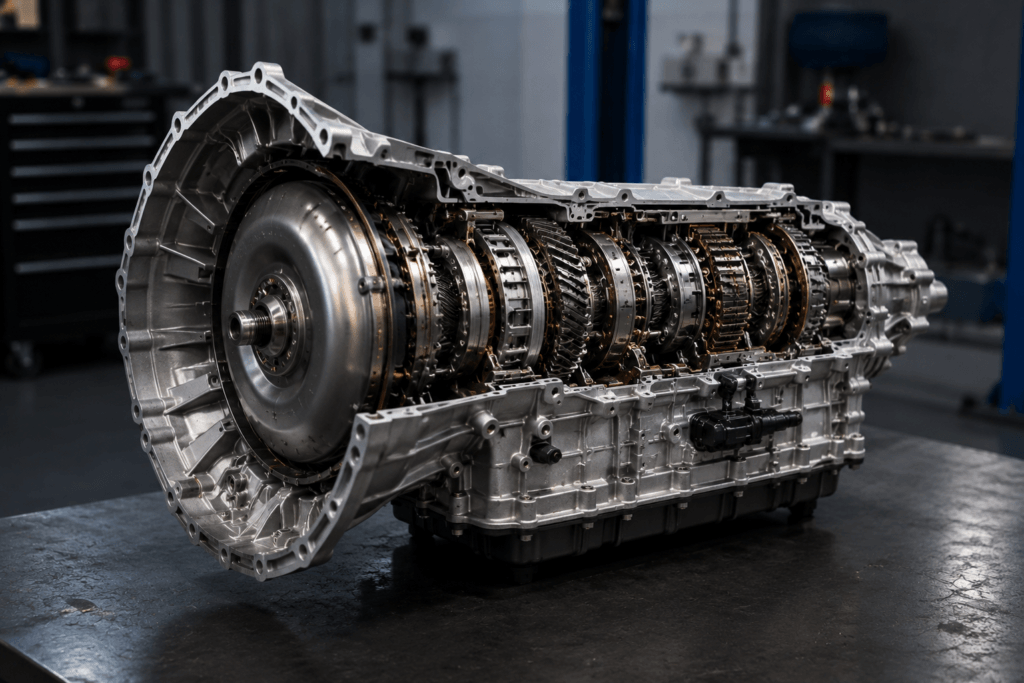
A car transmission transfers engine power while controlling torque, wheel speed, and engine RPM.
Its main jobs are to:
- Transfer engine power into the drivetrain
- Multiply torque during acceleration
- Control engine RPM at different road speeds
- Provide reverse movement
- Improve fuel economy during cruising
- Allow the vehicle to remain stationary while the engine continues running
The transmission allows the vehicle to remain stationary while the engine continues running. The method varies by transmission design.
Gear Ratios Explained
A gear ratio compares the rotational speed of the transmission input and output. Lower gears normally use numerically higher ratios. These provide greater torque multiplication but limit road speed at a given engine RPM.
A bicycle provides a useful comparison. A cyclist selects an easier gear when climbing. More pedal rotations create fewer wheel rotations but greater mechanical advantage.
Higher gears use numerically lower ratios. They reduce torque multiplication and lower engine RPM during cruising. This improves fuel economy.
For example, a 3.50:1 ratio means the input rotates about 3.5 times for one output rotation. A 0.75:1 overdrive ratio allows the transmission output shaft to rotate faster than the input shaft. The final-drive ratio still affects actual wheel speed.
Why Cars Need Multiple Gears
Combustion engines produce useful torque and power within a limited RPM range.That power begins as rotation at the crankshaft, before the transmission adjusts its torque and speed for the wheels. One fixed ratio cannot provide strong launches, efficient cruising, and suitable top speed.
First gear multiplies torque. Intermediate gears support acceleration. Higher gears reduce cruising RPM.
Most electric vehicles use a single-speed reduction gearbox. Electric motors produce strong torque from low speeds and operate across a wider speed range.
Main Parts of a Car Transmission
Transmission parts vary by design. A manual gearbox does not use the same valve-body and planetary-gear arrangement as a traditional automatic.
- Clutch or torque converter: Connects engine power to the transmission.
- Input shaft: Receives rotational power from the engine.
- Output shaft: Sends adjusted power toward the final drive.
- Planetary gear sets: Create ratios inside many automatics.
- Transmission fluid: Lubricates parts, removes heat, and supports hydraulics.
- Valve body: Routes pressurized fluid through an automatic.
- Synchronizers: Match gear and shaft speeds during manual shifts.
- Clutch packs: Lock selected components inside automatics and DCTs.
- Solenoids: Regulate hydraulic fluid flow.
- Transmission control module: Manages shift timing and pressure.
Not every transmission contains all these components. CVTs, DCTs, manuals, and hybrid systems use different layouts.
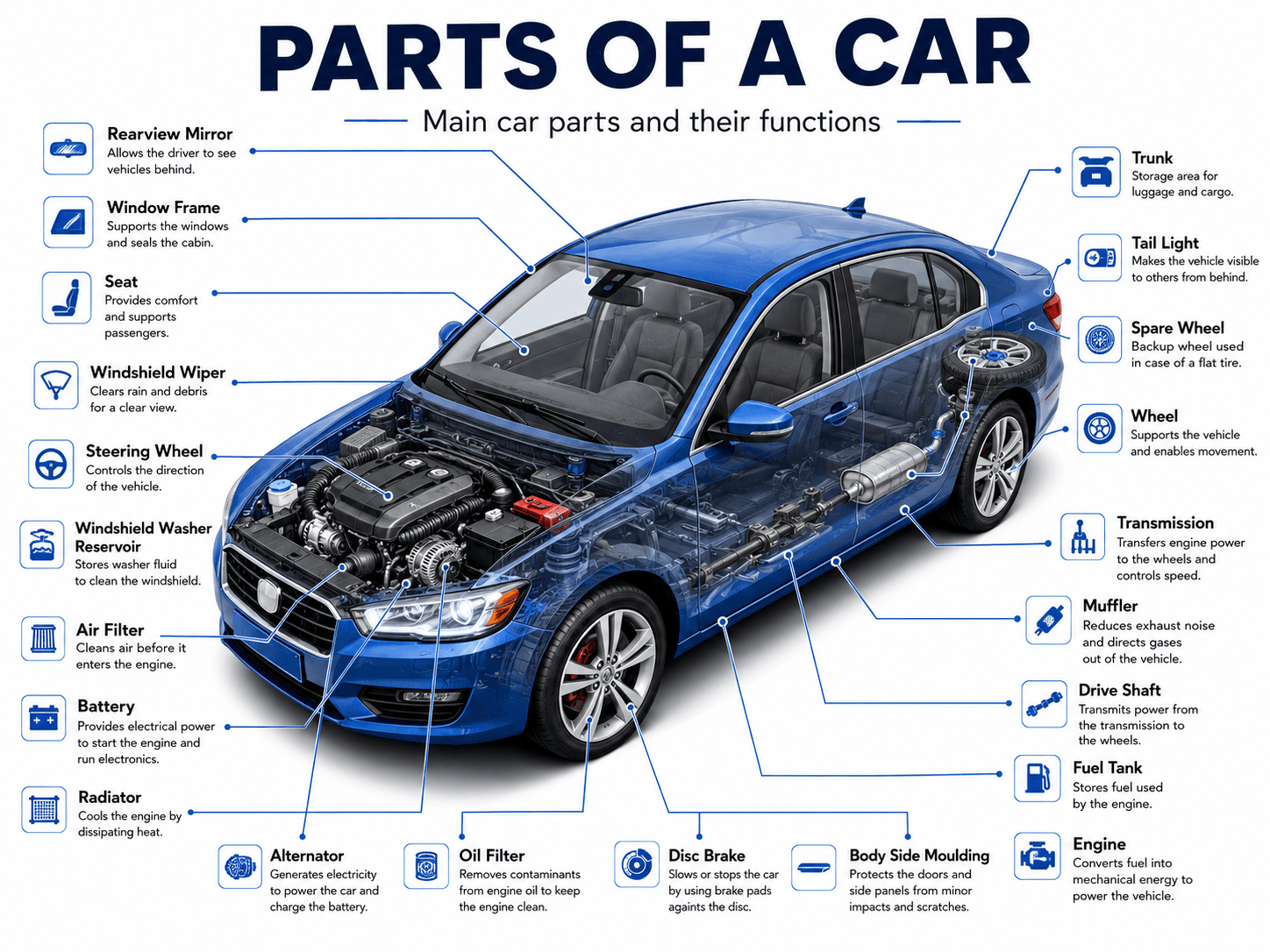
To understand how the transmission connects with the engine, driveshaft, axles, and wheels, explore the main parts of a car.
The 4 Main Car Transmission Types
The four primary car transmission types are manual, torque-converter automatic, continuously variable, and dual-clutch. Their purpose is similar, but their internal operation differs.
1. Manual Transmission
A manual transmission lets the driver choose each gear using a clutch pedal and gear lever. It creates a direct mechanical connection and offers close control over acceleration and engine braking.
How a Manual Transmission Works
The clutch sits between the engine and gearbox. It includes a flywheel, clutch disc, pressure plate, and release mechanism.
When the clutch pedal is released, the pressure plate holds the clutch disc against the flywheel. Engine torque reaches the input shaft.
Pressing the pedal separates the disc from the flywheel. The driver can then select another gear. Synchronizers match the speed of the selected gear and shaft, reducing gear clash. Power returns when the clutch engages.
Advantages
- Direct gear control
- Strong driver involvement
- Effective engine braking
- Efficient mechanical power transfer
- Relatively simple internal layout
Manual transmissions may cost less to repair in some vehicles because their internal design is relatively simple.
Disadvantages
- Requires coordination and practice
- Can be tiring in traffic
- Poor technique wears the clutch
- Hill starts may challenge new drivers
- Limited new-car availability
Common Vehicle Types
Manuals remain available in some sports cars, economy cars, commercial vans, off-road vehicles, and older pickups.
2. Automatic Transmission
A traditional automatic transmission changes gears using a torque converter, planetary gear sets, hydraulic pressure, clutch packs, and electronic controls. The driver selects Drive while the transmission manages individual shifts.
How an Automatic Transmission Works
The torque converter contains an impeller, turbine, stator, and lock-up clutch. The engine-driven impeller moves fluid toward the turbine. The stator redirects fluid at low speeds to help multiply torque. At steady speeds, the lock-up clutch reduces energy loss.
Planetary gear sets create different ratios. Each set contains a sun gear, planet gears, carrier, and ring gear. Clutch packs hold or drive selected components to produce forward gears and reverse.
Hydraulic pressure operates the clutches. Solenoids regulate fluid flow. The control module uses speed, load, throttle position, and temperature to time shifts.
Modern automatics may have eight, nine, or ten forward gears. Well-designed units can deliver fast shifts and strong fuel economy.
Advantages
- Easy to use
- Smooth low-speed driving
- Comfortable in traffic
- Suitable for towing when properly rated
- Compatible with driver-assistance systems
- Modern versions can shift quickly
Disadvantages
- Complex internal construction
- Repairs can be expensive
- Fluid condition affects operation
- Overheating can cause major damage
- Performance varies by model
Common Vehicle Types
Torque-converter automatics are widely used in sedans, SUVs, pickups, luxury cars, off-road vehicles, and performance models.
3. Continuously Variable Transmission
A CVT transmission provides a continuous range of ratios within its mechanical operating range. Most conventional CVTs use two adjustable pulleys connected by a steel belt or chain.
How a CVT Transmission Works
Each pulley has two cone-shaped faces. Moving them inward or outward changes the belt’s effective running diameter.
One pulley connects to the engine and the other to the wheels. Their effective diameters change in opposite directions, altering the ratio without fixed gears.
The CVT can keep the engine near an efficient or powerful RPM. Some models simulate gear steps for a familiar shifting sensation.
Pulley-based CVTs differ from many hybrid e-CVT systems. Those may use planetary gears and electric motors instead of a steel belt.
Advantages
- Strong fuel economy
- Smooth acceleration
- No conventional shift interruption
- Compact packaging
- Keeps the engine near a useful RPM
Disadvantages
- Can create a rubber-band sensation
- Engine sound may not match road speed
- Correct fluid is critical
- Some models have towing limits
- Repairs may require specialists
Common Vehicle Types
CVTs are common in compact cars, family sedans, small crossovers, and fuel-focused commuter vehicles.
4. Dual-Clutch Transmission
A dual-clutch transmission uses two clutches and two gear shafts. One clutch usually manages odd-numbered gears, while the other manages even-numbered gears.
How a Dual-Clutch Transmission Works
The next expected gear can be preselected on the other shaft. One clutch opens as the other closes, keeping power interruption brief.
Depending on the design, one shaft may carry the even-numbered gears and reverse.
Wet clutches operate in fluid, improving cooling and torque capacity. Dry clutches reduce weight and pumping losses but may struggle with heat and low-speed smoothness in heavy traffic.
Advantages
- Very fast shifts
- Direct mechanical power transfer
- Strong acceleration
- Automatic and manual modes
- Good high-speed performance
Disadvantages
- Expensive internal repairs
- Can feel jerky at low speeds
- Dry clutches may overheat in traffic
- Clutch wear varies by use
- Specialized servicing may be required
Common Vehicle Types
DCTs appear in performance hatchbacks, sports cars, premium sedans, supercars, and some passenger cars.
Other Transmission Designs
An automated manual transmission uses actuators to operate a manual-style gearbox. It can improve economy but may feel abrupt.
A hybrid e-CVT often combines planetary gearing with electric motors. It does not operate like a belt-and-pulley CVT.
A single-speed EV reduction gearbox lowers motor speed before power reaches the wheels. Most EVs need only one ratio because electric motors provide broad torque and speed ranges.
Car Transmission Types Comparison
This car transmission types comparison shows general differences. Results vary by vehicle, calibration, and maintenance history.
| Transmission Type | Fuel Economy | Driving Comfort | Driver Engagement | Repair Cost | Best For |
| Manual | Usually good | Driver-dependent | High | Often low to moderate | Control |
| Automatic | Good to excellent | Usually excellent | Moderate | Often moderate to high | Comfort and towing |
| CVT | Often excellent | Smooth under light load | Low | Model-specific | Commuting |
| DCT | Usually very good | Can vary at low speed | High | Often high | Performance |
Manual vs Automatic Transmission
The manual vs automatic choice depends on traffic, driving style, vehicle use, and model-specific costs.
A manual transmission suits drivers who value control, engine braking, and involvement. An automatic is easier in traffic and works better with adaptive cruise control and other driver-assistance features.
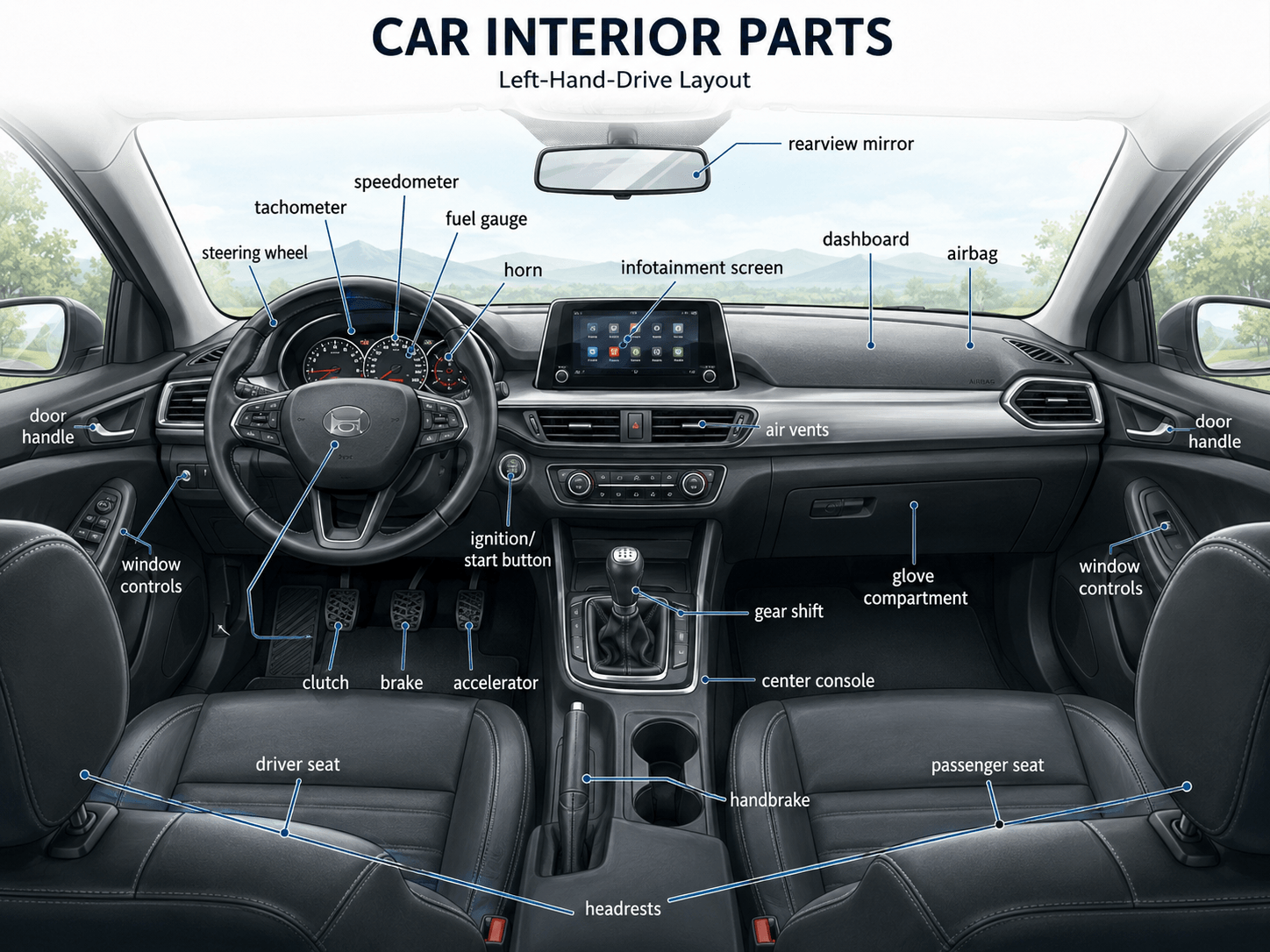
You can also see where the clutch pedal, gear selector, and paddle shifters are located in our guide to car interior parts.
Fuel economy depends more on the specific powertrain than the category. Modern automatics may match or outperform manuals. For towing, a suitably rated torque-converter automatic is often the practical choice.
Which Transmission Type Is Best?
There is no universal winner. The best choice depends on the vehicle, driving conditions, and proven reliability.
- Best for driver control: Manual transmission
- Best for comfort: Torque-converter automatic
- Best for fuel economy: CVT
- Best for performance: DCT
- Best for towing: Usually a properly rated torque-converter automatic
Check the exact model because durability, calibration, and servicing costs vary widely.
Transmission Maintenance
Transmission maintenance should follow the manufacturer’s schedule. There is no universal fluid-change interval for every design.
- Use the exact specified transmission fluid
- Check for leaks
- Repair cooling problems quickly
- Avoid loads beyond the vehicle’s rating
- Investigate delayed, rough, or slipping shifts
- Avoid repeated aggressive launches
- Review model-specific service requirements
Transmission fluid degrades through heat, contamination, and wear. “Lifetime fluid” does not mean the fluid can never deteriorate. It may describe an expected service life under defined conditions.
Frequently Asked Questions
What Are the Signs of a Failing Transmission?
Common warning signs include slipping, delayed engagement, rough shifts, fluid leaks, unusual noises, and a burning smell. The engine may rev without matching acceleration. Some vehicles display a transmission warning light or enter reduced-power mode. Early diagnosis can prevent a minor control or fluid problem from becoming major internal damage.
Which Transmission Type Lasts the Longest?
A well-maintained manual transmission can last a very long time because of its relatively simple design. However, a proven torque-converter automatic may also achieve high mileage. Vehicle design, heat, fluid condition, maintenance, and driving style matter more than the transmission category alone.
Is a CVT Considered an Automatic Transmission?
Yes. A CVT is an automatic transmission because it changes ratios without a clutch pedal or manual gear selection. A conventional CVT uses adjustable pulleys instead of fixed gear pairs. Hybrid e-CVT systems may use a different mechanical arrangement.
What Is the Difference Between a Gearbox and a Transmission?
A gearbox usually refers to the gears, shafts, and related parts that create ratios. A transmission can describe the complete assembly, including the gearbox, clutch or torque converter, controls, and casing. The terms are often used interchangeably in everyday automotive language.
Which Transmission Is Best for Towing?
A properly rated torque-converter automatic is usually best for towing. It can provide smooth low-speed control, torque multiplication, and effective cooling when designed for heavy loads. The correct choice still depends on towing capacity, cooling, axle ratio, and manufacturer guidance.
Why Are Manual Transmissions Disappearing?
Manual transmissions are disappearing because demand has fallen. Modern automatics shift quickly, deliver strong fuel economy, and integrate more easily with hybrids and driver-assistance systems. Heavy traffic also makes automatic driving more convenient. Manuals now remain mainly in selected enthusiast, economy, and commercial vehicles.
Final Verdict
Understanding car transmission types makes vehicle comparisons easier. A manual provides direct control. A torque-converter automatic favors comfort and towing. A CVT focuses on fuel economy, while a DCT delivers fast performance shifts.
The category alone does not determine quality. Check model-specific reliability, maintenance records, fluid requirements, and likely repair costs before buying. A well-designed transmission with proper servicing is usually a better choice than a neglected unit from a supposedly superior category.