
Contents
- Manual vs Automatic Transmission: Key Differences Explained
Manual vs Automatic Transmission: Key Differences Explained
Only 24 new car models sold in the U.S. still come with a manual transmission in 2026. Three decades ago, that number was in the hundreds, and manuals made up more than a third of new car sales. Something changed. A lot, actually.
If you’re trying to decide between manual and automatic, or you just want to understand what’s happening under your feet every time you shift, this guide breaks it down properly — how each system actually works, where they really differ (with real numbers, not vague generalities), and which one fits your specific situation.
Before comparing both systems in detail, it helps to understand what a car transmission is and how it works.
How a Manual Transmission Works
A manual transmission puts you in charge of every gear change. Press the clutch pedal, and you disconnect the engine from the wheels. Move the gear stick, and you select a new gear ratio. Release the clutch smoothly, and power flows again.
Here’s what’s actually happening mechanically. The clutch sits between the engine’s flywheel and the transmission’s input shaft. Engaged, spring pressure clamps a friction plate against the flywheel, so the engine and transmission spin as one unit. Push the pedal, and a release bearing pulls that plate away, breaking the connection.
Inside the gearbox, synchromesh rings do the unglamorous work of matching the spinning speeds of two gears before they lock together — that’s why modern manuals shift cleanly without grinding, even if your technique is a little sloppy.
Learning to drive manual means learning to feel the “bite point,” the exact spot where the clutch starts to grab. Stall out at a green light with three cars behind you, and you won’t forget that lesson. Everyone who’s learned stick has a story like it.
How an Automatic Transmission Works
An automatic does the same fundamental job — matching engine output to the right gear for your speed — but it makes every decision itself.
A torque converter replaces the clutch. It’s a fluid coupling: two finned wheels facing each other inside a sealed housing, transmitting power through transmission fluid instead of a physical connection. That’s why an automatic car can sit in gear at a red light without stalling.
Behind the torque converter sits a planetary gearset, a compact arrangement of gears that produces multiple ratios without the driver ever touching a clutch. A transmission control module reads your speed, throttle position, and engine load dozens of times a second, then commands hydraulic clutch packs and bands to lock in the right ratio.
That’s the traditional automatic. But here’s what most comparison guides skip entirely: “automatic” today rarely means that traditional setup anymore.
- CVT (Continuously Variable Transmission): Uses a belt and a pair of variable-diameter pulleys instead of fixed gears, producing an infinite range of ratios rather than jumping between set steps. Common across Honda, Nissan, Subaru, and Toyota economy models.
- DCT (Dual-Clutch Transmission): Uses two separate clutches — one for odd gears, one for even — so the next gear is pre-selected before you need it. Shifts happen in milliseconds. You’ll find this in the Porsche 911 (badged PDK), the Volkswagen Golf R (DSG), and most modern performance cars.
- Traditional torque-converter automatic: Still common in trucks, SUVs, and mainstream sedans, though modern versions now carry 8, 9, even 10 gears.
Lumping all three into “automatic” is a bit like lumping a bicycle and a motorcycle into “two-wheeled vehicle.” Technically true. Not that useful.
Manual vs Automatic: Quick Comparison
| Factor | Manual | Automatic |
|---|---|---|
| Typical price difference | Often $500–$1,000 cheaper | Baseline / slightly higher |
| Fuel economy | Historically 3–4 mpg better; gap has narrowed sharply | Now comparable, sometimes better, in many new models |
| Repair/replacement cost | Roughly $1,500–$4,000 | Roughly $2,500–$6,000+ (CVT often $4,000–$7,500) |
| Learning curve | Steep — expect some stalling while you learn | Minimal, comfortable within a day |
| Driver control | High — you choose every gear | Low to moderate (paddle shifters claw some back) |
| Best for stop-and-go traffic | Tiring | Comfortable |
| 2026 U.S. new-car availability | ~24 models total | Nearly everything else |
| Theft deterrence | Slight edge — fewer people can drive stick | None |
Key Differences, Explained
Driving Experience and Control
A manual lets you do things an automatic can’t replicate as intuitively: engine-brake down a mountain grade, hold a lower gear through a corner, rev-match a downshift for smoothness. It’s a physical, tactile relationship with the car.
Automatics — especially DCTs — have closed the performance gap almost entirely. A modern dual-clutch gearbox shifts faster than any human can, full stop. That’s not opinion; it’s a function of two clutches pre-loading the next gear instead of one clutch doing everything sequentially.
So which one’s more “fun” really comes down to what you value: involvement, or outright speed.
Fuel Efficiency
For decades, manual was the clear economy winner. Older automatics relied on torque converters that slipped by design, wasting energy as heat, which historically gave manual transmissions a real mileage edge — often cited around 3 to 4 mpg.
That gap has mostly closed. Modern automatics use locking torque converters, more gear ratios, and computer-optimized shift points. On newer vehicles, fuel economy between the two is often close to equal, and sometimes favors the automatic. If you’re comparing two brand-new trims of the same car, don’t assume the manual wins on mpg anymore — check the actual EPA numbers for that specific model.
Purchase Price
Manuals are almost always the cheaper trim to build, and some of that savings gets passed along, though the gap has shrunk as manuals shift from standard base trim to low-volume specialty option. On a Volkswagen Golf R, for instance, the manual version runs about $800 less than the automatic equivalent at current pricing — not nothing, but not a dealbreaker either.
Maintenance and Repair Costs — Real Numbers
This is where most articles get vague. Let’s not.
Fluid changes: Automatic transmission fluid changes typically run $100–$200. Manual gear oil changes cost roughly half that, and in many vehicles need changing less often.
Repairs and rebuilds: A manual transmission replacement typically lands between $1,500 and $4,000, parts and labor included. Automatic replacements run higher, commonly $2,500 to $6,000 — and that’s before you factor in a CVT, which can climb to $4,000–$7,500 because CVT-specific parts and rebuild expertise are harder to come by.
Why the gap? An automatic packs in hundreds of individual components — clutch packs, bands, solenoids, a valve body, sensors, a control module — against a manual’s comparatively simple shaft-and-gear layout. More parts means more failure points and more specialized labor to diagnose them.
There’s an ironic twist, too. Because manuals are so rare now, fewer shops have technicians who work on them regularly. Repair cost can occasionally run higher purely from scarcity of expertise, not mechanical complexity — worth a quick call to a local shop before you assume “manual” automatically means “cheaper” in your area.
Resale Value
The old rule of thumb — manuals are worth less — holds true for ordinary commuter cars, where a smaller buyer pool drags down demand. It stops holding once you get into enthusiast and performance segments.
Take two real examples from current used-market data. A manual Ford Mustang commands a 35% premium over an equivalent automatic. A manual Subaru WRX, by contrast, actually trades for about 8% less than its automatic counterpart, even though WRX buyers overwhelmingly choose manual — it accounts for 83% of listings. Scarcity alone doesn’t guarantee a premium; demand for that exact combination matters more.
The short version: buying a mainstream sedan or crossover, expect the automatic to hold value better. Buying something enthusiast-oriented, run a quick used-market check on that exact model before assuming either way.
Learning Curve
No sugarcoating this one. Learning manual takes real practice, usually several sessions before hill starts and stop-and-go traffic stop feeling stressful. Automatics, by comparison, take maybe twenty minutes to feel natural.
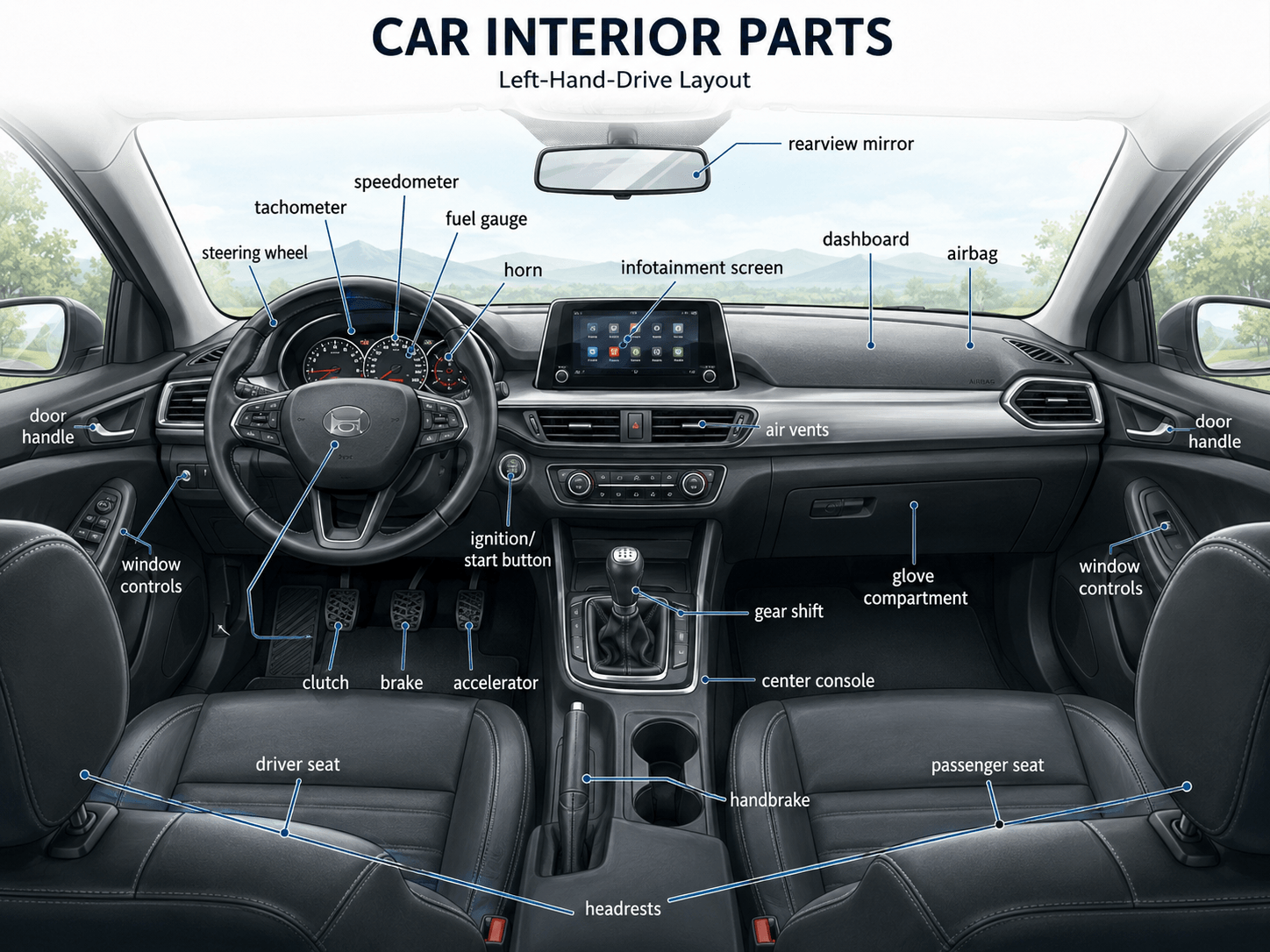
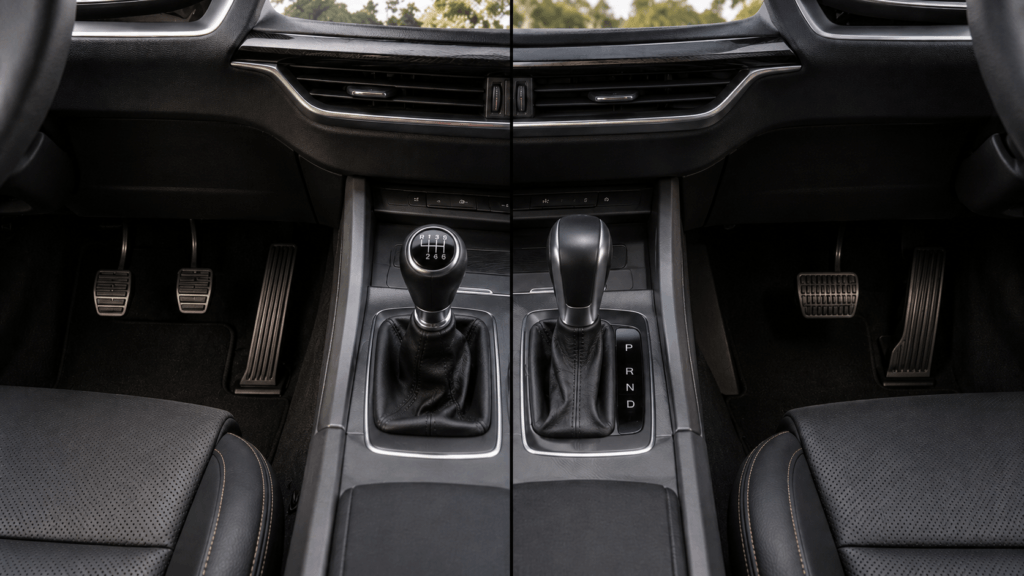
New drivers can also review our manual and automatic pedal layout to learn the correct position of the clutch brake and accelerator. Got weeks to practice in an empty parking lot instead? Learning manual first tends to build sharper car-control instincts that carry over to everything you drive afterward.
Performance and Towing
Modern performance cars have mostly moved to DCTs, not manuals — the Porsche 911, Chevrolet Corvette, and most track-focused machines now ship with dual-clutch gearboxes because they’re objectively quicker. Manual survives in performance cars as a choice for feel, not a requirement for speed.
For towing, automatics generally win outright. A torque converter multiplies torque at low speeds, exactly what’s needed to get a loaded trailer moving, and modern transmissions include dedicated tow/haul modes that adjust shift points to manage heat and load automatically. Doing that manually, gear by gear, up a long grade with a trailer behind you, is a skill few drivers practice enough to do well.
Longevity and Reliability
Fewer moving parts generally means fewer things to fail. A well-maintained manual can genuinely outlast a comparable automatic, and clutch replacement — the main manual wear item — is a known, predictable cost rather than a surprise bill.
“Well-maintained” is doing a lot of work in that sentence, though. A neglected manual, worn clutch, low gear oil, fails just as surely as a neglected automatic. And a modern automatic serviced on schedule will comfortably clear 200,000 miles in plenty of vehicles. Longevity has less to do with transmission type than with whether anyone ever bothered to change the fluid.
Safety and Theft Deterrence
Neither system has a clear safety edge. Accident data doesn’t show a consistent link to transmission type; it comes down to the driver far more than the gearbox. One small, real advantage for manual: because fewer people know how to drive stick, a manual car is modestly harder to steal opportunistically. Not a security system. Not nothing, either.
Why Manual Transmissions Are Disappearing in 2026
The numbers tell a stark story. Manual transmissions accounted for roughly 35% of new U.S. car sales in 1980. Today, that figure sits below 1%. Only 24 models in the entire U.S. new-car market still offer a manual for 2026, down from 27 the year before, and the list keeps shrinking. Toyota’s 2026 “Final Edition” GR Supra is confirmed as the last model year with a manual option. The BMW Z4’s manual variant disappears when the car’s production run ends in 2027.
Hybridization is speeding up the decline. Electric motors deliver instant torque with no need for clutch-based gear changes, which makes pairing a manual gearbox with a hybrid powertrain awkward at best. As more mainstream models add hybrid options, manual availability keeps shrinking right alongside them.
But “disappearing” doesn’t mean “gone.” Manuals are consolidating into a narrow, enthusiast-focused niche rather than vanishing outright. Around 83% of Porsche GT3 Touring buyers still choose the manual. About 90% of Subaru BRZ buyers do the same. More than half of Cadillac Blackwing buyers opt for three pedals over two. Manufacturers keep offering manuals in these specific halo models because a passionate, high-margin buyer base still wants them — just not in the family sedan anymore.
It’s a different story outside the U.S. In the EU, roughly half of new cars sold in 2020 were still manual. China’s market split about 50/50 as recently as 2019. Global data from 2020 already showed automatics holding a clear overall majority, a gap that’s almost certainly widened since. So if you’re shopping outside North America, don’t assume the U.S. trend applies to your market — manual availability, pricing, and buyer expectations can look completely different.
Which Transmission Should You Choose?
Generic pros-and-cons lists only get you so far. Here’s a more useful way to think about it, based on how you’ll actually drive.
You mostly drive in city traffic. Get the automatic. Working a clutch through hundreds of stop-and-go cycles a week gets old fast, and it adds real fatigue on longer commutes.
You’re a new or teen driver. Automatic is the practical choice on a tight timeline — it removes one entire skill you’d otherwise need to master before focusing on traffic and hazards. Got the time to invest instead? Learning stick first tends to build sharper habits.
You’re chasing driving enjoyment or track days. This one’s genuinely split. Manual gives you a more involved, tactile connection to the car. A DCT will out-shift you every single time and post quicker lap times. Neither answer is wrong; it depends on whether you’re chasing a feeling or a stopwatch.
You tow or drive off-road regularly. Automatic, generally. Torque converters and tow/haul modes are built for exactly this job, and they’ll manage heat and load better than most drivers can manage manually on a long grade.
You’re EV-curious. Here’s a genuinely useful shortcut: this whole debate mostly disappears with an EV. Nearly all electric vehicles use a single-speed reduction gear instead of a multi-speed transmission — no clutch, no gear stick, nothing to learn. Planning to go electric within the next car or two? The manual-vs-automatic decision may simply become moot for you.
Frequently Asked Questions
Is a manual transmission cheaper to fix than an automatic? Generally, yes. Manual repairs typically cost $1,500–$4,000, versus $2,500–$6,000 or more for automatics, because automatics have far more parts that can fail. CVTs tend to run even higher, often $4,000–$7,500, due to specialized parts and repair expertise.
Does a manual transmission last longer than an automatic? It can, mainly because it has fewer components that can wear out. But maintenance matters more than transmission type — a well-serviced automatic will easily outlast a neglected manual.
Are manual transmissions being phased out? Largely, yes, in the U.S. market. Only about 24 new models still offer one in 2026, down from well over a hundred decades ago, and hybridization is speeding up the decline. Manuals are shifting from a mainstream option to a niche feature in enthusiast cars.
Is it hard to learn how to drive a manual car? It takes real practice — expect some stalling and jerky starts in your first few sessions. Most people get comfortable within a few days of regular practice, though smooth hill starts take a little longer to master.
Do manual transmissions really get better gas mileage? They used to, by a meaningful margin. That advantage has narrowed significantly on newer vehicles, and in many current models, automatics match or slightly beat manual fuel economy. Always check the specific EPA rating for the model you’re considering.
Is a manual or automatic transmission safer? Neither has a clear, consistent safety advantage in the data — outcomes depend far more on the driver than the transmission type. Manual does require managing an extra pedal and lever, which some new drivers find distracting at first.
Can I still buy a new manual car in 2026? Yes, but the list is short — around 24 models, concentrated in sports cars with a handful of trucks and economy models mixed in. Options include cars like the Ford Mustang, Subaru WRX and BRZ, Toyota GR86 and GR Supra (final year), and select Jeep and Chevrolet models.
Which has better resale value, manual or automatic? It depends heavily on the vehicle. For mainstream commuter cars, automatics generally hold value better. For enthusiast and performance models, it can flip entirely — some manual variants, like the Ford Mustang, command a real premium on the used market.
The Bottom Line
There’s no universal “better” here, only “better for your situation.” Automatics win on convenience, towing, and daily-traffic sanity. Manuals win on control, involvement, and often on upfront and repair cost, assuming you can find a shop that still knows how to work on one.
Still torn? Think about what you’ll actually be doing most: sitting in traffic, hauling a trailer, or carving up a canyon road on a Sunday morning. That answer usually makes the choice for you.