
Contents
- Symptoms of a Bad Catalytic Converter: 8 Warning Signs and Simple Tests
- A Fast Diagnostic Order
- What Happens Inside a Catalytic Converter?
- Common Symptoms of a Failing Catalytic Converter
- 3. Rotten Egg Smell
- How to Test a Catalytic Converter
- What About Removing the Upstream Oxygen Sensor?
- Diagnostic Comparison Matrix
- Efficiency Failure, Restriction, or Sensor Fault?
- Can You Drive With a Bad Catalytic Converter?
- Fix the Cause Before Installing a New Converter
- Frequently Asked Questions
- What are the first signs of a bad catalytic converter?
- Can a bad catalytic converter make a vehicle shake violently?
- Can a blocked catalytic converter cause engine misfires?
- Can chemicals clean a melted catalytic converter?
- Can a bad oxygen sensor cause P0420?
- Does a rotten egg smell always mean the converter is bad?
- What is the best way to test for a clogged converter?
- Can a converter fail without reducing engine power?
- Final Verdict
Symptoms of a Bad Catalytic Converter: 8 Warning Signs and Simple Tests
A failing catalytic converter can quietly choke an engine.
At first, the car feels lazy. Then it falls flat under load. In severe cases, the engine may barely rev because exhaust gas has nowhere to go.
The most common warning signs include:
- P0420 or P0430 code
- Weak acceleration
- Rotten egg smell
- Metallic rattling
- Poor fuel economy
- Excessive floor heat
- Rough idle or stalling
- Limited engine speed
One detail matters.
A converter can stop cleaning the exhaust without restricting flow. It can also become physically blocked while still producing heat.
Those are different failures. They require different tests.
A Fast Diagnostic Order
Before replacing the converter:
- Scan all engine codes
- Check for active misfires
- Review fuel trims
- Inspect for exhaust leaks
- Compare oxygen-sensor signals
- Test for exhaust restriction
- Find the original cause
A P0420 code alone doesn’t confirm a blocked converter.
Weak acceleration alone doesn’t prove catalyst failure either.
Build the case first.
What Happens Inside a Catalytic Converter?
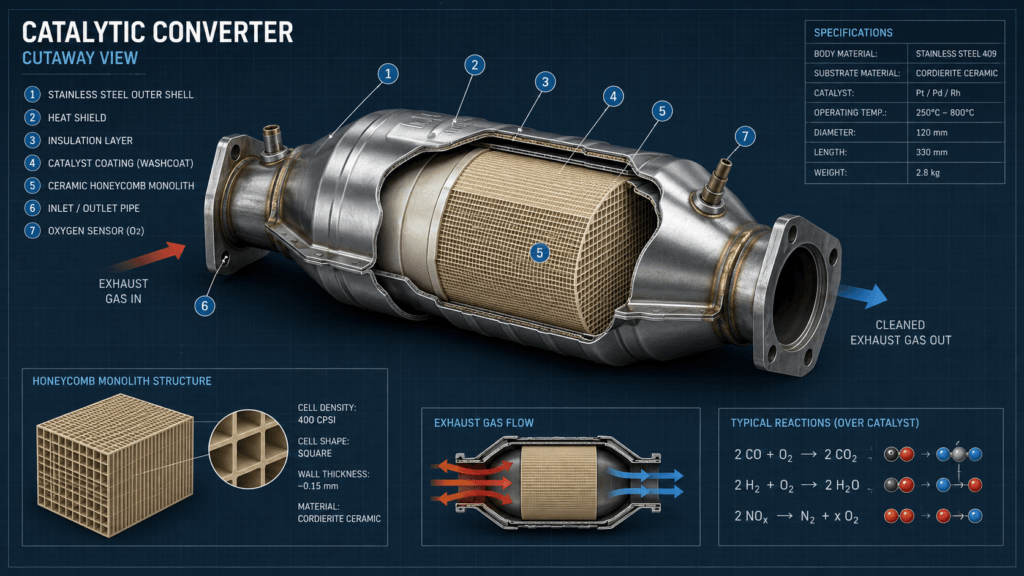
Inside the steel casing sits a ceramic or metallic substrate.
Most gasoline converters use a honeycomb structure. Thousands of narrow channels create a large reaction surface without heavily restricting exhaust flow.
The channel walls contain a washcoat with precious metals such as:
- Platinum
- Palladium
- Rhodium
These metals help convert carbon monoxide, hydrocarbons, and nitrogen oxides into less harmful gases.
The converter usually fails in three ways.
Restricted Converter
A restricted converter cannot pass enough exhaust gas.
Possible causes include:
- Collapsed passages
- Shifted ceramic pieces
- Heavy deposits
- Impact damage
- Melted substrate
Pressure builds ahead of the blockage.
The engine then struggles to empty each cylinder. Less fresh air enters during the next intake stroke, so power drops.
Melted Converter
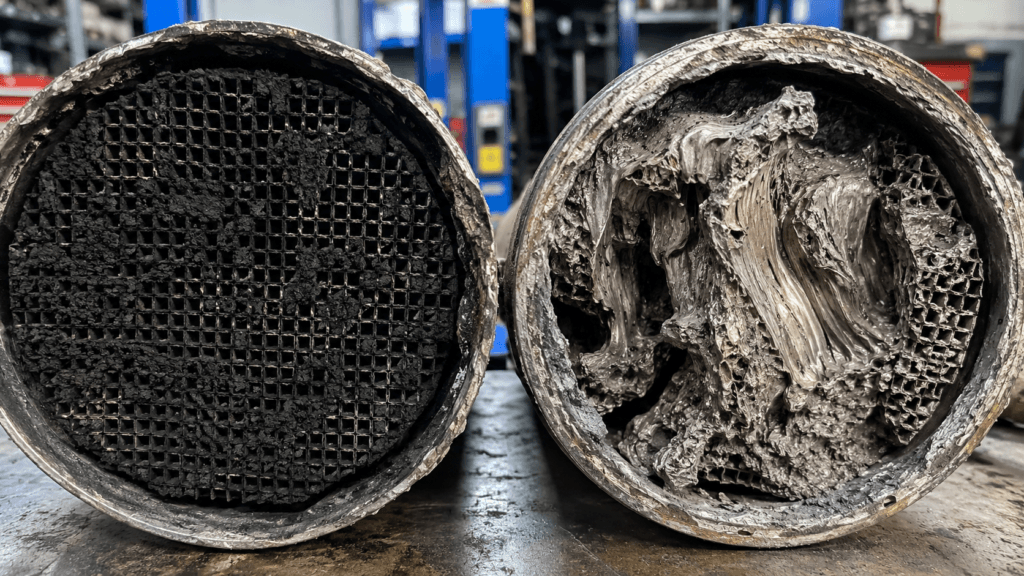
This normally begins with another engine fault.
An active misfire sends unburned fuel and oxygen into the exhaust. That mixture can react inside the converter and create extreme heat.
The ceramic substrate may soften, collapse, or fuse together.
Once that happens, the engine feels strangled.
No fuel additive can rebuild melted ceramic.
Poisoned Converter
A poisoned converter may still flow normally.
Its active coating has lost chemical efficiency.
Common contaminants include:
- Engine oil
- Coolant
- Silicone
- Unsuitable sealants
- Contaminated fuel
The exhaust path remains open, but the converter can no longer process pollutants correctly.
That may trigger P0420 or P0430 without causing obvious power loss.
Common Symptoms of a Failing Catalytic Converter
1. Sluggish Acceleration
This is one of the strongest signs of an exhaust restriction.
You press the accelerator. The engine gets louder. The car barely gains speed.
It feels choked.
A blocked converter creates exhaust backpressure. That pressure resists the piston during the exhaust stroke.
Some spent gas remains inside the cylinder. The next intake charge becomes smaller.
Cylinder filling drops. Torque falls with it.
Common complaints include:
- Weak hill climbing
- Slow highway merging
- Poor towing power
- Power fading when hot
- Engine refusing high rpm
- Better response at light throttle
The problem often appears under load.
At idle, the engine produces little exhaust volume. The restriction may remain hidden.
Open the throttle, and gas flow rises sharply. The blockage suddenly matters.
2. P0420 or P0430 Code
The two common catalyst-efficiency codes are:
- P0420: Catalyst efficiency below threshold on Bank 1
- P0430: Catalyst efficiency below threshold on Bank 2
Bank 1 contains cylinder number one.
Bank 2 exists on engines with a second cylinder bank.
The engine computer compares sensor activity before and after the converter.
The upstream oxygen sensor responds quickly to mixture changes. A working converter stores and releases oxygen, which usually makes the downstream signal steadier.
When oxygen-storage capacity falls, the downstream pattern may begin resembling the upstream pattern.
The computer then detects poor catalyst efficiency.
That still doesn’t prove the converter itself is faulty.
Other possible causes include:
- Exhaust leaks
- Engine misfires
- Slow oxygen sensors
- Sensor wiring faults
- Rich fuel mixtures
- Oil consumption
- Coolant contamination
- Calibration issues
Exhaust leaks are especially important. Outside air entering the system can distort downstream oxygen readings.
Does P0420 Make the Check Engine Light Flash?
Usually, no.
P0420 normally produces a steady warning light.
A flashing light points more strongly toward an active misfire. That misfire may be overheating the converter.
Reduce engine load and stop when safe.
3. Rotten Egg Smell
A rotten egg smell usually involves hydrogen sulfide, or H₂S.
The chemistry is often explained badly.
Under rich operating conditions, sulfur compounds in the exhaust can form hydrogen sulfide inside the catalyst.
Possible causes include:
- Rich air-fuel mixture
- Leaking injector
- Ignition misfire
- Catalyst overload
- High-sulfur fuel
- Poor fuel control
Smell alone isn’t enough.
Check fuel trims, injector operation, and misfire data before condemning the converter.
A different tank of fuel may make the smell disappear. Persistent odor needs diagnosis.
4. Metallic Rattling Under the Car
The ceramic core should remain firmly supported.
Heat damage can crack it. Road impact can break it. A weakened support mat can let it move inside the shell.
You may hear:
- Rattling at startup
- Buzzing near idle
- Clatter during acceleration
- Noise when shutting down
Loose fragments may still allow normal flow.
Then one piece turns sideways, blocks the outlet, and power suddenly disappears.
A loose heat shield can make a similar sound. Check the shield before blaming the internal core.
5. Poor Fuel Economy
A restricted converter doesn’t automatically force every ECU into a rich fuel map.
Fuel economy may fall because the driver needs more throttle to produce the same power.
The original fault may also be wasting fuel. A leaking injector, weak oxygen sensor, or misfire can damage the converter while increasing fuel use.
Check:
- Short-term fuel trim
- Long-term fuel trim
- Oxygen-sensor response
- Mass-airflow readings
- Manifold pressure
- Misfire counts
Large positive trim means the ECU is adding fuel.
Large negative trim means it is removing fuel.
Read the values at idle and at a steady raised engine speed.
6. Excessive Heat Under the Floor
Converters normally run hot.
A glowing converter is different.
Raw fuel may be burning inside the shell. That heat can damage wiring, insulation, and floor materials.
Warning signs include:
- Hot cabin floor
- Burning smell
- Discoloured converter shell
- Melted nearby wiring
- Red glow underneath
Stop the engine.
Don’t park over dry grass.
A glowing converter often points toward a severe misfire, rich mixture, or leaking injector.
7. Rough Idle, Shaking, or Stalling
A severe restriction can make an engine shake.
Poor exhaust scavenging leaves spent gas inside the cylinders. The next combustion event becomes unstable.
The engine may:
- Shake at idle
- Stall at junctions
- Start slowly
- Misfire under load
These symptoms have many other causes.
Ignition faults are more common. So are vacuum leaks, injector problems, and low compression.
Test before replacing parts.
8. Engine Won’t Rev Properly
This symptom deserves attention.
The engine may run reasonably well when cold, then refuse to pull past a certain speed.
That can happen when a damaged core moves or expands with heat.
A blocked muffler can cause the same complaint.
Other possibilities include:
- Crushed exhaust pipe
- Failed resonator
- Collapsed internal baffle
- Restricted diesel particulate filter
A pressure test helps locate the actual blockage.
How to Test a Catalytic Converter
These tests answer different questions.
- The temperature test checks heat behaviour.
- The vacuum test screens for restriction.
- The tap test finds loose ceramic.
- The backpressure test confirms restricted exhaust flow.
Work outdoors.
Let hot parts cool before touching them. Never work under a car supported only by a jack.
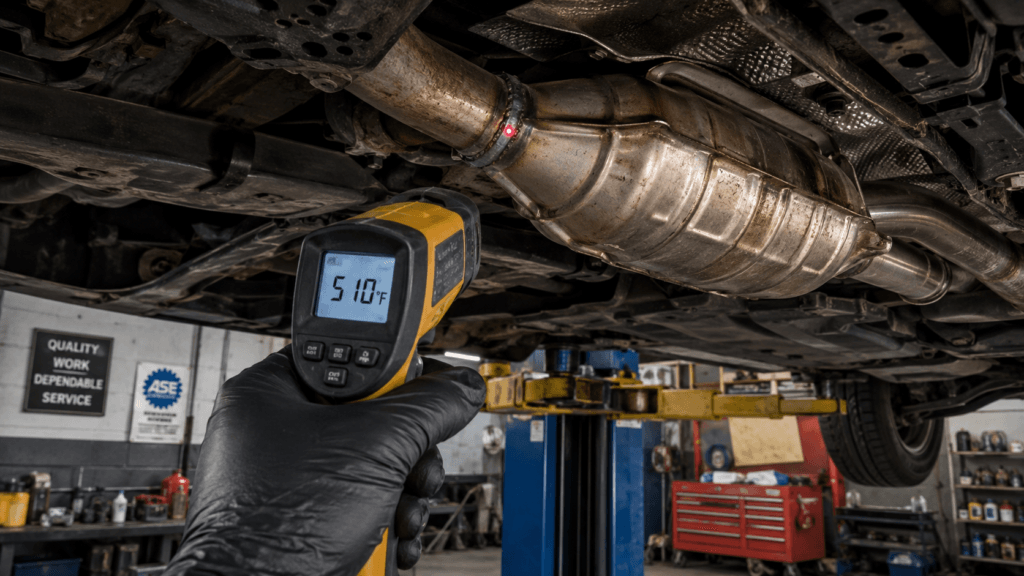
Test 1: Infrared Temperature Check
Procedure
You’ll need an infrared thermometer.
- Drive for 15–20 minutes.
- Use normal road load.
- Park safely outdoors.
- Keep the engine running.
- Measure near the converter inlet.
- Measure near the outlet.
- Use matching surfaces and angles.
Don’t aim at a shiny heat shield. Reflective metal can distort the reading.
A chemically active converter may show a hotter outlet after loaded driving.
Older workshop guidance sometimes expects an outlet increase of around 100°F to 150°F. That isn’t a universal pass mark.
Results depend on:
- Engine load
- Air-fuel mixture
- Converter design
- Exhaust flow
- Measurement position
- Pipe thickness
- Ambient temperature
A restricted converter can still run very hot.
A weak converter can also produce misleading readings.
Use this test as supporting evidence only.
Activity Versus Overheating
These are different conditions.
A moderate temperature increase may suggest chemical activity.
An extremely hot shell may indicate:
- Active misfire
- Rich mixture
- Injector leakage
- Excess fuel entering the exhaust
Severe heat doesn’t prove the converter is healthy.
Test 2: Intake Vacuum Gauge Test
This is a useful first test for restricted exhaust flow.
Connect the gauge to a direct intake-manifold vacuum source.
Procedure
- Warm the engine fully.
- Record vacuum at idle.
- Raise speed to around 2,500 rpm.
- Hold it steady.
- Watch the needle for 20–30 seconds.
Vacuum normally drops when the throttle opens. It should then recover and remain reasonably stable.
Restriction becomes likely when the reading keeps falling at steady rpm.
The exact value varies by engine.
Altitude, camshaft timing, valve condition, and ignition quality all affect manifold vacuum.
Focus on the trend.
This test detects a restriction somewhere in the exhaust. It doesn’t identify the converter by itself.
Test 3: Mechanical Tap Test
Perform this test with the exhaust fully cold.
Use a rubber mallet.
Tap the converter casing gently.
A dry rattle inside the main shell may indicate:
- Cracked substrate
- Loose ceramic pieces
- Broken support material
This test detects structural damage only.
It cannot diagnose chemical poisoning, low oxygen-storage capacity, or an exhaust leak.
No rattle doesn’t guarantee a healthy converter.
Test 4: Exhaust Backpressure Test
This is the strongest test for physical restriction.
A pressure gauge is installed in an oxygen-sensor port ahead of the suspected blockage.
Pressure is checked at:
- Idle
- Steady raised rpm
- Brief loaded operation where approved
Pressure that rises quickly with engine speed suggests restricted exhaust flow.
Manufacturer specifications should always come first.
Some light-duty engines show less than roughly 1 psi at idle when the exhaust flows normally. Treat that as a broad reference, not a universal limit.
Testing before and after the converter can locate the blockage.
- High pressure before it suggests converter restriction.
- Normal pressure there points farther downstream.
- High pressure behind it suggests a muffler or pipe blockage.
Hot exhaust escapes during this test. Use suitable equipment.
What About Removing the Upstream Oxygen Sensor?
Removing the upstream sensor creates a temporary exhaust escape.
If power returns, a downstream blockage becomes more likely.
This isn’t a normal driveway test.
Hot exhaust gas exits near wiring, hoses, and body panels. The vehicle also becomes extremely loud.
Treat it as a professional or last-resort diagnostic step.
A backpressure gauge gives better evidence.
Diagnostic Comparison Matrix
| Symptom | Likely Failure State | Priority |
| P0420 without power loss | Chemical degradation | Test soon |
| Normal flow with poor emissions | Poisoned coating | Schedule repair |
| Weak acceleration | Restricted substrate | Limit driving |
| Engine won’t rev | Severe blockage | Stop driving |
| Rotten egg odor | Rich catalyst operation | Check mixture |
| Internal rattle | Broken core | Repair promptly |
| Glowing shell | Fuel burning inside | Shut down |
| Hot floor area | Extreme overheating | Park safely |
| Falling vacuum at steady rpm | Exhaust restriction | Confirm pressure |
| Oil use with P0420 | Contaminated catalyst | Fix engine first |
| Coolant loss with white smoke | Coating damage risk | Inspect immediately |
| Similar sensor patterns | Low oxygen storage | Check leaks first |
Efficiency Failure, Restriction, or Sensor Fault?
This distinction prevents wasted money.
Catalyst Efficiency Failure
Typical signs:
- P0420 or P0430
- Normal acceleration
- No major backpressure
- Active downstream sensor
- Failed emissions test
The converter still flows, but its chemical performance has dropped.
Physical Exhaust Restriction
Typical signs:
- Power loss
- Falling vacuum at steady rpm
- High pressure before the converter
- Excess heat
- Limited engine speed
The engine cannot move exhaust gas efficiently.
Sensor or Exhaust-Leak Fault
Typical signs:
- Catalyst code with inconsistent data
- Visible exhaust leak
- Slow oxygen-sensor response
- Implausible fuel trims
- No restriction symptoms
Repair the leak or sensor fault first.
Can You Drive With a Bad Catalytic Converter?
A chemically weak converter may still allow normal driving.
You may face:
- Higher emissions
- Failed inspection
- Persistent warning light
- Legal compliance problems
A restricted or overheated converter is different.
Stop driving if you notice:
- Flashing warning light
- Severe power loss
- Glowing converter
- Burning floor smell
- Repeated stalling
- Engine unable to rev
- Loud internal rattling
A blocked converter increases exhaust manifold pressure and reduces cylinder scavenging.
It may also raise exhaust-valve temperatures and place extra stress on a turbocharger.
Severe restriction can eventually stop the engine.
Removing or hollowing the converter isn’t a proper repair. It may also make the vehicle illegal for road use.
Fix the Cause Before Installing a New Converter
Converters often fail because another fault damaged them.
Check:
- Spark plugs
- Ignition coils
- Injectors
- Misfire counters
- Compression
- Oil consumption
- Coolant loss
- Oxygen sensors
- Fuel trims
- Exhaust leaks
A common workshop sequence looks like this:
A coil starts misfiring. Raw fuel reaches the converter. The core overheats. The driver replaces only the converter.
The new converter fails because the original misfire remains.
The expensive part wasn’t the first problem.
Frequently Asked Questions
What are the first signs of a bad catalytic converter?
Early signs may include a catalyst-efficiency code, weaker acceleration, sulfur odor, or rattling under the vehicle.
A chemically weak converter may show only P0420.
A restricted converter usually affects power.
Can a bad catalytic converter make a vehicle shake violently?
Yes, if the restriction becomes severe.
Trapped exhaust can reduce cylinder filling and destabilise combustion.
Check ignition misfires first. They’re more common and may be damaging the converter.
Can a blocked catalytic converter cause engine misfires?
Yes.
High backpressure can reduce exhaust scavenging and weaken combustion.
The reverse happens more often. A misfire sends raw fuel into the converter and melts the core.
Determine which fault happened first.
Can chemicals clean a melted catalytic converter?
No.
A cleaner cannot reopen fused passages.
It cannot rebuild broken ceramic or restore missing catalyst coating.
A melted or rattling core needs replacement.
Can a bad oxygen sensor cause P0420?
Yes.
A slow sensor, wiring fault, exhaust leak, or mixture problem can imitate poor catalyst performance.
Inspect live data before buying a converter.
Does a rotten egg smell always mean the converter is bad?
No.
Rich operation, leaking injectors, misfires, and fuel sulfur content can create the smell.
Check the fuel system first.
What is the best way to test for a clogged converter?
An exhaust backpressure test gives the clearest confirmation.
A vacuum test is a useful first screen.
Temperature readings and tapping tests provide supporting evidence.
Can a converter fail without reducing engine power?
Yes.
A poisoned or aged converter may lose chemical efficiency while remaining physically open.
That can trigger P0420 or P0430 without noticeable acceleration problems.
Final Verdict
Don’t treat every catalyst code as a blocked converter.
First decide which fault you’re chasing:
- Efficiency loss
- Physical restriction
- Broken substrate
- Sensor or exhaust leak
Scan the codes. Check misfires. Review fuel trims. Inspect for leaks. Then test exhaust flow.
Replace the converter only when the evidence points there.
Otherwise, you may replace the most expensive part while leaving the real fault untouched.