
Contents
Brake Pedal Soft Causes: Diagnostics, Hydraulic Physics, and the “No-Leak” Mystery
Brake pedal soft causes almost always trace back to one physics violation: something compressible has taken the place of fluid that’s supposed to be incompressible. Brake fluid resists compression almost completely under pressure — that’s what lets pedal force reach the calipers instantly — but air, water vapor, and boiled fluid all compress significantly, soaking up pedal travel before real clamping force ever builds. Whether that gas got in through a bad bleed, absorbed moisture, or an internal seal bypass, the fix depends entirely on identifying which failure mode is actually in play.
⚠️ Engineering Safety Warning: US federal safety standards have required dual-circuit brake hydraulics since the 1967 model year, specifically so a single failure doesn’t mean zero brakes — most vehicles split the system diagonally, pairing one front wheel with the opposite rear wheel, for this exact reason. But a working second circuit is not the same as a safe vehicle. A failed circuit leaves the surviving one doing the work of both, pedal travel needed to reach that reduced capacity climbs sharply, and stopping distance grows with it. If the pedal has ever gone to the floor, or it’s gotten progressively softer over multiple drives, don’t keep driving on the assumption the other circuit has you covered. Get the vehicle towed to a qualified shop. Hydraulic brake failure at speed doesn’t give second attempts.
The Physics of Brake Hydraulic Failures
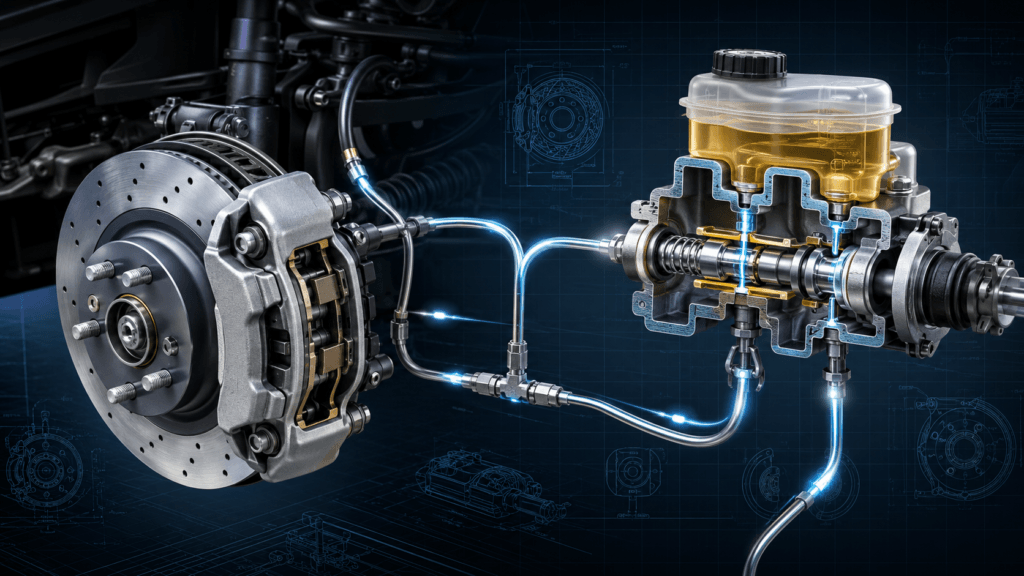
Pascal’s Law is the entire brake system in one sentence: pressure applied to a confined fluid transmits equally, undiminished, in every direction. Press the pedal, the master cylinder pressurizes the fluid, and that pressure shows up instantly at every caliper piston. No stretch. No delay. No loss — because liquid brake fluid is nearly incompressible under normal operating loads.
Gas behaves nothing like that. Air, water vapor, and boiled fluid vapor all compress significantly under pressure. Introduce even a small pocket of gas anywhere in a closed hydraulic circuit, and pedal effort now goes into squeezing that pocket smaller before any pressure reaches the caliper at all. That’s the entire mechanism behind a spongy brake pedal: energy that should move a piston instead disappears into compressing gas.
The volume math is unforgiving. A typical brake system holds well under a liter of fluid split across four circuits. A bubble equal to just 1-2% of that volume — barely visible in a clear hose — adds several millimeters of dead pedal travel before real clamping force builds. That’s why bleeding the brakes correctly is a precision job, not a five-minute afterthought.
Brake Pedal Soft Causes: The Technical Breakdown
1. Trapped Air Pockets in the Brake Lines
Air gets into a closed hydraulic system two ways: the reservoir runs dry, or the bleed job was incomplete.
- Reservoir depletion: as pads wear, caliper pistons extend further to close the gap, pulling more fluid out of the reservoir to fill that larger piston volume. Let the reservoir drop below the pickup port — from a slow leak elsewhere, or plain neglect — and the system starts drawing in air instead of fluid.
- Incomplete bleeding: air pockets settle at the highest point in a line or caliper bore. Skip a corner during a bleed sequence, or don’t hold the bleeder open long enough per stroke, and a bubble sits exactly where it’ll cause trouble later.
Air-induced sponginess has a signature feel: the pedal firms up with repeated pumping — each stroke compresses or relocates the bubble slightly — but sinks again the moment you hold steady pressure.
Diagnostic tip: if the pedal pumps up firm in two or three strokes but sinks under sustained pressure, suspect trapped air before you suspect master cylinder failure — re-bleed that corner first.
2. Moisture Absorption and Brake Fluid Vapor Lock
Standard DOT 3, DOT 4, and DOT 5.1 fluids are glycol-based, and glycol is hygroscopic — it pulls moisture straight out of the atmosphere, through microscopic pores in rubber hoses, through the reservoir cap vent, through every seal in the system. Nobody has to do anything wrong for this to happen; it’s chemistry, not neglect. (DOT 5 is the exception — silicone-based and non-hygroscopic, but it can’t be mixed with glycol fluids without ruining the system.)
Fresh DOT 4 has a dry boiling point around 446°F (230°C). Let it absorb roughly 3% water by volume — normal after two to three years in service — and the wet boiling point can fall to around 311°F (155°C). Calipers routinely see temperatures past that during a sustained mountain descent, an aggressive track session, or a loaded vehicle riding the brakes down a long grade.
Once trapped moisture flashes to steam, there’s a compressible gas pocket sitting inside the caliper — the same failure mode from the physics section above, just triggered by heat instead of a bad bleed. This is classic brake fade, and it announces itself as a pedal that was firm ten minutes ago and is soft now.
Diagnostic tip: check fluid moisture content or boiling point with a strip tester or refractometer at every service interval — a brake fluid flush before the pedal tells you there’s a problem beats one after.
3. Internal Master Cylinder Seal Bypass (The “No-Leak” Scenario)
This is the failure that sends people crawling under the car looking for a puddle that doesn’t exist.
Inside the master cylinder bore, primary and secondary piston cups (lip seals) are supposed to hold pressure forward toward the calipers. When the bore corrodes — often from moisture-contaminated fluid sitting against bare metal — or the cups themselves harden and crack with age, fluid bypasses internally. It moves backward past the seal lips into the low-pressure reservoir side instead of forward to the wheels.
No fluid hits the ground. No wet spot on the driveway. The reservoir might even read full. Pedal effort just disappears into that internal bypass, producing a slow sink under steady pressure or an inconsistent, mushy feel that no amount of bleeding will ever fix.
Diagnostic tip: engine off, apply firm steady pressure and hold it for 60 seconds — a pedal that creeps toward the floor with zero external leak anywhere is master cylinder failure, not a bleeding problem.
4. Stuck-Open ABS Modulator Valve
Every modern brake system routes fluid through the Hydraulic Control Unit (HCU) — a block of solenoid valves that modulate pressure to each wheel independently during an ABS event. Contamination in old, unflushed fluid can lodge in one of those valves and hold it slightly open.
When that happens, hydraulic pressure that should go to the caliper bleeds off into the HCU’s low-pressure accumulator instead. The result mimics a spongy pedal or partial hydraulic pressure loss — but only on the affected circuit, and conventional gravity or manual bleeding often can’t clear it, because the valve itself is blocking the path.
Diagnostic tip: if sponginess is isolated to one wheel, or shows up alongside ABS warning lights, a bi-directional scan tool cycling the HCU solenoids during the bleed is the fix a standard bleed procedure can’t deliver.
5. Mechanical Flex and Worn Rubber Hoses
Not every soft pedal means lost hydraulic pressure — some of it is the system flexing instead of transmitting force.
Rubber flex hoses at each corner carry internal reinforcement, usually braided fabric or steel, specifically to resist ballooning under pressure. Once that reinforcement degrades with age and heat cycling, the hose expands slightly with every pedal application, swallowing travel that should have gone into clamping the rotor instead.
Sticking caliper slide pins cause a related problem: a piston that doesn’t retract evenly knocks back further than it should, and the pedal needs extra travel just to take up that clearance before real braking starts.
Diagnostic tip: have a helper hold steady pressure while you watch each flex hose for visible bulging — a hose that swells under load steals pedal travel as surely as a bubble of trapped air.
6. External Hydraulic Leaks
The most straightforward brake pedal soft cause on this list, and the one most people check first — sometimes to the exclusion of everything above it.
- Copper-nickel hard lines: corrode from the outside in, especially where they contact the frame rail or see regular road salt exposure. Flare fittings are the usual leak point.
- Banjo bolts at the caliper: seal on soft copper or aluminum crush washers that harden and lose their seat over time.
- Wheel cylinders (drum brakes): leak fluid directly into the drum, often unnoticed until the shoes are soaked through.
- Caliper piston seals: the square-cut seal inside the bore wears or takes a permanent set, letting fluid weep past the piston.
Diagnostic tip: check for fluid discoloration in the brake dust at every wheel and along the full length of every visible line — external leaks show themselves visually long before the pedal fully gives out.
Unlike standard brake lines, an automotive engine bay contains multiple pressurized loops that carry separate fluids. If you notice a dark reddish fluid pooling under your vehicle rather than amber brake fluid, verify your components immediately using our detailed guide on power steering fluid leak symptoms.
The Ultimate Diagnostic Matrix: Symptoms vs. Root Causes
| Pedal Feel & Sensation | Root Failure Mechanism | Immediate Engineering Action Step |
| Pumps up to firm but fades under steady foot pressure | Trapped air in the lines or caliper bore | Re-bleed the affected circuit, farthest wheel from the master cylinder first |
| Consistently spongy but fluid level remains full and dry | Internal master cylinder seal bypass, or residual microbubbles from a prior bleed | Run the 60-second static pressure hold test; replace the master cylinder if it sinks with zero external leak |
| Soft only after descending mountain roads or heavy track use | Moisture-contaminated fluid vaporizing under heat (fade / vapor lock) | Test fluid boiling point immediately; flush and refill with fresh DOT 4 or DOT 5.1 |
| Travels completely to the floorboard instantly, no resistance | Catastrophic circuit failure — full external rupture or total master cylinder seal failure | Stop driving immediately; do not continue — have the vehicle towed |
Step-by-Step Troubleshooting Protocol
- The Static Pressure Drop Test. Engine off, pump the pedal three to five times to build residual pressure, then hold firm steady pressure for a full 60 seconds. Any sink points to a downstream leak or master cylinder bypass. Repeat with the engine running to bring the booster into the equation — a pedal that only sinks under boost assistance points toward the booster or a vacuum-side issue, not pure hydraulics.
- Brake Fluid Boiling Point and Moisture Strip Assessment. Test with a chemical strip or an electronic boiling-point tester before assuming anything mechanical is at fault. Moisture content above roughly 3% by volume, or a wet boiling point that’s dropped meaningfully below the manufacturer’s spec, means a brake fluid flush comes before any parts get replaced.
- Visual Wheel-by-Wheel Under-Car Inspection. Lift and support the vehicle properly. Check every caliper and wheel cylinder for weeping fluid, every rubber hose for cracking or bulging, and every hard line for corrosion, especially at frame contact points and flare fittings. Don’t skip the HCU itself — it can leak externally too.
- Sequence-Specific Bleeding Strategy. Bleed the wheel farthest from the master cylinder first, then work toward the closest — this pushes old fluid and trapped air in the direction it needs to travel instead of packing it further down the line. Confirm the system’s split (diagonal vs. front-rear) before deciding on order. On any vehicle with ABS or stability control, be ready to use a bi-directional scan tool to cycle the HCU valves mid-bleed — manual pumping alone often can’t force air out of the modulator itself.
Frequently Asked Questions (FAQs)
Why is my brake pedal soft but the fluid is full?
This is almost always caused by an internal master cylinder seal bypass or a sticking ABS modulator valve. Under pressure, the fluid slips past worn internal rubber piston cups back into the reservoir or drops into the ABS accumulator loop. No fluid leaves the system, meaning your reservoir stays completely full, but hydraulic pressure cannot reach the wheel calipers.
Can low brake pads cause a spongy pedal feel?
No, low pads alone do not create a spongy or soft feel. As friction material wears down, caliper pistons extend further, which pulls more fluid out of the master reservoir, lowering your fluid level. A soft pedal only occurs if that fluid drops low enough to introduce air pockets into the master cylinder pickup lines.
Will pumping the brakes fix a soft brake pedal?
Pumping the brakes is a temporary roadside recovery tactic, not a structural fix. If your pedal feels soft due to trapped air, pumping it rapidly compresses or shifts the air bubbles temporarily, momentarily restoring pressure. However, once you release the pedal, the bubbles expand again, and the system immediately returns to its dangerous, soft state.
How do I know if my master cylinder is leaking internally?
Perform the Static Pressure Drop Test. Turn the engine off to fully drain the vacuum booster reserves. Pump the pedal until it goes stiff, then maintain steady, firm foot pressure for 60 seconds. If the pedal steadily creeps downward toward the floorboards while the exterior of the system and ground stay completely dry, the master cylinder is failing internally.