
If your car is pulling to one side while driving, something is off — and it will not sort itself out. The car pulling to one side can cause range from something as simple as a slightly flat tire to something as serious as a sticking brake caliper. Either way, you should not ignore it.
Contents
- What Does It Mean When a Car Pulls to One Side?
- 9 Most Common Car Pulling to One Side Causes
- Why Does My Car Pull to the Right?
- Why Does My Car Pull to the Left?
- Car Pulling to the Right When Braking — What Does It Mean?
- How to Diagnose a Car Pulling to One Side?
- How to Fix a Car Pulling to One Side
- When Should You Go to a Mechanic Right Away?
- How to Keep Your Car From Pulling
- Frequently Asked Questions
What Does It Mean When a Car Pulls to One Side?
Think of it like a way that your car goes straight only when both sides of the car push and pull equally. The moment one side has more drag, less grip or uneven brake force, the car starts drifting toward that side.
While driving,A car pulling to the right on a flat road is not the same problem as a car that only pulls when you apply the brake. Same goes for a pull that happens only during hard acceleration. Each pattern points to a different part of the car.
That is why figuring out when the pull happens is the single most useful thing you can do before spending any money.
9 Most Common Car Pulling to One Side Causes
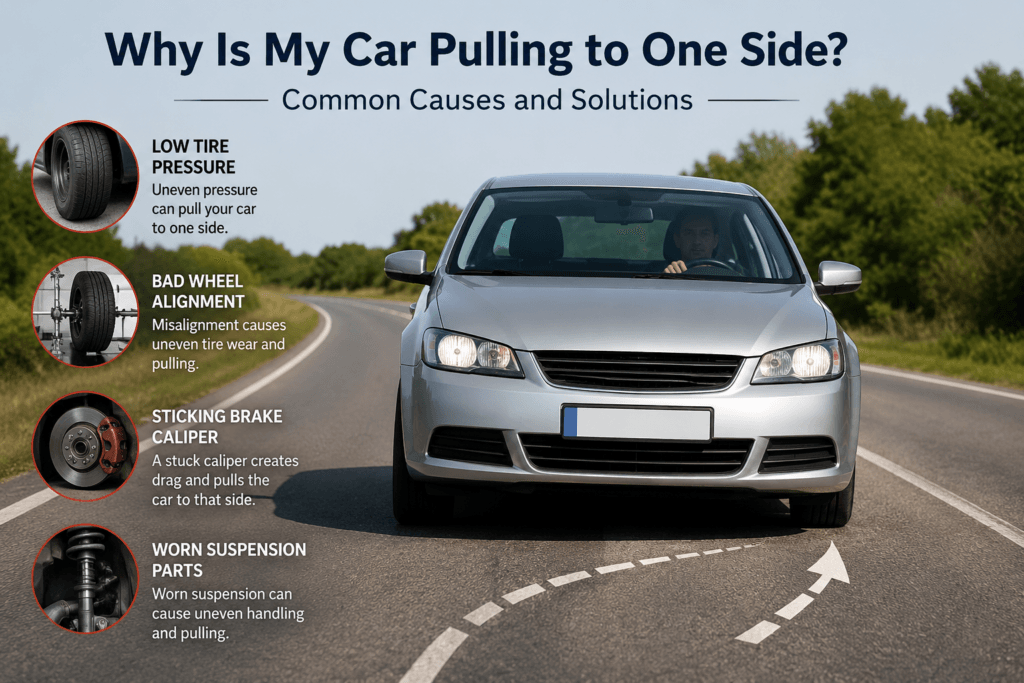
1. Low or Uneven Tire Pressure
This is responsible for more pulling complaints than anything else — and it is also the easiest fix.
When one tire has less air than the one across from it, that side sits slightly lower and creates more rolling resistance. The car naturally drifts toward the underinflated tire. A difference of just 6–8 PSI between the left and right tire is enough to feel it on the road.
Check all of the four tires with a gauge and inflate them to the number on the sticker inside the driver’s door — not the number printed on the tire sidewall. Those are two different numbers.
2. Bad Wheel Alignment
Alignment controls the angle of the car at which your tires contact the road. When those angles are shifted usually after hitting a pothole, clipping a curb or going over a speed bump too fast, then the car starts drifting consistently to one side.
A Bad alignment also causes your tires to wear unevenly, which makes the pulling worse over time. If your steering wheel sits slightly crooked on a flat road, that is a classic sign alignment is off.
3.Unevenly Worn Tires
A tire with noticeably less tread than the one on the other side of the same, axle grips the road differently. Less tread means less grip and the car pulls toward the side with less grip.
This is exactly why the tire rotation matters. Skipping rotation leads to uneven wear, which may leads to pulling, which eventually means buying new tires sooner than you should have to.
4. Sticking Brake Caliper
A brake caliper that does not release properly keeps a slight friction load on that wheel — even when you are not braking at all. The affected wheel drags constantly, and the car pulls toward it.
After a short drive, hold your hand near each wheel without touching it. A wheel that is noticeably hotter than the rest is almost always a stuck caliper.Sometimes, You will smell burning from that corner too.
A sticking caliper can also make the pedal itself feel unusually stiff — see our guide on hard brake pedal causes if that’s happening alongside the pull.”
5. Damaged Suspension Parts
Ball joints, control arm bushings, struts — these parts hold each wheel in the correct position under load. When they wear out, the wheel shifts position slightly especially during braking and the car pulls toward that side.
Worn suspension parts also make the steering feel loose. If the car pulls and the steering wheel feels less precise than it is more worthed to check the suspensions.
6. Damaged Steering Components
Worn tie rod ends and a damaged steering rack let the front wheels shift slightly without any input from you. The car drifts, and the steering wheel may not return to center smoothly after a turn.
One important note here — getting an alignment done on a car with worn steering parts gives you inaccurate results. The steering has to be fixed first, then aligned.
7. Collapsed Brake Hose
This one catches people off guard. A deteriorated brake hose can act almost like a one-way valve. Fluid goes in when you press the pedal, but does not flow back fully when you release it. This traps partial pressure on one caliper and causes both drag and a pull during braking.
If one caliper looks fine but the brakes still pull, the hose feeding that caliper is worth checking.
8. Torque Steer (Front-Wheel-Drive Cars Only)
This shows up specifically during hard acceleration in front-wheel-drive vehicles. Unequal axle lengths or worn engine mounts cause the car to pull to one side when you put your foot down.
No amount of tire rotation or alignment work will fix torque steer — it is a drivetrain issue. If the pull only happens under acceleration and you drive a FWD car, this is where to look.
9. Road Crown
Roads are built with a slight slope from the center toward the edges for drainage. On roads with a steep crown, even a car with fairly good alignment will tend to drift toward the right shoulder.
A quick way to check — if the pull disappears entirely on a flat parking lot or a freshly repaved road, road crown may be the only explanation. This is not a mechanical fault.
Why Does My Car Pull to the Right?
Low tire pressure on the right side is always the first thing to check. After that — bad wheel alignment, a sticking right-side brake caliper, uneven tread on the right front tire, or conicity in a new right-side tire (a manufacturing defect where the internal belts are slightly off-center).
Road crown can also amplify a mild alignment issue and make it feel like a right pull on most roads.
Why Does My Car Pull to the Left?
Same causes, opposite side. Low tire pressure on the left, uneven tire wear on the left front, alignment out of spec on the left side, worn left-side suspension parts, or left-side brake drag from a stuck caliper or failing brake hose.
Car Pulling to the Right When Braking — What Does It Mean?
If the pull only shows up when you hit the brakes, stop thinking about tires and alignment — those are not the problem here.
Car pulling right when braking almost always comes down to one of these:
- Seized right brake caliper — clamps harder on the right during braking, yanks the car that way
- Collapsed right brake hose — traps pressure in the right caliper after you release the pedal
- Uneven pad wear — thinner pads on the right side means less braking force on that side, so the left side grabs harder
- Warped right rotor — creates inconsistent contact between pad and rotor, causing the car to pull under braking
This is a major safety issue. A car that pulls hard to one side during braking can become very difficult to control in an emergency stop. SO get the brakes checked before start travelling on it.
How to Diagnose a Car Pulling to One Side?
Step 1: Check tire pressure on all four tires.
This takes two minutes.Check all four tire pressure readings with a gauge before checking alignment or brakes.
Fix any underinflated tires and test drive before doing anything else.
Step 2: Look at the tread on each tire.
Wear only on the inner or outer edge = alignment. Cupped or patchy wear = suspension. One tire looking much more worn than its axle partner = start there.
Step 3: Test drive on a straight flat road.
Feel whether the pull is constant at steady speed, or only shows up under braking. That one detail changes the entire repair direction.
Step 4: Check if the steering wheel is off-center.
On a flat straight road it should sit perfectly level. Even a slight rotation to one side means alignment is off.
Step 5: Feel for a hot wheel after driving.
After 10–15 minutes on the road, hold your hand near each wheel without touching it. One wheel much hotter than the rest = brake drag on that corner.
Step 6: Notice if the pull only happens during acceleration. If it does, and you drive a front-wheel-drive car, that points toward torque steer — not tires, not alignment.
How to Fix a Car Pulling to One Side
| Cause | Fix | Approximate Cost |
| Low/uneven tire pressure | Inflate tires to door jamb spec | Free |
| Bad wheel alignment | Professional alignment | $80 – $150 |
| Unevenly worn tires | Tire rotation (if early) or replacement | $25 rotation / $100–$300 per tire |
| Sticking brake caliper | Rebuild or replace caliper | $150 – $400 per side |
| Worn brake pads | Replace pads (both sides of axle) | $100 – $250 per axle |
| Collapsed brake hose | Replace brake hose | $100 – $200 per hose |
| Worn suspension parts | Replace ball joints, bushings, struts | $200 – $800+ depending on part |
| Worn tie rod / steering rack | Replace tie rod ends or rack | $150 – $600+ |
| Torque steer / drivetrain | Mounts, axle or drivetrain inspection | $200 – $600+ |
Costs are approximate and vary by vehicle and location.
When Should You Go to a Mechanic Right Away?
Go the same day if the car pulls when braking. This is a braking system problem and it gets worse, not better. An emergency stop with unequal brake force can cause you to lose directional control.
Go soon if one wheel is burning hot after a short drive. A dragging caliper builds up heat fast. It destroys brake pads and rotors and in extreme cases can cause a fire.
Go if tire pressure correction did not fix the pull. Once the obvious cause is ruled out, the problem is mechanical and needs a proper inspection — alignment, suspension, brakes, and steering.
Go if the steering feels looser or stiffer than normal. Combined with pulling, this usually points to a steering system problem beyond what tires or alignment can fix.
Go after hitting a pothole or curb hard. Even if the car drives okay immediately after, a hard impact can crack a bushing, knock alignment out of spec, or bend a wheel. Get it checked before more damage accumulates.
How to Keep Your Car From Pulling
- Check tire pressure every month. Pressure drops in cold weather without any visible flat. A quick check takes less than five minutes.
- Rotate tires every 5,000 to 7,000 miles. Even wear across all four tires means the car tracks straight and tires last longer.
- Get alignment checked after any hard pothole or curb hit. Catching it early costs $80–$150. Ignoring it destroys tires.
- Ask your mechanic to check brake calipers and suspension at every service. A caliper starting to stick is a $150 fix. A caliper that has been sticking for months is a $400 fix with a ruined rotor on top.
Frequently Asked Questions
Why does my car pull to the right?
Low right-side tire pressure is the most common cause. After that bad wheel alignment, a sticking right brake caliper, uneven tread on the right front or road crown amplifying a mild alignment issue are the main causes behind your car pulling toward right.
Why does my car pull to the left?
Usually low tire pressure on the left side, uneven tire wear, alignment out of spec, worn left-side suspension parts, or left-side brake drag from a stuck caliper or collapsed hose.
Why does my car pull to the side when braking?
Almost always a brake problem — a sticking right caliper, a collapsed right brake hose, uneven pad thickness, or a warped right rotor.
Can low tire pressure cause pulling?
Yes. Even 6–8 PSI less on one side creates enough extra rolling resistance to pull the car noticeably toward the low tire.
Is it safe to drive when my car pulls to one side?
A mild pull from low tire pressure is less urgent. Pulling during braking is a safety issue — the car should not be driven until the brakes are inspected.
Why does my car pull after new tires?
A new tire with a manufacturing defect called conicity has slightly off-center internal belts that make it pull. Move the suspected tire to the opposite side of the axle — if the pull switches direction, that tire is the problem.
How much does it cost to fix a car pulling to one side?
Fixing tire pressure is free. An alignment runs $80–$150. Replacing brake calipers, suspension parts, or steering components ranges from $150 to $800 or more depending on what is worn and what kind of vehicle you drive.