
Contents
- Battery Dead Symptoms: How to Tell If Your Car Battery Is Dead (2026 Guide)
- What Is a Dead Car Battery?
- 15 Battery Dead Symptoms Every Driver Should Know
- 1. Engine Fails to Crank or Start
- 2. Rapid Clicking Sound When Turning Ignition
- 3. Dim or Non-Functional Headlights
- 4. Weak or Flickering Interior Lights
- 5. Slow or Labored Engine Crank
- 6. Sluggish Electrical Accessories
- 7. Flickering Radio and Dashboard Lights
- 8. Slow-Moving Power Windows
- 9. Weak or Unresponsive Horn
- 10. Battery Warning Light on Dashboard
- 11. Vehicle Only Starts After Jump Starting
- 12. No Response from Ignition Switch
- 13. Reduced AC Blower Performance
- 14. Random or False Alarm System Triggers
- 15. Visible Corrosion on Battery Terminals
- How to Test a Dead Battery With a Multimeter at Home
- Battery vs Alternator vs Starter: How to Tell the Difference
- What Causes a Car Battery to Die?
- EV and Hybrid Battery Dead Symptoms
- How to Jump Start a Dead Battery
- Battery Replacement Cost (2026)
- FAQs About Battery Dead Symptoms
- Conclusion
Battery Dead Symptoms: How to Tell If Your Car Battery Is Dead (2026 Guide)
It always happens at the worst possible time. The key goes in the ignition and nothing happens. No crank. No click. Just silence — or worse, a rapid clicking sound that makes the situation feel even more frustrating.
Most drivers immediately assume the worst. But before calling a tow truck or heading to a workshop it helps to understand the actual symptoms of a dead battery and what they really mean. Because not every no-start is a dead battery. And not every battery drain means the battery needs replacing.
If your car is completely dead, start with the battery first. But if it cranks and still will not start, use a proper car not starting diagnosis before replacing parts blindly.
This guide covers everything — the real signs your battery is dying, how to test it at home with a multimeter, how to tell if the battery or the alternator is the actual problem and what to do next.
What Is a Dead Car Battery?
A car battery stores electrical energy and delivers it to the starter motor during cranking. It also powers all electronics when the engine is off. A healthy battery holds around 12.6 volts when fully charged and at rest.
A dead battery is one that has dropped below the minimum voltage needed to start the engine — typically below 11.8 volts. This can happen gradually over time through normal battery discharge and aging or suddenly due to a fault in the electrical system.
Understanding battery failure early saves money and prevents being stranded. The good news is that a dying battery almost always shows warning signs before it completely fails.
15 Battery Dead Symptoms Every Driver Should Know
1. Engine Fails to Crank or Start
This is the most obvious of all dead battery symptoms. The driver turns the key and the engine refuses to crank. No sound from the starter motor. No response at all. Can a dead battery cause no start? Absolutely — and it is one of the first components to check in any no-start diagnosis.
The key distinction is that other electronics in the car may still work. Dashboard lights come on. The radio turns on. But the engine will not turn over. This pattern strongly points toward low battery voltage or a failed battery cell.
2. Rapid Clicking Sound When Turning Ignition
A rapid series of clicks when the key is turned is one of the most recognizable dead battery clicking sound patterns. It happens because the battery has just enough charge to trigger the starter relay but not enough to actually spin the starter motor.
What does a dead battery sound like? It sounds like a machine gun — fast repetitive clicks coming from the engine bay. This is different from a single click which usually points to a starter or relay problem rather than the battery itself.
3. Dim or Non-Functional Headlights
Headlights that appear noticeably dim or completely fail to turn on are a classic weak battery warning sign. The battery no longer has enough battery capacity to power high-draw components like headlights at full brightness.
If the headlights brighten slightly when the engine revs up it means the alternator is compensating — which confirms the battery is weak and struggling to hold battery charge.
4. Weak or Flickering Interior Lights
Interior cabin lights that flicker or appear unusually dim when the car is sitting with the engine off are a reliable early warning. A fully healthy battery should power interior lights at consistent brightness without any fluctuation.
5. Slow or Labored Engine Crank
When the engine cranks slowly — almost like it is struggling to turn over — the battery is likely on its way out. This battery discharge symptom often shows up before the battery goes completely dead. Drivers describe it as the engine sounding “lazy” or “tired” during startup.
6. Sluggish Electrical Accessories
Power windows that move slowly. A sunroof that opens at half speed. Seat adjustments that barely respond. These are all signs the electrical system is not receiving adequate voltage. A flat battery reduces available current to all accessories simultaneously.
7. Flickering Radio and Dashboard Lights
Dashboard warning lights that flicker or go dim along with a radio that cuts in and out are symptoms of unstable voltage. When battery cells begin to fail internally the voltage output becomes inconsistent which causes electronics to behave erratically.
8. Slow-Moving Power Windows
Power windows are one of the most current-hungry accessories in a vehicle. When the battery starts losing battery capacity power windows are often the first to show reduced performance — moving noticeably slower than normal especially in cold weather.
9. Weak or Unresponsive Horn
A horn that sounds weak or unusually quiet is another early indicator of a weak battery. The horn requires a consistent burst of current and a battery struggling with low charge cannot deliver it properly.
10. Battery Warning Light on Dashboard
The battery warning light — shaped like a small battery symbol — illuminating on the dashboard is the vehicle’s built-in alert that something is wrong with the charging system. It does not always mean the battery is dead but it does mean the system needs immediate attention.
If the battery light appears while driving, the issue may not be the battery itself. It can also point to a service battery charging system warning caused by alternator, wiring, belt, or charging system failure.
This light can indicate a dead battery ,a failing alternator or a broken drive belt. Any time this light appears the vehicle should be tested as soon as possible.
11. Vehicle Only Starts After Jump Starting
A car that starts fine after a jump start but dies again within a short period has a battery that can no longer hold charge. This is one of the clearest signs that battery replacement is needed rather than a simple recharge.
Dead battery after jump start won’t hold charge — this pattern means the battery life has reached its end. Recharging it will only provide temporary relief.
12. No Response from Ignition Switch
Complete silence when the key is turned — no clicks no lights no response at all — points to a battery that has fully discharged below the minimum threshold. This is the battery dead no warning signs scenario that catches many drivers off guard especially after the car has been sitting unused for several days.
13. Reduced AC Blower Performance
An air conditioning blower running at lower speed than selected or a heater fan that feels weaker than usual are subtle signs of low battery voltage affecting motor-driven accessories inside the cabin.
14. Random or False Alarm System Triggers
A vehicle alarm that goes off randomly without any apparent cause — particularly overnight — can be caused by unstable voltage from a weak battery. The alarm control module interprets voltage fluctuations as a security breach and triggers the alarm accordingly.
15. Visible Corrosion on Battery Terminals
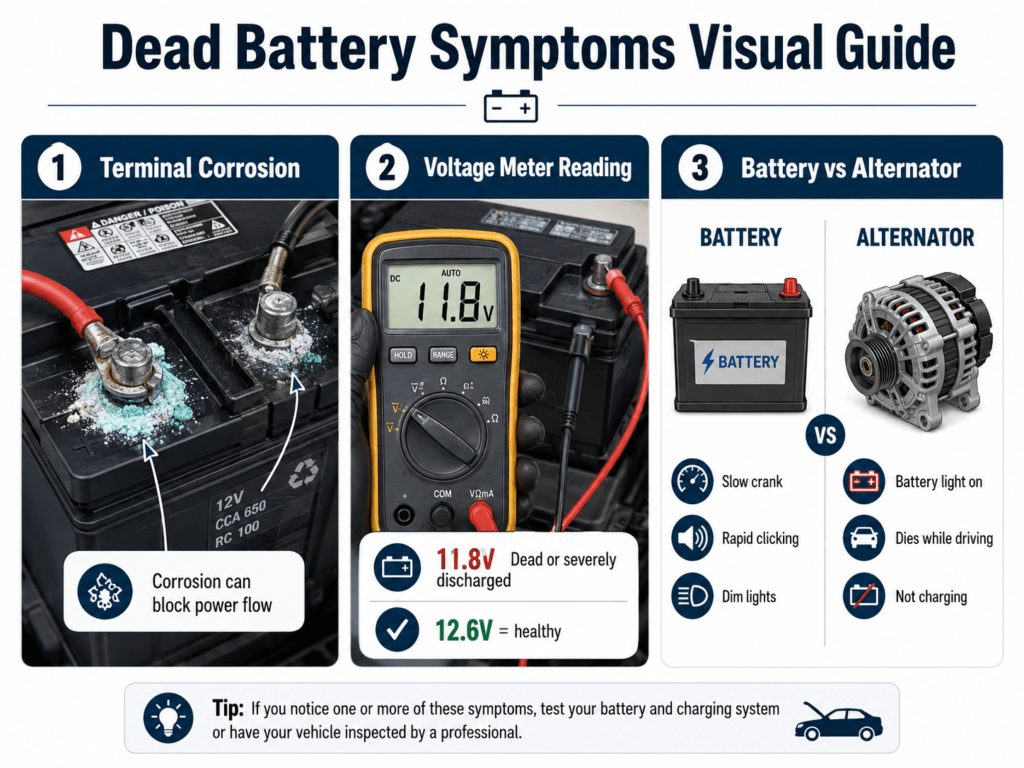
White or bluish-green powdery buildup on the battery terminals is a physical symptom of battery corrosion that accelerates discharge. Corroded terminals increase resistance in the circuit which reduces the effective current the battery can deliver — even if the battery itself still holds a reasonable charge.
How to Test a Dead Battery With a Multimeter at Home
This is the section most automotive websites skip entirely. Learning how to test if a car battery is dead at home takes less than two minutes and requires only a basic multimeter — available at any hardware store for a few dollars.
Step 1 — Set the Multimeter
Set the multimeter to DC voltage mode. Select the 20V range if the multimeter does not auto-range. Connect the red probe to the positive battery terminal and the black probe to the negative terminal.
Step 2 — Read the Resting Voltage
With the engine off and all accessories turned off for at least 15 minutes read the voltage on the display. Use this reference:
| Voltage Reading | Battery Condition |
|---|---|
| 12.6V or higher | Fully charged — battery healthy |
| 12.4V – 12.5V | 75% charged — acceptable |
| 12.2V – 12.3V | 50% charged — needs recharge |
| 12.0V – 12.1V | 25% charged — weak battery |
| Below 11.8V | Dead or severely discharged |
Step 3 — Load Test While Cranking
Have someone crank the engine while watching the multimeter. The voltage will drop during cranking — this is normal. But if it drops below 9.6 volts the battery cannot hold up under load and needs replacement even if the resting voltage seemed acceptable.
Step 4 — Check Charging Voltage
With the engine running read the voltage again. A healthy charging system should show between 13.8V and 14.7V. A reading below 13.5V means the alternator is not charging the battery properly. A reading above 15V indicates alternator overcharging.
This battery test multimeter method is the most accurate way to diagnose a dead battery at home — and it takes less time than waiting for roadside assistance.
Battery vs Alternator vs Starter: How to Tell the Difference
This is where most drivers get confused — and where most automotive articles fail to provide a clear answer. The symptoms of a dead battery a failing alternator and a bad starter often overlap. Here is a simple decision tree to separate them.
Step 1 — Do the Headlights Work?
Turn on the headlights with the engine off. If they are completely dead or extremely dim the battery is the most likely culprit. If headlights are bright the battery has enough charge and the problem is elsewhere.
Step 2 — Jump Start the Car
Attempt a jump start. If the car starts immediately and runs fine the battery was the problem — either dead battery from discharge or a battery that can no longer hold charge.
If the car starts but the battery warning light comes on while driving the alternator is failing. The battery was discharged because the alternator stopped charging it.
If the car will not start even with a jump start and the battery tests at good voltage the starter motor or starter relay is the likely fault — not the battery.
Quick Reference Table
| Symptom | Dead Battery | Bad Alternator | Bad Starter |
|---|---|---|---|
| No crank no start | Yes | Sometimes | Yes |
| Clicking sound | Yes (rapid) | No | Yes (single) |
| Dim headlights | Yes | Yes | No |
| Starts with jump | Yes | Yes (briefly) | No |
| Battery warning light | Sometimes | Yes | No |
| Voltage below 12V | Yes | Yes | No |
The dead battery vs dead alternator distinction is critical. Replacing a battery when the alternator is the actual problem means the new battery will go dead within days.
What Causes a Car Battery to Die?
Understanding what causes a car battery to die overnight or prematurely helps prevent repeat failures.
Age and Natural Degradation
Most car batteries last between 3 and 5 years under normal conditions. After this point battery cells begin to fail internally and battery capacity drops significantly. A battery that is 4 years old showing any symptoms should be tested proactively.
Parasitic Drain
A parasitic drain is when something in the vehicle continues drawing current after the ignition is off. Common culprits include a stuck relay a faulty module an aftermarket alarm system or interior lights that stay on. This is the most common reason a battery drains while the car is off — and why a battery dies after sitting overnight.
Short Trips and Infrequent Use
Every time a car starts it draws significant current from the battery. The alternator recharges the battery while driving but short trips do not give the alternator enough time to fully restore the charge. Vehicles driven only on short daily trips experience faster battery discharge over time.
Extreme Temperatures
Cold weather is particularly harsh on batteries. Low temperatures thicken engine oil which increases the cranking load and simultaneously reduce the chemical reaction speed inside the battery. A car battery dead in cold weather is extremely common — especially in batteries that are already aging.
Corroded or Loose Terminals
Heavy battery corrosion on the terminals creates resistance in the circuit. The battery may test at normal voltage but still fail to deliver adequate current due to the poor connection at the terminals.
Faulty Charging System
If the alternator is not charging properly the battery slowly depletes with every drive. The driver may notice the battery keeps dying repeatedly — replacing batteries every few months — when the real problem is the alternator never recharging them.
EV and Hybrid Battery Dead Symptoms
Electric vehicles and hybrids have two separate battery systems — the high-voltage traction battery that powers the motor and a smaller 12V auxiliary battery that runs electronics. Most EV owners do not realize the 12V auxiliary battery can go dead just like a conventional car battery.
Signs of a Dead 12V Auxiliary Battery in EVs
- The vehicle will not power on even with full traction battery charge
- The touchscreen or infotainment system is unresponsive
- Charging port will not open or respond
- Key fob is unrecognized by the vehicle
- No response from door handles on models with electronic latches
Tesla Battery Dead Symptoms
Tesla vehicles rely heavily on the 12V auxiliary battery. When it dies the car may appear completely bricked — no screen no door handles and no response to the app. This is a known issue particularly on older Model S and Model X vehicles. Tesla owners who notice repeated 12V warnings in the app should replace the auxiliary battery proactively.
Hybrid Battery Symptoms
In hybrid vehicles a dead 12V battery prevents the hybrid system from initializing. The Ready light will not come on even if the traction battery is fully charged. This catches many hybrid owners off guard because they assume EV range means no battery problems.
The 12V auxiliary battery in most hybrids and EVs lasts 3 to 5 years — the same as a conventional battery. It requires the same battery test multimeter checks and the same replacement schedule.
How to Jump Start a Dead Battery
A jump start dead battery is a quick solution to get back on the road temporarily. Here is the correct process:
- Park the working vehicle close enough for jump cables to reach both batteries
- Connect the red cable to the positive terminal of the dead battery
- Connect the other red cable end to the positive terminal of the working battery
- Connect the black cable to the negative terminal of the working battery
- Connect the final black cable end to an unpainted metal surface on the dead vehicle — not the negative terminal of the dead battery
- Start the working vehicle and let it run for 2 to 3 minutes
- Attempt to start the dead vehicle
- Once started disconnect cables in reverse order
- Drive for at least 20 to 30 minutes to allow the alternator to recharge the battery
If the vehicle starts after a jump but the battery draining fast problem returns within a day or two the battery is no longer holding charge and needs replacement.
Battery Replacement Cost (2026)
One of the most searched questions is how long does it take to charge a dead battery and what will a replacement actually cost.
Charging a fully dead battery with a standard charger takes 8 to 12 hours on a slow charge or 2 to 3 hours on a fast charger. However a battery that has been deeply discharged multiple times may never fully recover its original battery capacity.
| Battery Type | Typical Price Range |
|---|---|
| Standard 35Ah – 45Ah (small cars) | $80 – $130 |
| Standard 50Ah – 60Ah (sedans) | $120 – $180 |
| AGM Battery (newer models) | $180 – $300 |
| EV / Hybrid 12V Auxiliary | $150 – $250 |
The battery replacement job itself takes under 15 minutes at any workshop. Labour charges are minimal — most shops include installation free of charge with a battery purchase.
FAQs About Battery Dead Symptoms
What are the symptoms of a dead battery?
The most common symptoms of a dead battery include engine failing to crank a rapid clicking sound when turning the key dim headlights slow power windows and no response from the ignition. A battery warning light on the dashboard is also a strong indicator.
How do I know if my battery is dead?
The fastest way to know is a battery test multimeter check. A resting voltage below 11.8V confirms a dead or severely discharged battery. If the voltage drops below 9.6V during cranking the battery needs replacement even if resting voltage seemed acceptable.
Why does my battery keep dying?
A battery keeps going dead for several reasons — a parasitic drain from a faulty component short daily trips that do not allow full recharging a failing alternator that is not charging properly or a battery that has reached the end of its service life. Testing the charging system voltage while the engine is running identifies alternator faults quickly.
Can a dead battery damage the alternator?
Yes. When a severely dead battery is jump started the alternator works at maximum output to recharge it. Repeated deep discharge and recharge cycles put excessive strain on the alternator and can shorten its lifespan significantly.
How long does a car battery last?
Most car batteries last 3 to 5 years under normal conditions. Battery life is shortened by extreme heat or cold frequent short trips heavy electronics usage and deep discharge cycles.
Can I drive with a weak battery?
Technically yes — if the engine is already running the alternator maintains the electrical system. But a weak battery that cannot hold adequate charge makes every restart a gamble. It should be tested and replaced as soon as possible before it leaves the driver stranded.
Battery dead but lights still work — what does that mean?
Interior lights and some electronics require very little current to operate — even a severely discharged battery can power them. But the starter motor requires a massive burst of current that a flat battery cannot deliver. So lights working does not mean the battery is healthy enough to start the engine.
Conclusion
A dead battery is one of the most common automotive problems — and one of the most misdiagnosed. The signs your car battery is dying are almost always present before a complete failure. Slow cranking dim lights flickering electronics and a battery that needs repeated jump starting are all warnings the battery is on its way out.
The most important step any driver can take is a simple battery test multimeter check at home. Two minutes and a basic tool are all it takes to confirm whether the battery the alternator or the starter is the actual problem — and avoid spending money on the wrong part.
For batteries older than 3 years showing any of these symptoms proactive replacement before complete battery failure is always the smarter and cheaper choice.