
There are few things that are more frustrating than turning the key in the morning and getting absolutely nothing in return. No crank, no click, just silence — or worse, a rapid clicking sound that leaves the driver completely stranded. In most of these cases, the culprit is not the battery and not even the starter motor. It is a tiny, often overlooked component called the starter relay.
Understanding starter relay symptoms can save a lot of time, money, and unnecessary stress. This guide covers everything — from what the starter relay does, to the most common signs of a faulty starter relay, how to test it, and what to do next. Whether someone drives a Toyota, Honda, Ford, Suzuki, or even a motorcycle, this breakdown has them covered.
Contents
- What Is a Starter Relay?
- What Causes a Starter Relay to Fail?
- How to Tell If Starter Relay Is Bad: All the Symptoms
- Starter Relay Symptoms by Vehicle Type
- 4-Pin vs 5-Pin Starter Relay Symptoms
- Starter Relay vs Starter Solenoid: What Is the Difference?
- How to Test a Starter Relay
- How to Fix a Bad Starter Relay
- FAQs About Starter Relay Symptoms and Failures
- Are a Starter Relay and a Starter Solenoid the Same Thing?
- Can You Jump Start a Car Showing Starter Relay Failure Symptoms?
- How Do You Bypass a Starter Relay?
- How Long Does a Starter Relay Last?
- What Is the Starter Relay Replacement Cost?
- Can a Starter Relay Drain a Battery?
- Can I Drive With a Bad Starter Relay?
- Conclusion
What Is a Starter Relay?
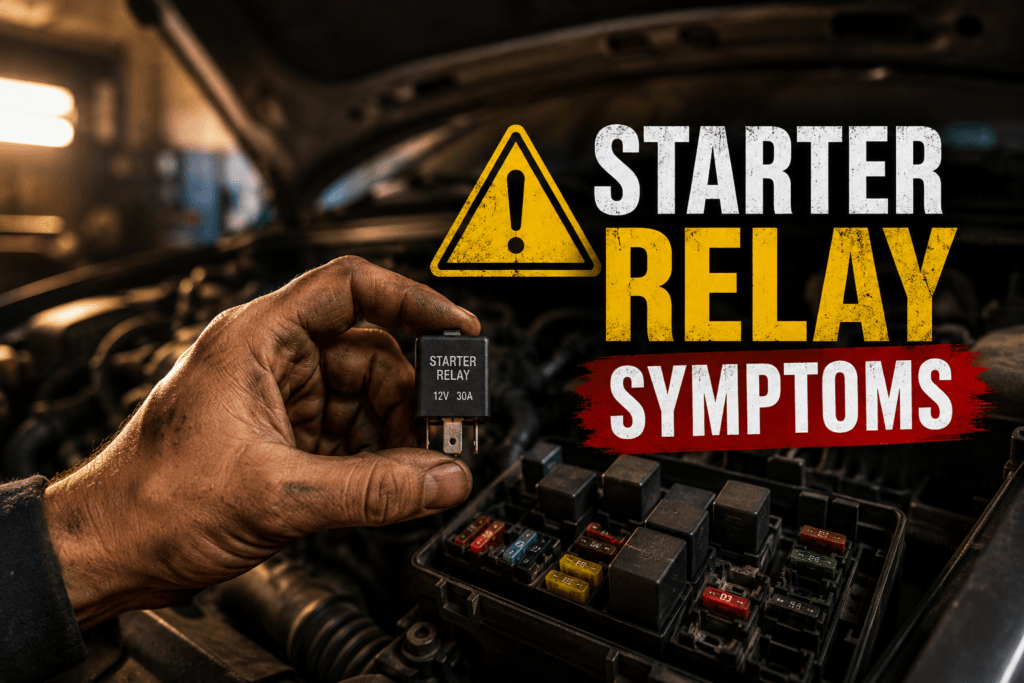
Before diving into bad starter relay symptoms, it helps to understand what this component actually does. A starter relay is a small but critical part of the vehicle’s ignition system. In simple terms, it acts as an electrically operated switch — a bridge between the battery and the starter motor.
Problems in this circuit often overlap with bad ignition coil symptoms, since both components sit within the same ignition system and can produce similar no-start conditions. The relay then uses its internal relay coil to generate a magnetic field, which closes the relay contact points and allows high current to flow from the battery directly to the starter motor. This is what makes engine cranking possible.
Without a functioning electrical relay in this circuit, the ignition switch would have to handle the full load of current required by the starter motor — which would quickly destroy it. The relay protects the ignition system while making sure the starting system operates efficiently every time.
So what does starter relay do in a car? Simply put — it makes starting the engine possible, reliably and safely, every single day.
What Causes a Starter Relay to Fail?
Knowing what causes starter relay to fail helps prevent the problem before it leaves someone stranded. Starter relay failure does not happen overnight — it usually builds up over time due to a combination of factors.
Relay Corrosion
Relay corrosion is one of the most common causes of relay failure. Moisture and road grime find their way into the relay housing and attack the metal terminals. Corroded starter relay terminals restrict current flow, which means the starter motor never gets the power it needs. Starter relay corrosion symptoms usually show up as slow starting or intermittent no-start conditions.
Electrical Overload
A starter relay overload happens when the relay is forced to carry more current than it was designed for. This typically occurs when there is a short circuit somewhere in the starter relay wiring or the starter motor itself is drawing excessive amperage. Over time, overload leads to melted insulation and relay internal failure.
Mechanical Wear and Tear
Starter relay wear and tear signs develop gradually with repeated use. The internal plunger and spring — the mechanical parts that physically move the contacts — degrade with time. Starter relay mechanical failure and specifically starter relay plunger spring failure can cause the relay to stay either permanently open or permanently closed.
Loose or Damaged Wiring
A loose starter relay connection is another underrated cause. Vibrations from the engine and road gradually loosen the terminals, creating resistance and inconsistent current delivery. Regular inspection of the starter relay wiring can catch this early.
Fusible Link Issues
The starter relay fusible link — a thin wire designed to burn out before the relay or wiring is damaged — can fail on its own due to age or an overcurrent event. When this happens, the relay receives no power at all.
How to Tell If Starter Relay Is Bad: All the Symptoms
Now comes the most important part. Here are all the starter relay problems and symptoms that drivers should watch for. These are the symptoms of a bad starter relay that mechanics and vehicle owners most commonly report in 2026.
1. The Vehicle Is Dead — Car Won’t Start
The most obvious of all bad starter relay symptoms car owners experience is a complete failure to start. The driver turns the key, the interior lights work fine, the battery seems healthy — but nothing happens. No cranking sound, no response from the starter motor whatsoever.
This is the classic starter relay no click no start scenario. When the relay’s internal circuit has completely broken down, no electrical signal passes through to the starter solenoid. The result is a dead vehicle — and one of the most frustrating ones at that. Drivers dealing with this situation will find a full breakdown of possible causes in this guide on car not starting.
Can a bad starter relay cause no start?
Absolutely — and it is one of the first things a mechanic should check during a no crank no start diagnosis. The key distinction here is that the battery voltage appears normal. If the headlights are bright and the electronics are responsive but the engine will not turn over, engine not cranking starter relay failure is a strong candidate.
It is also worth checking the starter relay fuse. A blown fuse in this circuit produces identical symptoms. The starter relay fuse location is typically inside the engine bay fuse box or the cabin fuse panel — refer to the owner’s manual for the specific vehicle.
2. Starter Making Clicking Sounds
One of the most telling starter relay going bad signs is an audible clicking noise when the key is turned. Many drivers ask — what does a bad starter relay sound like? The answer is: a single sharp click, or a rapid series of clicks, coming from the engine bay.
The starter relay clicking sound occurs because the relay is receiving the trigger signal from the ignition switch, but it cannot deliver consistent current to the starter motor. The relay engages and disengages rapidly, producing that distinctive chattering noise.
A single click when starting car usually points to the relay itself making contact once before failing. A rapid, repetitive clicking — often called starter relay clicking rapidly — is more commonly associated with a weak battery, but a failing relay can produce the same effect.
Why does my car click but not start?
In most cases, it comes down to either a discharged battery or a relay that cannot sustain current flow. Car clicks once and won’t start scenarios should prompt an immediate check of both. And when someone hears a car makes clicking noise when starting, the relay and battery should both be tested before assuming the worst.
3. Occasional Failures in Starting the Vehicle
Not all relay failures are complete — and that is what makes this symptom so frustrating to diagnose. An intermittent starting problem relay means the car starts perfectly one day and refuses to start the next. There is no consistent pattern.
This is one of the most reported symptoms of failing starter relay in daily drivers. The relay’s internal relay contact points may be partially worn, corroded, or loose — allowing current to pass sometimes but not always. Heat, humidity, and vibration all influence whether the relay works on any given morning.
Can a starter relay cause intermittent starting? Yes — and this intermittent behavior is a classic warning sign that the relay is on its way out. If someone notices their vehicle acting up randomly during startup, that is one of the clearest starter relay going bad signs worth taking seriously.
A relay that starter relay keeps going bad even after replacement may point to an underlying wiring problem, a fusible link issue, or excessive current draw from a damaged starter motor.
4. Starter Does Not Get Switched Off
This is one of the more serious starter relay stuck on symptoms and needs immediate attention. In a normal starting sequence, releasing the key or the start button cuts the signal to the relay, which opens the circuit and stops the starter motor. But when the relay stuck closed condition occurs, the starter motor keeps running even after the engine has fired up.
The starter relay welded contacts symptoms are caused by exactly that — the internal contact points have physically welded together due to excessive heat or arcing. When this happens and the starter stays on after engine starts, serious damage can occur to the starter motor, the transmission flywheel, and the relay circuit itself within minutes.
This is not a problem to ignore. A starter motor that runs continuously while the engine is already running will burn out quickly and can cause significant mechanical damage.
5. Starter Relay Overheating
Starter relay overheating symptoms often appear alongside other signs. A relay that feels unusually hot to the touch after a starting attempt, or one that emits a faint burning smell, is experiencing thermal stress. Why is my starter relay getting hot? The most common reasons are a starter relay overload, extended cranking periods, or a high-resistance fault somewhere in the starting circuit.
A hot relay is also a relay that is working much harder than it should. Left unaddressed, overheating accelerates internal insulation breakdown and leads to total relay internal failure.
6. Starter Relay Fuse Keeps Blowing
If the starter relay fuse keeps blowing every time it is replaced, there is a deeper problem in the circuit. A fuse that blows repeatedly indicates a short circuit in the starter relay wiring, a grounded wire, or a starter motor that is drawing far too much current. The fuse is doing its job by protecting the circuit — but the root cause must be found before simply replacing the fuse again.
This is one of the starter relay not working symptoms that often leads drivers down a long troubleshooting path. Always inspect the wiring and connectors thoroughly when this pattern appears.
Starter Relay Symptoms by Vehicle Type
Toyota Starter Relay Symptoms
Toyota starter relay symptoms typically follow the same pattern — intermittent no-start, clicking, and in older models like the Corolla and Hilux, corrosion-related failures are particularly common due to engine bay heat exposure.
Honda Starter Relay Problems
Honda starter relay problems are frequently reported in older Civic and CR-V models. The relay on many Honda vehicles is located inside the under-hood fuse box. Clicking on startup and complete no-start are the most common complaints.
Ford Starter Relay Bad Symptoms
Ford starter relay bad symptoms are especially common in older F-150 and Ranger models. Ford uses a dedicated starter relay in the power distribution box. Symptoms include a dead crank, starter staying engaged, and in some cases, starter circuit voltage drop during cranking.
Suzuki Starter Relay Symptoms
Suzuki starter relay symptoms most commonly appear in Mehran, Alto, and Swift models popular in Pakistan. Clicking sounds, failure to crank in hot weather, and blown fuses are the most typical complaints seen in local workshops.
Motorcycle Starter Relay Symptoms
Motorcycle starter relay symptoms are slightly different from car-based systems. On a bike, pressing the start button and hearing a single click with no motor engagement is the primary sign. Relay corrosion is especially common on motorcycles exposed to rain and humidity. Checking the relay with a multimeter is the quickest diagnostic step.
Diesel Engine Starter Relay Symptoms
In diesel engine starter relay symptoms, the demands on the relay are higher because diesel engines require more cranking power to fire. Slow or laboured cranking, heat-related failures, and welded contacts are more frequent in diesel vehicles, especially those used for heavy loads.
4-Pin vs 5-Pin Starter Relay Symptoms
Most passenger vehicles use either a 4-pin or 5-pin relay in their starting circuit. Understanding the difference matters for proper testing.
4-pin starter relay symptoms are similar to all relay failures — no start, clicking, or stuck-on conditions. The 4-pin design has two control pins and two power pins. When the coil fails internally, there is no click at all. When the contacts fail, clicking occurs but no cranking follows.
5-pin starter relay failure adds a normally-closed contact to the circuit. This type is used in more complex starting circuits where the relay also controls other functions. A failed 5-pin relay can disrupt multiple systems simultaneously, making diagnosis slightly more complex. Always refer to the starter relay electrical diagram specific to the vehicle when working with a 5-pin unit.
Starter Relay vs Starter Solenoid: What Is the Difference?
This is one of the most searched questions in automotive circles — what is the difference between starter relay and solenoid? Many people use the terms interchangeably, but they are two distinct components.
The starter relay vs starter solenoid comparison comes down to their roles. The relay is a switching device — it controls whether current flows to the starter circuit. The solenoid, on the other hand, is mounted directly on the starter motor and performs two tasks: it engages the starter pinion gear with the flywheel, and it closes the high-current circuit to spin the motor.
Is starter relay same as starter solenoid? No. On most modern vehicles, both exist in the circuit and work together. The relay triggers the solenoid, and the solenoid activates the motor.
Similarly, starter relay vs ignition relay — the ignition relay controls power to the ignition system itself, not the starter circuit. They are separate relays, though both live inside the fuse box.
When it comes to bad starter relay vs bad starter motor, the key difference is: a bad relay will not send current to the starter at all, while a bad starter motor receives current but fails to crank the engine. Testing the relay first is always the smarter starting point — it is cheaper and faster to diagnose.
How to Test a Starter Relay
Learning how to diagnose a bad starter relay at home is straightforward with the right approach. Here are the most reliable methods for starter relay troubleshooting.
Method 1: Checking Voltage (Multimeter Test)
The starter relay test multimeter method is the most accurate. Set the multimeter to DC voltage mode. With the ignition key turned to the start position, check for voltage on the input and output terminals of the relay. There should be battery voltage (around 12V) on the control side.
If voltage is present at the input but not at the output, the relay’s internal contacts have failed. This confirms relay internal failure. Checking for starter circuit voltage drop across the relay terminals during cranking can also reveal high resistance caused by corroded or loose contacts.
How to check starter relay with battery: Remove the relay from the fuse box and apply 12V directly to the control terminals (pins 85 and 86 on a standard 4-pin relay). A working relay will click audibly, indicating the coil is functioning. Then check continuity between the power terminals with a multimeter — resistance should be near zero when energised.
Method 2: Releasing the Relay (Listen Test)
This is the simplest test. With the ignition turned to the start position, listen carefully to the relay. A healthy relay produces a single, clean click as it engages. A relay that produces no click at all suggests the coil has failed. A relay that clicks but the engine does not crank points to failed contact points.
Method 3: Relay Swap
Many fuse boxes contain multiple relays of the same type. Swapping the starter relay with an identical relay from another circuit (such as the horn or cooling fan relay) is a quick way to test. If the car starts after the swap, the original relay was faulty. This is the fastest form of starter relay diagnosis available without tools.
Method 4: Starter Relay Jump Test
The starter relay jump test involves using a jumper wire to bridge the two large power terminals of the relay socket directly. If the starter motor cranks immediately, the relay is confirmed faulty. This also works as a temporary starter relay bypass to get a vehicle running in an emergency. However, this should only be done briefly and by someone familiar with automotive electrical systems.
Method 5: OBD and Professional Diagnosis
Modern vehicles in 2026 increasingly support starter relay OBD diagnosis through scan tools. Some advanced systems log starting circuit faults as trouble codes. Drivers dealing with multiple warning signs at once should also check for camshaft position sensor symptoms, as a failing CMP sensor can mimic a relay fault during startup. A scan tool connected to the OBD-II port may reveal voltage irregularities in the starting circuit. For complex cases, an ASE starter system diagnosis at a certified workshop provides the most thorough evaluation.
How to Fix a Bad Starter Relay
How do you fix a bad starter relay? In most cases, the answer is simply replacement. Starter relays are not serviceable components — once the internal coil burns out or the contacts weld together, the relay must be swapped out.
Here is a basic starter relay repair and replacement process:
- Locate the relay — starter relay location is almost always inside the engine bay fuse box or the main relay panel. Check the fuse box cover diagram or the owner’s manual for the exact position.
- Turn off the ignition and disconnect the battery negative terminal for safety.
- Pull the old relay straight out from its socket.
- Check the socket pins for corrosion — clean with electrical contact cleaner if needed.
- Insert the new relay firmly into the same position.
- Reconnect the battery and test the starting system.
Starter relay replacement cost is typically very affordable. The part itself ranges from a few hundred to around one or two thousand rupees depending on the vehicle make. Labour charges at a workshop add a small amount, making total starter relay price and replacement accessible for most budgets. In Pakistan, most spare parts shops stock standard relay sizes for Suzuki, Toyota, Honda, and other common vehicles.
FAQs About Starter Relay Symptoms and Failures
Are a Starter Relay and a Starter Solenoid the Same Thing?
No. The starter relay is a switching relay inside the fuse box that controls current to the starting circuit. The solenoid is physically attached to the starter motor and directly engages it. They work together but are separate components. Many people confuse them, but understanding the difference helps with accurate starter relay diagnosis.
Can You Jump Start a Car Showing Starter Relay Failure Symptoms?
Jump starting may work if the problem is a weak battery rather than a relay. But if the relay itself has failed — especially in a relay stuck closed or complete open-circuit condition — jump starting will not help. The electrical fault is in the relay, not the battery charge level.
How Do You Bypass a Starter Relay?
How do you bypass a starter relay? A temporary starter relay bypass can be done using a jumper wire to bridge the relay’s two large power terminals in the fuse box socket. This sends battery power directly to the starter solenoid. It is a short-term emergency measure only and should not be used as a permanent fix due to safety risks.
How Long Does a Starter Relay Last?
How long does a starter relay last? A quality relay in a well-maintained vehicle can last the lifetime of the car — often 10 years or more. However, exposure to moisture, heat, and electrical faults can shorten this significantly. Vehicles in humid climates or dusty conditions tend to see relay failures sooner due to accelerated corrosion.
What Is the Starter Relay Replacement Cost?
What is the cost to replace a starter relay? The relay itself is one of the most affordable parts in the ignition system. In Pakistan, standard relays cost between PKR 300 and PKR 1,500 for most common vehicles. Workshop labour for relay replacement is minimal since the job takes under 10 minutes in most cases.
Can a Starter Relay Drain a Battery?
Can a starter relay drain battery? Yes — when the relay is stuck in the closed position (relay stuck closed), it keeps the starter motor engaged even when the ignition is off. This drains the battery rapidly and can destroy both the battery and the starter motor within hours if not caught.An overworked electrical system in this condition can also trigger alternator overcharging, as the charging system tries to compensate for the excessive current draw.
Can I Drive With a Bad Starter Relay?
Can I drive with a bad starter relay? If the car has already started and is running, driving is technically possible — but restarting may not be. A failing relay that produces intermittent starting problem relay symptoms may leave the driver stranded without warning. Replacement as soon as possible is always the recommended course of action.
Once the starting issue is resolved, drivers sometimes notice the engine running unevenly.
In that case, it is worth checking for
bad spark plug symptoms
or
engine misfire symptoms,
as a prolonged no-start condition can foul spark plugs over time.
Conclusion
A starter relay is a small part that carries enormous responsibility in a vehicle’s starting system. When it fails, it does not always announce itself dramatically — sometimes it causes a full no-start, sometimes just an annoying intermittent problem that keeps getting worse.
Recognising the symptoms of a bad starter relay early — whether it is a clicking sound, a completely dead engine, an overheating relay, or a starter that will not shut off — makes diagnosis faster and repairs more affordable. The good news is that starter relay replacement is one of the simplest and cheapest fixes in automotive maintenance.
Anyone experiencing starter relay symptoms and fixes should start with the simple tests — check the fuse, swap the relay, and use a multimeter before assuming the problem lies with the battery or starter motor. In most cases, a fresh relay solves the issue entirely and gets the vehicle back on the road without any major expense.
If the problem persists even after replacement, the underlying starter relay wiring, the fusible link, or the starter motor itself should be inspected by a qualified technician to prevent repeated failures.