
Contents
- How to Improve Car Mileage Without Wasting Money on Gimmicks
- Measure Your Real Fuel Economy First
- The Habits That Actually Move the Needle
- 1. Accelerate smoothly — don’t crawl
- 2. Look further ahead, protect your momentum
- 3. Watch your highway speed
- 4. Check tire pressure cold
- 5. Don’t brush off alignment issues
- 6. Clear out what you’re not using
- 7. Take the roof box off when you’re done with it
- 8. Use the oil your car actually calls for
- 9. Don’t ignore the check engine light
- 10. Make sure the engine actually reaches operating temperature
- 11. Follow the service schedule — don’t guess-replace parts
- 12. Cut the idling
- 13. Combine your short trips
- 14. Use AC and windows based on your speed, not habit
- 15. Weather isn’t a car problem
- When Mileage Drops Suddenly, Check This First
- Myths That Waste Money Instead of Fuel
- Quick Answers
- The Real Takeaway
How to Improve Car Mileage Without Wasting Money on Gimmicks
Your route hasn’t changed. Traffic feels about the same. You’re not hauling anything unusually heavy. And yet the fuel gauge seems to drop faster than it did a few months ago.
That’s the frustrating part — poor mileage rarely shows up with a warning light. Sometimes it’s just soft tires. Other times it’s three or four small things stacking up at once: short trips, hard acceleration, a roof rack you forgot was still on, the wrong engine oil, a brake that isn’t fully releasing.
There’s no single trick that fixes this. There’s also no need for magnets, mystery additives, or any device promising impossible gains. What actually works is simpler: measure what your car is doing right now, fix the obvious losses, then check if it made a difference.
Measure Your Real Fuel Economy First
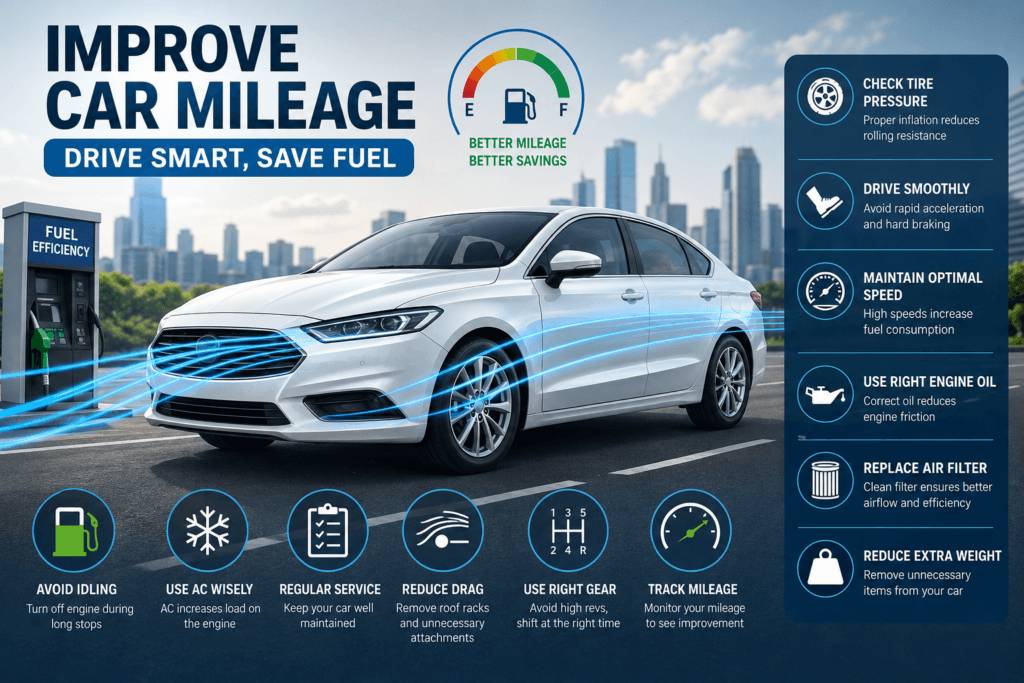
Dashboard mileage readouts are convenient, but they’re not precise enough to catch a small improvement. You need a proper baseline.
Fill the tank, reset the trip meter, and drive normally. At your next fill-up, note the distance and how much fuel went in.
- Km/L: distance driven ÷ litres used
- MPG: miles driven ÷ gallons used
Or just plug your numbers into the Engineer Wala mileage calculator and get your efficiency, consumption, and trip cost instantly.
One tank doesn’t tell you much — a bad traffic jam, a heatwave, or a string of cold starts can throw the number off. Track two or three normal tanks before deciding anything’s actually changed.
Why your mileage never matches the brochure number
That printed figure comes from a lab, under conditions your daily commute doesn’t have — no hills, no traffic lights, no AC, no crosswind, no passengers. Two people driving the same car can get noticeably different mileage from each other.
A big chunk of your fuel’s energy never makes it to the road anyway. It’s lost as heat through the exhaust and cooling system, eaten up by internal engine friction, spent running the alternator and AC compressor, and lost again through the tires and transmission. You can’t eliminate all of that. You can stop wasting the part that’s avoidable.
The Habits That Actually Move the Needle
1. Accelerate smoothly — don’t crawl
Flooring the accelerator forces the engine to make a lot of power fast, which usually means burning more fuel than the situation needs. The fix isn’t creeping away from every light like you’re avoiding a pothole — it’s steady, controlled throttle input that gets you up to speed cleanly. Do this consistently and you’ll often arrive at the same time as the aggressive driver next to you, using noticeably less fuel to get there.
2. Look further ahead, protect your momentum
If the light 200 metres ahead just turned red, stomping the gas won’t get you through it any faster. Lift off early and let the car slow down naturally instead of racing up to it and braking hard. Keep enough following distance that small speed changes ahead of you don’t force a brake stab every few seconds — tailgating is what locks you into that accelerate-brake-accelerate cycle in the first place.
3. Watch your highway speed
At lower speeds, you’re mostly fighting tire and drivetrain resistance. Push past a certain point, and air resistance takes over — and it doesn’t scale gently, it climbs fast with speed. That’s why a car that sips fuel at a moderate cruise can drink it at sustained high speed. There’s no single “perfect” number for every car, but a steady, sensible pace beats chasing one. Body shape plays into this too — a tall SUV pushes through air very differently than a low sedan, which is worth keeping in mind if you’re comparing car body types before your next purchase.
4. Check tire pressure cold
Under-inflated tires flex more as they roll, and that flexing turns into heat and rolling resistance your engine has to overcome. Check monthly, before long trips, and whenever the weather shifts — ideally after the car’s been sitting for a few hours. Use the number on your driver’s door placard, never the maximum figure molded into the tire itself. Front and rear pressures often differ, especially loaded, so go by what the manufacturer specifies for your exact car — a TPMS warning is a backup, not a substitute for checking manually.
5. Don’t brush off alignment issues
A wheel that’s slightly off doesn’t roll freely — it scrubs against the road, and your engine pays for that resistance every single kilometre, even if you can’t feel it. Watch for a steering wheel that sits crooked on a straight road, the car pulling to one side, tires wearing unevenly, or constant small steering corrections. Get it checked when these show up, after suspension work, or after hitting something hard — not on some arbitrary schedule.
6. Clear out what you’re not using
Every extra kilogram costs a little more energy each time you accelerate, and city driving means accelerating constantly. Check the trunk and back seat for the stuff that quietly accumulates — old boxes, tools, sports gear you haven’t touched in months. Keep the spare, jack, and safety kit. Everything else is dead weight you’re paying to move around.
7. Take the roof box off when you’re done with it
Weight inside the car matters when accelerating; anything on the roof adds a second problem — drag. A roof box or bike rack disrupts airflow over the whole car, and that cost grows the faster and longer you drive. Take it off once the trip’s over instead of leaving it bolted on for the next three months. While you’re at it, check the underbody panels are secure — a loose one disturbs airflow and can turn into a safety issue.
8. Use the oil your car actually calls for
Engine oil protects moving parts, manages heat, and keeps everything running smoothly. Go thicker than specified and you add pumping resistance the engine has to fight constantly. Go too thin, or off-spec, and you risk not protecting it properly. Skip the internet advice based purely on climate — start with the viscosity and spec in your owner’s manual, and the same logic to your transmission and differential fluid. If you want the bigger picture of how these systems connect, Engineer Wala’s breakdown of car parts is worth a look.
9. Don’t ignore the check engine light
A modern car can drive completely normally with a fault the computer has already flagged. A loose gas cap can trigger it. So can an air-measurement sensor, an emissions component, or a fuel-delivery issue. “It still feels fine” is exactly how a small, cheap problem turns into worse mileage and a bigger repair bill. Get it scanned and diagnose the actual cause — a trouble code tells you where to look, not what to replace.
10. Make sure the engine actually reaches operating temperature
A cold engine burns more fuel than one running at its intended temperature. A thermostat stuck open lets coolant circulate too early, so the engine takes longer to warm up and runs inefficiently the whole time. A faulty coolant sensor can fake the same symptom. Watch for a temperature gauge that stays low, weak cabin heat in winter, or mileage that’s dropped without any real change in how you drive.
11. Follow the service schedule — don’t guess-replace parts
Spark plugs, filters, and fluids wear out on a schedule, not because your average mpg ticked down last week. Worn plugs cause misfires and hesitation. A clogged filter hurts performance. A leaking injector burns extra fuel. Each needs its own diagnosis — and on a modern, computer-controlled engine, swapping a mildly dirty filter usually won’t hand you a dramatic mileage jump, since the ECU already compensates for reduced airflow to a point.
12. Cut the idling
An idling engine burns fuel to cover zero distance. Waiting at a light is unavoidable — sitting outside a shop for twenty minutes with the AC running isn’t. Switch off if you’re parked and expecting a long wait, using your judgment in extreme heat or cold. Stop-start systems handle this automatically on newer cars; don’t manually kill an older car’s engine in moving traffic just to shave a few seconds’ worth of fuel.
13. Combine your short trips
Several five-minute errands can burn more fuel than one longer trip covering the same distance, because each cold start means warming everything up again — and short trips often end before the engine even gets there. Bundle the grocery run, the bank, and everything else into one loop, planned to avoid backtracking. You save on both the cold starts and the extra kilometres.
14. Use AC and windows based on your speed, not habit
AC costs energy. Open windows cost you through drag. Which one wins depends on how fast you’re going — at low speed, windows barely add drag; at highway speed, they add more than the AC would have cost. On a scorching day, crack a window for a few seconds before blasting the AC to let trapped heat out first, rather than making the system fight it from a dead start.
15. Weather isn’t a car problem
A mileage dip after the seasons change doesn’t always mean something’s broken. Cold weather thickens fluids, drops tire pressure, and stretches out warm-up time — short winter trips are especially rough since much of the drive happens before the engine’s even warm. Hot weather adds AC load, especially on short hops with a heat-soaked cabin. Headwinds, wet roads, and heavy traffic all shift the number too. Compare similar conditions before blaming the car — a winter city tank against a mild-weather highway tank tells you nothing useful.
When Mileage Drops Suddenly, Check This First
| What you’re noticing | Likely cause | What to do |
|---|---|---|
| Worse mileage since cold weather hit | Tire pressure, warm-up time, short trips | Check cold pressures, compare similar trips |
| Car pulls to one side | Alignment, tire damage, dragging brake | Get tires, alignment, and brakes inspected |
| Engine takes forever to warm up | Thermostat or temp sensor | Check live temperature data |
| Rough idle, hesitation, warning light | Ignition, air metering, fuel delivery | Scan the car, diagnose the actual code |
| One wheel runs hot or smells | Dragging brake | Stop driving if severe, get it inspected |
| Mainly worse on the highway | Speed, tire pressure, roof gear | Remove roof equipment, ease off speed |
| Power drops at higher RPM | Fuel, ignition, or exhaust restriction | Professional diagnosis under load |
Safety note: brakes, wheels, and exhaust parts get dangerously hot. Never touch them right after driving, and never get under a car without proper stands and support.
Myths That Waste Money Instead of Fuel
“Premium fuel always improves mileage.” Higher octane resists knock in engines that need it — it isn’t a higher-energy fuel. If your manual doesn’t call for premium, you’re likely getting no benefit from it.
“This device/additive can boost mileage 20%.” Be skeptical of anything promising big universal gains. If a cheap magnet or plug-in module reliably worked, manufacturers would already be installing it at the factory.
“A full tank makes the car noticeably less efficient.” Fuel does weigh something, but making extra trips to the pump just to keep the tank near-empty isn’t going to produce a meaningful saving for normal driving.
“Coasting in neutral saves fuel.” Most modern fuel-injected engines actually cut fuel delivery when you lift off the accelerator in gear. Coasting in neutral can burn more, not less, and costs you engine braking too.
Quick Answers
Fastest way to improve mileage?
Cold tire pressure, less aggressive acceleration, less unnecessary weight, and easing off unnecessary highway speed — free, and effective immediately.
Why did my mileage suddenly get worse?
Start with tires, a dragging brake, alignment, a fault code, or a cold-running engine before assuming a part needs replacing.
Does an oil change improve mileage?
Only meaningfully if the oil was wrong, degraded, or overdue — using the correct spec avoids unnecessary internal resistance, but it’s not a dramatic fix on its own.
Is cruise control good for mileage?
On flat highway, yes, it holds a steady speed well. On hills, a driver sometimes manages the throttle more efficiently than cruise control does.
Does AC really burn more fuel?
Yes. So do open windows at highway speed. Use windows at low speed, AC at high speed.
The Real Takeaway
Most cars don’t need a mechanical miracle — they need fewer avoidable losses. Tires that roll freely. Brakes that release fully. An engine that reaches temperature. A driver who doesn’t accelerate toward a red light. A roof box that comes off once the holiday’s over.
Measure it, fix one thing at a time with the mileage calculator, and compare over a few tanks. It’s slower than buying a gadget — and it’s the version that actually works.