

A car door is an essential part of cars that allows the driver and passenger to enter and exit the vehicle. During a drive, the door works as the primary entry and primary exit to the passenger cabin. Most car doors are hinged at the front edge, while some designs are hooked on rails or tracks in special vehicles. The main function of the door is simple. It controls the door opening, gives access to the cabin, and then closes firmly to keep the passenger inside safe during a ride.
Modern doors also include a lock system so they can be locked into place and remain secure while driving. Some are manually operated, while others use power or powered doors, especially in a minivan, luxury vehicles, or a modified vehicle. Each door usually includes a side window so passengers remain visible while sitting inside the car. Since a door has a number of parts, it is important to be aware of their purpose. This section acts as a small guide to define the various parts used in car doors.
Contents
Parts of Car Door
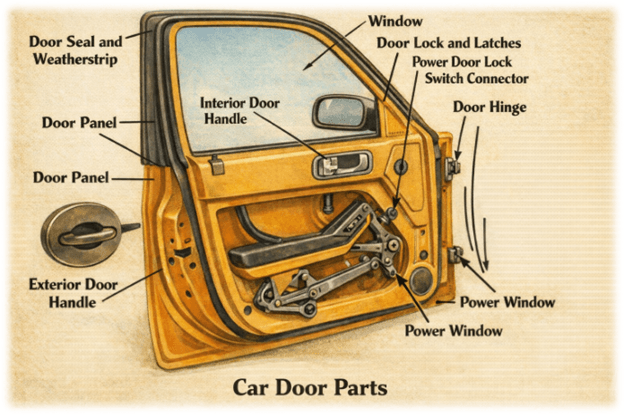
basic parts of a car door with their functions:
- External parts
- Door hinges
- Door handles
- Window
- Molding
- Door seals and weather-stripping
- Pillar
- Internal Parts
- Window regulator
- Window switch
- Door panel
- Door locks and latches
- Power window motor
- Door switch
- Car door speakers
- Door carrier
Car Exterior Door
The car exterior door is the outer panel of the car. Most car doors exterior surfaces have a metal finish, protective paint, and a clean finish. Extra molding and trim are often added to improve appearance.
Door Hinges
Door hinges are the hinges that let doors open and close easily. Like house doors and automobile doors, they work in many applications and act almost like a revolving door joint. They are usually welded or fixed to the door body with a nut-bolt system at the connection point with the car body. This keeps vehicle doors secure. Most are made from solid metal or steel.
Door Handles
Car door handles enable exit and entrance from the car, but they impede unauthorized access. The inner and outer handles are sometimes made of either plastic or metal.
The latch releases when you draw the handle; there is a long metal rod inside the handle that leads to the door. Some knobs include a physical key for entry, some can come with a key fob, passcode, or a handle to choose access using fingerprint scans.
Window
A window or windows in vehicles allow airflow and visibility for passengers. Older cars used manual windows where a mechanical crank or manual handle type helped open and close the glass. Modern cars often use power windows, controlled by a switch with buttons that move an electric motor automatically. The first power-operated windows were introduced by Ford Motors Company in 1941.
Molding
Molding is a type of trim usually made from plastic or rubber. It protects the window glass and also improves the look of the vehicle. This decorative and protective molding runs along the car body, often called car window molding, placed at the top of the car door or the bottom of the window near the vehicle beltline.
Door Seals and Weather-stripping
Door seals and weather-stripping help prevent leaks of air and water from entering the passenger cabin. They create a snug fit between the door and body of the vehicle. Usually made of rubber, they are secured with sealant or special hardware to protect the door compartment during opening and closing. If damaged, they should be replaced to keep rain out of the cabin.
Pillar
A pillar is a vertical structure in the car window area that supports the windshield and roof assembly of the vehicle body. In convertible-style automobiles, the vehicle pillar may differ because of roof load changes. In many cars, especially sedan car windows, additional pillars appear near the front doors and rear doors, such as the B pillar and C pillar near the rear window. Different vehicles use different pillar designs around car doors.
Internal Parts
The internal parts sit inside of the door and control key switches, motors, and other electrical accessories. These controls usually manage the window, power window, locks, and power mirrors.
Window Regulator
A window regulator is the device that moves the window up and down. It may be powered by an electric motor or use a crank in manual windows. When components wear out or break, the power window can get stuck, unable to roll up, or unable to roll down. This often occurs when the part leaves its track inside the door, behind the door panel, out of sight and mind, until repair is needed to make it work and stay in the right position.
Window Switch
A window switch moves the window up and down. In older cars, manually controlled windows used a crank. In power windows, electrical switches send power to an electric motor through a two-way control switch wired to two circuits.
On each door, the switch position decides how the motor will drive, rotate, and move the glass using battery power from the vehicle’s electrical system.
Door Panel
The door panel conceals the inner mechanisms of a car door like the window regulator, power window motor, and wiring. It also acts as an interface for vehicle occupants, covering the hidden machinery.
In older vehicles, cardboard door panels with material matched to the upholstery of the cabin were common. In today’s vehicles, plastic door panels better meet modern specifications for safety, style, and functionality.
Door Locks and Latches
Door locks and latches keep car doors closed and secure. They help with proper closure of the door and stop unintended entry into the car.
Depending on the car type and models, a latching system may use a latch, manual door locks, or power door locks with an electric motor, switch, or key fob.
Many vehicle types also include child safety locks for rear seat occupants to prevent opening the door from inside the vehicle.
Power Window Motor
The power window motor is a small electric motor used in power windows. It works with the regulator or power window regulator to move the glass up and down.
It is usually placed at the rear of the door panel, where it guides the window glass through two channels on either side using a drive mechanism for a precise range of motion.
Door Switch
A door switch, often called a door ajar switch, controls the interior dome light when a door is opened. This device is an electrical contact component that opens and closes a circuit during opening and closing. It is usually secured to the door frame, and depending on the type of car, it may also send input to the onboard computer for other car functions.
A micro switch design is common, and if it gets damaged, the function may fail during normal use.
Car Door Speakers
Car door speakers are speakers in cars usually mounted on the inside of the door. They come in different sizes and output levels. Many vehicles use standard-size speakers in the doors, rear side panels, or the rear area. A common size is 5×7 inch.
Door Carrier
A door carrier or door carriers forms the internal structure that holds key parts like door handles, latches, and window regulators in a single unit. This carrier also acts like a shield to protect the vehicle door from bumps and scratches.
Problems with Car Door & Their Remedies
A vehicle can develop many problems with car door systems over time. These problems, issues, and worn doors parts can affect comfort, use, and safety. The good thing is that many remedies are simple if the fault is found early.
Leakage
Leakage usually comes from water infiltration caused by bad weather stripping or damaged seals. This allows water and wind to infiltrate the passenger compartment of the vehicle. It is best to examine the weather stripping and each seal carefully.
If damaged, replace it with the right replacement part. The cost is often lower when fixed early.
Defective Automatic Lock
A defective automatic lock may happen when the car’s automatic lock, door lock actuator, lock door switch, or wiring issues go bad. If the part has failed, the automatic lock may not operate correctly.
In that case, proper diagnostic work helps find the right fix. Many people take the car to a shop because it is also a safety issue.
Difficulties in Opening or Closing
Difficulties in opening or closing a door may come from excess tension, a worn door latch, a broken door latch, excess rust, poor lubrication, or a damaged door hinge.
The door may not open or close properly, causing difficulty and even injury during opening or closing. Sometimes lubricating a stiff door hinge or latch helps.
In other cases, you need to remove a bad door latch or faulty hinge.
Pingback: How To Open A Locked Car Door When Your Keys Are Stuck Inside? -
Pingback: How Heavy Is A Gallon Of Gas? Full Breakdown -