
Contents
- Camshaft Position Sensor Symptoms: 9 Signs Your Engine Should Not Ignore
- What Are the Symptoms of a Bad Camshaft Position Sensor?
- What a Bad Camshaft Position Sensor Feels Like in Real Driving
- 9 Camshaft Position Sensor Symptoms You Should Never Ignore
- Camshaft Position Sensor Symptoms by Stage of Failure
- Bad Camshaft Position Sensor Symptoms vs Bad Crankshaft Sensor Symptoms
- Bad Camshaft Position Sensor Symptoms vs VVT Solenoid vs Timing Chain Problem
- Common Trouble Codes Linked to Camshaft Position Sensor Symptoms
- What Causes a Camshaft Position Sensor to Fail
- How to Diagnose Camshaft Position Sensor Symptoms Before Replacing It
- Can Camshaft Position Sensor Symptoms Cause a No Start?
- Can You Drive With Camshaft Position Sensor Symptoms?
- How Much Does Camshaft Position Sensor Replacement Cost?
- After Replacing the Sensor, What Should You Check Next?
- Final Verdict on Camshaft Position Sensor Symptoms
- FAQs
- What are the symptoms of a bad camshaft position sensor?
- Will camshaft position sensor symptoms throw a code every time?
- Can camshaft position sensor symptoms cause rough idle but no code?
- Can camshaft position sensor symptoms appear only when hot?
- Is it better to replace cam and crank sensors together when camshaft position sensor symptoms appear?
- Can low oil or dirty oil affect camshaft position sensor readings?
Camshaft Position Sensor Symptoms: 9 Signs Your Engine Should Not Ignore
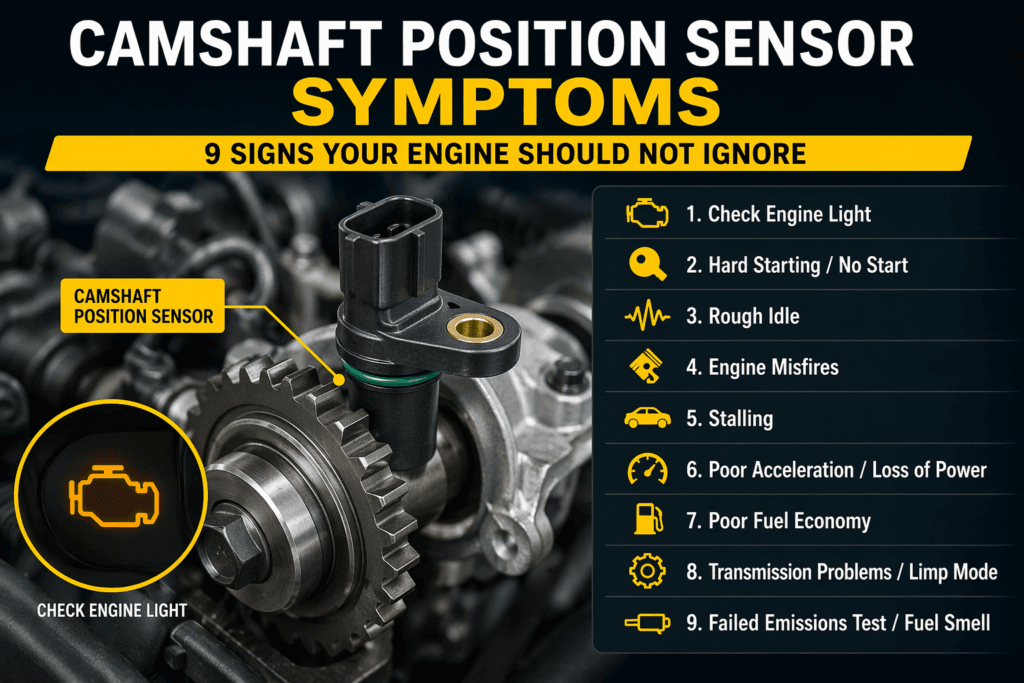
If you are dealing with camshaft position sensor symptoms, the most common signs are a check engine light, hard starting, rough idle, misfires, stalling, weak acceleration, poor fuel economy, and sometimes a crank no start condition. The safest way to confirm the problem is to scan for trouble codes like P0340 to P0344 and check the sensor circuit before replacing parts.
A bad camshaft position sensor can be confusing because the engine does not always fail in the same way. On one car it may start hard and idle rough. On another it may stall at traffic lights, lose power during acceleration, or suddenly feel normal again after cooling down. That is exactly why this fault gets misdiagnosed so often.
A lot of drivers replace spark plugs, ignition coils, or even injectors before checking the camshaft sensor properly. That wastes money and it also delays the real fix. The engine computer depends on the camshaft position sensor to know valve timing and fuel injector timing. When that signal becomes weak, erratic, or disappears, the whole engine management strategy starts getting messy. In some cases the engine can suddenly stall, create a safety risk on the road, and turn a simple diagnosis into a much more expensive repair.
If you are noticing similar issues but your car is cranking longer or not starting at all, you should also check the signs of a bad crankshaft position sensor to avoid misdiagnosing the problem.
What Are the Symptoms of a Bad Camshaft Position Sensor?
The symptoms of a bad camshaft position sensor usually include a check engine light, hard starting, rough idle, misfires, stalling, weak acceleration, poor fuel economy, and sometimes a crank no start condition. These camshaft position sensor symptoms can appear slowly at first or become severe without much warning.
What a Bad Camshaft Position Sensor Feels Like in Real Driving
Most people do not search this keyword because they want a textbook definition. They search it because their car feels wrong and they want to know if the camshaft position sensor could be the reason.
In real life, the problem often feels like this:
- The engine cranks longer than usual before starting
- The idle feels shaky or uneven
- The car hesitates when you press the throttle
- Power drops during acceleration
- The engine stalls at a stop or while slowing down
- Fuel consumption suddenly gets worse
- The check engine light appears and stays on
That pattern matches how top automotive sources describe a failing camshaft position sensor, especially when combined with fault codes and rough engine behavior.
9 Camshaft Position Sensor Symptoms You Should Never Ignore
1. Check Engine Light Comes On
This is usually the first warning sign. The engine control module monitors the camshaft signal constantly. If the signal is missing, out of range, intermittent, or not matching expected timing, it stores a fault code and turns on the check engine light.
Common codes linked to this problem include:
Some vehicles may also log correlation codes like P0016 to P0019 if the cam and crank signals do not line up correctly. That does not always mean the sensor itself is bad. It can also point to timing issues, wiring faults, or related control problems.
2. Hard Starting
A bad camshaft position sensor can make the engine crank longer than normal before it starts. In some vehicles it can even cause a crank no start condition. The computer needs accurate camshaft data to time fuel injection and ignition events correctly. When that signal is unreliable, starting becomes difficult.
This symptom can show up in a few different ways:
- Long cranking before startup
- Starts when cold but struggles when hot
- Intermittent no start
- Starts after waiting a few minutes
That hot restart pattern is one of the most overlooked clues. Some failing sensors act worse when heat builds up in the engine bay.
3. Rough Idle
If the camshaft position sensor sends unstable data, idle quality often suffers. The engine may shake at a stop, stumble slightly, or feel uneven even though it does not stall right away.
A rough idle on its own does not prove the sensor is bad. Many engine faults can cause that. But if rough idle appears together with a check engine light, starting trouble, and camshaft-related fault codes, the sensor moves much higher on the suspect list.
4. Engine Misfires
Misfires are another common symptom. If injector timing or spark timing gets thrown off because of poor camshaft data, combustion can become inconsistent. The engine may feel like it is missing under load, stumbling during acceleration, or running unevenly at idle.
This is where people get misled. They replace plugs or coils because the engine feels like a classic ignition issue. Sometimes that works if those parts were bad too. But if the root problem is a weak camshaft signal, the misfire usually comes back. If your engine is misfiring, you should also check common ignition issues like bad spark plug symptoms and engine misfire causes.
5. Stalling While Idling or Driving
This is one of the more serious camshaft position sensor symptoms. The engine may stall while sitting at a red light, slowing down into traffic, or even driving at low speed. An intermittent signal can cause the computer to lose sync at the wrong moment.
If your vehicle stalls and then restarts after a short wait, do not ignore it. That pattern shows up often with failing sensors and heat-related electronic faults. It is also one of the main reasons driving with this issue can become unsafe.
6. Poor Acceleration and Loss of Power
A bad camshaft position sensor can make the car feel flat and lazy when you press the accelerator. The engine may hesitate before responding or it may pull weakly through the rev range. Some drivers describe it as the car feeling held back.
This loss of power usually happens because the engine computer is no longer timing fuel delivery as accurately as it should. On some vehicles the computer may also switch to a protective strategy that reduces performance.
7. Poor Fuel Economy
When valve event calculations and injector timing are not working as intended, the engine becomes less efficient. That can lead to noticeably worse fuel economy. You may find yourself filling up sooner even though your driving habits have not changed.
This symptom matters because many people miss it. They notice the starting problem or rough idle but do not connect the extra fuel use to the same underlying fault.
8. Transmission Shift Problems or Limp Mode on Some Cars
Not every vehicle reacts this way, but some do. On certain engine and transmission setups, incorrect camshaft data can affect how the control system manages load and shift behavior. That may show up as delayed shifts, harsh shifting, or a limited performance mode.
This point needs careful wording. A rough shift does not automatically mean the camshaft position sensor is bad. But if it appears with the other symptoms listed here, it becomes a useful supporting clue rather than a standalone diagnosis.
9. Failed Emissions Test or Fuel Smell
A bad camshaft signal can lead to incomplete combustion or overly rich running in some cases. That may increase emissions and sometimes produce a fuel smell from the exhaust. If left long enough, it can also put extra stress on the catalytic converter.
This is not always the symptom drivers notice first. But it often shows up later when the problem has already been ignored for too long.
Camshaft Position Sensor Symptoms by Stage of Failure
One reason this issue confuses so many people is that the sensor does not always fail all at once. Sometimes it degrades slowly.
| Stage | What You May Notice |
|---|---|
| Early stage | Check engine light, occasional hesitation, slight rough idle |
| Moderate stage | Hard starting, misfires, weak acceleration, lower fuel economy |
| Severe stage | Stalling, crank no start, repeated restart issues, possible limp mode |
This progression is not identical on every vehicle, but it matches the way sensor-related faults often develop in real driving.
Bad Camshaft Position Sensor Symptoms vs Bad Crankshaft Sensor Symptoms
This is where many articles stay too shallow. The symptoms overlap, but they are not exactly the same.
| Symptom or clue | Bad camshaft position sensor | Bad crankshaft position sensor |
|---|---|---|
| Check engine light | Common | Common |
| Hard starting | Common | Common |
| Crank no start | Possible | Very common |
| Rough idle | Common | Possible |
| Intermittent stall | Common | Very common |
| Fuel timing issues | Strong clue | Less specific |
| Correlation codes | Possible | Possible |
| Signal importance for sync | High | Critical |
The crankshaft sensor often causes more severe no start and stall behavior because the crank signal is fundamental for engine speed and position. The camshaft sensor is still critical, but its failure pattern can be a little more varied depending on vehicle strategy. That is why some vehicles still run badly with a bad cam sensor while others refuse to start. You should also compare these signs with [crankshaft position sensor symptoms].
Bad Camshaft Position Sensor Symptoms vs VVT Solenoid vs Timing Chain Problem
This comparison is essential because many engines show similar symptoms for all three.
| Problem | Typical signs | What makes it different |
|---|---|---|
| Camshaft position sensor | CEL, hard starting, rough idle, misfires, stalling, hesitation | Often linked to P0340 to P0344 and signal-related faults |
| VVT solenoid issue | Rough idle, poor acceleration, timing-related drivability problems | More often tied to oil flow control and variable valve timing operation |
| Timing chain problem | Rattle, poor running, correlation codes, hard start, major timing issues | Mechanical wear can throw cam and crank signals out of sync |
This is why replacing the camshaft position sensor blindly is a mistake. If you have correlation codes or clear timing symptoms, you must think beyond the sensor itself.
Common Trouble Codes Linked to Camshaft Position Sensor Symptoms
| Code | What it usually means | Possible causes |
|---|---|---|
| P0340 | Camshaft position sensor circuit malfunction | Failed sensor, damaged wiring, connector fault |
| P0341 | Camshaft position sensor range or performance issue | Weak signal, sensor drift, timing issue |
| P0342 | Camshaft position sensor low input | Short to ground, weak signal, wiring fault |
| P0343 | Camshaft position sensor high input | Open circuit, short to power, connector issue |
| P0344 | Camshaft position sensor intermittent | Loose connection, heat-related failure, wiring break |
| P0016 to P0019 | Cam and crank correlation problem | Sensor fault, timing chain issue, reluctor problem |
These codes are useful, but they are not permission to replace the part without testing. A code tells you where to look. It does not guarantee the sensor itself is the only problem.
What Causes a Camshaft Position Sensor to Fail
A camshaft position sensor can fail for more than one reason. The most common causes include:
- Internal electronic failure from age and heat
- Oil contamination near the sensor or connector
- Corroded or loose electrical terminals
- Damaged wiring harness
- Water intrusion
- Debris affecting signal quality
- Problems with the tone wheel or reluctor
- Rarely, an ECU or control circuit issue
Heat is a major factor. Many sensors behave worse when hot, which explains why some vehicles start fine cold and then act up later.
How to Diagnose Camshaft Position Sensor Symptoms Before Replacing It
This is the section most weak articles fail to explain well enough.
Step 1: Scan for trouble codes
Start with a scan tool. Look for P0340 through P0344 and any related correlation codes. Do not ignore freeze-frame data if available. That can tell you when the fault happened.
Step 2: Inspect the connector and wiring
Look closely at the sensor connector, wiring insulation, and nearby harness routing. Check for oil contamination, corrosion, loose pins, or rubbing damage. Many sensor problems are actually circuit problems.
Step 3: Check the 5V reference and ground
If your sensor type uses a reference voltage, verify that the proper voltage and ground are present. A missing reference or weak ground can mimic a failed sensor.
Step 4: Check the signal output
Use a multimeter where appropriate or, ideally, a scan tool or oscilloscope for a better view of signal behavior. Intermittent faults are especially difficult to catch without live data.
Step 5: Rule out crank sensor and timing issues
If the codes or symptoms point to correlation problems, think beyond the cam sensor. A worn timing chain, tone wheel issue, or crank sensor fault can create very similar complaints.
Step 6: Replace only after the evidence makes sense
If you have the right symptoms, matching codes, wiring checks passed, and a bad signal pattern, then sensor replacement becomes a logical move instead of a guess.
Can Camshaft Position Sensor Symptoms Cause a No Start?
Yes, it can. On some vehicles a failed camshaft position sensor can cause a no start condition. On others the engine may still start but run poorly. The difference depends on how the engine management system uses the cam signal for synchronization and fuel control.
Can You Drive With Camshaft Position Sensor Symptoms?
You may be able to drive for a short time in some cases, but it is not a smart idea to ignore it. A bad sensor can cause sudden stalling, poor acceleration, and unreliable starting. If the engine is already stalling or showing severe misfires, keep driving only increases the chance of getting stranded or creating more expensive problems.
A simple rule helps here:
| Condition | Risk level |
|---|---|
| Mild hesitation and code only | Moderate |
| Hard starting and rough idle | High |
| Stalling or no start | Very high |
How Much Does Camshaft Position Sensor Replacement Cost?
Replacement cost depends heavily on the vehicle. The sensor itself is often not the expensive part. Labor and access are what change the total. Some engines make the sensor easy to reach. Others bury it in a tight area where labor rises quickly.
A realistic article should not pretend there is one universal number for every car. The better advice is this: diagnose first, confirm the circuit, then price the correct part for your exact engine.
After Replacing the Sensor, What Should You Check Next?
Do not install the new sensor and assume the job is finished.
After replacement you should:
- Clear stored codes
- Start the engine and verify idle quality
- Test hot restart behavior
- Take a short road test
- Recheck for pending codes
- Inspect the connector area for oil or wiring movement
If symptoms stay exactly the same after replacement, the original diagnosis may have been wrong. That usually means wiring, crank signal problems, or a timing-related fault still needs attention.
Final Verdict on Camshaft Position Sensor Symptoms
Camshaft position sensor symptoms are easy to underestimate because they overlap with many other engine problems. That is exactly why shallow symptom lists are not enough. You need the full picture.
If your car has a check engine light, hard starting, rough idle, misfires, stalling, hesitation, and codes like P0340 to P0344, the camshaft position sensor should be taken seriously. But the winning move is not blind replacement. The winning move is proper diagnosis.
That is what separates a quick guess from a real fix.
FAQs
What are the symptoms of a bad camshaft position sensor?
The engine can develop a check engine light, hard starting, rough idle, misfires, stalling, poor acceleration, and reduced fuel economy. Some vehicles may also develop a no start condition.
Will camshaft position sensor symptoms throw a code every time?
Not always. An intermittent fault can cause symptoms before a code becomes consistent. But many vehicles do store codes such as P0340 to P0344 when the signal problem becomes clear enough.
Can camshaft position sensor symptoms cause rough idle but no code?
Yes. Early or intermittent failure can produce drivability symptoms before the ECU logs a stable fault. That is one reason live data and circuit inspection matter.
Can camshaft position sensor symptoms appear only when hot?
Yes. Heat-related sensor failure is a real pattern and can cause hot-start problems, intermittent stalling, or a no start after the engine warms up.
Is it better to replace cam and crank sensors together when camshaft position sensor symptoms appear?
Not by default. Replace both only when testing or evidence supports it. The smarter move is to diagnose first because wiring, timing issues, or a single faulty sensor can mimic the other.
Can low oil or dirty oil affect camshaft position sensor readings?
Oil condition and related timing control problems can contribute to cam signal or variable timing issues on some engines, especially when VVT components are involved. That does not automatically mean the sensor itself has failed, but it can complicate diagnosis.