
Contents
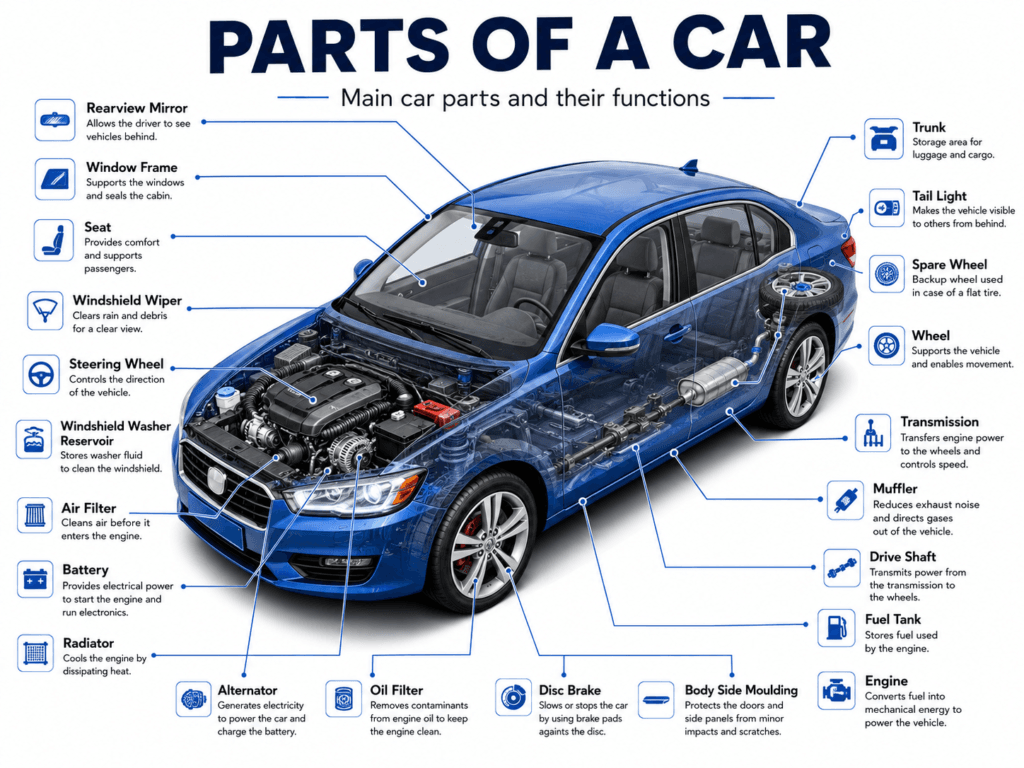
Driving a car is simple. Understanding how it works is a different story — and honestly, most people never bother. But here’s the thing: you don’t need to be a mechanic to benefit from knowing your car’s parts. When something goes wrong, even basic knowledge helps you describe the problem clearly, avoid getting ripped off at a workshop, and catch early warning signs before small issues turn expensive.
From my experience working around vehicles, the drivers who notice problems early are almost always the ones who understand what’s under the hood. This guide breaks down every major part of a car in simple, honest language — no jargon, no confusion. Whether you drive a basic sedan, an SUV, or a manual hatchback, these parts apply to you. And if you’re curious about the different types of cars out there, that’s worth a read too before diving in here.
Let’s get into it.
—
Exterior Parts of a Car
The exterior is the first thing anyone sees — but it does far more than just look good. Every panel, light, and piece of glass on the outside of your car has a specific job. Together, they protect the body structure, improve visibility, and make driving safer.
Car Hood (Bonnet)
The hood is that flat, hinged cover sitting on top of the front of the car. It closes off the engine bay, keeping out dust, water, and road debris while also offering some protection during minor frontal impacts. When your temperature gauge climbs or you smell something burning, you lift the hood and check what’s going on underneath. It’s your access point to the engine, battery, coolant reservoir, and more.
Doors
Car doors do more than just let you in and out. Modern doors contain the window glass, side mirrors, door locks, and in many vehicles, side-impact airbags. They form part of the car’s safety structure — that’s why a door that doesn’t shut fully can actually be a safety concern, not just an annoyance. If you want to go deeper on what’s inside, check out this detailed breakdown of car door parts and how each component works.
Trunk (Boot)
Located at the rear, the trunk is your main storage space for luggage, tools, shopping, and spare tyre equipment. On some vehicles — like hatchbacks and SUVs — the trunk space is part of the main cabin, but on sedans it’s a separate enclosed area. It also usually houses the spare tyre underneath the floor mat.
Windshield
The windshield is made from laminated safety glass, which means if it cracks, it holds together rather than shattering into sharp pieces. Its main job is obvious — it shields you from wind, rain, dust, and anything the road kicks up. But it’s also a structural part of the car’s body, helping support the roof during a rollover. A cracked windshield isn’t just annoying — it weakens that structure, which is why it’s worth fixing sooner rather than later.
Windshield Wipers
Simple but critical. These rubber blades clear the windshield of rain, mud, and dust so you can see clearly while driving. Modern cars come with variable speed wipers, and many newer models have rain-sensing wipers that adjust automatically. Replace the rubber blade inserts every 6–12 months, especially before the monsoon season.
Headlights
Headlights cut through darkness, fog, and rain to light up the road ahead and make your car visible to oncoming traffic. Modern vehicles use LED or HID headlights for better brightness and longer lifespan than the older halogen bulbs. Always check that both headlights are working — one burned-out light cuts your night visibility in half.
Taillights and Brake Lights
At the rear, taillights tell drivers behind you that your car is there. When you press the brake pedal, the brighter brake lights activate — giving the car behind you time to slow down. This is especially important at night or in heavy traffic. A burned-out brake light is both illegal in most places and genuinely dangerous.
Indicator (Turn Signal) Lights
These flashing orange lights signal your intention to turn or change lanes. Used correctly, they give surrounding traffic time to react and adjust. In heavy traffic or highway merging, using indicators consistently reduces collision risk significantly. They’re a small thing, but ignoring them is one of the most common causes of avoidable accidents.
—
Engine System
The engine is the heart of the car. Everything else depends on it. Understanding even the basics of how an engine works helps you recognize warning signs and talk sensibly with your mechanic. For a full picture, the guide on basic car engine parts and their functions goes into much deeper detail — but here’s the essential overview.
Engine
The engine converts fuel into mechanical energy through a process called combustion. Fuel mixes with air inside the cylinders, ignites, and the explosion pushes pistons downward — that motion eventually spins the wheels and moves the car. Most cars use a petrol or diesel internal combustion engine. Electric vehicles skip combustion entirely and use electric motors powered by large battery packs. Hybrid vehicles combine both.
Engine size is measured in litres (e.g., 1.3L, 2.0L) — larger displacement generally means more power. A well-maintained engine is smooth, responsive, and fuel-efficient. When it starts misfiring or running rough, those are warning signs worth addressing early. Engine misfire symptoms are worth knowing — they can range from a rough idle to a flashing check engine light.
Cylinder Block and Pistons
The cylinder block is essentially the engine’s skeleton — a heavy cast-iron or aluminium block containing the cylinders, coolant passages, and oil channels. Inside each cylinder, a piston moves up and down in a tight, rhythmic motion. When fuel ignites, the piston is pushed downward with force, and that downward motion becomes the rotational power that eventually drives the wheels.
Cars typically have 4, 6, or 8 cylinders. More cylinders generally means smoother power delivery and higher output — but also more fuel consumption.
Spark Plugs
In a petrol engine, spark plugs are what actually ignite the air-fuel mixture inside each cylinder. A tiny electrical spark fires at the right moment, causing the explosion that powers the piston. Spark plugs wear out over time — and when they do, you’ll notice rough idling, sluggish acceleration, difficulty starting, and increased fuel consumption. Knowing the bad spark plug symptoms can help you catch this early before it leads to engine misfires or catalytic converter damage.
Crankshaft and Camshaft
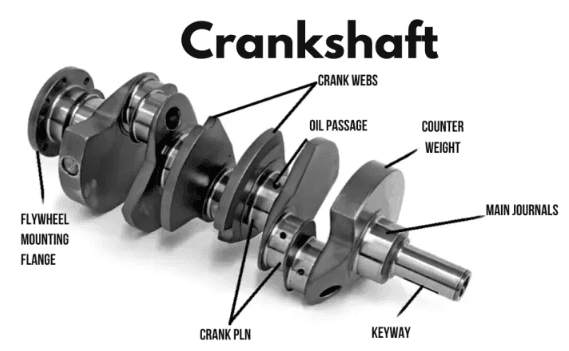
The crankshaft converts the pistons’ up-and-down motion into the rotational motion that drives the car forward — much like how bicycle pedals work. It’s one of the most important moving parts inside the engine. The crankshaft works alongside the camshaft, which controls the opening and closing of the engine’s intake and exhaust valves. Both must be perfectly synchronized. The camshaft position sensor monitors this timing and helps the ECU manage fuel and ignition precisely. If it fails, the engine may stall, struggle to start, or lose power.
—
Fuel System
The fuel system stores petrol or diesel and delivers it to the engine in the exact amount needed — at the right pressure, at the right time. Any weak point in this chain affects performance, efficiency, and sometimes safety.
Fuel Tank
The fuel tank is mounted under the car’s body, usually near the rear. It stores the fuel supply and is built from materials designed to resist leaks, corrosion, and impact. Modern tanks include safety valves and pressure-release systems to prevent vapour buildup. The tank capacity in most passenger cars ranges from 40 to 70 litres.
Fuel Pump
The fuel pump pulls fuel from the tank and pushes it toward the engine at a consistent pressure. Too low, and the engine starves — it’ll stumble and hesitate. Too high, and fuel is wasted, and the engine runs rich. When a fuel pump starts failing, you’ll often notice hard starts, sputtering at speed, or sudden power loss. These are some of the most recognizable bad fuel pump symptoms and they shouldn’t be ignored — a dying pump can leave you stranded without warning.
Fuel Filter
The fuel filter sits between the tank and the engine, catching dirt, rust particles, and debris before they can reach the fuel injectors or carburettor. Clean fuel means clean combustion. A clogged fuel filter restricts flow, causing the engine to feel weak, especially under load. Most manufacturers recommend replacing it every 30,000 to 60,000 kilometres. When the fuel pressure regulator starts failing, similar symptoms appear — weak acceleration and poor fuel economy — so it’s worth diagnosing which component is the actual cause.
Fuel Gauge
The fuel gauge on your dashboard shows how much fuel is remaining in the tank. Running too low too often isn’t just inconvenient — it can actually damage your fuel pump, since the fuel itself helps cool the pump. Letting the tank drop below a quarter regularly is a habit worth breaking, especially on long drives between cities.
—
Air and Exhaust System
Air Filter
The air filter protects the engine from dust, sand, pollen, and debris that would otherwise enter the cylinders. A clean filter means clean air for combustion — and clean combustion means better power and fuel economy. A clogged air filter chokes the engine, reducing power and increasing fuel consumption noticeably. Typically, air filters need replacement every 30,000 to 45,000 km, though dusty driving conditions may require more frequent changes.
Exhaust System
Once combustion is complete, the engine produces waste gases — carbon monoxide, hydrocarbons, and other byproducts. The exhaust system channels these gases safely away from the engine and out through the tailpipe at the rear. A healthy exhaust system reduces emissions, controls engine backpressure, and keeps harmful fumes out of the cabin. Exhaust problems often show up as smoke — and the colour tells you a lot. Black smoke from the exhaust typically means the engine is burning too much fuel, while white smoke from the exhaust can signal coolant leaking into the combustion chamber — a serious issue.
Catalytic Converter
The catalytic converter is a ceramic device inside the exhaust pipe that chemically converts harmful gases — carbon monoxide, unburned hydrocarbons, nitrogen oxides — into less harmful emissions before they exit the tailpipe. It’s a legal requirement in most countries and plays a real role in keeping city air cleaner. A failing catalytic converter can trigger a check engine light and often comes with a P0420 error code. If you’ve seen that fault, the P0420 code meaning article explains exactly what it means and what to do.
Muffler and Resonator
The muffler reduces the loud noise produced by exhaust pulses leaving the engine. Without it, most cars would be deafeningly loud. The resonator works alongside the muffler to further tune the sound — smoothing out specific frequencies that the muffler alone can’t fully cancel. Together, they make driving a far more comfortable experience for everyone, inside and outside the car.
—
Cooling System
An engine running under load generates extreme heat. Without a functioning cooling system, that heat would destroy engine components within minutes. The cooling system keeps everything within a safe operating temperature range — not too hot, not too cold.
Radiator
The radiator is a large heat exchanger mounted at the front of the car, behind the grille. Hot coolant flows from the engine into the radiator, where airflow passing through its thin metal fins draws heat away. The cooled fluid then returns to the engine. If the radiator gets clogged, leaks, or fails, coolant temperatures spike dangerously fast — leading to engine overheating that can warp the cylinder head or worse.
Coolant
Coolant — also called antifreeze — is the fluid that circulates through the engine and radiator to carry heat away. It’s usually a mixture of water and ethylene glycol, which also prevents freezing in cold climates and inhibits rust inside the cooling passages. Coolant should be flushed and replaced every two years or per the manufacturer’s recommendation. If you ever notice your coolant level dropping without any visible leak, it’s worth reading about coolant disappearing without a leak — because sometimes it’s burning inside the engine, which is a serious warning sign.
Thermostat
The thermostat is a small valve that regulates coolant flow based on engine temperature. When the engine is cold, it stays closed to help the engine warm up faster. Once the engine reaches operating temperature, it opens to allow coolant to flow to the radiator. A thermostat stuck closed is a common cause of sudden overheating — the engine warms up but coolant never gets to the radiator to cool down.
Cooling Fan
When you’re driving at speed, airflow through the grille cools the radiator naturally. But when the car is stopped in traffic, there’s no natural airflow — that’s when the cooling fan kicks in. It pulls air through the radiator to prevent temperatures from climbing while the engine is still running. A faulty cooling fan is one of the main reasons cars overheat at idle but run fine on the highway.
Water Pump
The water pump is what keeps coolant circulating throughout the system. It’s driven by the engine via a belt and pushes coolant through the engine block, cylinder head, and back to the radiator in a continuous loop. When the water pump fails, circulation stops — and without circulation, even a full tank of coolant won’t prevent overheating. A failed water pump can also lead to bubbles in the coolant reservoir, which is worth investigating immediately.
—
Lubrication System
Oil Pump
The oil pump keeps engine oil circulating under pressure through every moving part inside the engine — crankshaft bearings, camshaft, valve train, and piston walls. Without constant lubrication, metal parts grind against each other and wear out within seconds. When the oil pump weakens or fails, oil pressure drops — and you’ll usually see a warning light on the dashboard. This is not something to ignore even for a short drive.
Oil Filter
As engine oil circulates, it picks up microscopic metal particles, carbon deposits, and other contaminants. The oil filter removes these before they can cause damage. Over time, it gets clogged — which is exactly why regular oil and filter changes matter so much. Skipping oil changes doesn’t just dirty the oil; it eventually causes sludge buildup that chokes passages the pump relies on. A general rule of thumb: change oil and filter every 5,000 to 10,000 km depending on the oil type and driving conditions.
—
Transmission and Drivetrain
Transmission (Gearbox)
The engine produces power, but it’s the transmission that decides how that power reaches the wheels. It adjusts the gear ratio between the engine and the wheels — giving you more torque at low speeds and higher speed efficiency at highway cruising. Transmissions come in three main types: manual (you change gears yourself), automatic (gears shift on their own), and CVT (continuously variable, no fixed steps).To compare manual, automatic, CVT, and DCT systems in detail, read our complete guide to car transmission types.
Clutch (Manual Vehicles Only)
In a manual car, the clutch sits between the engine and gearbox. Pressing the clutch pedal temporarily disconnects the engine from the drivetrain, allowing you to change gears without grinding. Smooth clutch use is a skill — releasing it too quickly causes jerky movement, while “riding the clutch” (keeping partial pressure while moving) accelerates wear. A slipping or worn clutch is one of the more common manual transmission issues.
Driveshaft
The driveshaft (also called the propeller shaft in rear-wheel-drive vehicles) transfers the rotational power from the transmission to the differential at the rear or front axle. It spans the length of the vehicle and includes universal joints that allow it to flex as the suspension moves. A worn driveshaft often produces vibration felt through the floor, especially at higher speeds.
Timing Belt
The timing belt synchronizes the rotation of the crankshaft and camshaft — making sure the engine’s intake and exhaust valves open and close at exactly the right moments. If the timing belt snaps, the engine’s internal timing is completely lost — and in interference-type engines, this causes the pistons and valves to collide, resulting in catastrophic damage. Most manufacturers recommend replacing the timing belt every 60,000 to 100,000 km. This is one service interval you really don’t want to skip.
—
Steering and Suspension System
Steering Wheel and Steering System
The steering wheel is your direct control over the car’s direction. It connects to the steering column, which links to the steering rack and tie rods that physically turn the front wheels. Modern cars use power-assisted steering — either hydraulic or electric — which reduces the effort needed, especially at low speeds or during parking. If you ever hear noise when turning the steering wheel, that’s worth investigating — it often points to worn tie rod ends, low power steering fluid, or a failing pump.
Suspension System
The suspension connects the wheels to the car’s frame and absorbs the bumps and irregularities of the road. It’s what keeps the car stable during cornering, the ride smooth over rough surfaces, and the tyres in contact with the road at all times. Without proper suspension, every pothole would be felt through the entire vehicle, and handling would be unpredictable. Worn suspension components are often behind steering wheel shaking while driving — a symptom that’s easy to dismiss but important to address.
Shock Absorbers
Shock absorbers (or dampers) work with the springs to control body movement. Springs absorb the initial impact; shock absorbers stop the car from bouncing back up repeatedly. Worn shocks cause the car to float and sway — which feels uncomfortable but, more importantly, reduces tyre contact with the road and lengthens stopping distances. Most drivers don’t replace shocks until they’re completely gone. Replacing them when they start to fade is the smarter call for both comfort and safety.
Axles
Axles are the rotating shafts that connect the wheels on each side of the vehicle and transfer power from the differential to the wheels. The front axle works alongside the steering and suspension systems to manage both direction and power delivery. The rear axle bears most of the vehicle’s load and, in rear-wheel-drive cars, also drives the rear wheels. Damaged or worn axle CV joints often make a clicking noise when turning — especially noticeable in tight parking manoeuvres.
—
Braking System
No part of your car is more directly connected to safety than the brakes. They need to work perfectly every single time — there’s no second chance with a brake failure.
Brake Pads and Brake Discs (Rotors)
When you press the brake pedal, hydraulic pressure pushes the brake callipers to clamp the brake pads against the spinning brake discs (rotors). This friction slows the wheel down. Brake pads are the wear item — they’re designed to sacrifice themselves to protect the rotors. When they get too thin, you’ll often hear a high-pitched squeal or grinding noise. Noise when braking at low speed is one of the clearest signs your pads need replacing. Ignoring it means the metal backing plate contacts the rotor directly — damaging it and increasing your stopping distance significantly.
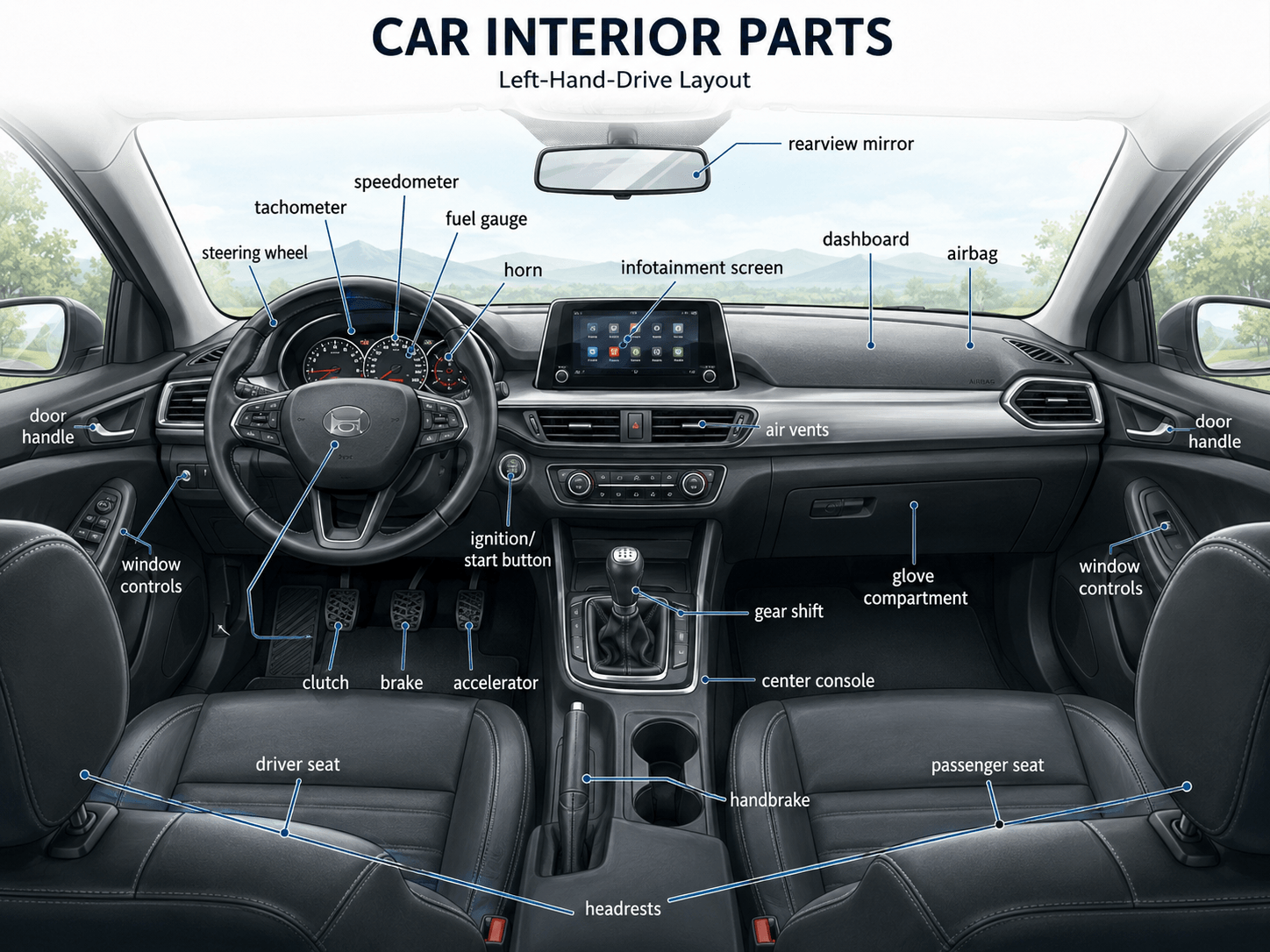
If you’ve ever wondered which pedal is the brake — in an automatic, the brake is always the left pedal and the accelerator is the right. In a manual, the clutch is on the far left, brake in the middle, and accelerator on the right.
ABS (Anti-lock Braking System)
ABS prevents the wheels from locking up during hard braking — which keeps you able to steer even while braking at maximum force. Without ABS, panic braking on a wet road often sends the car sliding straight, even if you’re turning the steering wheel. ABS engages automatically when sensors detect wheel lockup. You’ll feel a pulsing sensation in the pedal — that’s normal. Keep steady pressure and let the system do its job.
—
Electrical and Electronic Systems
Battery
The car battery provides the electrical energy needed to start the engine. When you turn the ignition key or press the start button, the battery sends current to the starter motor, which cranks the engine until combustion takes over. Beyond starting, the battery also powers the lights, radio, and other electronics when the engine is off. A weak battery often shows up as slow cranking or a clicking sound when you try to start. If you’ve seen a battery saver active message on your dashboard, the car is telling you the battery voltage is dropping and the system is cutting power to non-essential features to preserve starting ability. This is your warning to get the battery tested.
Alternator
Once the engine is running, the alternator takes over. It generates electricity by converting mechanical energy from the engine’s rotation, keeping the battery charged and powering all the car’s electrical systems while you drive. A healthy alternator outputs around 13.5 to 14.5 volts. When it starts to fail, you may notice dimming headlights, a battery warning light, or electrical accessories behaving erratically. The service battery charging system warning is one of the most direct signals of alternator trouble — and it usually means the battery isn’t being charged properly while you drive.
Ignition System
The ignition system creates the spark that starts combustion in each cylinder. It includes the ignition coil, which transforms the battery’s 12V into the high voltage needed to fire a spark across the spark plug gap, and the distributor or ignition control module that times each spark correctly. A failing ignition coil causes misfires in the affected cylinder — rough running, loss of power, and often a check engine light. Knowing bad ignition coil symptoms can help you identify which cylinder is the problem before it spreads.
Electronic Control Unit (ECU)
The ECU is the car’s brain. It constantly receives data from dozens of sensors throughout the vehicle — oxygen levels in the exhaust, engine temperature, throttle position, vehicle speed — and uses that data to fine-tune fuel injection timing, ignition timing, idle speed, and emissions control, thousands of times per second. When something goes wrong and the ECU can’t correct it, it stores a fault code and triggers the check engine light. A flashing check engine light specifically means the ECU has detected an active misfire serious enough to damage the catalytic converter — and that’s a situation requiring immediate attention, not next week.
Sensors
Modern cars are covered in sensors. The oxygen sensors monitor exhaust gases to help the ECU control the fuel mixture. The crankshaft position sensor tracks engine speed and piston position — essential for ignition timing. Temperature sensors, knock sensors, mass airflow sensors, and dozens more all feed data to the ECU continuously. When one fails, specific symptoms appear. Often an error code stored in the ECU can point directly to the faulty sensor — which is why reading codes with an OBD2 scanner is always the smarter first step before replacing random parts.
—
Interior and Safety Systems
For a complete breakdown of what’s inside the cabin — seat types, dashboard controls, HVAC systems and more — the guide on basic car interior parts covers all of it with pictures.
Airbags
Airbags are passive safety devices that inflate within milliseconds during a significant collision. Front airbags protect the driver and front passenger from head and chest impact with the steering wheel and dashboard. Side curtain airbags protect against head impact during side collisions. The system relies on impact sensors feeding data to an airbag control module — if any part of that chain fails, the airbag may not deploy when needed. A airbag warning light on the dashboard means something in that system needs checking — don’t drive assuming the airbags will save you if that light is on.
Seat Belts
Still the single most effective safety feature in any car. In a collision, seat belts keep occupants from being thrown forward into the dashboard or through the windshield. Modern seatbelts include pretensioners — small explosive devices that instantly tighten the belt at the moment of impact — and load limiters that prevent the belt from applying too much force to the chest. Wearing your seatbelt correctly (across the chest, not under the arm) makes an enormous difference in how well it protects you.
Dashboard and Gauges
The dashboard puts critical information in front of you while you drive. The most important gauges are:
| Gauge | What It Shows | Warning Sign |
|---|---|---|
| Speedometer | Current vehicle speed | — |
| RPM (Tachometer) | Engine revolutions per minute | Redline zone = risk of damage |
| Temperature Gauge | Engine coolant temperature | Red zone = pull over immediately |
| Fuel Gauge | Remaining fuel | Reserve light = refill soon |
| Odometer | Total km driven | Guides service intervals |
The odometer is also useful when checking if a used car’s service history matches its actual mileage — and if you’re ever unsure how to track your car’s fuel consumption accurately, this guide on how to find car mileage walks through the exact steps.
Cruise Control
Cruise control maintains a set speed without the driver needing to keep pressure on the accelerator pedal. On long highway drives, this reduces leg fatigue significantly and can help maintain more consistent speed — which often improves fuel economy too. Modern adaptive cruise control goes further, automatically adjusting speed to maintain a safe following distance behind the vehicle ahead.
—
Wheels and Tyres
The wheels are where all the engine’s power, the braking system, and the steering system finally meet the road. Every force your car generates goes through these four contact patches. Understanding your wheels matters — for safety, for handling, and for maintenance. If you want the full details on rims, hubs, bearings, and valve stems, the guide on car wheel parts breaks down every component with diagrams.
Tyres need to be at the correct inflation pressure — under-inflated tyres wear unevenly, reduce fuel economy, and can fail at speed. Most passenger cars run between 30–35 PSI depending on the vehicle. Check tyre pressure monthly and before any long journey.
—
Final Thoughts
Knowing the parts of your car doesn’t make you a mechanic — but it does make you a smarter driver and a better car owner. When you understand what the cooling system does, you take temperature warning lights seriously. When you know how spark plugs work, you don’t ignore rough idling. When you understand what brake pads do, you act on the squealing noise before it becomes rotor damage.
Cars are designed to give you warning signs before things go wrong. The more you know about these systems, the earlier you catch those signs — and the less you spend on repairs over time. Keep up with your service schedule, pay attention to any unusual sounds or lights, and when in doubt, get it checked early. A small repair today is almost always cheaper than a major one down the road.
—
Frequently Asked Questions (FAQ)
What are the most important parts of a car every driver should know?
The engine, battery, brakes, tyres, cooling system, and electrical system (including the alternator and ECU) are the most important parts for everyday drivers to understand. These systems directly affect safety and reliability.
How do I know if my car parts are failing?
Warning lights on the dashboard are the most direct signal. Beyond that, unusual noises (squealing brakes, knocking engine, grinding gears), changes in performance (sluggish acceleration, poor fuel economy), and physical signs like smoke or fluid leaks all indicate problems worth investigating.
What does the ECU do in a car?
The ECU (Electronic Control Unit) is the car’s main computer. It reads data from sensors throughout the vehicle and controls fuel injection, ignition timing, idle speed, and emissions systems in real time. When it detects a fault it can’t correct, it stores an error code and turns on the check engine light.
What is the difference between brake pads and brake discs?
Brake pads are the replaceable friction material that clamps against the brake discs (rotors) to slow the car. Pads wear out faster and need replacing more often. Discs are more durable but can warp or wear thin over time — especially if pads are ignored until the metal backing contacts the rotor directly.
How long does a car battery last?
Most car batteries last between 3 to 5 years depending on climate, driving habits, and maintenance. Hot climates accelerate battery degradation. If your car cranks slowly in the morning or you’ve had jump-starts recently, get the battery tested — most auto parts shops do it for free.
What happens if the timing belt breaks while driving?
In an interference engine, a broken timing belt causes the pistons and valves to collide — resulting in immediate and severe internal engine damage. In a non-interference engine, the engine simply stops. Either way, the timing belt is one component you replace preventively, never reactively.